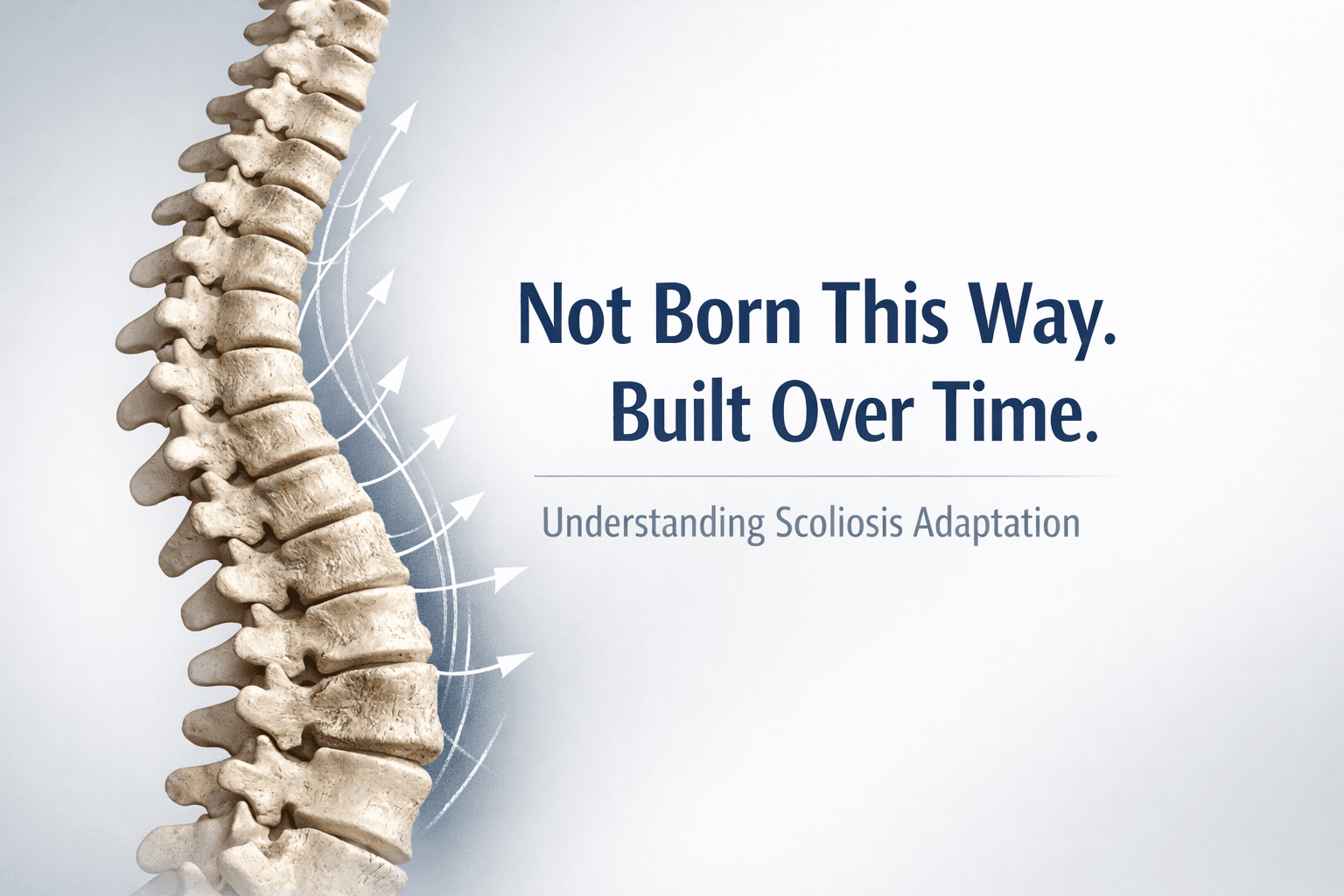
Adolescent Scoliosis That “Settled” Over Time: When the Spine Adapts Instead of Fails
“My spine wasn’t born this way… so why does it look like it’s fused now?”
This is one of the most common and confusing scenarios patients bring into clinic.
You didn’t have any known spinal deformity at birth.
You stayed active. Maybe even healthy.
Yet today, your X-ray shows curvature, stiffness, arthritis… even areas that look partially fused.
So what happened?
Let’s break it down clearly.
Not All Scoliosis Is the Same
Understanding what your scoliosis is NOT is just as important as understanding what it is.
1. Why This Is NOT Congenital Scoliosis
Congenital scoliosis is present from day one of life.
It is caused by structural abnormalities such as:
-
Hemivertebrae (half-formed bones)
-
Vertebral bars (bony bridges)
-
Fused spinal segments
These changes are built into the spine at birth and are visible early on.
In your case:
-
The vertebrae were originally formed normally
-
There were no structural birth defects
This immediately rules out a congenital origin.
2. Why This Is NOT Degenerative Scoliosis
Degenerative scoliosis typically appears later in life, driven by:
-
Disc degeneration
-
Joint arthritis
-
Age-related spinal instability
Here, the breakdown causes the curve.
But in your spine:
-
The curve came first
-
The arthritis and stiffness developed after years of imbalance
So the degeneration is not the cause —
it’s the consequence.
3. The Real Diagnosis: Adolescent Idiopathic Scoliosis with Long-Term Adaptation
This points us toward:
➤ Adolescent idiopathic scoliosis (AIS)
This is the most common type of scoliosis, developing during growth — often silently.
-
No clear cause (“idiopathic”)
-
Appears during puberty
-
Can progress or stabilize over time
What Happened Over the Years?
Your body is not passive. It adapts.
This is where things get fascinating.
➤ Enter: Wolff's Law
This principle states:
Bone remodels and strengthens along the lines of stress placed upon it.
In a Scoliotic Spine:
Over years (even decades), uneven loading leads to:
-
Bone thickening on one side
-
Joint compression and arthritis
-
Reduced mobility in overloaded segments
-
Protective fusion in severe cases
Your body is essentially trying to stabilize what it cannot correct.
The Big Misconception
Many patients are told:
“You have arthritis, that’s why your spine is like this.”
That’s backwards.
In cases like yours:
-
Arthritis is not the root cause
-
It is the result of long-term mechanical imbalance
Why This Matters for Treatment
If we misunderstand the origin, we treat it incorrectly.
Treating it as purely degenerative:
-
Focus only on pain relief
-
Ignore underlying biomechanics
Treating it as congenital:
- Assume it cannot change or improve
The Right Approach: Functional + Structural Understanding
A spine that has adapted over time needs:
-
Movement restoration (not just rest)
-
Load redistribution
-
Muscle re-education
-
Targeted spinal care to improve function around stiff segments
Even if parts of the spine are stiff or fused,
the rest of your body still has potential to improve.
What You Should Take Away
-
Your spine was not born this way
-
Your spine did not suddenly collapse with age
-
Your body has been adapting for years
And adaptation…
means there is still something we can work with
Final Thought
Your spine tells a story.
Not of failure —
but of survival, compensation, and long-term adaptation.
The goal now is not just to “fix” the curve,
but to guide your body toward better balance, movement, and resilience.
Medical Disclaimer
This article is for educational purposes only and does not constitute medical advice.
Scoliosis varies significantly between individuals. Always consult a qualified healthcare professional before starting any new sport or exercise program, especially if you have scoliosis, spinal conditions, pain, or previous injuries. Participation in sports should be guided by individual assessment and professional recommendation.
The image is shared for educational purposes with patient consent. Individual outcomes vary. Structural correction does not automatically restore full respiratory function. Clinical assessment is required.
Copyright & Content Protection Notice
© 2026 All Well Scoliosis Centre. All rights reserved.
This content is original and protected by copyright law.
No part of this article may be reproduced, distributed, copied, or reused in any form without prior written permission. Unauthorized use, duplication, or content scraping is strictly prohibited.