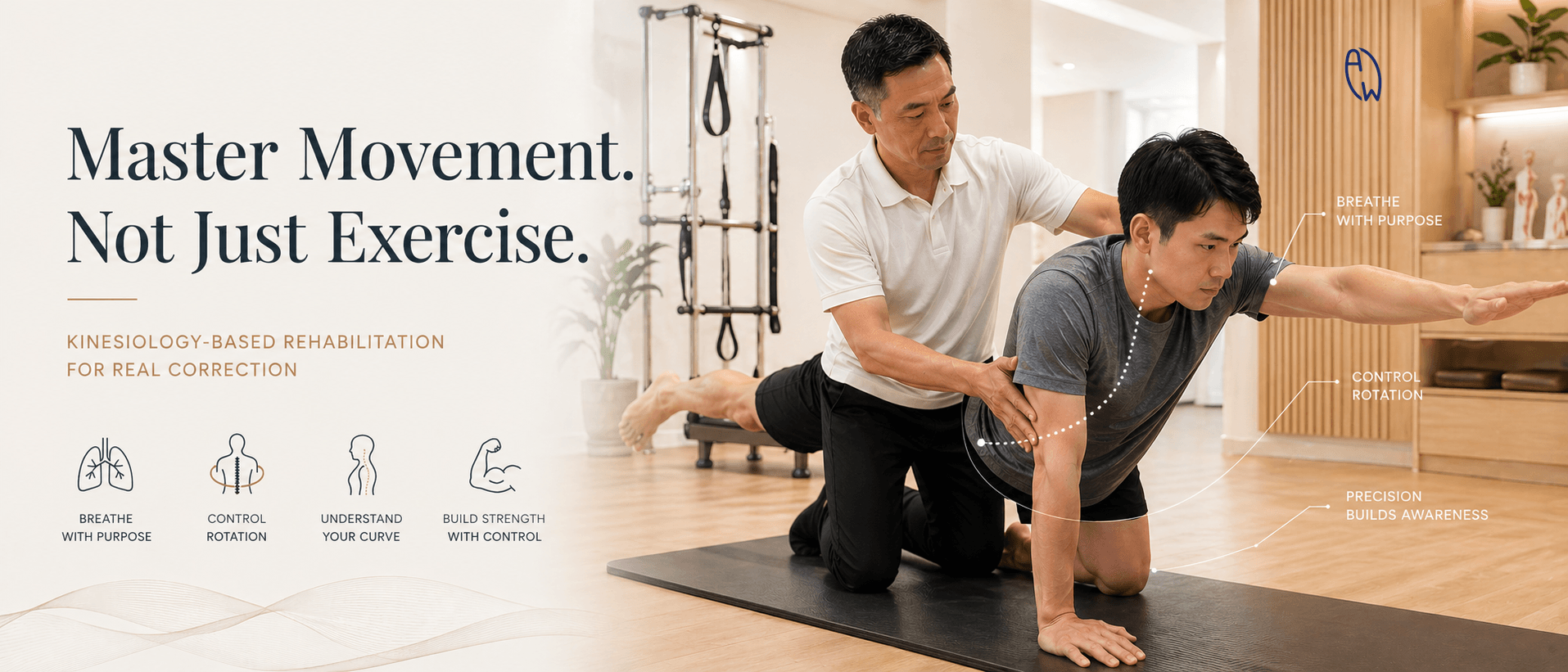
Basic Kinesiology Explained: The Foundation of Effective Exercise-Based Rehabilitation
If you’re doing rehabilitation exercises—especially for spinal conditions like scoliosis—understanding basic kinesiology is not optional. It is the foundation that determines whether your exercise is truly corrective… or just movement without purpose.
At our clinic, every exercise prescription is built on these principles. Not trends, not guesswork—but how the human body is designed to move, breathe, and adapt.
What Is Kinesiology and Why It Matters
Kinesiology is the study of human movement. It looks at how muscles, joints, and the cardiovascular system work together to produce controlled, efficient motion.
In exercise-based physiotherapy and rehabilitation, kinesiology answers critical questions:
-
Which muscles should activate?
-
When should they activate?
-
How should they lengthen or shorten?
-
How does breathing support movement?
Without this understanding, exercises become mechanical—and ineffective.
Skeletal Muscles: The Drivers of Voluntary Movement
The muscles responsible for voluntary movement are skeletal muscles.
These are the muscles you consciously control:
-
Walking
-
Sitting upright
-
Correcting posture
-
Performing rehabilitation exercises
Unlike involuntary muscles (like your heart or digestive system), skeletal muscles require active instruction from your brain.
That means:
If you don’t consciously guide them, they will continue using old, often incorrect movement patterns.
This is especially important in scoliosis rehabilitation, where asymmetry is already present.
The Largest Muscle in the Body: Gluteus Maximus
The gluteus maximus is the largest muscle in the human body.
It plays a key role in:
-
Hip extension
-
Pelvic stability
-
Postural support
-
Power generation (walking, running, lifting)
Weak or poorly activated glutes often lead to:
-
Lower back pain
-
Hip instability
-
Compensatory spinal movement
In rehabilitation, we don’t just “strengthen” the glutes—we teach patients how to activate them correctly and in the right sequence.
Cardiovascular Endurance and VO₂ Max
When we talk about fitness, many people think about strength. But cardiovascular endurance is just as critical.
The gold standard measurement is VO₂ max.
What is VO₂ Max?
VO₂ max measures:
Your body’s ability to take in oxygen, transport it through the blood, and use it in the muscles during activity.
In simple terms:
-
It reflects how “fit” you are from a breathing and endurance perspective
-
It determines how efficiently your muscles can sustain activity
Poor VO₂ max means:
-
Faster fatigue
-
Reduced exercise quality
-
Less effective rehabilitation sessions
Concentric vs Eccentric Muscle Contraction
One of the most important principles we teach every patient is the difference between concentric and eccentric muscle contractions.
Concentric Contraction (Shortening)
-
The muscle shortens as it contracts
-
Example: lifting a weight
Eccentric Contraction (Lengthening)
-
The muscle lengthens under control
-
Example: lowering a weight slowly
Both are essential.
Most people focus only on the “lifting” phase (concentric), but the control phase (eccentric) is where:
-
Stability is built
-
Injury risk is reduced
-
True muscle control is developed
The Core Cues We Teach Every Patient
No matter the condition, these are the cues we consistently reinforce:
1. Breathe Properly
Breathing is not passive. It affects:
-
Muscle activation
-
Core stability
-
Oxygen delivery
Holding your breath = reducing control.
2. Control Rotation
Especially in scoliosis, uncontrolled rotation worsens asymmetry.
Patients must learn:
-
Where their body is rotating
-
How to actively control and correct it
3. Understand Your Curve and Position
Every spine is different.
Generic exercises don’t work unless the patient:
-
Understands their own alignment
-
Knows what “correct” feels like
4. Master Concentric and Eccentric Control
You are not just moving—you are training your muscles to behave differently.
This requires:
-
Slowing down
-
Feeling the movement
-
Controlling both shortening and lengthening
Why Awareness Is Everything in Rehabilitation
Here’s the truth most people overlook:
Your skeletal muscles only do what you repeatedly teach them.
If you move without awareness:
-
You reinforce the same faulty patterns
-
You delay recovery
-
You increase risk of reinjury
But when you train with intention:
-
Your brain rewires movement patterns
-
Your muscles adapt correctly
-
Your body becomes more efficient
Final Takeaway: Exercise Is Not Just Movement—It’s Communication
Exercise-based rehabilitation is not about doing more reps.
It is about:
-
Precision
-
Control
-
Awareness
You are constantly communicating with your skeletal muscles.
If the message is unclear, the result will be inconsistent.
If the message is precise, your body will respond.