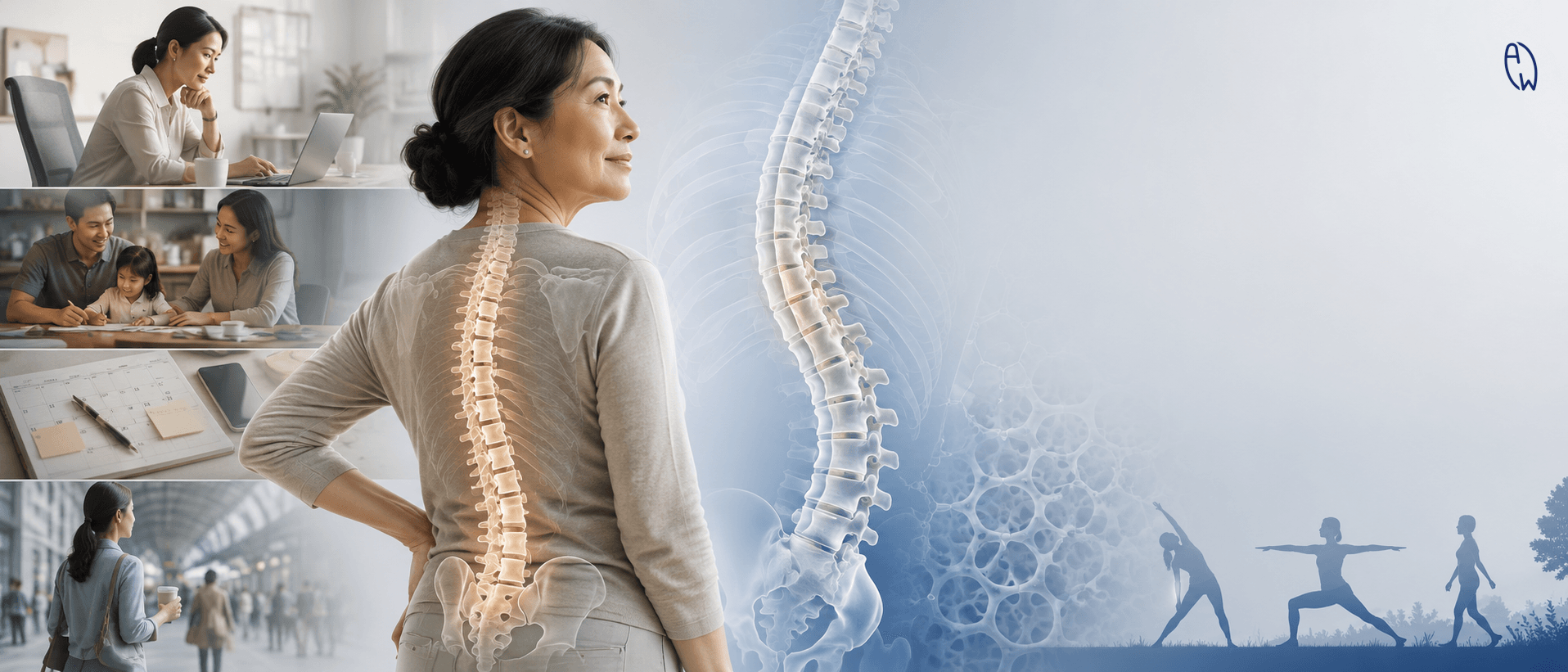
Can Scoliosis Get Worse With Age? What Really Determines Spinal Progression
“Will my scoliosis get worse as I get older?”
It is one of the most common questions people ask after being diagnosed with scoliosis.
The short answer is:
Yes, scoliosis can progress with age—but getting older does not automatically mean your curve will get worse.
Progression depends on several factors, including age, skeletal maturity, curve size and pattern, growth, spinal degeneration, bone health and individual biomechanics.
For adolescents, growth is an important period of risk. For adults, degeneration, bone health and existing curve characteristics become increasingly relevant.
But there is another factor we rarely talk about:
How much attention do you give your spine throughout your life?
Because life gets busy.
You study. You work. You build a career. You get married. You have children. You take care of your parents. You run a business.
And somewhere along the way, the stiffness becomes “normal.”
The back pain you once noticed becomes something you tolerate.
Exercise disappears.
Follow-ups get postponed.
Your own health quietly moves down the priority list.
And because you cannot see your spine in the mirror, it becomes surprisingly easy to forget about it.
But your spine never stops supporting you.
Scoliosis Does Not Automatically Get Worse With Age
Having scoliosis does not mean your curve will increase every year.
Some curves remain relatively stable for many years.
Others progress, particularly during growth or later in life when degenerative changes affect the spine.
So instead of asking:
“Will my scoliosis get worse because I am getting older?”
A better question is:
“What factors could influence my scoliosis as I get older?”
That question gives you something much more useful:
a reason to understand, monitor and care for your spine.
What Determines Scoliosis Progression?
There is no single factor that predicts progression for everyone.
1. Growth and Skeletal Maturity
For children and teenagers, remaining growth is one of the most important considerations.
A curve can behave differently in a growing child compared with someone who has reached skeletal maturity.
For appropriately selected growing patients, bracing can reduce the risk of significant curve progression, and adherence to the prescribed wearing schedule is an important part of treatment.
Scoliosis-specific exercise may also be incorporated into an individualized conservative treatment plan.
Once growth is complete, the rapid growth-related progression seen during adolescence is no longer the same concern.
But that does not mean the spine stops changing.
The discs continue to experience loading.
The muscles continue to adapt.
The bones continue to remodel.
And the spine continues to age.
2. Curve Size and Pattern
The size and characteristics of the curve matter.
A larger curve may have a different progression risk from a smaller one, while curve pattern, spinal balance and other radiographic characteristics also influence clinical decisions.
This is why the Cobb angle is important—but it is not the entire story.
Two people can have similar Cobb angles and very different symptoms, movement patterns and treatment needs.
3. Degeneration and Aging
As we age, discs, facet joints, muscles and other spinal structures can undergo degenerative changes.
When degeneration occurs asymmetrically, it can contribute to further deformity in some adults.
This is one reason adult scoliosis can behave differently from adolescent scoliosis.
One study of nonsurgical adult spinal deformity patients followed for about five years found that 72% showed coronal progression. The average Cobb angle increased from 37.2° to 40.8°, or approximately 0.83° per year, although progression varied considerably between individuals.
The important message is not that everyone will progress at 0.83° per year.
It is that:
Adult scoliosis can progress, but it does not progress at the same rate in everyone.
4. Bone Health
Bone health becomes increasingly important as we age.
Low bone density and osteoporosis can affect the structural health of the spine and are important considerations in adult spinal deformity.
But we should not oversimplify the relationship.
Low bone density is not the same thing as the cause of scoliosis.
Bone health is one part of a much larger picture.
That is why protecting your bones throughout life matters whether or not you have scoliosis.
Your Spine Is a Living Structure
Your spine is not a piece of metal.
It is living tissue.
Your bones remodel.
Your muscles adapt.
Your joints respond to loading.
Your movement patterns become habits.
Your physical activity changes.
Your bone density changes throughout life.
Your body continuously responds to the demands placed upon it.
That is why scoliosis care should not simply be about producing a better X-ray once.
It should also be about creating a body and lifestyle that can support the spine over decades.
Then Life Gets Busy
This is where many adults with scoliosis recognize themselves.
At 15, you may have time to think about your posture.
At 22, you are studying.
At 28, you are building your career.
At 32, perhaps you are getting married.
At 35, you may have young children.
At 40, work responsibilities are increasing.
At 50, you may be caring for aging parents.
And suddenly, your back pain has been there for ten years.
You learned to live with it.
You learned to ignore it.
You learned to say:
“I'm fine.”
Not because you don't care about your health.
Sometimes it is simply because life keeps demanding your attention.
But your musculoskeletal health continues to change throughout life.
You Can See Your Teeth. You Cannot See Your Spine.
Think about orthodontic treatment.
A person may wear braces for several years to improve the alignment of their teeth.
Eventually, the braces come off.
But treatment does not necessarily mean:
“Done forever. Never think about it again.”
Retainers are commonly used because teeth and their surrounding tissues can continue to change.
The biology is not the same as scoliosis.
Teeth are not the spine, and orthodontic movement is not scoliosis correction.
But there is a useful principle:
Alignment and function often require maintenance.
For scoliosis, that may mean appropriate exercise, physical activity, follow-up, monitoring and—when clinically indicated—a prescribed brace.
The exact approach depends on the individual.
Maintenance Does Not Mean Treatment Failed
Some people think:
“If I still need exercises or maintenance, my treatment didn't work.”
We don't see it that way.
You continue exercising after becoming stronger.
You maintain your health after feeling better.
You continue dental care after orthodontic treatment.
Maintenance is not failure.
Maintenance is what you do because you want the benefit to last.
The same philosophy can apply to long-term scoliosis management.
What Can You Control—and What Can't You?
This may be the most practical question.
You cannot control:
-
Your original curve pattern
-
Genetic and developmental factors
-
Skeletal maturity
-
How much you have already grown
-
Some aspects of aging
-
Certain degenerative processes
-
Whether a curve will ever progress
But you can influence:
-
Physical activity
-
Muscle strength
-
Bone-health habits
-
Nutrition
-
Regular exercise
-
Scoliosis-specific exercise when appropriate
-
Following a prescribed brace program
-
Appropriate follow-ups
-
Responding to meaningful changes
-
Healthy movement habits
This distinction matters.
You are not completely responsible for what scoliosis does.
But you are responsible for how you respond to it.
That is a much more empowering way to think about scoliosis.
What Does Long-Term Scoliosis Maintenance Mean?
There is no universal maintenance program.
It depends on age, curve characteristics, symptoms, physical condition, treatment history and clinical goals.
But long-term spinal health may involve:
Movement
Regular physical activity helps maintain strength and physical function.
Strength
A well-conditioned body is better equipped to handle everyday physical demands.
Scoliosis-Specific Exercise
For appropriate patients, individualized scoliosis-specific exercises can support posture, movement and muscular control.
Bone Health
Adequate nutrition, appropriate resistance exercise and attention to calcium and vitamin D can support bone health. People at risk of osteoporosis may benefit from medical assessment.
Monitoring
Symptoms alone cannot tell you whether your Cobb angle has changed. Appropriate clinical assessment and imaging can provide objective information when monitoring is indicated.
Bracing
For growing patients with appropriate indications, bracing can reduce the risk of progression.
For adults, bracing is a different conversation and should be considered for specific clinical goals rather than assumed to be necessary simply because someone has scoliosis.
What About Wearing a Brace for Long Periods?
A scoliosis brace is not something everyone with scoliosis needs.
And adult bracing is not the same as adolescent bracing.
For a growing adolescent, the goal is often to reduce progression during growth.
For adults, the goal may instead include postural support, symptom management, specific activities or a rehabilitation strategy.
There is no universal rule that someone with adult scoliosis should sleep in a brace or wear one all day.
The brace should have a purpose.
That purpose should be determined by the person's condition and treatment plan.
“But My Back Doesn't Hurt.”
Pain does not reliably tell you whether scoliosis is progressing.
Someone can have a significant curve and experience little pain.
Someone else may have a smaller curve but considerable discomfort.
Pain may come from muscles, discs, joints, nerves or other structures rather than directly reflecting a change in Cobb angle.
So don't use pain as your only monitoring system.
A painless spine is not necessarily a stable spine.
Don't Wait Until Your Body Forces You to Pay Attention
There is a difference between being obsessed with your scoliosis and being responsible for your health.
You don't need to think about your spine every minute.
You don't need to be afraid of every ache.
But you should understand your condition.
Know your treatment plan.
Know when follow-up is appropriate.
And notice when something meaningfully changes.
That is responsible long-term care.
Can We Predict Who Will Have Stable Scoliosis?
Not perfectly.
We cannot say:
“If you exercise and take care of yourself, your scoliosis will never progress.”
That would be an overpromise.
Scoliosis progression is influenced by factors that are not completely under your control.
However, there is a meaningful difference between being passive and being proactive.
Someone who understands their scoliosis and consistently pays attention to bone health, physical activity, strength, appropriate exercise, follow-up and prescribed bracing when indicated has more opportunities to identify changes and address modifiable factors.
That does not guarantee a stable Cobb angle.
But it is a healthier long-term strategy than simply ignoring the spine.
Your Spine Deserves a Place on the Priority List
You don't need to put yourself first every single day.
Sometimes your child needs you.
Sometimes your career needs you.
Sometimes your family needs you.
Sometimes life simply gets overwhelming.
But don't let “later” become years.
Your body has carried you through every stage of your life.
Your spine has been there for all of it.
It deserves to be part of the plan.
You Don't Have to Be Perfect. You Have to Be Consistent.
Long-term scoliosis management is rarely about doing everything perfectly.
It is about building habits you can maintain.
Move regularly.
Build strength.
Protect your bone health.
Eat well.
Do your prescribed exercises.
Wear your brace when clinically indicated.
Attend your follow-ups.
Monitor your spine when appropriate.
And when life gets busy, don't completely abandon yourself.
Because ten years of neglect cannot always be undone with one intensive effort.
Consistency matters.
So, Can Scoliosis Get Worse With Age?
Yes, it can. But age alone does not determine what happens to your spine.
For children and teenagers, growth and skeletal maturity are major considerations.
For adults, degeneration, bone health, existing curve characteristics, muscle function and mechanical factors become increasingly relevant.
Some curves remain stable.
Some progress slowly.
Some become more problematic as degenerative changes accumulate.
There is no single prediction that applies to everyone.
That is why scoliosis should be treated as a long-term health condition, not simply a number written on an X-ray.
Your Teeth Have a Mirror. Your Spine Doesn't.
This may be why scoliosis is so easy to neglect.
You can see your teeth.
You can see whether they are straight.
Your spine is hidden.
You may not know that your posture has changed.
You may not know that your muscles are compensating.
You may not know whether your curve has changed without appropriate assessment.
But just because you cannot see your spine does not mean you should forget about it.
Your spine is living bone.
It changes.
It adapts.
It responds to how you move, how you load it, how strong your body is and how well you take care of yourself.
You cannot control every factor that influences scoliosis progression.
But you can control whether you pay attention.
You can support your bone health.
You can follow appropriate treatment.
You can monitor when necessary.
And you can stop treating your own health as something that can always wait until tomorrow.
You don't need to be afraid of scoliosis.
You need to respect it.
Because you may not be able to see your spine in the mirror—
but you will carry it through every chapter of your life.
Frequently Asked Questions
Can scoliosis get worse after age 18?
Yes. Adult progression can occur, although the mechanisms differ from adolescent growth-related progression. Degeneration, bone health and existing curve characteristics may influence progression.
Does scoliosis always get worse as you get older?
No. Some curves remain stable for many years. Age alone does not determine progression.
Can osteoporosis affect scoliosis?
Bone health is an important consideration in adult spinal deformity. Low bone density can affect the structural health of the spine, but it should not be considered the only cause of scoliosis progression.
This is especially exciting because there is a very recent 2026 review from the Scoliosis Research Society Adult Spinal Deformity Task Force.
It specifically examines osteoporosis and bone density in adult spinal deformity and emphasizes bone health as an important consideration in this population. It was published in Spine Deformity on April 28, 2026.
Can exercise stop scoliosis from getting worse?
Exercise cannot guarantee that a curve will never progress. However, appropriate scoliosis-specific exercise and physical activity can support strength, function and postural control.
Can adults wear a scoliosis brace?
Some adults may benefit from bracing for specific clinical goals. Adult bracing is different from adolescent growth-modulation bracing and should be individualized.
Should I wear my scoliosis brace while sleeping?
Not everyone should. Nighttime use depends on the brace, age, curve characteristics and treatment goals. Follow the schedule prescribed for your condition.
Can scoliosis be corrected to zero degrees?
For an established curve, particularly after skeletal maturity, it is generally unrealistic to promise a return to exactly zero degrees. Conservative care may instead focus on alignment, function, symptoms and long-term stability.
Does back pain mean my scoliosis is getting worse?
Not necessarily. Pain does not reliably measure Cobb-angle progression. A person can have pain without significant curve progression, while another may have progression with little pain.
How often should scoliosis be monitored?
There is no single schedule for everyone. Monitoring depends on age, skeletal maturity, curve characteristics, symptoms, treatment history and clinical risk.
The Bottom Line
Scoliosis does not automatically get worse because you are getting older.
But your spine continues to live, move, adapt and age with you.
Bone density changes.
Muscle strength changes.
Movement habits change.
Spinal degeneration can occur.
And life can make it very easy to stop paying attention.
So don't wait until your spine becomes the loudest problem in your life.
Take care of it while it is quietly supporting everything else you do.
Because long-term scoliosis care is not just about what happens on the X-ray.
It is also about what you do between one X-ray and the next.