When to Worry About Your Child's Posture: A Scoliosis Screening Guide for Parents
Concerned about your child's uneven shoulders, tilted hips or unusual posture? These changes may be early signs of scoliosis, a spinal condition that often develops during childhood and adolescence. Knowing what to look for can help parents recognise potential warning signs and seek an appropriate assessment before a spinal curve progresses.
Scoliosis does not always cause pain, and many children with the condition continue their normal activities without realising their spine is changing.
For parents in Singapore, understanding the early signs of scoliosis is particularly important during the pre-teen and teenage years, when rapid growth can influence spinal curve progression.
At All Well Scoliosis Centre, we believe that early awareness, proper assessment and informed decision-making help parents navigate scoliosis with greater confidence.
How Common Is Scoliosis Among Children in Singapore?
Adolescent idiopathic scoliosis (AIS) is the most common form of scoliosis in children and teenagers. It typically develops between the ages of 10 and 18, often during puberty.
Singapore has conducted school-based scoliosis screening since 1982. Research involving 72,699 schoolchildren, published in Spine in 2005, found that scoliosis prevalence increased with age.
Among girls aged 13–14, the reported prevalence was 2.22%, compared with 0.66% among boys of the same age group.
A separate Singapore study published in 2009 examined 93,626 female students aged 9–13. Researchers found that scoliosis prevalence increased from 0.27% at age nine to 2.49% at age 13.
Although these figures come from historical studies rather than current national estimates, they demonstrate an important pattern: scoliosis becomes more commonly identified during adolescence, particularly among girls.
Why does this matter?
During puberty, children experience rapid skeletal growth. In those with scoliosis, this period can increase the risk of curve progression.
Identifying scoliosis early allows families and healthcare professionals to monitor spinal development and consider appropriate management options while the child is still growing.
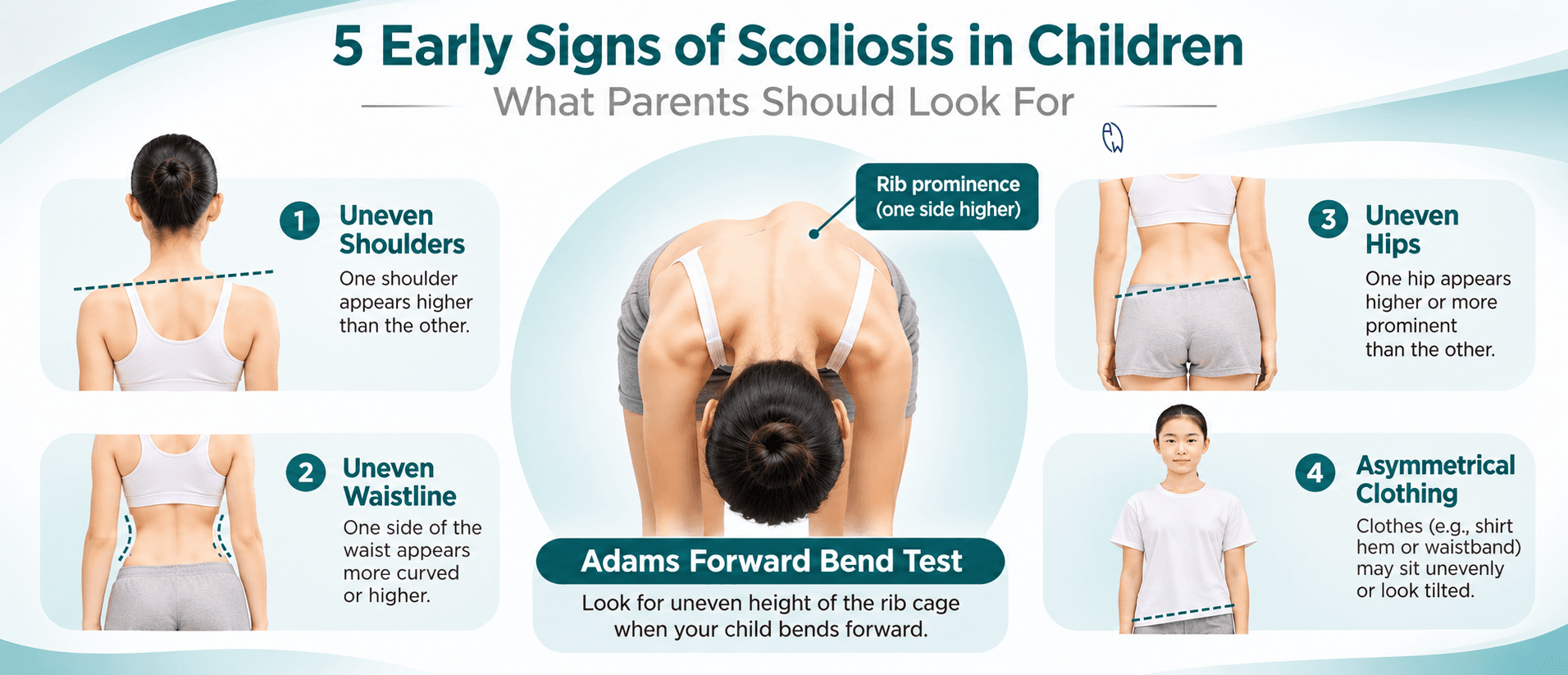
5 Early Signs of Scoliosis Parents Should Look For
Scoliosis is not always obvious. Sometimes, the first signs are subtle changes in how a child stands, walks or wears their clothes.
Here are five things parents can observe at home.
1. Uneven Shoulders
Look at your child from behind while they stand naturally.
Does one shoulder appear higher than the other? Is one shoulder blade more prominent?
Uneven shoulders can be associated with spinal curvature and rotation, although they may also result from other postural or musculoskeletal differences.
2. Uneven Waistline
Observe the natural spaces between your child's arms and waist.
One side may appear more curved inward, while the other looks straighter. This difference can indicate trunk asymmetry associated with scoliosis.
3. A Prominent Rib Hump When Bending Forward
One of the most recognisable signs of scoliosis is a rib prominence on one side of the back.
Parents can observe this using a simple screening position known as the Adams Forward Bend Test.
Ask your child to:
-
Stand with feet together.
-
Keep their knees straight.
-
Bend forward slowly at the waist.
-
Allow their arms to hang naturally.
Look at the back from behind. Does one side of the rib cage appear higher than the other?
This asymmetry may indicate vertebral rotation associated with scoliosis.
A healthcare professional may use a scoliometer to measure the angle of trunk rotation. However, the forward bend test is only a screening observation, not a definitive diagnosis.
4. One Hip Appears Higher Than the Other
Does one hip look more prominent? Does your child's waistline appear tilted?
Pelvic asymmetry can sometimes accompany scoliosis, particularly when the lower spine is involved.
However, differences in leg length and other musculoskeletal conditions can produce similar appearances.
5. Clothes No Longer Hang Evenly
Sometimes parents notice something as simple as:
-
One trouser leg appearing shorter.
-
Skirts or dresses hanging unevenly.
-
Shirt seams sitting differently across the shoulders.
-
One side of the waist appearing more fitted.
These observations do not automatically mean your child has scoliosis. However, persistent or increasing asymmetry deserves attention.
Understanding the Cobb Angle: How Is Scoliosis Measured?
If scoliosis is suspected, a healthcare professional may recommend a standing spinal X-ray.
The severity of scoliosis is measured using the Cobb angle, which describes the degree of sideways spinal curvature.
A Cobb angle of at least 10 degrees is generally required for a diagnosis of scoliosis.
The measurement helps guide treatment decisions, but it is not the only consideration. A child's age, remaining skeletal growth, curve location and documented progression are equally important.
What Do Different Cobb Angles Mean?
Below 10 degrees: This is generally considered spinal asymmetry rather than structural scoliosis.
10–20 degrees: Observation and periodic monitoring are commonly recommended, depending on growth and progression risk.
20–25 degrees: Closer monitoring is important. Scoliosis-specific exercises or bracing may be considered depending on skeletal maturity and progression.
25–40 degrees: Bracing is commonly considered for children who are still growing, particularly when there is a risk of progression.
40–50 degrees: Specialist orthopaedic assessment is important. Surgical consultation may be appropriate depending on the individual circumstances.
Above 50 degrees: The risk of further progression is generally greater, particularly after skeletal maturity. Surgical assessment is commonly considered.
These are general clinical reference points, not automatic treatment rules. A child with a 22-degree curve who is experiencing rapid growth may require a different management approach from a child with the same curve who has nearly completed skeletal development.
The objective is to assess the whole clinical picture rather than make decisions based on the Cobb angle alone.
Non-Surgical Scoliosis Treatment Options for Children
Not every child diagnosed with scoliosis requires surgery. Depending on the curve, age and growth stage, several conservative management approaches may be appropriate.
1. Scoliosis Bracing
Bracing is one of the most established non-surgical approaches for children with progressive scoliosis who are still growing.
The primary objective is to reduce the risk of further curve progression during growth.
The BrAIST study, published in the New England Journal of Medicine in 2013, demonstrated that bracing significantly reduced the likelihood of progression to a surgical-range curve in appropriately selected adolescents. Greater brace-wearing time was associated with better treatment success.
Modern scoliosis braces can be individually designed according to the child's spinal curve and body shape.
At All Well Scoliosis Centre, we work with the ScoliBrace™ approach, which uses three-dimensional assessment and computer-aided brace design to develop an individualised corrective brace.
Brace compliance is important. Some children find wearing a brace challenging because of discomfort, appearance, school activities or social concerns.
Parents can help by encouraging consistent wear according to the prescribed schedule, attending regular follow-up appointments and communicating any fitting difficulties to the treating team.
2. Schroth Method and Scoliosis-Specific Exercises
The Schroth Method is a specialised exercise approach designed for people with scoliosis.
Unlike general stretching or strengthening exercises, scoliosis-specific exercises aim to address individual spinal curvature through three-dimensional postural correction, breathing techniques and muscular control.
The objectives include improving postural awareness, developing muscular endurance and supporting better trunk control.
The 2016 SOSORT guidelines recommend physiotherapeutic scoliosis-specific exercises as part of conservative scoliosis management.
At All Well Scoliosis Centre, we also incorporate ScoliBalance® exercises, which focus on individualised corrective strategies, postural awareness and functional movement.
These exercise approaches should be tailored to the child's individual curve pattern. They should not replace bracing when bracing is clinically indicated.
3. Maintaining Normal Childhood Activities
A scoliosis diagnosis does not mean a child must stop being a child.
Most children with scoliosis can continue participating in swimming, recreational sports, school activities and everyday movement.
Physical activity helps maintain general fitness, coordination, muscular strength and confidence.
Unless a healthcare professional identifies a specific reason for restriction, unnecessary activity limitations may create additional physical and emotional burdens.
The goal is to support normal childhood development while managing the spinal condition appropriately.
When Should Parents Seek a Scoliosis Assessment?
Consider arranging a professional assessment if you notice:
-
Persistent uneven shoulders, hips or waistline.
-
A visible rib prominence during forward bending.
-
Increasing postural asymmetry over several months.
-
A previous scoliosis diagnosis without recent follow-up.
-
A school screening referral recommending further assessment.
Certain symptoms require more prompt medical attention. These include significant or persistent back pain, pain that wakes a child at night, unexplained fever or weight loss, weakness, numbness, difficulty walking, or changes in bladder or bowel control.
Sudden or progressive neurological symptoms, particularly bladder or bowel changes, warrant urgent medical assessment.
Remember that many children with adolescent idiopathic scoliosis do not experience pain. Significant pain or unusual neurological symptoms should not automatically be attributed to scoliosis and may require investigation for other conditions.
How to Choose a Scoliosis-Focused Clinic in Singapore
Not all spinal care providers have the same training or experience in managing scoliosis.
When choosing a clinic or healthcare professional, parents should consider asking:
1. Do they regularly assess children with scoliosis?
Experience with growing spines is important because treatment decisions depend on skeletal maturity and progression risk.
2. Do they understand Cobb angle measurements and spinal growth?
A proper assessment should consider curve magnitude, location, pattern and the child's remaining growth.
3. Are their treatment recommendations supported by recognised clinical guidelines?
Ask whether the provider understands observation, bracing and physiotherapeutic scoliosis-specific exercises.
4. Do they recognise when orthopaedic referral is necessary?
A responsible scoliosis care provider should recognise when medical specialist assessment or surgical consultation is appropriate.
5. Is there a clear monitoring and follow-up plan?
Scoliosis management is not a one-time appointment. Children may require regular reassessment throughout their growth years.
At All Well Scoliosis Centre, Singapore, our approach focuses on individual spinal assessment and non-surgical scoliosis management. Our services include ScoliBrace™, ScoliBalance® and the CLEAR Institute protocol.
Our aim is to help families understand their options, the limitations of different approaches and when referral to an orthopaedic specialist is necessary.
Every Child's Scoliosis Journey Is Different
Consider two illustrative situations.
A child with a mild spinal curve
A school-aged child is referred for further assessment after a school screening identifies uneven shoulders. An X-ray confirms a 15-degree Cobb angle.
Because the child is still growing, regular monitoring is important. Depending on the clinical findings, scoliosis-specific exercises may be considered.
The priority is not to rush into aggressive treatment but to monitor spinal development and identify any progression.
A teenager with a progressing curve
Another teenager initially presents with a moderate spinal curve. During a period of rapid growth, follow-up imaging demonstrates progression.
The management plan is reassessed, and scoliosis bracing is considered alongside scoliosis-specific exercises.
Frequently Asked Questions About Scoliosis in Children
1. At what age should children be screened for scoliosis?
Scoliosis commonly develops during adolescence, particularly between 10 and 18 years of age. The Scoliosis Research Society's international screening task force has recommended screening girls at ages 10 and 12, and boys at ages 13 or 14. Parents should also seek assessment whenever noticeable asymmetry develops, regardless of age.
2. Can a child have scoliosis without back pain?
Yes. Most children with adolescent idiopathic scoliosis do not experience significant pain. Changes in shoulder height, waistline symmetry or rib cage prominence may be the first visible signs.
3. Is scoliosis screening available in Singapore schools?
Singapore has a longstanding school-based scoliosis screening programme. However, screening does not replace diagnostic assessment. If a child receives a referral or parents notice persistent asymmetry, further professional evaluation may be appropriate.
4. Does my child need an X-ray to diagnose scoliosis?
A physical examination may identify signs of spinal asymmetry, but a standing spinal X-ray is generally used to confirm scoliosis and measure the Cobb angle. Imaging should be recommended when clinically appropriate, with attention to minimising unnecessary radiation exposure.
5. Can scoliosis be treated without surgery?
Many children can be managed without surgery. Depending on the curve and remaining growth, management may include observation, scoliosis-specific exercises and bracing. More significant or progressive curves may require orthopaedic surgical assessment.
Conclusion: Early Awareness Gives Parents More Options
Not every uneven shoulder or change in posture indicates scoliosis. However, persistent asymmetry, a rib hump or noticeable changes in spinal alignment should not be ignored.
The most important thing parents can do is recognise potential warning signs and arrange an appropriate assessment when necessary.
Scoliosis is manageable in many children, particularly when identified early and monitored throughout their growth years.
At All Well Scoliosis Centre, we encourage parents to approach scoliosis with knowledge rather than fear. Understanding your child's spinal development, exploring evidence-informed treatment options and maintaining appropriate follow-up can help support their long-term spinal health.
Concerned about your child's posture or possible scoliosis?
If you have noticed uneven shoulders, a prominent rib cage or other signs of spinal asymmetry, consider arranging a professional scoliosis assessment.
Visit All Well Scoliosis Centre in Orchard City Centre, Singapore, to learn more about scoliosis assessment and non-surgical management options.
Medical References
-
Wong HK, Hui JHP, Rajan U, Chia HP. Idiopathic scoliosis in Singapore schoolchildren: a prevalence study 15 years into the screening program. Spine. 2005;30(10):1188–1196. doi:10.1097/01.brs.0000162280.95076.bb.
-
Yong F, Wong HK, Chow KY. Prevalence of adolescent idiopathic scoliosis among female school children in Singapore. Annals of the Academy of Medicine, Singapore. 2009;38(12):1056–1063. PubMed.
-
Negrini S, Donzelli S, Aulisa AG, et al. 2016 SOSORT guidelines: orthopaedic and rehabilitation treatment of idiopathic scoliosis during growth. Scoliosis and Spinal Disorders. 2018;13:3. doi:10.1186/s13013-017-0145-8.
-
Weinstein SL, Dolan LA, Wright JG, Dobbs MB. Effects of bracing in adolescents with idiopathic scoliosis. New England Journal of Medicine. 2013;369:1512–1521. doi:10.1056/NEJMoa1307337.
-
Scoliosis Research Society. Adolescent Idiopathic Scoliosis: Patient Handbook. SRS Patient Resources.