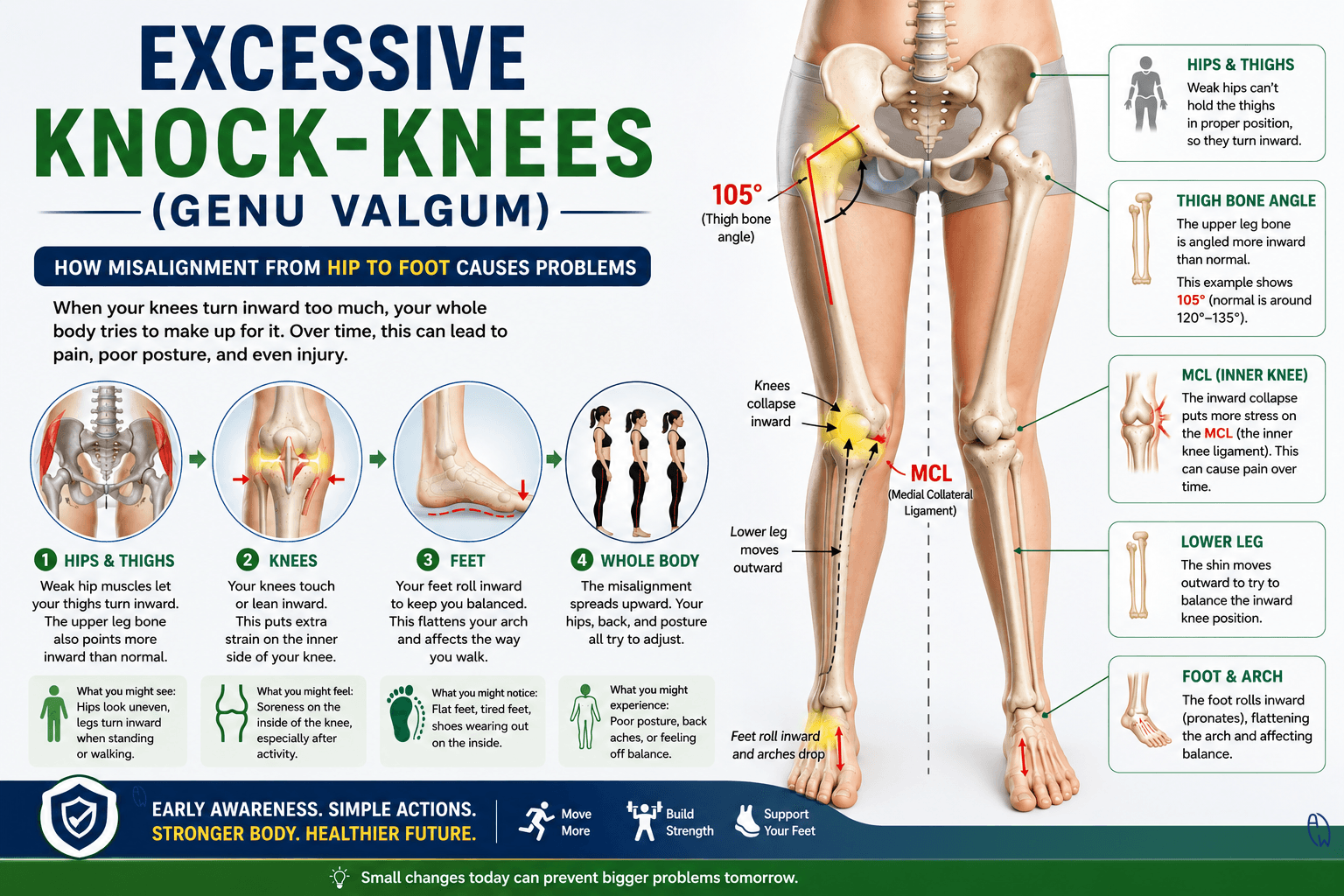
Excessive Knock Knees (Genu Valgum) in Kids & Teenagers: How Flat Feet, Hip Weakness & Poor Alignment Create a Hidden Chain Reaction
Today, more children and teenagers are developing knock knees, also known medically as genu valgum. Many parents notice their child’s knees collapsing inward while standing, walking, running, or playing sports. Others notice flat feet, awkward posture, poor balance, or unusual walking patterns.
What many people do not realize is that flat feet and knock knees often happen together.
This combination is becoming extremely common in modern children and teenagers due to:
-
Poor posture habits
-
Reduced physical activity
-
Weak hip muscles
-
Long hours sitting indoors
-
Poor lower body strength
-
Repetitive inward sitting positions
-
Rapid adolescent growth spurts
While mild knock knees can be normal during early childhood development, excessive genu valgum may create a full-body biomechanical imbalance affecting the hips, knees, ankles, feet, posture, and even the spine.
What Are Knock Knees (Genu Valgum)?
Knock knees happen when the knees angle inward and touch each other while the ankles stay apart.
The medical term for this condition is:
Genu Valgum
In many children and teenagers, the inward knee position becomes more obvious during:
-
Walking
-
Running
-
Squatting
-
Sports
-
Standing for long periods
Some children also develop:
-
Flat feet
-
Inward rolling ankles
-
Hip imbalance
-
Poor posture
-
Uneven walking
-
Knee pain after activity
The body does not work in isolated parts. When the knees collapse inward, the entire lower body begins compensating.
Why Flat Feet and Knock Knees Often Occur Together
One of the most common things seen today is:
Flat Feet + Knock Knees
When the knees collapse inward:
-
The feet often roll inward to compensate
-
The arches begin flattening
-
The ankles collapse inward
-
Balance and walking mechanics change
This is called:
Excessive Pronation
Over time, the body adapts to this misalignment pattern.
Children with flat feet and knock knees may complain about:
-
Tired legs
-
Foot pain
-
Knee pain
-
Poor sports endurance
-
Frequent tripping
-
Uneven shoe wear
-
Poor posture
-
Hip discomfort
The Hidden Biomechanical Chain Reaction
1. Weak Hips & Thigh Alignment
The hips play a huge role in controlling knee position.
When the hip and glute muscles are weak, the thighs begin rotating inward. This causes the knees to drift toward each other.
Some teenagers may also have a structural thigh bone angle called:
Coxa Vara
This means the upper thigh bone angle becomes smaller than normal.
Normal femur angle:
120º - 135º
Example of coxa vara:
105º
This inward thigh bone angle may worsen knee collapse and increase lower body imbalance.
2. Knee Collapse & MCL Stress
As the knees collapse inward, the knee joint experiences abnormal stress.
The inner knee ligament — called the:
Medial Collateral Ligament (MCL)
may become overloaded over time.
This inward knee collapse can increase:
-
Inner knee pressure
-
Joint strain
-
Knee instability
-
Risk of pain during sports
-
Poor movement mechanics
Teenagers with excessive knee valgus may notice:
-
Knee pain during walking
-
Pain after exercise
-
Knees touching during standing
-
Weak jumping mechanics
-
Difficulty running efficiently
3. Flat Feet & Foot Pronation
As the knees angle inward, the feet try to stabilize the body.
The feet begin rolling inward:
Excessive Pronation
This causes:
-
Flat feet
-
Collapsed arches
-
Inward ankle rolling
-
Reduced stability
-
Altered walking patterns
This creates a vicious cycle:
-
Flat feet worsen knock knees
-
Knock knees worsen flat feet
Over time, the imbalance may spread upward into:
-
The hips
-
Pelvis
-
Lower back
-
Posture
-
Walking mechanics
Why Are More Kids Developing Knock Knees Today?
Modern lifestyles are changing how children move and develop.
Many children today:
-
Sit for long periods
-
Spend less time outdoors
-
Develop weaker hip muscles
-
Move less naturally
-
Spend more time on screens
-
Wear unsupportive footwear
-
Lose lower body strength during growth years
In some cultures, prolonged kneeling sitting positions from a young age may also influence lower limb posture and flexibility patterns over time.
Today, it is increasingly common to see:
-
Knock knees in teenagers
-
Flat feet in kids
-
Poor posture in adolescents
-
Inward knee collapse during sports
-
Hip instability
-
Movement imbalance
Signs Parents Should Watch For
Parents should pay attention if their child has:
-
Knees touching while ankles stay apart
-
Flat feet
-
Ankles rolling inward
-
Poor posture
-
Hip shifting during walking
-
Frequent tripping
-
Uneven shoe wear
-
Knee pain after sports
-
Tired legs easily
-
Awkward running style
Early awareness is important because the body adapts to repeated movement patterns over time.
Why Early Assessment Matters
The earlier movement imbalances are recognized, the greater the opportunity to improve:
-
Strength
-
Stability
-
Posture
-
Walking mechanics
-
Sports performance
-
Long-term joint health
Addressing knock knees often requires looking at the entire body — not just the knees themselves.
A comprehensive approach may include:
-
Hip strengthening
-
Glute activation
-
Balance training
-
Foot stability exercises
-
Gait assessment
-
Postural correction
-
Functional rehabilitation
Healthy Movement During Growth Years Matters
Children’s bodies are constantly adapting during growth.
Repeated poor movement patterns may gradually affect:
-
Knee alignment
-
Foot posture
-
Hip balance
-
Walking mechanics
-
Overall body stability
Research Supporting Corrective Exercises & Supportive Care
A 2024 systematic review titled:
“The Effects of Various Corrective Exercise and Supportive Tools in Individuals with Genu Valgum” found that several conservative approaches showed positive effects in helping improve knee alignment, lower limb stability, and movement mechanics.
The review highlighted benefits from:
-
Corrective exercises
-
Hip and glute strengthening
-
Resistance training
-
Balance and stability work
-
Foot orthotics and arch support
-
Kinesiology taping for rehabilitation support
These interventions aim to improve how the body moves as a whole kinetic chain — from the hips down to the feet — rather than focusing only on the knees themselves.
Recent research suggests that strengthening weak hip muscles, improving foot stability, and correcting movement patterns may help reduce excessive inward knee collapse and improve overall lower limb function in individuals with genu valgum.
Flat feet and knock knees are no longer rare issues. They are becoming increasingly common in modern children and teenagers. But, that excessive knock knees (genu valgum) and related movement imbalances may improve with proper guidance, strengthening, and supportive care.
The good news is that movement awareness, strength development, posture education, and proper assessment may help improve long-term function and reduce future joint stress.