Why Your Upper Back Feels Tight (Even If It Doesn't Need More Stretching) Part. 2
One of the biggest misconceptions about hunchback posture is that tight muscles always need more stretching.
At first, this seems logical.
Your upper back feels stiff.
Your neck feels tight.
Your shoulders ache.
So stretching appears to be the obvious solution.
But the human body is rarely that simple.
Sometimes, muscles feel tight because they have become shorter.
Other times, they feel tight because they have been working continuously for hours without a chance to rest.
These are two very different problems.
Imagine carrying a heavy shopping bag all day.
By the end of the day, your arm muscles feel tight and tired—not because they are too short, but because they have been working constantly.
The muscles in your upper back often behave the same way.
When your thoracic spine rounds forward, gravity shifts your head and shoulders in front of your body. To stop you from falling further forward, your spinal extensor muscles, middle trapezius, upper trapezius, levator scapulae, and other postural muscles remain active for much longer than they were designed to.
The result?
They become fatigued.
They become sore.
They feel tight.
Stretching may temporarily reduce this sensation, but if those muscles immediately return to supporting the same collapsed posture, the tightness usually comes back.
This is why many people find themselves stretching the exact same muscles every single day.
Why Stretching Feels Good—But Doesn't Last
This doesn't mean stretching is bad.
In fact, stretching can be an important part of a comprehensive rehabilitation program.
The problem arises when stretching becomes the only treatment.
Stretching can temporarily:
-
Reduce muscle tension.
-
Improve flexibility.
-
Increase circulation.
-
Provide short-term pain relief.
However, stretching alone does not automatically improve spinal alignment, muscle endurance, movement control, or the way your body distributes mechanical load.
Think of your posture like the alignment of a car.
If the wheels are out of alignment, replacing the tyres may make the ride feel smoother for a while, but unless the alignment is corrected, the tyres continue wearing unevenly.
Your spine works in a similar way.
If the underlying mechanics remain unchanged, your body will eventually return to its familiar posture, regardless of how often you stretch.
Can a Hunchback Be Corrected?
One of the most common questions people ask is:
"Can I fix my hunchback?"
The answer depends on why the hunchback developed.
Postural Hyperkyphosis
This is the most common type seen in younger adults and office workers.
The spine remains flexible, but prolonged sitting, poor movement habits, muscle weakness, and reduced thoracic mobility gradually create a rounded posture.
With appropriate rehabilitation, many people can improve their posture, movement quality, and symptoms.
Structural Hyperkyphosis
Some people have changes in the shape of the vertebrae themselves.
Examples include:
-
Scheuermann's disease
-
Osteoporosis with compression fractures
-
Degenerative spinal changes
-
Certain congenital spinal conditions
Although structural changes cannot always be completely reversed, rehabilitation may still improve spinal mobility, muscle function, breathing mechanics, balance, pain, and overall quality of life.
This is why understanding the cause of the hunchback is more important than simply searching for the "best exercise."
Why Assessment Comes Before Treatment
One of the biggest mistakes people make is assuming everyone with a rounded upper back needs the same exercises.
In reality, posture is influenced by many different systems working together.
A comprehensive assessment may include:
-
Standing posture analysis
-
Spinal mobility assessment
-
Shoulder blade (scapular) movement
-
Muscle strength and endurance
-
Breathing mechanics
-
Balance and body awareness (proprioception)
-
Daily work and lifestyle habits
-
Standing spinal X-rays when clinically appropriate
Two people may both appear to have a hunchback, yet require completely different rehabilitation strategies.
One person may primarily need mobility.
Another may need strengthening.
Someone else may require breathing retraining or ergonomic changes.
Treating everyone the same ignores the complexity of how posture develops.
A Whole-Body Approach to Hunchback Treatment
At All Well Scoliosis Centre, we view posture as a whole-body system rather than focusing on a single painful area.
Instead of simply asking, "Which muscle hurts?" we aim to understand why that muscle is under stress.
This often involves addressing several contributing factors together rather than relying on one intervention alone.
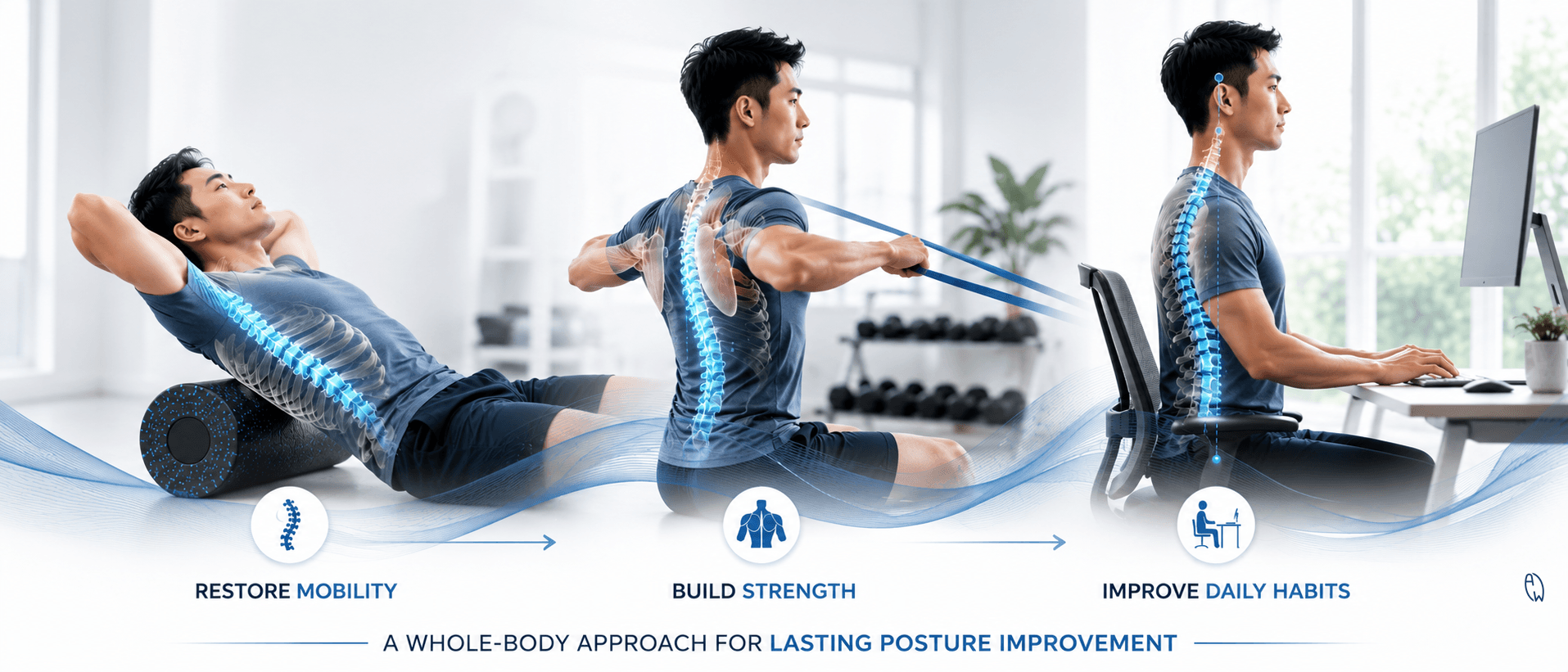
A comprehensive rehabilitation program may include improving spinal mobility, strengthening postural muscles, retraining movement patterns, optimizing breathing mechanics, and modifying the daily habits that contributed to the problem.
The goal is not simply to stand up straighter for a few minutes.
The goal is to help your body make an upright posture easier to maintain throughout the day.
The Three Principles of Effective Hunchback Treatment
1. Restore Thoracic Mobility
Healthy posture requires the thoracic spine to move.
After years of prolonged sitting, the joints between the thoracic vertebrae often become less mobile.
Gentle thoracic extension exercises, performed with proper technique, may help restore movement to spinal segments that have gradually become stiff.
Mobility exercises should focus on quality of movement rather than aggressive stretching.
For many people, breathing exercises performed alongside thoracic mobility work also help improve rib cage expansion and spinal movement.
2. Build a Stronger Postural Support System
Good posture is not maintained by willpower.
It is maintained by muscles that have the strength and endurance to support your body throughout the day.
These include:
-
Middle trapezius
-
Lower trapezius
-
Rhomboids
-
Serratus anterior
-
Deep neck flexors
-
Thoracic spinal extensors
-
Core stabilising muscles
Rather than pulling your shoulders back forcefully, rehabilitation aims to improve how these muscles work together to support natural alignment.
As endurance improves, maintaining good posture usually requires less conscious effort.
3. Change the Habits That Created the Problem
Even the best exercise program cannot overcome eight to ten hours of poor posture every day.
Your nervous system adapts to what you do most often.
If you spend hours leaning towards a laptop or looking down at your phone, your body gradually accepts that position as its new normal.
Simple changes can make a significant difference over time:
-
Raise your computer monitor to eye level.
-
Bring your screen closer instead of leaning forward.
-
Use an external keyboard with laptops.
-
Change positions every 30 to 60 minutes.
-
Take regular walking breaks.
-
Alternate between sitting and standing when possible.
-
Limit prolonged smartphone use with your head bent forward.
Small daily habits, repeated consistently, usually have a greater long-term impact than occasional intensive exercise sessions.
Your Brain Learns Posture Too
Many people think posture is purely a muscle problem.
In reality, your nervous system plays an equally important role.
Every second, your brain combines information from your eyes, inner ear, muscles, joints, and skin to determine where your body is in space.
This process is called proprioception, sometimes referred to as your body's position sense.
After months or years of a rounded posture, your brain may begin to recognise that posture as "normal."
When you first try standing taller, it can actually feel awkward or even incorrect.
That doesn't necessarily mean the new posture is wrong.
It simply means your brain is adapting to a different movement pattern.
Consistent practice, repetition, and movement retraining help your nervous system gradually accept healthier posture as the new default.
This is one reason lasting posture improvement usually takes time—it is not only your muscles that are learning, but your brain as well.
There Is No Single Miracle Exercise
If you've searched online for "the best exercise for a hunchback," you've probably found hundreds of different recommendations.
The truth is that no single exercise works for everyone.
Lasting improvement usually comes from combining several elements:
-
Restoring mobility where movement has been lost.
-
Strengthening muscles that have become weak.
-
Improving coordination and movement control.
-
Optimising breathing mechanics.
-
Changing daily habits.
-
Following a programme that matches your individual needs.
Rather than searching for a quick fix, think of posture correction as rebuilding the way your body manages gravity—one movement, one habit, and one day at a time.
In Part 3, we'll answer the most common questions about hunchback posture, discuss when to seek professional assessment, and summarise the key steps that can help you move towards long-term improvement.