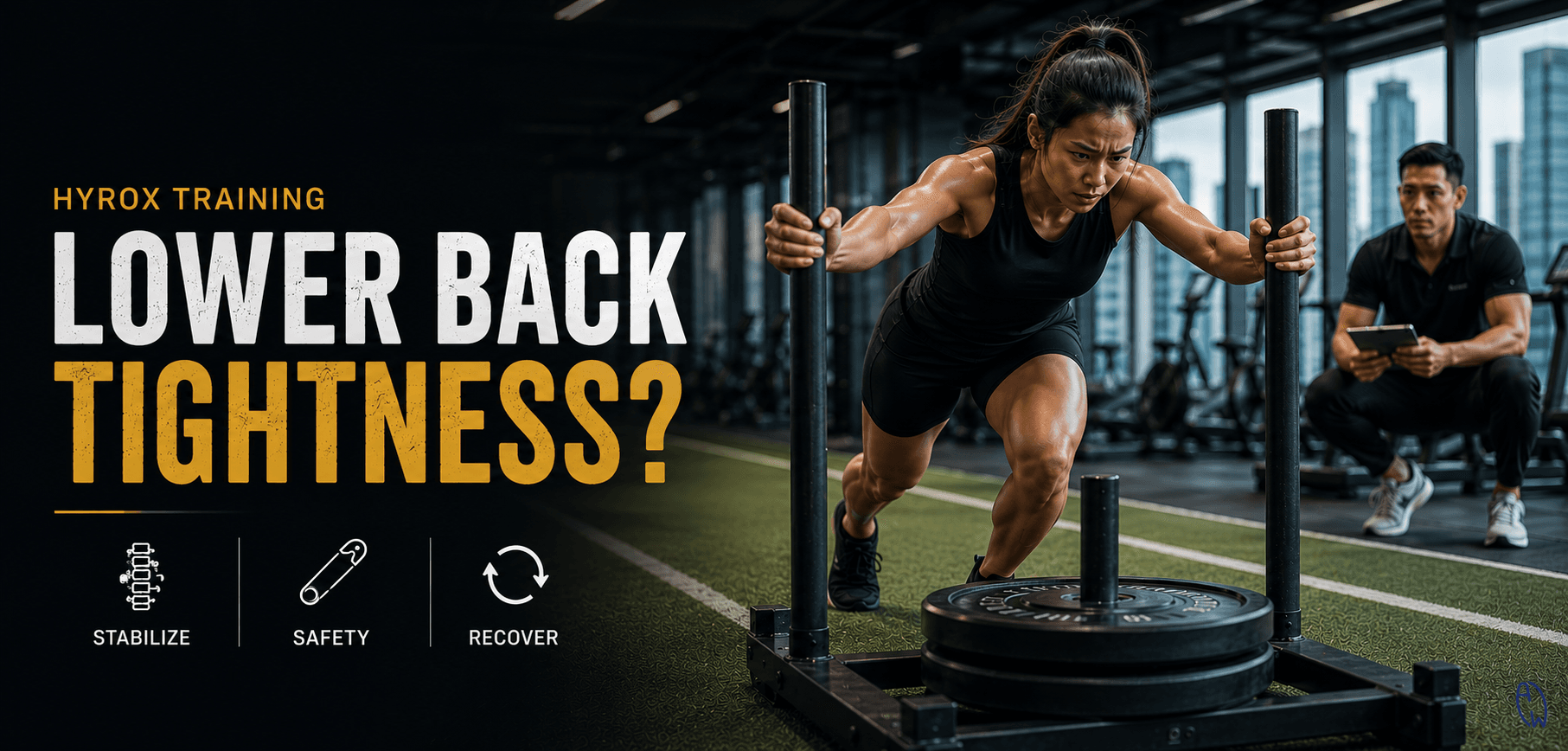
HYROX Lower Back Tightness During Sled Push & Pull: Causes, Prevention, Recovery & Scoliosis Considerations
Why Your Lower Back Gets Tight During HYROX Training
One of the most common complaints we hear from HYROX athletes is:
“My lower back gets insanely tight during sled push or sled pull.”
What makes this confusing is that many of these athletes are extremely fit.
They run well.
They lift heavy.
They condition hard.
But despite looking strong externally, internally the body may be compensating heavily.
This is especially common during:
-
sled push
-
sled pull
-
farmers carry
-
lunges
-
running under fatigue
The problem is not always a “weak back.”
Often, the lower back is overworking because the body is losing coordination and stabilization under fatigue.
Why HYROX Athletes Experience Lower Back Tightness
HYROX combines:
-
endurance
-
force production
-
repetitive impact
-
breathing under fatigue
-
trunk stability
-
asymmetrical loading
As fatigue increases, movement quality often decreases.
The body starts relying on compensation strategies to continue producing force.
This commonly looks like:
-
excessive lumbar extension
-
rib flare
-
pelvic shifting
-
trunk rotation
-
gripping through hip flexors
-
over-bracing the lower back
Many athletes describe it as:
“My back blows up before my legs do.”
That is usually a stabilization issue, not just a conditioning issue.
The Hidden Compensation Pattern in HYROX Athletes
A common compensation pattern in HYROX athletes includes:
-
dominant quads
-
underactive glutes
-
weak adductors
-
stiff ankles
-
poor rotational control
-
reduced rib cage mobility
-
loss of diaphragmatic breathing
When these systems stop coordinating efficiently, the lower back becomes the backup stabilizer.
This is why some athletes:
-
feel uneven during running
-
rotate more to one side
-
lose posture under fatigue
-
develop one-sided tightness
-
struggle during sled pushes despite strong legs
Research on movement compensation and lumbar mechanics shows that altered spinal movement patterns are common during repetitive athletic activity and fatigue-related loading.
Why Fatigue Exposes Movement Problems
HYROX is not simply about strength.
It is about maintaining movement quality while exhausted.
When fatigue rises:
-
stabilizers become less efficient
-
breathing mechanics collapse
-
coordination decreases
-
compensation increases
The nervous system defaults into the strongest available strategy.
Usually:
-
lumbar extension
-
rotational dominance
-
hip flexor gripping
-
excessive spinal compression
This is why many athletes feel:
“I only notice the tightness halfway through training.”
The Biggest Mistake HYROX Athletes Make
Most athletes try to fix the issue by:
-
stretching the lower back
-
foam rolling aggressively
-
adding more conditioning
-
training harder
But tightness is often the result of overload from compensation.
The body may already be strong enough.
It just is not distributing force efficiently.
What HYROX Athletes Need to Train for Better Coordination and Stabilization
1. Anti-Rotation and Rotational Control
Most HYROX athletes train heavily in straight lines:
-
running
-
sled push
-
rowing
-
ski erg
But many lack rotational control.
This becomes obvious under fatigue.
Helpful exercises include:
-
single-arm farmers carry
-
offset carries
-
Pallof press
-
split stance cable press
-
controlled rotational drills
-
single-leg stability work
These exercises teach the body to resist unnecessary spinal rotation while maintaining efficient force transfer.
2. Glute and Adductor Coordination
Many athletes think:
“I already train legs.”
But strength alone is not enough.
The body also needs:
-
timing
-
sequencing
-
pelvic control
The glutes and adductors play a major role in:
-
stabilizing the pelvis
-
controlling stride mechanics
-
absorbing force
-
reducing lumbar overload
Without proper coordination, the lower back compensates excessively.
Research on core and stabilization training supports improved spinal control and reduced low back stress in athletes.
3. Breathing and Rib Cage Control
Many HYROX athletes over-brace.
When breathing mechanics collapse:
-
ribs flare upward
-
pelvis loses alignment
-
spinal pressure increases
-
lower back tension builds
Learning:
-
diaphragmatic breathing
-
rib expansion
-
stacked posture
-
breathing under load
can dramatically improve stabilization and reduce unnecessary tension.
This becomes especially important during:
-
sled push
-
carries
-
running intervals
-
wall balls
Recovery: What HYROX Athletes Need to Do Mindfully
Recovery is not just:
-
massage
-
rest days
-
stretching
HYROX creates repetitive stress throughout the body.
Mindful recovery should include:
-
breathing resets
-
movement variability
-
mobility with control
-
sleep optimization
-
nervous system recovery
-
asymmetry awareness
-
gradual load progression
Sometimes the best recovery session is restoring coordination, not adding more intensity.
HYROX Training and Scoliosis: Can You Still Train?
This is a common question from athletes who:
-
have stabilized their scoliosis
-
reduced progression
-
strengthened their muscles
-
continue maintenance care
At All Well Scoliosis Centre, one of the biggest things we emphasize is:
Be mindful of your own condition.
Even if a scoliosis curve is under 20 degrees and considered stable, asymmetry still exists.
Under fatigue, the body often returns to old compensation patterns.
This means athletes need to understand:
-
where they rotate more
-
which side dominates
-
where stability is weaker
-
how fatigue affects posture
-
how asymmetry changes under load
The goal is not to avoid exercise.
The goal is to train intelligently.
What Scoliosis Athletes Should Be Mindful of During HYROX Training
Understand Your Own Rotation Pattern
Many scoliosis athletes rotate excessively into their dominant side during:
-
sled push
-
running
-
carries
-
lunges
This can increase:
-
lumbar tightness
-
rib compression
-
pelvic imbalance
-
asymmetrical fatigue
Mindful training means:
-
noticing trunk shifts
-
controlling rib flare
-
monitoring pelvic position
-
adjusting asymmetrical loading
Train the Asymmetry, Not Ignore It
A common mistake is trying to train like everyone else without understanding individual asymmetry.
Instead:
-
strengthen weaker stabilizers
-
improve proprioception
-
build endurance in corrective positions
-
increase control under fatigue
Research on scoliosis-focused core exercise suggests stabilization-based training may improve spinal control and movement quality.
Stability Before Intensity
Before aggressively increasing:
-
sled load
-
running volume
-
race simulation
-
fatigue circuits
the body should first demonstrate:
-
pelvic stability
-
breathing control
-
trunk coordination
-
single-leg control
-
rotational awareness
Performance improves when stability improves.
Final Thoughts
HYROX is an incredible sport.
But long-term performance is not just about training harder.
The athletes who perform best long-term are usually the ones who:
-
understand their body
-
identify compensation early
-
train stabilization intentionally
-
manage recovery properly
-
respect asymmetry under fatigue
Because sometimes the strongest-looking athlete is also compensating the hardest internally.