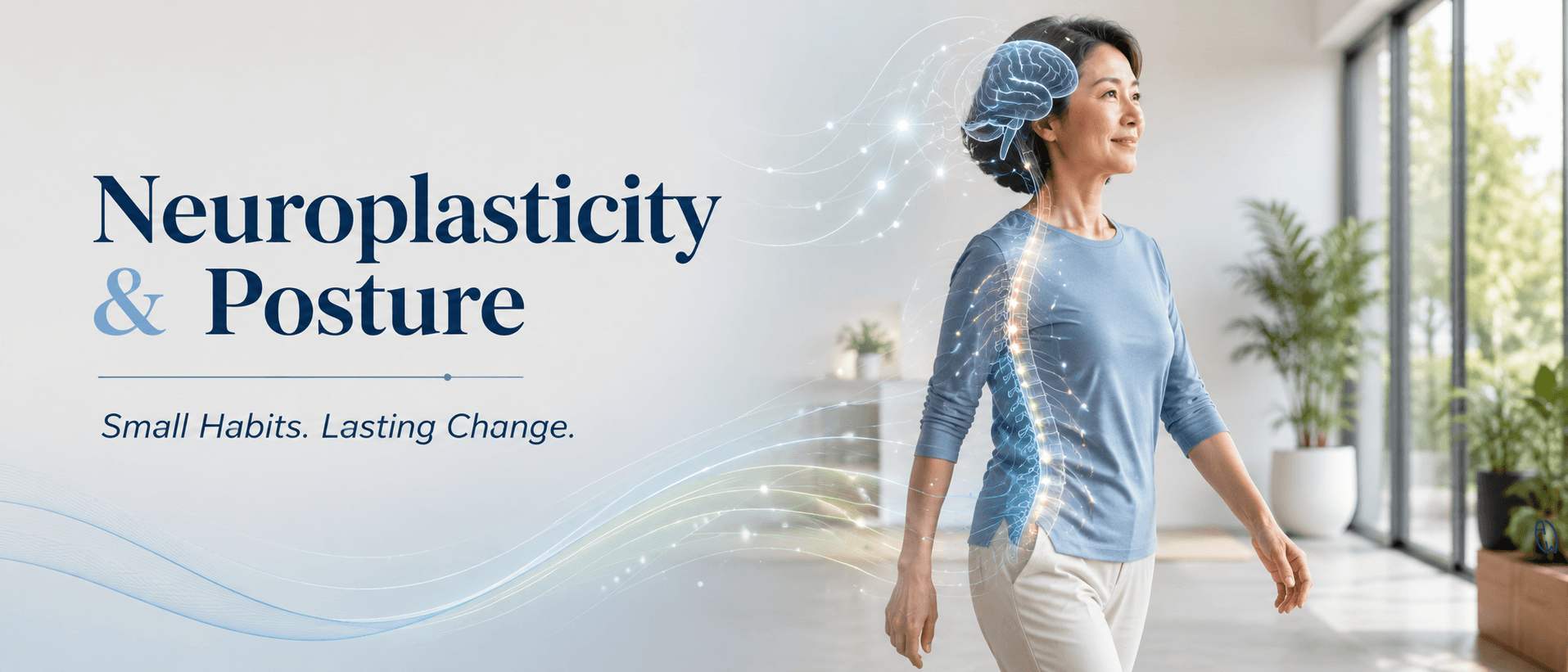
Neuroplasticity: How the Brain Learns New Movement Patterns and Why Good Posture Is a Habit
"Learning Something New After 60 Feels Like Learning How to Walk Again"
A recent conversation with one of my patients inspired this article.
She is a 66-year-old woman with scoliosis who had been making steady progress with her posture exercises, balance training, and movement awareness. Like many adults, life eventually became busy. Family commitments took priority, appointments became less frequent, and her home exercises gradually became less consistent.
When she returned for a follow-up visit, she shared something that many older adults quietly experience.
"I notice that when I don't come regularly, I stop focusing on the things I've learned. The habits disappear. It becomes harder to remember what I should be doing."
Then she paused and said something that stayed with me:
"I can still remember many things I learned as a teenager. But learning something new after sixty feels like learning how to walk again."
Her words perfectly describe one of the greatest challenges of healthy aging.
Most people understand that muscles become weaker with age. Fewer people realize that the brain also requires more repetition and reinforcement to learn new movement patterns.
The good news is that the brain never stops learning.
This remarkable ability is called neuroplasticity.
What Is Neuroplasticity?
Neuroplasticity is the brain's ability to change, adapt, and form new neural connections throughout life.
Every movement you perform repeatedly strengthens pathways within the nervous system. Over time, these pathways become automatic.
This is why you can:
-
Walk without thinking about every step.
-
Drive a familiar route almost automatically.
-
Type on a keyboard without looking at your fingers.
The same process applies to posture.
If you have spent years sitting at a desk, looking down at a phone, favoring one side of your body, or moving in certain ways because of scoliosis or pain, your brain has practiced those patterns thousands of times.
Eventually, those patterns become your body's default setting.
The nervous system is simply doing what it has learned to do.
Fortunately, neuroplasticity means the brain can learn new patterns, even later in life.
Posture Is a Motor Skill, Not a Position
One of the biggest myths about posture is that good posture means forcing yourself to sit or stand perfectly straight.
Many people spend a few minutes pulling their shoulders back and tightening their muscles, only to find themselves slouching again shortly afterward.
The reason is simple.
Posture is not a position.
Posture is a motor skill.
Just like riding a bicycle, playing the piano, or learning a new language, posture must be practiced repeatedly until it becomes automatic.
Your posture is constantly influenced by:
-
The brain
-
The eyes
-
The inner ear
-
The muscles
-
The joints
-
The nervous system
Good posture is not about remaining perfectly still.
Good posture is the ability to adapt efficiently while maintaining balance, stability, and comfort throughout daily life.
Why Old Habits Are Hard to Break
Many people talk about "muscle memory."
In reality, muscles do not remember.
The nervous system remembers.
Every time you repeat a movement, neural pathways become stronger and more efficient.
This is why:
-
Slouching can become automatic.
-
Leaning to one side can become automatic.
-
Poor lifting mechanics can become automatic.
-
Scoliosis compensation patterns can become automatic.
Over time, these patterns require very little conscious thought.
Changing them means teaching the brain a new way of moving.
This is where many adults become frustrated.
They know what they should do.
They simply cannot remember to do it consistently.
The issue is often not motivation.
The issue is habit formation.
The Habit Loop: How the Brain Learns Better Posture
Every habit consists of three essential components.
1. The Cue
A cue is a trigger that reminds you to act.
Examples include:
-
A phone notification
-
Sitting down at your desk
-
Waiting for coffee to brew
-
Standing up after a meeting
-
Answering a phone call
The cue creates awareness.
2. The Action
The action is the movement itself.
Instead of aggressively correcting posture, think small.
Try:
-
Lengthening through the crown of the head
-
Relaxing the shoulders
-
Taking a deeper breath
-
Engaging your core gently
Small corrections performed repeatedly are more effective than dramatic corrections performed occasionally.
3. The Reward
The brain learns through reinforcement.
After making a posture adjustment, notice:
-
Easier breathing
-
Reduced neck tension
-
Better balance
-
Less fatigue
When the brain recognizes a benefit, it becomes more likely to repeat the behavior.
Over time, the habit becomes automatic.
Why Small Changes Work Better Than Big Changes
Many people fail because they attempt to maintain perfect posture all day.
That approach usually leads to fatigue and frustration.
The nervous system learns through repetition, not force.
A more effective strategy is to start small.
Try:
-
One minute of posture awareness every hour.
-
Five deep breaths before checking email.
-
A quick posture reset whenever your phone rings.
-
A balance exercise while brushing your teeth.
Small actions repeated daily create stronger neural pathways than occasional bursts of motivation.
The Challenge of Learning New Habits After 60
The older we get, the more deeply established our movement patterns become.
This does not mean change is impossible.
It simply means change requires greater consistency.
The neural pathways built during childhood and early adulthood have been reinforced for decades.
New pathways can still form, but they need regular practice.
This is exactly what my patient was describing.
She had not forgotten everything she learned.
Her brain simply needed more repetition to keep those pathways active.
This is why many older adults benefit from:
-
Regular follow-up sessions
-
Home exercise programs
-
Balance training
-
Walking routines
-
Posture reminders
-
Ongoing encouragement
Consistency becomes more important than intensity.
Movement Is the Antidote to Poor Posture
Human beings were designed to move.
The goal is not perfect posture.
The goal is healthy movement.
Even the "perfect" posture can become uncomfortable if maintained for too long.
Movement provides the brain with fresh sensory information and helps prevent stiffness.
The 20–30 Minute Rule
Whenever possible:
-
Change positions every 20 to 30 minutes.
-
Stand up and walk briefly.
-
Stretch your chest and shoulders.
-
Perform a few shoulder rolls.
-
Take a short walk around the office or home.
Movement nourishes both the body and the brain.
Creating an Environment That Supports Better Habits
Willpower alone is rarely enough.
The environment should make healthy habits easier.
Simple changes can help:
Ergonomic Workstations
Position your monitor at eye level.
Raise Your Devices
Bring phones and tablets closer to eye level rather than constantly bending your neck.
Wear Appropriate Footwear
Supportive footwear may reduce unnecessary stress during prolonged standing.
Use Structural Cues
For some individuals with scoliosis, posture support garments, corrective bracing, or rehabilitation equipment may provide useful feedback while the brain learns new movement patterns.
These tools do not replace movement training.
They support it.
Neuroplasticity and Scoliosis
For individuals living with scoliosis, posture retraining often involves more than simply standing straighter.
The nervous system may have adapted to asymmetrical movement patterns over many years.
Successful scoliosis rehabilitation often focuses on:
-
Body awareness
-
Balance training
-
Breathing mechanics
-
Postural control
-
Functional movement
-
Consistent repetition
The objective is not perfection.
The objective is helping the brain develop more efficient movement strategies that support comfort, function, and quality of life.
Consistency Matters More Than Perfection
One of the most important lessons I have learned from working with scoliosis patients is that progress does not come from being perfect.
It comes from showing up.
The patients who improve over time are rarely the ones who do everything perfectly.
They are the ones who continue practicing.
They return after setbacks.
They rebuild habits after interruptions.
They understand that learning is a process.
Every exercise, every posture reset, every walk, and every balance drill is a message to the nervous system:
"This is the movement pattern I want to keep."
The Bigger Picture: Building Independence Through Neuroplasticity
For older adults, posture is about much more than appearance.
It affects:
-
Balance
-
Mobility
-
Breathing
-
Confidence
-
Fall risk
-
Independence
The ability to continue learning and adapting is one of the greatest gifts of the human nervous system.
Learning a new movement at sixty-five may not feel the same as learning it at fifteen.
It may take more repetition.
It may require more patience.
But it remains possible.
The brain is capable of change throughout life.
Every healthy habit, every corrective exercise, and every conscious movement is an investment in future function.
Key Takeaway
Good posture is not a static pose you force yourself to maintain.
It is a dynamic, lifelong motor skill shaped by neuroplasticity, repetition, and daily habits.
The goal is not perfect posture.
The goal is teaching the brain better movement patterns through small, consistent actions.
Because when healthy movement becomes a habit, the body no longer has to remember what to do.
It simply does it naturally.