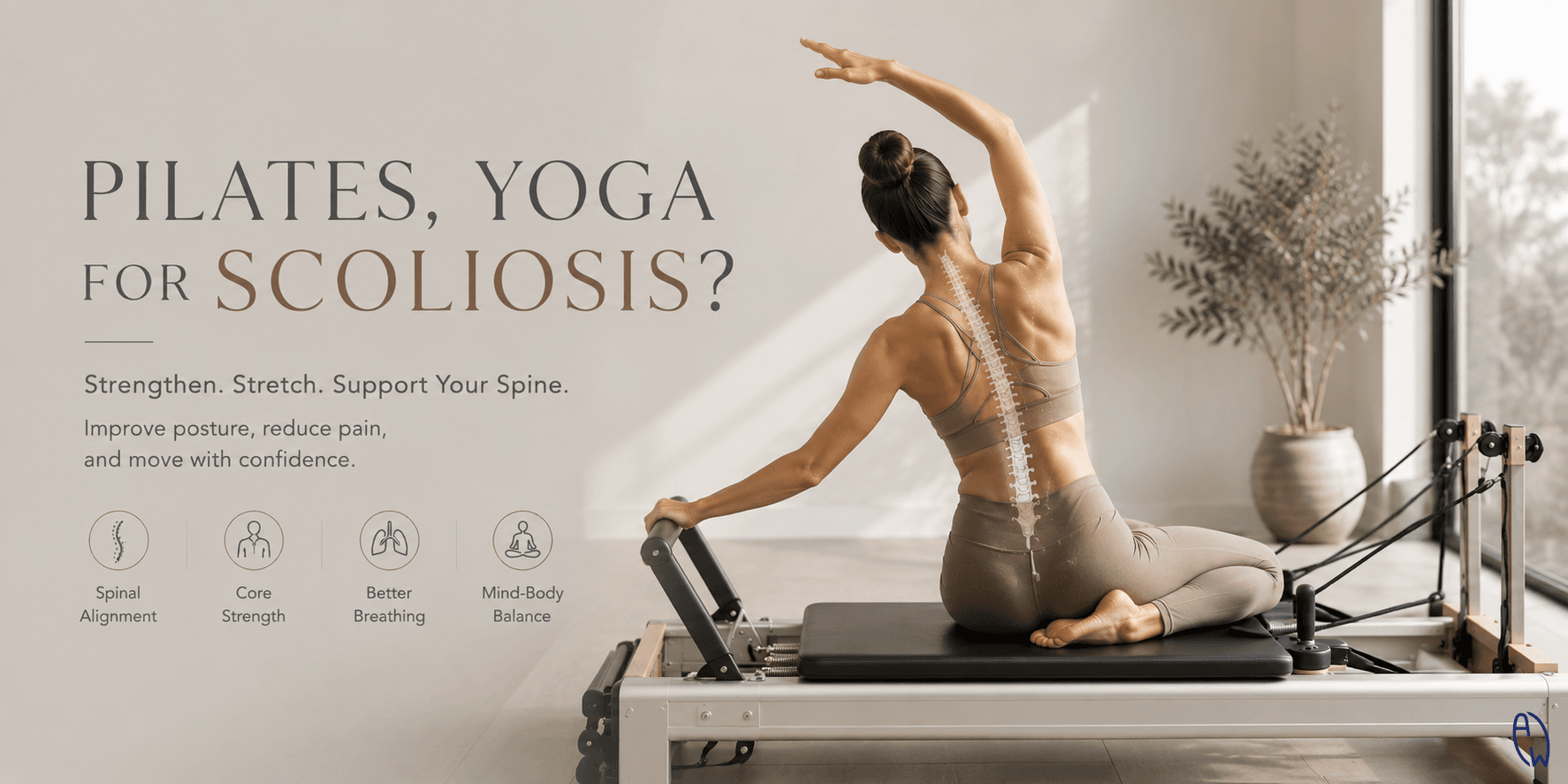
Pilates for Scoliosis: Can It Really Help Improve Posture, Pain, and Spinal Strength?
Stretching and movement-based therapies are often favored as natural ways to help manage scoliosis. Among the most popular approaches are Pilates and yoga because they focus on mobility, body awareness, posture, breathing, and core strength.
For many people living with scoliosis, especially adults with desk jobs or teenagers dealing with spinal imbalance, Pilates can become a useful tool for reducing tension, improving movement quality, and building better spinal support. However, it is important to understand that not all exercises are suitable for every curve pattern, and scoliosis-specific modifications matter.
Understanding Scoliosis Before Starting Pilates
Before beginning Pilates for scoliosis, it is important to understand your spinal curve pattern.
Scoliosis is not just a sideways curve. The spine also rotates, which changes muscle tension and balance throughout the body. If someone does not understand whether their curve bends right or left — and where the rotation occurs — it becomes difficult to choose exercises that support correction rather than reinforce imbalance.
When assessing scoliosis, therapists often think about two concepts related to spinal stability:
-
Form closure — how the bones and joints align structurally
-
Force closure — how muscles, fascia, and connective tissues support the spine dynamically
This is why scoliosis exercise programs should never be completely generic.
Begin with Conscious Breathing
One of the most overlooked parts of scoliosis rehabilitation is breathing.
People with scoliosis often develop tightness on the concave side of the curve — the side where the body collapses inward. This area can feel compressed, restricted, or constantly tense.
Conscious breathing exercises may help:
-
Expand restricted rib cages
-
Improve body awareness
-
Reduce muscular guarding
-
Encourage better spinal mobility
In Pilates, breathing is a foundational principle. Learning how to direct breath into restricted areas of the rib cage may help reduce discomfort and improve movement efficiency.
Why Pilates Movements Need to Be Different on Each Side
With scoliosis, muscle tension is rarely symmetrical.
The tissues on the concave side of the curve are usually:
-
Shorter
-
Tighter
-
More compressed
Meanwhile, the tissues on the convex side are often:
-
Lengthened
-
Weaker
-
Less stable
Because of this imbalance, exercises may need to be modified differently for the right and left sides of the body.
The goal is not simply to “stretch everything.” Instead, effective scoliosis exercise programs usually focus on:
-
Stretching areas that are shortened and compressed
-
Strengthening areas that are weak and overstretched
-
Restoring better muscular balance around the spine
This is why scoliosis-specific Pilates is very different from a general fitness class.
How Pilates Can Help Manage Scoliosis
Pilates is an exercise system focused on:
-
Core strength
-
Postural control
-
Flexibility
-
Coordination
-
Range of motion
Some research suggests Pilates may help reduce scoliosis-related discomfort and improve posture, spinal mobility, and muscular endurance.
Potential benefits of Pilates for scoliosis may include:
Improved Core Strength
The deep abdominal and spinal stabilizing muscles help support the spine during daily movement. Better core activation may reduce unnecessary strain on the back.
Better Postural Awareness
Many people with scoliosis unconsciously shift weight unevenly. Pilates encourages body awareness and controlled movement patterns, helping patients recognize asymmetries more clearly.
Increased Flexibility and Mobility
Gentle spinal mobility exercises and stretching techniques may help reduce stiffness around the thoracic spine, hips, and rib cage.
Reduced Lower Back Pain
Poor muscular balance and spinal compensation patterns can overload the lower back. Pilates may help redistribute forces more evenly through the body.
Improved Movement Efficiency
Pilates emphasizes controlled movement instead of aggressive repetition. This can be particularly useful for individuals with scoliosis who struggle with compensatory movement patterns.
Stretch or Strengthen Where It Is Needed
One of the biggest misconceptions about scoliosis exercise is assuming every tight muscle should be stretched and every weak muscle should be strengthened equally.
Scoliosis management should always be individualized.
A proper scoliosis-informed Pilates program may include:
-
Targeted stretching on the concave side
-
Strengthening on the convex side
-
Rib cage expansion work
-
Rotational control exercises
-
Core stabilization drills
-
Pelvic alignment training
The key is working within your flexibility, capacity, and range of motion rather than forcing aggressive correction.
Pilates vs Yoga for Scoliosis
Both Pilates and yoga may help people with scoliosis, but they work differently.
Yoga for Scoliosis
Some research suggests yoga may help:
-
Reduce pain
-
Improve mobility
-
Enhance quality of life
-
Improve postural awareness
However, yoga should still be approached carefully with scoliosis.
Certain poses may overload the thoracic spine, especially inversion-based positions. In clinical experience, inversion poses often create discomfort due to pressure through already rotated spinal segments.
Many therapists prefer Iyengar Yoga for scoliosis because it focuses heavily on:
-
Alignment
-
Postural awareness
-
Controlled positioning
-
Use of props and modifications
Helpful yoga accessories may include:
-
Bolsters
-
Foam rollers
-
Blocks
-
Straps
These tools can improve support and reduce strain during stretching.
Are There Risks of Pilates for Scoliosis?
Current reviews have not shown major adverse effects associated with Pilates for scoliosis. However, all exercise carries some level of risk, especially if someone has:
-
Severe scoliosis
-
Limited mobility
-
Chronic pain
-
Recent scoliosis surgery
Certain movements may aggravate symptoms if performed incorrectly or excessively.
This is why professional guidance matters.
Why Private Pilates Sessions Are Often Better for Scoliosis
If you are considering Pilates for scoliosis, private sessions with a knowledgeable instructor are often safer than jumping directly into public group classes.
An experienced instructor should be able to:
-
Identify your convex and concave sides
-
Understand spinal rotation patterns
-
Modify exercises appropriately
-
Prevent overloading sensitive areas
-
Guide breathing and alignment strategies
Before attending any public class, it is also important to inform the instructor about:
-
Your curve pattern
-
Any pain triggers
-
Past injuries or surgery
-
Movements you prefer to avoid
You should also feel comfortable telling instructors if you do not wish to be physically adjusted during class.
Additional Tips for Managing Scoliosis Naturally
Alongside Pilates and yoga, some additional strategies may help support spinal health:
-
Practicing better posture awareness
-
Gentle spinal twists and mobility exercises
-
Core strengthening exercises such as plank variations
-
Hip mobility training
-
Walking and general movement
-
Strength training with proper supervision
Movement matters — but movement quality matters even more.
Final Thoughts
Pilates is not a cure for scoliosis, but it may become a valuable part of a long-term management strategy.
When performed thoughtfully and modified appropriately, Pilates may help:
-
Improve posture
-
Reduce muscular tension
-
Increase spinal awareness
-
Support core stability
-
Improve mobility and quality of life
The most important thing is understanding that scoliosis is highly individual. Exercises that help one person may not help another.
That is why scoliosis-informed guidance, individualized modifications, and proper assessment remain essential before starting any Pilates or yoga program.