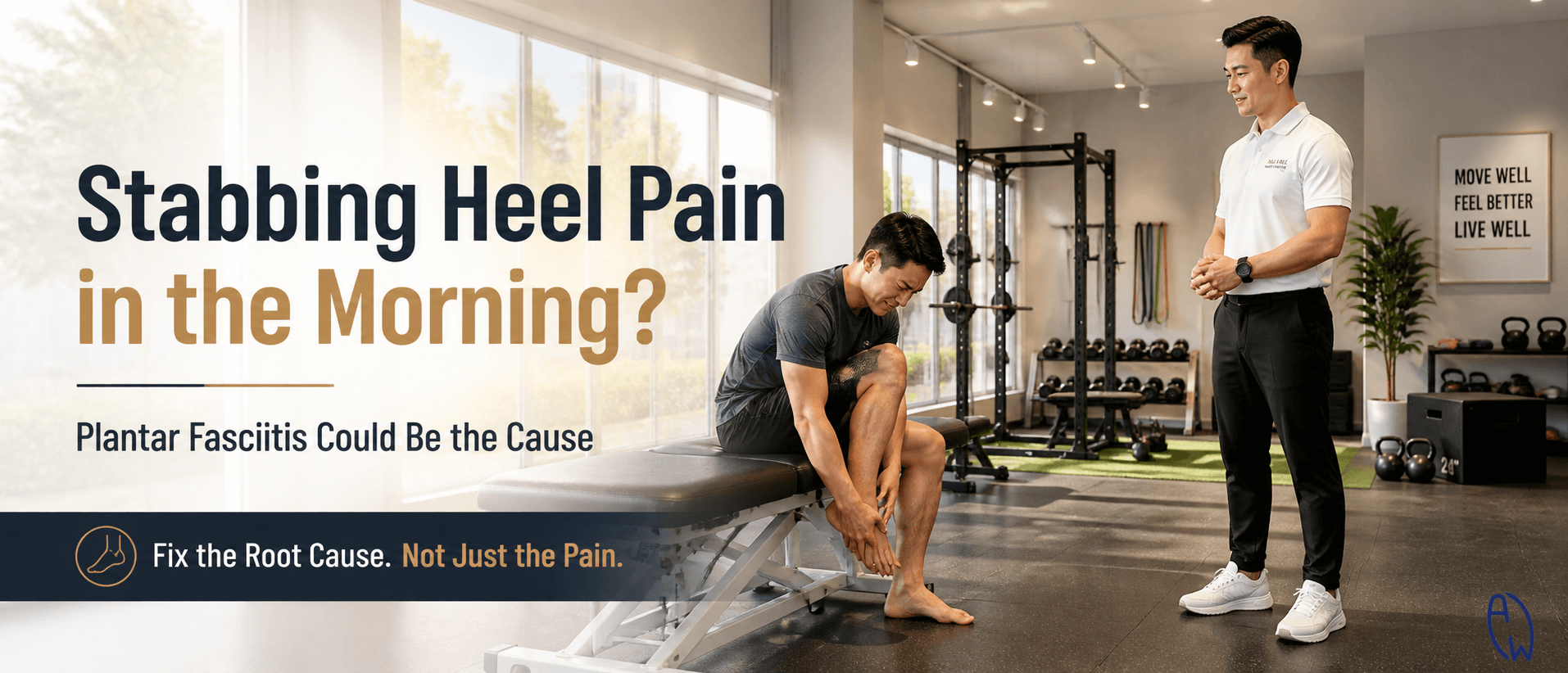
Stabbing Heel Pain in the Morning? You Might Be Dealing with Plantar Fasciitis
Waking up and taking your first step out of bed only to feel a sharp, stabbing pain in your heel is one of the most classic signs of Plantar Fasciitis. It is one of the most common causes of heel pain, especially among individuals who stand or walk for prolonged periods.
What many people misunderstand is this: plantar fasciitis is not just an inflammation issue. It is largely a problem of load management and tissue capacity.
What Is Plantar Fasciitis?
The plantar fascia is a thick connective tissue band running from the heel to the toes. It plays a critical role in supporting the arch of the foot and absorbing mechanical stress during walking and standing.
When repetitive strain exceeds the tissue’s capacity, the plantar fascia becomes irritated or degenerative, leading to pain—particularly at the medial heel.
4 Key Clinical Tests Used to Identify Plantar Fasciitis
Clinicians rely on a combination of history and physical examination to identify plantar fasciitis accurately.
1. Windlass Test
Lifting the big toe stretches the plantar fascia. Reproduction of sharp heel pain is a strong indicator.
2. First-Step Pain
Pain during the first steps in the morning or after prolonged sitting is highly characteristic.
3. Ankle Dorsiflexion Assessment
Limited ankle mobility, often due to tight calf muscles, increases strain on the plantar fascia.
4. Medial Heel Palpation
Direct pressure on the medial calcaneal region reproducing pain is a classic finding.
Clinical insight: Morning pain combined with localized medial heel tenderness is highly suggestive of plantar fasciitis.
Why Your Heel Pain Is Not Improving
A common mistake is relying solely on stretching.
Most individuals:
-
Focus only on stretching
-
Avoid any form of loading due to discomfort
-
Do not progressively challenge the tissue
As a result, the plantar fascia does not develop the strength required to tolerate daily stress.
Evidence-Based Treatment That Actually Works
1. High-Load Heel Raises
This is considered one of the most effective rehabilitation strategies.
Protocol:
-
Rise up on both feet and lower slowly on one foot
-
Place a towel under the toes to increase plantar fascia engagement
-
Perform 3 to 4 sets of 8 to 12 repetitions
-
Gradually add resistance as strength improves
Mild discomfort is acceptable. Sharp pain indicates excessive loading and should be adjusted.
2. Calf Strengthening (Straight and Bent Knee)
The calf complex directly influences plantar fascia loading.
-
Straight knee targets the gastrocnemius
-
Bent knee targets the soleus
-
Perform 3 sets of 12 to 15 repetitions
-
Progress to single-leg variations
Weak calves increase the mechanical demand on the plantar fascia.
3. Plantar Fascia-Specific Stretch
Generic calf stretching is often insufficient.
Technique:
-
Cross the affected leg over the other
-
Pull the toes back toward the shin
-
Feel tension along the arch
Hold for 20 to 30 seconds and repeat 3 to 5 times. This is particularly effective when performed before the first step in the morning.
What Most People Get Wrong
-
Over-reliance on passive treatments
-
Avoidance of discomfort altogether
-
Lack of progression in exercise intensity
These factors delay recovery and contribute to chronic symptoms.
What Actually Drives Recovery
-
Progressive loading of the plantar fascia
-
Consistency in rehabilitation
-
Maintaining pain within a tolerable range
Plantar fasciitis behaves more like a degenerative condition than a purely inflammatory one, meaning tissue adaptation is essential for recovery.
The Overlooked Connection: Foot Pain and Spinal Alignment
There is increasing clinical discussion around how postural and spinal factors influence foot mechanics, particularly in individuals with Scoliosis.
Observed patterns include:
-
Uneven weight distribution
-
Pelvic asymmetry affecting gait
-
Increased load on one foot over time
While scoliosis is not a direct cause of plantar fasciitis, asymmetrical loading can contribute to chronic strain on the plantar fascia.
Final Takeaway
That sharp pain during your first step in the morning is not something you need to accept long term.
Effective recovery requires:
-
Building strength, not just flexibility
-
Gradually increasing load tolerance
-
Addressing contributing factors such as calf weakness and overall biomechanics
With the right strategy and consistency, plantar fasciitis can improve, and normal movement can be restored.