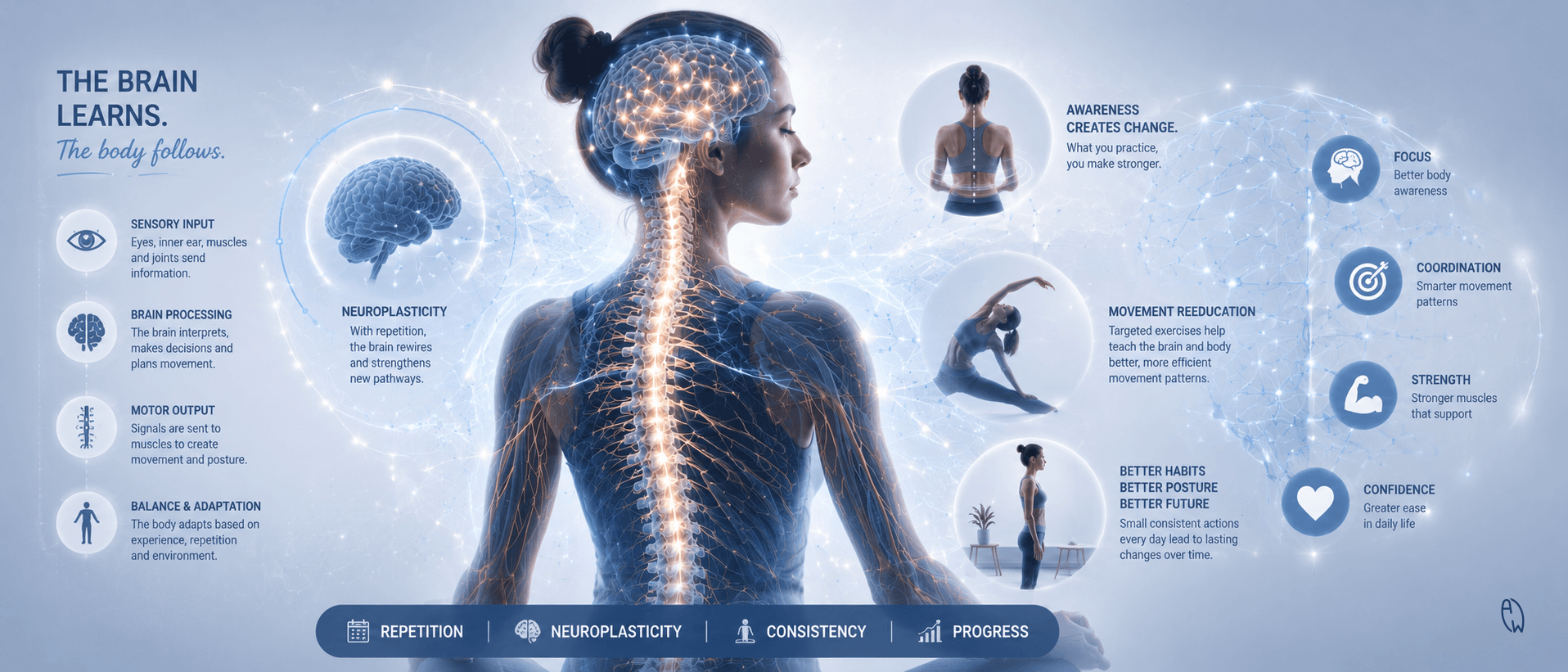
Part 4: The Brain Behind the Spine — How Proprioception and Neuroplasticity Shape the Way We Move
When most people look at an X-ray of scoliosis, they naturally focus on the curve.
The angle.
The rotation.
The shape of the spine.
And this makes sense.
The spine is what we can see.
But one of the most fascinating areas of modern scoliosis research asks a deeper question:
What controls the spine?
Because your spine does not hold itself upright alone.
Your posture is not controlled by bones alone.
Every second of every day, your brain is receiving information, making calculations, and sending instructions to help your body balance against gravity.
You do not consciously think:
"Activate this muscle."
"Shift this joint."
"Adjust my balance."
Your nervous system does it automatically.
Your posture is not just a position.
It is a learned behaviour.
Your Brain Creates a Map of Your Body
Close your eyes.
Without looking, can you touch your nose?
Can you tell whether your knee is bent or straight?
Can you sense where your feet are on the ground?
You can do this because your brain has something remarkable:
A body map.
Scientists call this ability proprioception.
Proprioception is your body's internal GPS.
It allows your brain to understand:
-
Where your body is.
-
How your joints are positioned.
-
How much your muscles are stretching.
-
How much force you need.
-
How to stay balanced.
Your muscles, joints, and connective tissues contain millions of tiny sensors constantly sending information back to your brain.
Your brain receives the information.
Interprets it.
Then decides how your body should respond.
This happens thousands of times every day without you noticing.
What Happens When the Body Map Changes?
Imagine driving with a GPS that is slightly inaccurate.
The GPS still works.
It still gives directions.
But small errors repeated over time can slowly move you away from where you intended to go.
Your body's internal GPS works similarly.
If the brain receives altered information from muscles, joints, or balance systems, it may create movement patterns based on that information.
The body adapts.
Because that is what it is designed to do.
Sometimes adaptation helps us.
Sometimes adaptation becomes compensation.
For example:
If one area of the body feels unstable, another area may tighten to provide support.
If one movement pattern is repeated thousands of times, the brain may make that pattern automatic.
The body is always trying to protect you.
But protection is not always the same as optimal function.
Scoliosis and the Sensory System
Researchers studying scoliosis have investigated differences in several sensory systems, including:
-
Proprioception (body position awareness).
-
Vestibular function (balance system inside the inner ear).
-
Visual processing.
-
Muscle activation patterns.
These systems work together to answer one simple question:
"Where is my body in space?"
When you stand upright, your brain combines information from:
Your eyes.
Your inner ears.
Your muscles.
Your joints.
Your feet.
Then it creates your posture.
This is why two people with the same Cobb angle on an X-ray may feel completely different.
One person may have pain.
Another may have none.
One may feel balanced.
Another may feel twisted.
The X-ray shows the structure.
But it does not show the entire conversation happening between the brain and body.
Your Brain Learns Through Repetition
Think about learning to ride a bicycle.
The first time, everything feels difficult.
You wobble.
You overcorrect.
You think about every movement.
Then something changes.
After enough practice, riding becomes automatic.
You no longer think:
"Balance now."
"Move this muscle."
"Adjust my posture."
Your brain learned.
This ability is called neuroplasticity.
Neuroplasticity is the brain's ability to change, adapt, and create new pathways based on experience.
It is how we learn:
-
Sports.
-
Musical instruments.
-
Languages.
-
New movements.
It is also how we develop habits.
Including posture habits.
Posture Is Something Your Brain Practices Every Day
Many people think posture is about reminding yourself:
"Stand straight."
"Pull your shoulders back."
"Don't slouch."
But posture is much deeper than that.
Posture is a habit your nervous system has practised thousands of times.
The way you:
Sit at school.
Look at your phone.
Carry your bag.
Stand while waiting.
Exercise.
Sleep.
All of these send messages to your brain.
Repeated enough times, the brain says:
"This must be normal."
And it becomes automatic.
Why Awareness Comes Before Correction
At All Well, one of the most important things we teach is awareness.
Not perfection.
Awareness.
Because your brain cannot change something it does not recognise.
Imagine someone telling you:
"Stop leaning."
But to you, you feel straight.
Your brain believes your current position is normal.
This is why scoliosis rehabilitation often involves retraining perception.
The goal is not only:
Move differently.
The goal is:
Recognise differently.
Feel differently.
Control differently.
Rehabilitation Is Teaching, Not Just Training
Traditional thinking often focuses only on strength.
"If something is weak, make it stronger."
Strength is important.
Muscles matter.
But strength without awareness is incomplete.
You can strengthen a movement pattern that your brain still controls incorrectly.
This is why scoliosis-specific rehabilitation focuses on:
-
Body awareness.
-
Breathing.
-
Balance.
-
Muscle activation.
-
Postural correction.
-
Repetition.
The purpose is not simply exercising for one hour.
The purpose is helping the brain learn a pattern that carries into the other 23 hours of the day.
Why Consistency Matters
The brain changes through repetition.
Not intensity alone.
A pianist does not become skilled by practising once for eight hours.
A dancer does not develop coordination from one lesson.
An athlete does not build muscle memory from one training session.
They improve because they repeat.
Again.
And again.
And again.
The nervous system learns through consistency.
Scoliosis rehabilitation follows the same principle.
Each correction.
Each exercise.
Each moment of awareness.
Each time you choose a better position.
You are giving your brain another opportunity to learn.
The Body Follows What the Brain Accepts as Normal
One of the most powerful things about the human body is also one of the most challenging:
We adapt.
If we repeatedly practise compensation, compensation becomes familiar.
If we repeatedly practise better movement, better movement can become more familiar too.
This does not happen overnight.
The body needs time.
The brain needs repetition.
The nervous system needs trust.
Adaptation is a process.
Looking Beyond the Curve
This is why scoliosis care should not only ask:
"What is the Cobb angle?"
It should also ask:
How does this person move?
How does their body balance?
How do their muscles activate?
How does their brain perceive posture?
How do they function in daily life?
Because we are not treating an X-ray.
We are working with a person.
The Lesson of Neuroplasticity
The most hopeful lesson from neuroscience is that the body continues learning.
At any age.
Your brain is listening.
Your muscles are responding.
Your habits are being reinforced.
Every day, you are teaching your body something.
The question is:
What are you teaching it to remember?
Looking Ahead
We have now connected:
Genes — the blueprint.
Growth — the construction phase.
Hormones and nutrition — the building environment.
The brain — the control centre.
The final question becomes:
What do we do with this knowledge?
If the body adapts to what we repeatedly do, how can daily choices influence the environment we create?
In the next section, we will explore lifestyle, exercise, nutrition, sleep, posture awareness, and why small consistent actions matter in the long journey of scoliosis care.