Severe Adult Scoliosis Case Study: When a ScoliBrace™ Achieves More Than We Expected
72° to 58°: A Story of Severe Scoliosis, Determination, and Brotherhood
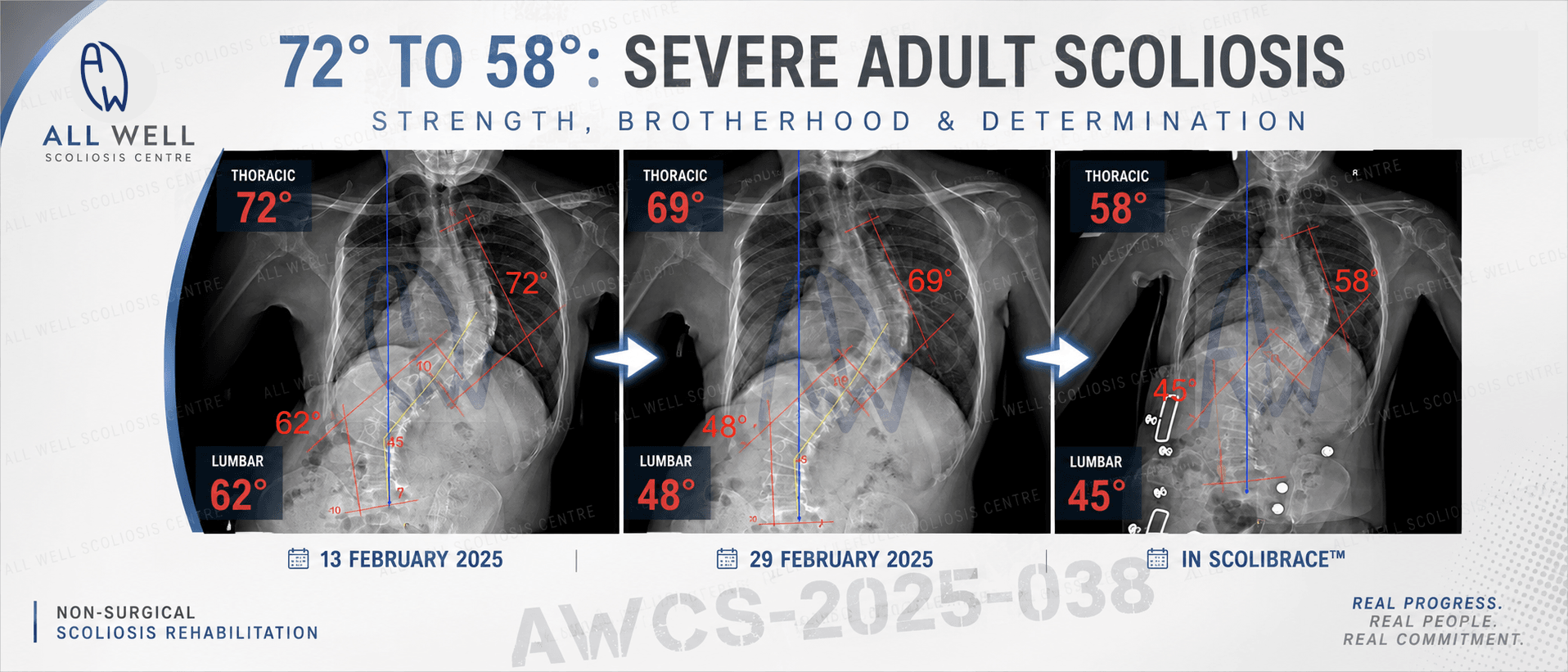
When this patient first arrived at All Well Scoliosis Centre, his X-rays showed a severe scoliosis measuring 72° in the thoracic spine and 62° in the lumbar spine.
At 38 years old, he had already spent years adapting to a body that was gradually becoming more difficult to support. Walking was challenging. His muscles were weak. His body fatigued easily. Sitting for long periods caused his trunk to collapse further under gravity, increasing pressure on his heart, stomach, and internal organs.
Surprisingly, he was not in pain.
His breathing remained good.
His biggest challenge was weakness.
The question was no longer whether the scoliosis existed. The question was how much function he could maintain and whether we could help him continue living independently and contributing to the work he loved.
Diagnosis: Severe Adult Scoliosis with Progressive Postural Collapse
Patient Profile
-
Age: 38 years old
-
Diagnosis: Severe adult scoliosis
-
Initial Cobb Angles:
-
Thoracic scoliosis: 72°
-
Lumbar scoliosis: 62°
-
-
Primary symptoms:
-
Significant muscle weakness
-
Difficulty walking long distances
-
Progressive postural collapse when sitting
-
Reduced physical endurance
-
-
No significant pain
-
Breathing function remained stable
Unlike many severe scoliosis cases, surgery was not considered an appropriate option due to other underlying idiopathic medical conditions.
As a result, non-surgical scoliosis management became the primary pathway forward.
When Prescribing a Brace Is Not Just About "Pushing"
One of the biggest misconceptions about scoliosis bracing is that the brace simply pushes the spine straight.
That is not how modern corrective bracing works.
A ScoliBrace™ is designed to improve spinal balance, reduce abnormal loading, support weakened structures, and create an environment where rehabilitation exercises can be more effective.
For severe scoliosis cases, the objective is often not perfection.
The objective is function.
Can the patient sit longer?
Can the patient work more comfortably?
Can the body resist further collapse?
Can we improve quality of life?
These are often the questions that matter most.
When we first reviewed this case, we had honest discussions with the patient about expectations.
The severity of the deformity meant that dramatic correction was unlikely.
The amount of muscle weakness presented another challenge.
We wanted him to understand both the possibilities and the limitations.
Yet the numbers would eventually surprise us.
Intensive Rehabilitation: A Difficult Journey
This was not an easy case.
The patient's body was significantly deconditioned.
Adding another layer of complexity, he followed strict dietary restrictions that prevented him from consuming animal protein.
Muscle recovery and rehabilitation depend heavily on adequate nutrition. Building strength is difficult under the best circumstances. It becomes even more challenging when protein sources are limited.
There are moments in healthcare when every tool available should theoretically help, yet progress remains uncertain.
This felt like one of those moments.
Yet he continued.
Day after day.
Session after session.
He completed the intensive program despite the physical challenges that would have discouraged many others.
The Brotherhood We Will Never Forget
Behind every successful rehabilitation journey is often a support system that few people ever see.
For this patient, that support came in the form of his brother.
When he enrolled in our intensive scoliosis program, his brother travelled from India to Singapore to ensure he would not have to face the journey alone. What began as a family member accompanying a loved one soon became one of the most remarkable examples of brotherhood our team has ever witnessed.
Throughout the program, his brother was by his side every day—encouraging him, supporting him, and helping him navigate the many challenges that severe scoliosis and profound muscle weakness created.
There were days when stiffness and fatigue made even short walks difficult. His body simply would not cooperate. On those days, his brother stepped in without hesitation. Sometimes he supported him arm in arm. Sometimes he helped him move from one place to another. And when walking became nearly impossible, he quite literally carried him on his back.
Not because it was convenient.
Not because it was easy.
But because it was necessary.
Because family does not always measure the distance—it simply carries the weight.
As healthcare providers, we spend much of our time discussing Cobb angles, rehabilitation protocols, corrective bracing, and treatment outcomes. Yet this family reminded us that some of the most important factors in recovery cannot be measured on an X-ray.
Love.
Commitment.
Sacrifice.
The willingness to put your own life on hold, travel across countries, and stand beside someone through one of the most difficult chapters of their life.
In all our years of treating scoliosis patients, few stories have demonstrated the power of brotherhood as profoundly as theirs.
This patient's progress was not achieved by determination alone. It was supported by a brother who refused to let him face the journey by himself.
Their story reminded us that while rehabilitation focuses on strengthening the body, it is often the strength of the people around us that helps carry us forward.
X-Ray Results
Initial X-Ray
13 February 2025
-
Thoracic curve: 72°
-
Lumbar curve: 62°
The spine demonstrated severe structural deformity with significant postural imbalance.
Post-Intensive X-Ray
29 February 2025
-
Thoracic curve improved from 72° to 69°
-
Lumbar curve improved from 62° to 48°
Early improvements suggested that the spine retained some capacity for correction despite its severity.
In ScoliBrace™
The in-brace X-ray demonstrated:
-
Thoracic curve reduced to 58°
-
Lumbar curve reduced to 45°
For a severe adult scoliosis case of this magnitude, these findings were encouraging.
The brace was not merely pushing the spine.
It was helping support a body that no longer had sufficient muscular strength to support itself efficiently.
A Brilliant Mind Trapped in a Struggling Body
What impacted our team most was not the X-ray.
It was the person behind it.
Despite his physical limitations, his mind remained sharp.
He continued to work in technology and remained passionate about contributing his skills and knowledge.
He understood the challenges ahead.
He understood that progress would be difficult.
Yet he continued because he still had more to give.
Sometimes as clinicians we meet people whose bodies are failing them while their ambitions remain fully alive.
Those moments remind us that scoliosis is not simply a spinal condition.
It affects careers.
Families.
Dreams.
Independence.
Identity.
What This Case Teaches Us About Severe Scoliosis
This case is not about achieving a perfect spine.
It is about preserving function.
It is about helping someone sit longer without collapsing.
It is about supporting a weakened body while rehabilitation continues.
It is about maintaining independence.
And most importantly, it is about commitment.
Over the past few weeks, we have shared several scoliosis case studies.
We are not sharing them to compare one patient with another.
Every scoliosis journey is unique.
What we consistently see, however, is a common trait among patients who make meaningful progress:
Commitment.
The willingness to show up.
The willingness to keep going.
The willingness to trust the process even when the outcome is uncertain.
This patient had that commitment.
His brother had that commitment.
And we are grateful they trusted us with their care.
A Message to Anyone Living With Severe Scoliosis
If you are living with severe scoliosis and feel overwhelmed by your diagnosis, know that you are not alone.
Many patients who walk through our doors arrive carrying years of frustration, uncertainty, and fear.
Not every case will achieve the same result.
Not every spine will respond the same way.
But meaningful progress is often still possible.
Sometimes the first step is not making the spine perfect.
Sometimes the first step is simply helping someone stand a little taller, sit a little longer, and continue living the life they want to live.
And sometimes, that is a victory worth celebrating.