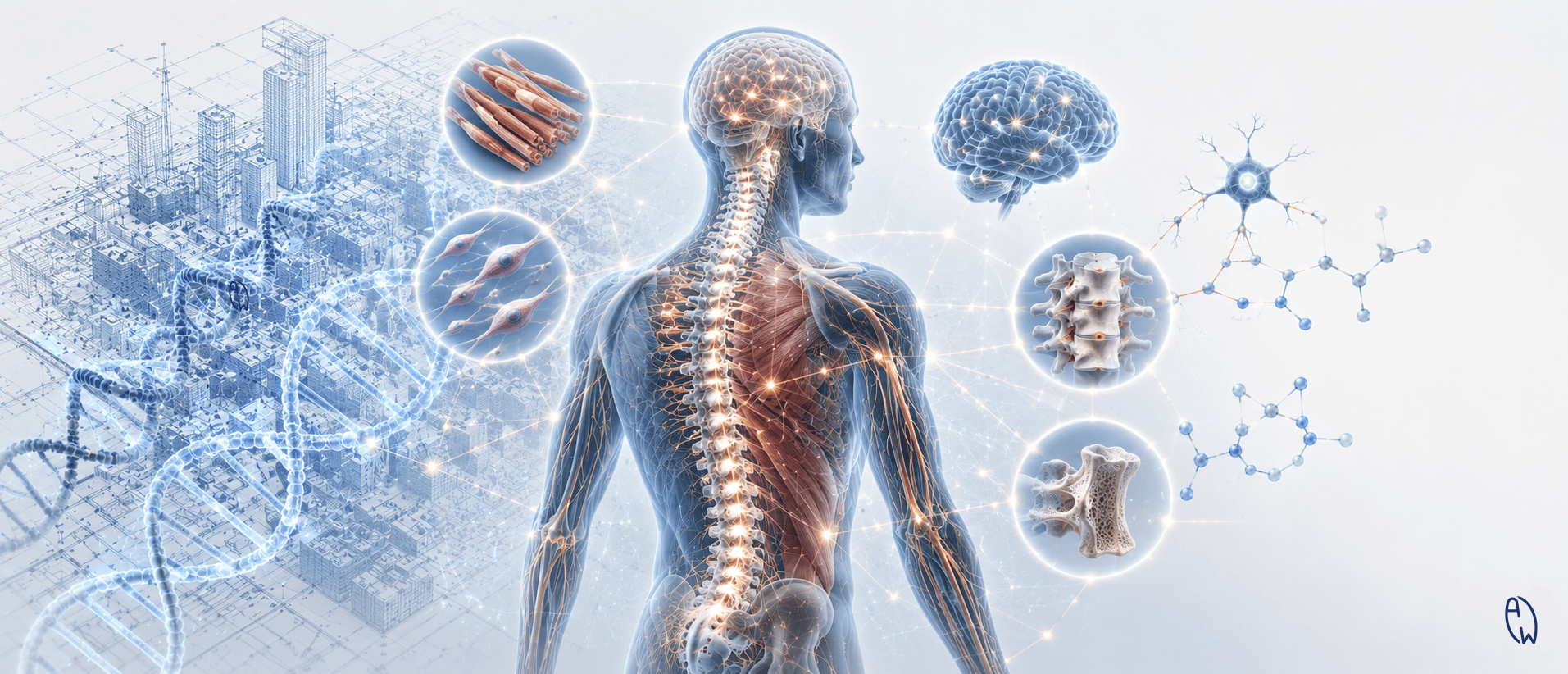
Part 2: The Four Genes That Help Shape the Spine
In the first part of this article, we explored an important idea:
Your genes are the blueprint—but they are not your destiny.
Scientists now know that scoliosis is not caused by a single faulty gene. Instead, it is influenced by many genes working together with growth, hormones, the nervous system, muscles, and the environment. This helps explain why two children from the same family can inherit similar genetic traits yet experience very different outcomes. One may never develop scoliosis, while another develops a curve that progresses rapidly during adolescence.
But what exactly are these genes doing?
Are they building the spine?
Controlling the muscles?
Directing the brain?
The answer is all of the above.
Imagine Building an Entire City
Before the first road is paved or the first building is constructed, a city needs planners.
Someone must decide:
-
Where the roads will go.
-
How bridges will connect.
-
Where electricity will run.
-
Which neighbourhoods will be built first.
-
How everything will communicate with one another.
Your developing body works in a remarkably similar way.
Long before you are born, specialised genes begin directing where muscles should form, how vertebrae should develop, how nerves should connect, and how different parts of your body communicate with one another.
These genes are not builders themselves.
They are master planners.
If one planner gives slightly different instructions, the city can still function beautifully. However, when the city experiences rapid growth, those small differences may become more noticeable.
Researchers believe something similar may occur in scoliosis.
The developing spine is not built by one gene. It is coordinated by hundreds of genes working together in extraordinary harmony.
Among them, four genes consistently appear in scoliosis research:
-
LBX1
-
PAX3
-
PAX1
-
TBX1
Each plays a different role.
Each contributes a small piece of a much larger puzzle.
LBX1: Helping Build the Muscles That Support the Spine
Of all the genes studied in Adolescent Idiopathic Scoliosis, LBX1 (Ladybird Homeobox 1) has become the most consistently associated with the condition.
Researchers have found variations in LBX1 in many different populations around the world, making it one of the strongest genetic markers linked to scoliosis susceptibility.
But what does LBX1 actually do?
LBX1 is responsible for guiding muscle precursor cells during early development.
Imagine constructing a suspension bridge.
The steel cables must be placed in exactly the right positions before the bridge can support weight. If one cable develops slightly differently, the bridge may still stand—but over time, the forces acting on it become less evenly distributed.
The deep muscles surrounding your spine function in much the same way.
They are constantly making tiny adjustments to keep your body balanced while you sit, walk, run, or simply stand still.
LBX1 helps direct how these muscles develop and where they migrate during embryonic growth. It also contributes to the development of sensory nerve pathways that help the brain understand where the body is in space—a process known as proprioception, which we will explore later in this article.
Interestingly, researchers have also discovered that LBX1 appears to influence energy metabolism within the paraspinal muscles. In other words, it may affect how efficiently these muscles produce and use energy throughout the day.
Some studies have observed differences in muscle composition and endurance in individuals with scoliosis. Whether these changes are a cause of scoliosis or a response to the spinal curve remains an area of active research, but they remind us that scoliosis involves much more than bones alone.
PAX3: The Gene That Directs the Builders
If LBX1 is the construction crew, then PAX3 (Paired Box 3) is the site manager.
PAX3 becomes active very early during embryonic development.
Its role is to organise the migration of immature muscle cells and ensure they arrive at the correct locations throughout the body.
Perhaps even more importantly, PAX3 is required for normal LBX1 activity.
Without appropriate signalling from PAX3, LBX1 cannot carry out its work effectively.
This relationship demonstrates something fascinating about genetics.
Genes rarely work in isolation.
Instead, they communicate continuously with one another, forming complex biological networks rather than simple cause-and-effect relationships.
Researchers believe variations affecting the PAX3-LBX1 pathway may influence:
-
Muscle symmetry.
-
Neuromuscular coordination.
-
Postural stability.
-
Communication between muscles and the nervous system.
This is one reason why many researchers now describe scoliosis as a condition involving neuromuscular development, not simply spinal alignment.
PAX1: Building the Spine's Foundation
PAX1 is often confused with PAX3 because they belong to the same family of developmental genes.
However, they perform very different jobs.
While PAX3 focuses largely on muscles, PAX1 helps shape the spine itself.
During fetal development, PAX1 contributes to:
-
Formation of the vertebrae.
-
Development of cartilage.
-
Growth of intervertebral discs.
-
Organisation of spinal joints.
Think of PAX1 as the structural engineer responsible for designing the framework of a building.
If that framework develops with subtle differences, the building may still function normally, but it could respond differently when exposed to years of mechanical loading and rapid adolescent growth.
Researchers have identified several PAX1 variants associated with increased susceptibility to scoliosis. These changes are usually far too subtle to produce obvious birth defects, yet they may influence how resilient the growing spine becomes during childhood.
TBX1: Another Piece of the Puzzle
The fourth gene frequently discussed in scoliosis research is TBX1 (T-Box Transcription Factor 1).
Like the PAX genes, TBX1 is involved in early embryonic development.
It helps regulate the formation of multiple structures within the body, including components of the skeleton.
Compared with LBX1, the evidence linking TBX1 directly to Adolescent Idiopathic Scoliosis is less consistent.
Nevertheless, TBX1 reinforces an important lesson:
The spine is built by an entire orchestra of genes, not by a single solo performer.
Every developmental gene contributes to the final result.
Some have major roles.
Others have supporting roles.
Together, they create an extraordinarily complex system.
Scientists Have Now Identified More Than One Hundred Genetic Clues
When researchers first began studying scoliosis genetics, many hoped to discover a single "scoliosis gene."
That is no longer the expectation.
Modern genome-wide association studies have identified more than one hundred susceptibility loci associated with Adolescent Idiopathic Scoliosis.
These genes influence many different biological systems, including:
-
Muscle development.
-
Bone growth.
-
Connective tissue.
-
Nervous system development.
-
Balance.
-
Cellular energy production.
-
Hormonal signalling.
-
Sensory processing.
Each individual gene contributes only a small amount.
It is the combined effect of many genes interacting together that appears to influence overall susceptibility.
This is why scientists describe scoliosis as a polygenic and multifactorial condition.
In simple terms:
Many small influences working together can become much more important than one large influence acting alone.
Genes Load the Blueprint—Life Helps Build the House
Learning about genetics often leaves families with an understandable concern.
"If my child inherited these genes, is there anything we can do?"
This is where one of the biggest misconceptions about genetics deserves to be challenged.
Genes are not permanent instructions carved into stone.
They are constantly being regulated.
Some genes become more active.
Others become less active.
Some respond to hormones.
Others respond to mechanical forces, nutrition, inflammation, sleep, or physical activity.
The science studying these changes is known as epigenetics.
Imagine owning a piano.
The piano contains all eighty-eight keys from the day you buy it.
But the music depends on which keys are played.
Your DNA provides the keys.
Life plays the music.
Researchers now understand that many biological factors—including growth, hormones, nutrition, sleep, movement, and environmental influences—can affect how genes are expressed throughout life.
This does not mean lifestyle can rewrite your DNA.
Nor does it mean exercise can erase genetic susceptibility.
What it does mean is that the body is not passive.
It is constantly responding, adapting, repairing, strengthening, learning, and remodelling itself.
This is one of the reasons we encourage our patients to think beyond their X-ray.
Your spine is part of a much larger system.
Supporting that system through healthy movement, adequate nutrition, quality sleep, regular exercise, and good body awareness may not change the genes you inherited, but it helps create an environment in which your body has the greatest opportunity to function well.
At All Well, this is an important distinction.
We do not promise that lifestyle changes will prevent scoliosis or stop every curve from progressing.
Current scientific evidence simply does not support such guarantees.
What we do believe—and what modern research increasingly supports—is that the body adapts to the environment it is given.
Our goal is to help patients create the healthiest possible environment for that adaptation to occur.
Looking Ahead
If genes provide the blueprint and epigenetics helps determine how those instructions are carried out, another question naturally follows:
Why do so many scoliosis curves appear during puberty?
Why do some curves remain stable while others suddenly progress?
The answer leads us to another remarkable chapter in the story—one involving growth spurts, hormones, bone development, and the incredible changes that occur during adolescence.