Vibration and Osteoporosis: Can a Vibration Plate Help Improve Bone Density Naturally?
Looking for a Drug-Free Way to Improve Bone Density?
Osteoporosis affects hundreds of millions of people worldwide and is one of the leading causes of fractures, disability, loss of independence, and chronic pain among older adults.
Often called the "silent disease," osteoporosis develops gradually over many years without obvious symptoms. Many people do not realize they have osteoporosis until they experience a fracture after a seemingly minor fall or injury.
For this reason, patients across the globe are searching for safe and effective ways to improve bone density and reduce fracture risk.
While osteoporosis medications may be helpful for some individuals, many patients are concerned about potential side effects. One of the most widely discussed complications is medication-related osteonecrosis of the jaw (MRONJ), a rare condition involving damage to the jawbone associated with certain osteoporosis medications.
As a result, many individuals seek natural ways to support bone health, including:
-
Calcium supplementation
-
Vitamin D optimization
-
Increased protein intake
-
Weight-bearing exercise
-
Resistance training
-
Consuming leafy green vegetables
-
Reducing excessive soda consumption
-
Avoiding smoking
-
Limiting alcohol intake
Unfortunately, some patients continue to lose bone density despite these efforts.
This has led researchers and rehabilitation specialists to investigate another promising option: Whole Body Vibration Therapy (WBV).
What Is Whole Body Vibration Therapy?
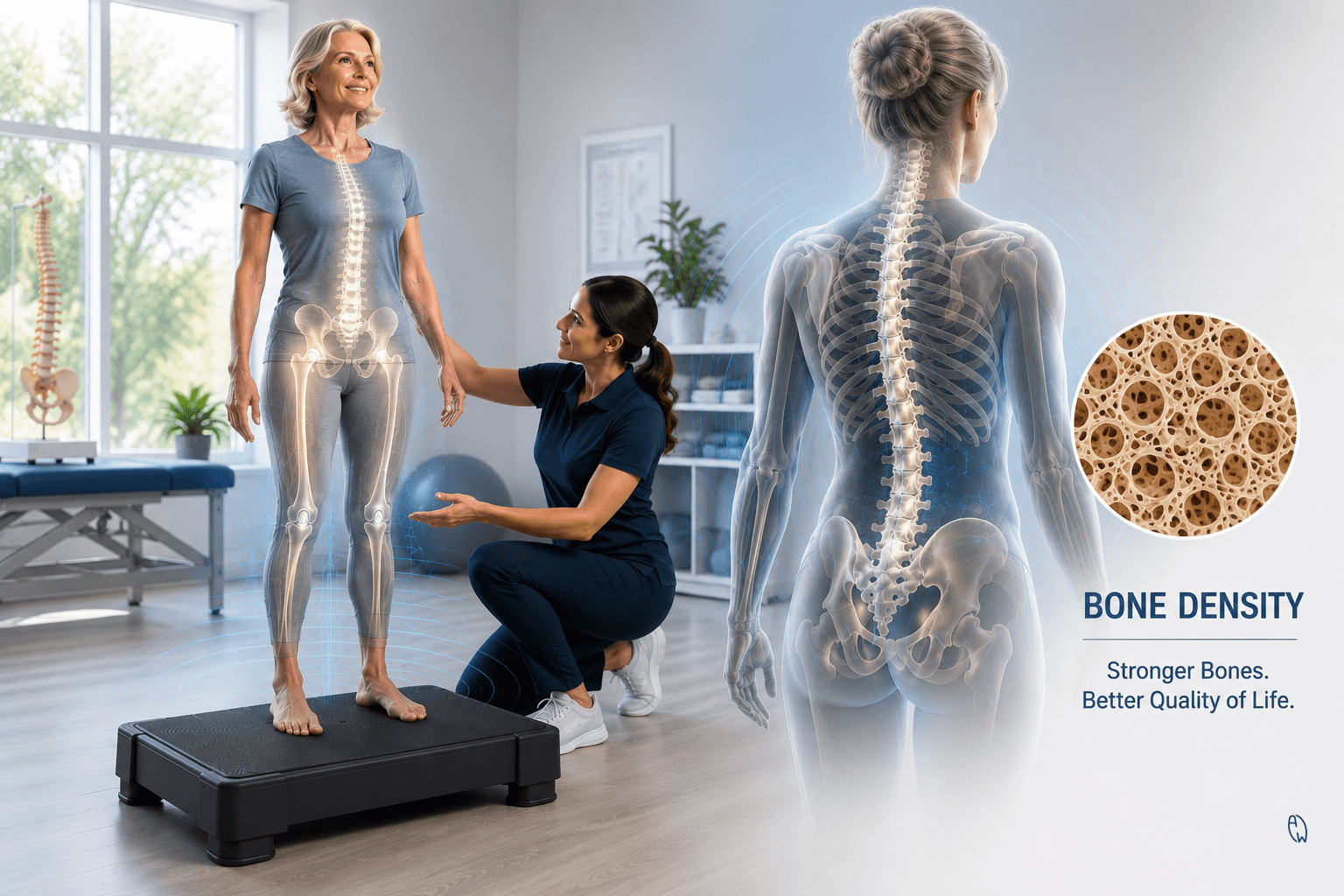
Whole Body Vibration Therapy uses a specially designed vibrating platform that produces rapid mechanical oscillations while an individual stands, sits, or performs exercises on the machine.
Although the concept appears simple, the physiological effects are surprisingly powerful.
Whole Body Vibration Therapy or WBV, which is recommended by the CLEAR Scoliosis Institute in conjunction with rehabilitation of scoliosis may also provide answers for Osteoporosis patients. WBV performed three times per week for 20 minutes has been shown to improve bone density.
When standing on the platform, the body automatically responds to the vibrations by activating muscles to maintain balance and stability. These involuntary contractions occur repeatedly and rapidly throughout the session.
Depending on the frequency used, postural muscles may contract between 20 and 50 times per second.
This creates mechanical stimulation throughout the:
-
Bones
-
Muscles
-
Tendons
-
Ligaments
-
Joints
-
Nervous system
Researchers believe these repeated mechanical signals may encourage bone remodeling while simultaneously improving strength, balance, and muscle function.
How Does Whole Body Vibration Improve Bone Density?
Bone is living tissue that continuously adapts to the demands placed upon it.
Throughout life, the body constantly breaks down old bone and replaces it with new bone through a process known as bone remodeling.
One of the strongest triggers for bone formation is mechanical loading.
This is why activities such as:
-
Walking
-
Running
-
Resistance training
-
Jumping
-
Weight-bearing exercise
can stimulate bone growth.
Whole Body Vibration provides an alternative form of mechanical stimulation.
As the platform vibrates, tiny forces travel through the skeleton while muscles repeatedly contract and relax. Researchers believe this combination may stimulate osteoblasts, the cells responsible for building bone.
Although WBV is not a replacement for exercise, it may help provide an additional stimulus for bone formation, particularly in individuals who cannot tolerate high-impact activities.
What Does the Research Say About Whole Body Vibration and Osteoporosis?
Research into Whole Body Vibration Therapy has expanded significantly over the past two decades.
Several studies have reported positive outcomes in individuals with osteopenia and osteoporosis.
Researchers have observed potential benefits including:
-
Increased bone mineral density
-
Improved muscle mass
-
Better lower limb strength
-
Improved balance
-
Enhanced postural stability
-
Reduced fall risk
-
Improved functional mobility
One case report demonstrated that a patient performing Whole Body Vibration Therapy three times per week for 20 minutes experienced improvements in bone density while also increasing lean muscle mass.
These findings are particularly important because osteoporosis is not simply a disease of weak bones.
Many osteoporosis patients also experience:
-
Muscle loss (sarcopenia)
-
Poor balance
-
Reduced coordination
-
Slower reaction times
-
Increased fall risk
In many cases, preventing falls may be just as important as increasing bone density.
Why Is 30 Hz Often Recommended?
Frequency plays an important role in Whole Body Vibration Therapy.
Research suggests that frequencies around 30 Hertz (30 Hz) may be particularly effective for stimulating musculoskeletal adaptation.
At 30 Hz, muscles contract approximately 30 times per second.
Over the course of a 20-minute session, this translates into thousands of muscle activations.
These repeated contractions may help:
-
Improve muscle recruitment
-
Enhance balance
-
Increase neuromuscular activation
-
Stimulate bone-loading forces
This may explain why many rehabilitation centers and sports performance facilities utilize frequencies around this range.
More Than Bone Health: Additional Benefits of Whole Body Vibration
1. Increased Muscle Mass
Bone and muscle function as a team.
Stronger muscles place greater forces on bones, encouraging bone maintenance and growth.
Research has demonstrated that WBV may improve:
-
Muscle activation
-
Muscle strength
-
Lean body mass
This is especially important because age-related muscle loss often occurs alongside osteoporosis.
2. Improved Balance and Reduced Fall Risk
Most osteoporosis fractures occur because of falls.
Whole Body Vibration may improve:
-
Balance
-
Proprioception
-
Coordination
-
Postural control
-
Reaction time
These improvements may reduce the likelihood of falls and related fractures.
3. Improved Circulation
The repeated muscular contractions generated during vibration therapy help increase blood flow throughout the body.
Improved circulation supports:
-
Tissue healing
-
Recovery
-
Nutrient delivery
-
Overall musculoskeletal health
4. Better Joint Function
Many patients report improvements in:
-
Mobility
-
Joint flexibility
-
Functional movement
-
General stiffness
This may be particularly valuable for older adults with arthritis or degenerative joint conditions.
Whole Body Vibration vs Walking
Walking is one of the most commonly recommended activities for osteoporosis.
It improves cardiovascular fitness, endurance, and overall health.
However, walking may not always provide enough mechanical stimulation to significantly increase bone density in individuals who already have osteoporosis.
Whole Body Vibration offers a different form of stimulation through rapid muscular activation and neuromuscular loading.
Walking and vibration therapy should not be viewed as competing treatments.
Instead, they often work best together as part of a comprehensive bone health program.
Whole Body Vibration vs Weight Training
Weight training remains one of the most effective methods for improving bone health.
Resistance exercise directly loads the skeleton and stimulates bone formation.
However, not every osteoporosis patient can safely perform heavy resistance training.
Some individuals have:
-
Vertebral compression fractures
-
Severe osteoporosis
-
Chronic pain
-
Joint replacements
-
Significant weakness or deconditioning
For these patients, Whole Body Vibration may serve as a lower-impact entry point into rehabilitation.
The ideal long-term strategy often combines vibration therapy with progressive strengthening exercises under professional supervision.
Why Many Osteoporosis Patients Tolerate WBV Better Than Traditional Exercise
Many individuals diagnosed with osteoporosis have undergone previous medical procedures or have additional musculoskeletal conditions.
These may include:
-
Hip replacements
-
Knee replacements
-
Spinal surgery
-
Degenerative scoliosis
-
Vertebral compression fractures
-
Chronic back pain
High-impact exercise can feel intimidating or physically difficult.
Because Whole Body Vibration relies largely on automatic muscular responses, many patients find it easier to tolerate than traditional exercise.
The patient is not required to jump, run, or lift heavy weights.
Simply standing on the vibration platform may provide a meaningful neuromuscular stimulus.
Whole Body Vibration and Scoliosis
Many adults with scoliosis eventually develop osteopenia or osteoporosis as they age.
Degenerative scoliosis and osteoporosis frequently occur together, creating a cycle of reduced mobility, worsening posture, muscle weakness, and increased fracture risk.
Patients with both scoliosis and osteoporosis often experience:
-
Balance deficits
-
Muscle asymmetry
-
Back pain
-
Reduced confidence with movement
-
Increased risk of falls
At All Well Scoliosis Centre, Whole Body Vibration is often incorporated alongside scoliosis-specific rehabilitation because it may help activate postural muscles, improve body awareness, and enhance neuromuscular control.
Although vibration therapy does not straighten a scoliosis curve, it may support overall strength, balance, and function as part of a comprehensive rehabilitation program.
Can Whole Body Vibration Reverse Osteoporosis?
One of the most common questions patients ask is whether vibration therapy can reverse osteoporosis.
The reality is that osteoporosis develops over many years.
No single treatment can instantly rebuild decades of lost bone.
However, Whole Body Vibration may help:
-
Slow bone loss
-
Support bone remodeling
-
Improve muscle strength
-
Improve balance
-
Reduce fall risk
-
Improve physical function
When combined with proper nutrition, exercise, and medical management, Whole Body Vibration may contribute to improved bone health over time.
Who Should Avoid Whole Body Vibration Therapy?
Although Whole Body Vibration is generally considered safe when appropriately prescribed, it may not be suitable for everyone.
Consult your healthcare provider before starting WBV if you have:
-
Recent fractures
-
Acute spinal injuries
-
Severe disc herniations
-
Pregnancy
-
Uncontrolled cardiovascular disease
-
Recent surgery
-
Active infections
-
Certain neurological conditions
An individualized assessment is always recommended.
Building Strong Bones Requires More Than One Tool
There is no magic solution for osteoporosis.
The strongest bones are built through a combination of healthy habits working together over time.
A comprehensive bone health program should include:
Nutrition
-
Adequate protein intake
-
Calcium-rich foods
-
Vitamin D optimization
-
Magnesium and trace minerals
Exercise
-
Resistance training
-
Weight-bearing activities
-
Balance exercises
-
Postural rehabilitation
Lifestyle
-
Smoking cessation
-
Limiting excessive alcohol intake
-
Maintaining a healthy body weight
-
Daily movement
Rehabilitation
-
Fall prevention programs
-
Scoliosis-specific exercise when appropriate
-
Mobility training
-
Whole Body Vibration Therapy
The future of osteoporosis management is not simply about increasing bone density. It is about preserving strength, balance, movement, independence, and quality of life.
Frequently Asked Questions
Is Whole Body Vibration Safe for Seniors?
For most healthy seniors, Whole Body Vibration is considered safe when performed under professional supervision. Individuals with medical conditions should consult their healthcare provider before beginning treatment.
How Long Should You Use a Vibration Plate for Osteoporosis?
Many studies have used sessions lasting 10 to 20 minutes, performed two to three times per week. Recommendations may vary depending on individual needs.
What Frequency Is Best for Bone Density?
Research suggests that frequencies around 30 Hz may provide favorable effects on muscle activation and bone-loading stimulation.
Can Whole Body Vibration Replace Osteoporosis Medication?
No. Whole Body Vibration should be considered a complementary therapy rather than a replacement for medical treatment unless advised by a physician.
Can Whole Body Vibration Help Prevent Falls?
Potentially yes. Research suggests improvements in balance, strength, coordination, and postural control, all of which may contribute to reduced fall risk.
Final Thoughts
Whole Body Vibration Therapy represents a promising, non-pharmaceutical approach for individuals seeking to support bone density, improve muscle strength, and reduce fall risk.
While it is not a miracle cure and should not replace medical care, research suggests it may play a valuable role within a comprehensive osteoporosis management program.
For many individuals, stronger bones are only part of the goal.
The ultimate objective is maintaining the ability to move confidently, stay independent, prevent fractures, and enjoy a higher quality of life for years to come.