Why Do Active Adults With Scoliosis Keep Getting Injured?
How a 43-Year-Old Mother from Hong Kong Learned That Adult Scoliosis Is About Much More Than a Curve
For most of her life, Janis never considered herself a typical scoliosis patient.
She was active.
She enjoyed sports.
She exercised regularly.
She believed movement was one of the best investments she could make for her health.
Yet despite her active lifestyle, there was one frustrating pattern she could never seem to escape.
No matter what activity she did, she always seemed to get injured.
A sore shoulder.
A strained back.
Neck tension.
Hip discomfort.
Persistent muscle tightness.
Every time she felt like she was making progress, another injury would appear.
For years, she assumed this was simply part of getting older.
But deep down, she knew something wasn't right.
When Motherhood Made Everything More Noticeable
Like many women with scoliosis, her symptoms became more obvious after the birth of her two children.
The physical demands of motherhood exposed weaknesses that had likely been building for years.
Carrying children.
Lifting strollers.
Travelling.
Managing family responsibilities.
Running after growing kids.
Activities that once felt effortless suddenly required more energy and recovery.
The soreness lasted longer.
The injuries happened more often.
And for the first time, she began thinking seriously about her future.
Not because she wanted a straighter spine.
But because her children still needed her.
She wanted to be able to travel with them.
Play with them.
Carry her own luggage.
Stay active and independent as they grew older.
Her goal was never perfection.
Her goal was to remain present for her family.
Searching for Better Adult Scoliosis Treatment
After relocating from Hong Kong to Singapore, she decided it was finally time to understand the real reason behind her recurring injuries and daily discomfort.
Like many adults with scoliosis, she had already tried several approaches.
One of them was the Schroth Method.
The exercises helped.
She became more aware of her posture.
She experienced symptom relief.
She learned valuable breathing techniques.
But something still felt missing.
As she described it:
"I felt better, but I didn't feel stronger."
That distinction became incredibly important.
Pain relief is valuable.
But feeling capable, resilient, and confident in your body is something entirely different.
What she wanted was not simply less pain.
She wanted a body she could trust again.
Coming In With Low Expectations
When Janis first arrived at our clinic, she was realistic.
At 43 years old, she knew she was no longer an adolescent.
She understood that many people believe scoliosis can only be addressed during growth.
She wasn't expecting a miracle.
She wasn't expecting a perfectly straight spine.
Her goal was simple.
If she could wake up without feeling sore every day and reduce her risk of injury, she would already consider the program a success.
What she didn't expect was that the biggest change would not be her X-ray.
It would be her understanding.
The Problem Wasn't That She Was Weak
One of the first discoveries we made together was that strength was not her biggest problem.
In many ways, she was already strong.
The challenge was that her body had spent decades adapting to a three-dimensional spinal deformity.
Like many active adults with scoliosis, she had unknowingly developed compensation patterns that influenced almost every movement she performed.
Every lift.
Every reach.
Every pull.
Every workout.
Every step.
Her body wasn't simply moving.
It was compensating.
And over time, those compensations were contributing to recurring pain, muscle fatigue, and injury.
Why Active Adults With Scoliosis Often Keep Getting Injured
Many people assume scoliosis is only a posture problem.
In reality, scoliosis affects how force travels through the entire body.
When the spine rotates, the rib cage rotates.
When the rib cage rotates, breathing mechanics change.
When breathing changes, core stability changes.
When stability changes, movement patterns change.
Over time, some muscles become overworked while others become underutilized.
The body becomes highly efficient at compensating—but not always efficiently enough to avoid injury.
This is one reason many active adults with scoliosis experience:
-
Neck pain
-
Shoulder pain
-
Hip discomfort
-
Lower back pain
-
Sports injuries
-
Muscle tightness
-
Exercise-related flare-ups
The issue is not necessarily a lack of activity.
Sometimes the issue is that the body is organizing movement around a three-dimensional spinal deformity.
The Day She Realized Scoliosis Is a 3D Condition
One of the biggest turning points in Janis' journey came when she stopped viewing scoliosis as a simple left-versus-right curve.
For years, she had focused on the visible bend in her spine.
Like many patients, she assumed scoliosis was primarily a side-to-side problem.
Then she learned that scoliosis is actually a three-dimensional condition.
The spine bends sideways.
The vertebrae rotate.
The rib cage twists.
The pelvis compensates.
The muscles adapt.
Even breathing patterns change.
Suddenly, years of frustration began making sense.
She learned that the rotational component of her thoracic curve was pulling her shoulder complex backward.
Her rib cage was asymmetrical.
Her breathing mechanics had adapted around decades of spinal rotation.
For the first time, she understood why her body constantly felt like it was working harder than it should.
Learning to Breathe Into the Space She Had Lost
One of the most important skills she developed during her program was three-dimensional breathing.
Because of the rotational component of her scoliosis, parts of her rib cage had become compressed over time.
Instead of simply taking deeper breaths, she learned how to expand areas that had gradually lost mobility.
She learned how to:
-
Expand her left rib cage
-
Improve mobility in the concave side
-
Increase thoracic expansion
-
Improve trunk stability
-
Direct intra-abdominal pressure into underutilized areas
Breathing became more than a respiratory exercise.
It became part of her scoliosis correction strategy.
For the first time, she could actively influence the shape and function of her trunk from the inside.
Learning How to Use Correction in Everyday Life
Perhaps the most valuable lesson was understanding that scoliosis correction does not stop when therapy ends.
It happens throughout the day.
She learned that the apex of her lumbar curve rotated toward the left.
Therefore, many of her corrective strategies required movement and stabilization in the opposite direction.
She learned how to apply this understanding during:
-
Lifting
-
Carrying
-
Pulling
-
Reaching
-
Exercise
-
Household activities
She learned when to activate muscles.
She learned how to manage her rib hump.
She learned how to protract and stabilize specific areas during movement.
Most importantly, she learned how to recognize when her body was slipping back into old compensation patterns.
For the first time, she felt like she could influence her own biomechanics.
Instead of reacting to her scoliosis, she was learning how to work with it.
Building Strength in Every Direction
One of the biggest differences in her rehabilitation program was that we did not focus solely on strengthening one side of the body.
While strengthening the concave side remains important, scoliosis affects the body in far more ways than left and right.
We focused on:
-
Left and right balance
-
Anterior chain strength
-
Posterior chain endurance
-
Rotational control
-
Core stability
-
Breathing mechanics
-
Functional movement integration
The goal was not simply to strengthen a curve.
The goal was to create a stronger, more resilient body capable of supporting the spine throughout daily life.
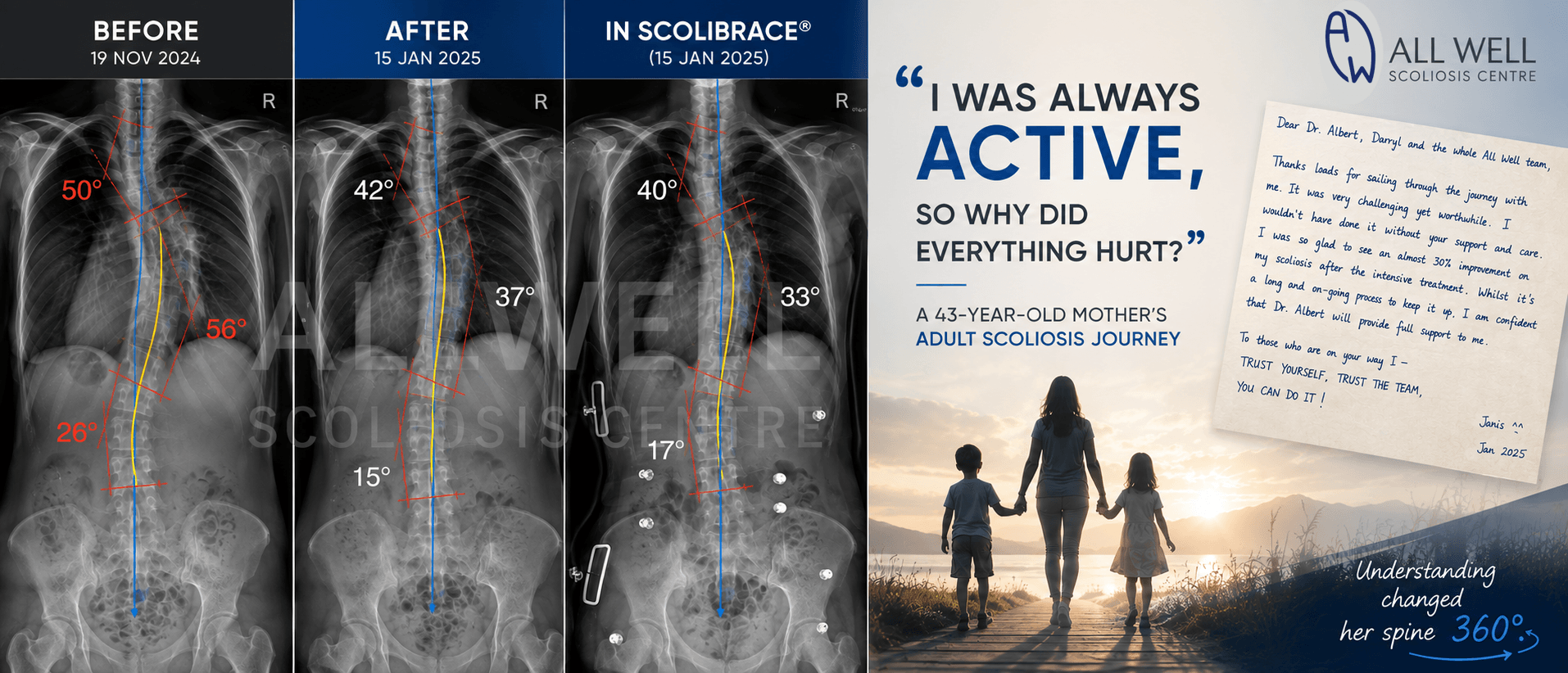
Her Adult Scoliosis X-Ray Results
November 2024
-
Thoracic Curve: 50°
-
Lumbar Curve: 56°
-
Lower Curve: 26°
January 2025
After completing her intensive rehabilitation program:
-
Thoracic Curve: 42°
-
Lumbar Curve: 37°
-
Lower Curve: 15°
In ScoliBrace®
-
Thoracic Curve: 40°
-
Lumbar Curve: 33°
-
Lower Curve: 17°
The improvements were encouraging.
But the X-rays only told part of the story.
Can Adult Scoliosis Really Improve?
One of the most common questions we hear is:
"Isn't it too late for me?"
Many adults with scoliosis have been told that once growth is complete, there is very little that can be done beyond pain management.
While adult scoliosis treatment differs from adolescent scoliosis treatment, that does not mean improvement is impossible.
Adults can still improve:
-
Posture
-
Strength
-
Balance
-
Breathing mechanics
-
Core stability
-
Body awareness
-
Movement efficiency
-
Overall quality of life
For some patients, measurable improvements in spinal alignment may also occur.
However, the goal of adult scoliosis rehabilitation is not always a perfectly straight spine.
The goal is often something far more meaningful.
A stronger body.
Better movement.
Less pain.
Greater confidence.
For Janis, success was never about chasing a perfect X-ray.
It was about understanding her body, reducing recurring injuries, and remaining active for the people who mattered most.
Her children.
The Real Victory Was Learning How to Manage Adult Scoliosis
Many patients focus entirely on Cobb angles.
Janis discovered that the biggest transformation was not measured in degrees.
It was measured in understanding.
She felt stronger.
She felt more stable.
She understood her breathing.
She understood her posture.
She understood her movement patterns.
Most importantly, she understood why her body behaved the way it did.
Instead of feeling trapped by scoliosis, she felt empowered by knowledge.
She no longer felt like a passenger.
She felt like she was finally back in the driver's seat.
A Journey That Continues
Today, Janis continues her scoliosis management journey.
She still returns approximately once a month for maintenance care and follow-up.
Not because she is chasing perfection.
But because she understands that adult scoliosis management is a lifelong process of awareness, strength, and consistency.
The difference now is that she has a roadmap.
She knows what her body needs.
She knows how to apply correction in everyday life.
And she knows how to continue moving forward.
A Message to Other Adults With Scoliosis
At the end of her intensive program, Janis left our team a handwritten note that remains one of our most treasured reminders of why we do what we do.
After seeing almost a 30% improvement in her scoliosis measurements, she wrote:
"It was very challenging yet worthwhile. I wouldn't have done it without your support and care."
She ended her note with a message for future patients:
"Trust Yourself. Trust The Team. You Can Do It."
For adults living with scoliosis, that may be the most important lesson of all.
Because scoliosis is not simply about the curve.
It is about understanding your body.
Building strength.
Improving function.
Protecting your future.
And creating the confidence to keep showing up for the people who need you most.
Your family.
Your children.
And yourself.