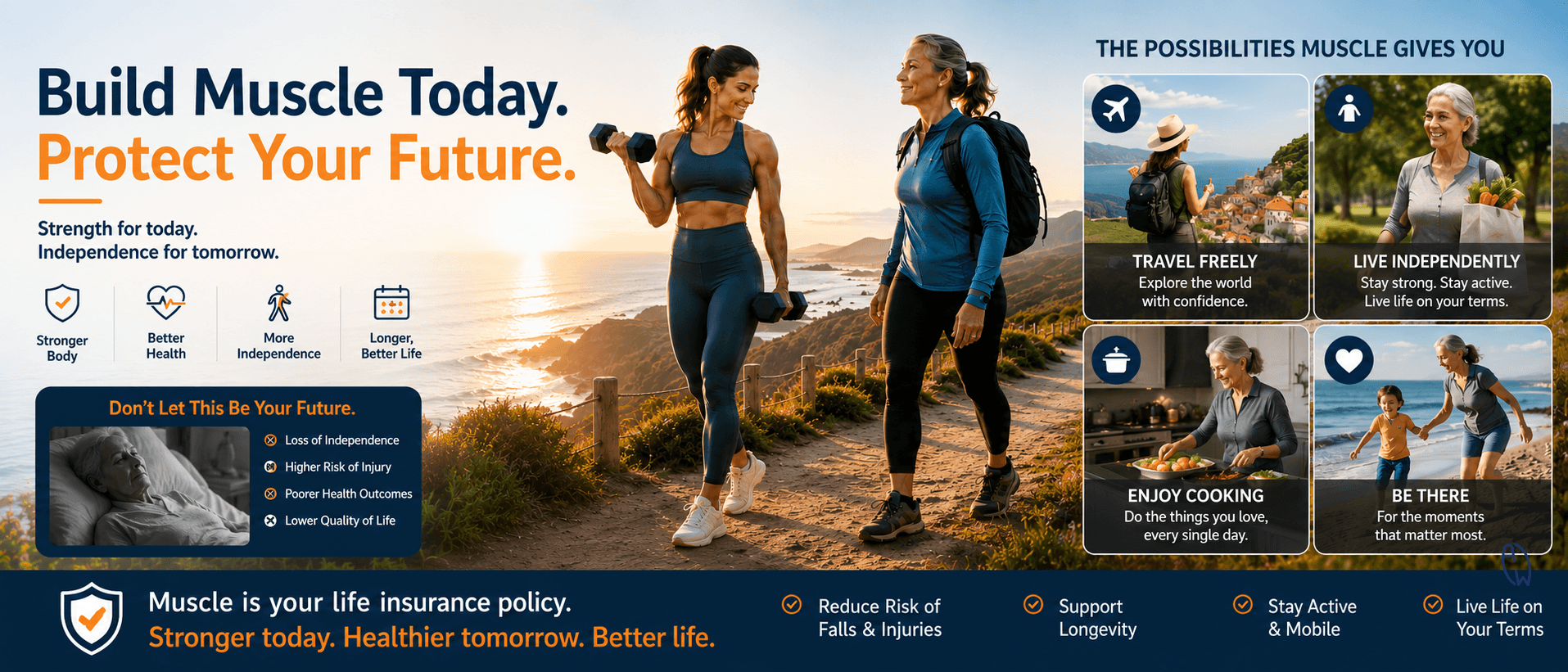
Why Muscle Mass Is Your Best Life Insurance Policy for Longevity and Healthy Aging
When people think about living longer, they often focus on supplements, diets, or the latest health trends. While those can play a role, one of the most powerful predictors of healthy aging is something much simpler:
Muscle mass.
Think of muscle as your body's life insurance policy.
The muscle you build today may be the reason you remain independent, active, and resilient decades from now. It can help you recover from illness, maintain mobility, reduce your risk of falls, and continue doing the things you love throughout life.
Muscle Is Your Reserve for Life's Unexpected Challenges
No one plans to get injured, undergo surgery, or experience a period of illness.
Life happens.
As we age, accidents, illnesses, and periods of inactivity become more common. During these times, the body naturally loses muscle mass and strength.
If you've spent years building and maintaining muscle, you have a larger reserve to draw from. This reserve can help support recovery, maintain mobility, and reduce the likelihood of becoming frail.
In many ways, muscle acts like a savings account. The more you invest early, the more resources you have when challenges arise.
Why Women Should Pay Special Attention to Muscle Loss
Women are particularly vulnerable to age-related muscle loss, also known as sarcopenia.
Hormonal changes during and after menopause can accelerate the decline in muscle mass and strength. Without regular resistance training, many women experience:
-
Reduced strength
-
Poor balance
-
Increased fall risk
-
Loss of independence
-
Difficulty performing daily activities
Building muscle before these changes occur can make a significant difference later in life.
The earlier you start, the more resilient your body becomes.
Strong Legs Keep You Independent
When we talk about longevity, we're not just talking about living longer.
We're talking about maintaining the ability to live well.
Your legs are responsible for carrying you through life. Every time you stand up from a chair, climb stairs, walk through an airport, or carry groceries, you're relying on lower-body strength.
Your femur—the largest and strongest bone in the body—needs strong muscles surrounding it to function efficiently and support your body weight.
Without adequate muscle strength, everyday tasks become increasingly difficult.
The ability to:
-
Walk independently
-
Get off the floor
-
Climb stairs
-
Carry shopping bags
-
Travel comfortably
-
Bathe yourself
-
Maintain balance
all depend heavily on muscular strength and endurance.
Strength Training Is One of the Best Investments in Your Future Health
Regular strength training doesn't just build bigger muscles.
Research consistently shows that maintaining muscle mass and strength is associated with better health outcomes throughout life.
Strength training may help:
-
Improve blood sugar regulation
-
Support cardiovascular health
-
Improve bone density
-
Reduce fall risk
-
Improve balance and coordination
-
Enhance mobility
-
Support healthy body composition
-
Improve quality of life as you age
Studies have also found that higher levels of muscular strength are associated with lower rates of all-cause mortality.
In simple terms:
People who maintain their strength tend to age better and often live healthier, more active lives.
Functional Strength Looks Different for Everyone
Many people hear the term "functional training" and immediately picture complicated exercises balancing on unstable surfaces.
The truth is much simpler.
Functional strength is task-specific.
What's functional for one person may not be functional for another.
A parent carrying a child has different demands than a chef working long hours in a kitchen.
A golfer has different needs than a frequent traveler.
The real question is:
What movements matter most in your daily life?
For some people, functional strength means:
-
Carrying groceries
-
Lifting luggage into an overhead compartment
-
Playing with grandchildren
-
Gardening
-
Cleaning the house
-
Standing for long hours at work
-
Walking long distances while traveling
Your exercise program doesn't need to look fancy.
It simply needs to make you stronger at the things that matter most to you.
Muscle Helps You Burn More Calories—Even at Rest
One reason many people struggle with weight management is that they focus only on calorie restriction.
Muscle changes the equation.
Muscle tissue is metabolically active, meaning it requires energy to maintain.
The more lean muscle mass you carry, the higher your resting energy expenditure tends to be.
In other words:
Muscle helps your body burn calories even when you're not exercising.
This is especially important for people who enjoy food and travel.
Personally, I love exploring different cuisines when I travel. Building and maintaining muscle allows me to enjoy food while supporting a healthier metabolism.
Exercise Improves More Than Gym Performance
Many people think exercise only burns calories during a workout.
But one of the biggest benefits is what happens outside the gym.
Regular exercise often improves energy levels, endurance, and overall movement capacity.
As a result, many people naturally become more active throughout the day.
This increases:
Exercise Activity Thermogenesis (EAT)
The calories burned during structured exercise.
Non-Exercise Activity Thermogenesis (NEAT)
The calories burned through daily movement such as:
-
Walking
-
Standing
-
Cleaning
-
Cooking
-
Taking the stairs
-
Playing with children
For many people, NEAT contributes significantly to total daily calorie expenditure.
The stronger and more energetic you feel, the more naturally active you become.
Protein Gives Muscle an Additional Advantage
Building muscle isn't only about lifting weights.
Nutrition matters too.
Protein has the highest thermic effect of food (TEF) among the three macronutrients.
This means your body uses more energy to digest, absorb, and process protein compared to fats or carbohydrates.
A higher-protein diet can help:
-
Support muscle growth
-
Preserve muscle during weight loss
-
Increase satiety
-
Slightly increase calorie expenditure through digestion
Combined with resistance training, adequate protein intake creates a powerful foundation for long-term health.
The Bottom Line
If your goal is to live longer, move better, and remain independent as you age, building muscle should be one of your highest priorities.
Muscle is more than aesthetics.
It's protection.
It's resilience.
It's mobility.
It's freedom.
The muscle you build in your 20s, 30s, 40s, and 50s may become the reserve that helps you recover from illness, prevent falls, stay active, travel confidently, and continue doing the things you love later in life.
You don't need fancy workouts.
You don't need to become a bodybuilder.
You simply need to get stronger.
Because when it comes to longevity, muscle isn't just part of the equation.
It may be one of the best investments you'll ever make.
What If You're Starting Later in Life?
One of the biggest misconceptions about muscle mass is that if you didn't start exercising in your 20s or 30s, it's too late.
The good news?
It's not.
Research consistently shows that older adults can still build muscle, increase strength, improve balance, and enhance their quality of life through resistance training.
You may not become as muscular as someone who has trained for decades, but that's not the goal.
The goal is to become stronger than you are today.
Even modest improvements in strength can make a meaningful difference in your daily life.
Imagine being able to:
-
Get up from a chair without assistance
-
Climb stairs with confidence
-
Carry groceries without pain
-
Travel without worrying about fatigue
-
Play with your grandchildren
-
Maintain your independence longer
These are not small victories.
They are the building blocks of a fulfilling life.
The best time to build muscle was 20 years ago.
The second-best time is today.
Your body is incredibly adaptable. Whether you're 40, 60, or 80 years old, it can still respond positively to strength training when performed safely and consistently.
Every workout is an investment in your future self. Think of muscle as retirement savings for your body. The earlier you start, the more you'll have later. But even if you're starting late, every repetition, every walk, every strength session adds to your reserve. One day, when life throws you an unexpected challenge, you'll be grateful for every bit of strength you built along the way.