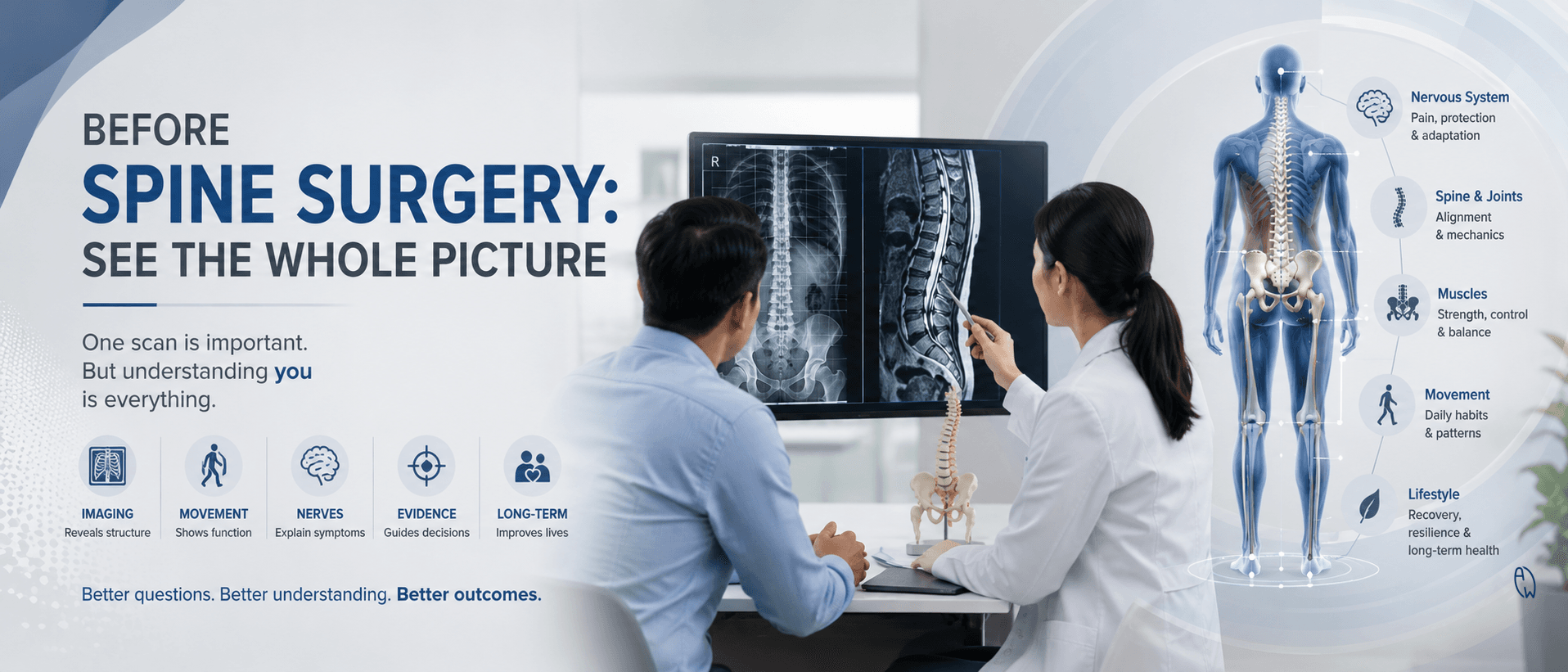
Before You Decide on Spine Surgery: Why One Scan Does Not Tell the Whole Story
The Importance of Better Clinical Reasoning and Looking at the Whole Person
A diagnosis can change someone’s life.
A few words on a report — “disc degeneration,” “spinal curve,” “nerve compression,” or “structural abnormality” — can create fear and uncertainty.
Naturally, patients ask:
“Is this serious?”
“Will it get worse?”
“Do I need surgery?”
But one of the most important lessons in healthcare is this:
A finding is not always the full story.
Imaging Shows Structure — But Humans Are More Than Images
Modern imaging has transformed healthcare.
X-rays, MRI, and advanced technology allow clinicians to see details we could never understand before.
They save lives.
They guide important decisions.
But imaging is one chapter of the story — not always the entire book.
Research has shown that many people can have findings such as disc changes, degeneration, or structural differences without symptoms.
This does not mean imaging is unimportant.
It means imaging must be interpreted together with the person.
The Risk of Treating the Picture Instead of the Patient
Every healthcare profession has blind spots.
Sometimes we become so focused on what we specialize in that we may unintentionally narrow our view.
A surgeon may naturally look for a surgical solution.
A rehabilitation specialist may focus on movement.
A therapist may focus on muscles.
This is why collaboration and clinical reasoning matter.
The question should not simply be:
“Can this structure be corrected?”
The deeper question is:
“What is driving the problem, and what gives this person the best long-term outcome?”
Surgery: Powerful When Necessary, But It Is Still a Big Decision
Spine surgery has helped many people regain quality of life.
For the right condition, at the right time, with the right patient, it can be life-changing.
But every intervention has trade-offs.
Before making an irreversible decision, patients deserve to understand:
✓ Why surgery is recommended
✓ What problem it is trying to solve
✓ What symptoms may improve
✓ What may not change
✓ Possible complications
✓ Long-term effects
✓ Available conservative options
A successful healthcare decision is not only about correcting anatomy.
It is about improving life.
Bayesian Reasoning: The Science of Updating Our Understanding
Good science is not about proving our first belief correct.
It is about being willing to update when new evidence appears.
This approach is called Bayesian reasoning.
A clinician starts with a possibility:
“Could this be the cause?”
Then continues asking:
Does the patient history support it?
Does the examination match it?
Does movement confirm it?
Does imaging explain the symptoms?
Does the body’s response over time change our understanding?
Each answer updates the picture.
The Body Is an Adaptive System
The spine does not work alone.
It communicates with:
-
Muscles
-
Fascia
-
Joints
-
Balance systems
-
The nervous system
-
Daily movement habits
Sometimes pain comes from structural damage.
Sometimes it comes from years of compensation.
Sometimes it is a combination.
The goal is not to choose between imaging or function.
The goal is to understand how they connect.
Better Questions Create Better Healthcare
Medicine should continue evolving.
Not because previous knowledge was wrong.
But because science improves when we stay curious.
The best clinicians are not the ones attached to one solution.
They are the ones willing to ask:
“What else could explain this?”
“What information are we missing?”
“What is best for this patient in the long run?”
Because behind every X-ray, MRI, and diagnosis is not just a spine.
There is a person
And that person deserves the complete picture.
Read More:
- “When Does Scoliosis Really Need Surgery?”