Can Scoliosis Cause Reversal of Cervical Lordosis? Understanding the Hidden Relationship Between Neck Alignment, Balance, and the Nervous System
The Neck Curve Many Scoliosis Patients Never Realize Has Changed
When people are diagnosed with scoliosis, most of the attention is focused on the sideways curve of the spine.
Parents often ask about Cobb angles. Adults are usually concerned about back pain, posture, or whether their curve is progressing.
However, one of the most common findings we see on X-rays at All Well Scoliosis Centre is not just scoliosis itself.
It is a loss of the natural curve in the neck.
Some patients develop a straight neck, commonly known as military neck. Others develop something more significant—a reversal of cervical lordosis, where the neck begins curving in the opposite direction from what nature intended.
What surprises many patients is that they may not initially seek help for neck problems at all.
They come in because of scoliosis, but they also experience:
-
Neck stiffness
-
Shoulder tension
-
Frequent headaches
-
Upper back tightness
-
Fatigue after studying or computer work
-
Poor posture
-
Difficulty maintaining an upright position
When their X-rays are reviewed, the cervical spine often reveals an important part of the story.
Understanding the Cervical Spine
The cervical spine consists of the first seven vertebrae of the spine, known as C1 through C7.
In a healthy spine, the neck has a gentle forward curve called cervical lordosis.
This curve is not simply a structural feature. It serves several important purposes.
It helps:
-
Support the weight of the head
-
Absorb mechanical stress
-
Protect the spinal cord
-
Maintain balance
-
Allow smooth movement
-
Reduce strain on muscles and ligaments
The neck is often described as the bridge between the brain and the body.
Every signal traveling between the brain and the rest of the body passes through the cervical spine.
When the neck loses its normal alignment, the consequences can extend far beyond the neck itself.
What Is Reversal of Cervical Lordosis?
A healthy cervical spine should form a gentle "C" shape when viewed from the side.
When that curve becomes flatter, it is known as loss of cervical lordosis or hypolordosis.
When the curve bends in the opposite direction, it is called a reversal of cervical lordosis.
Instead of helping distribute forces efficiently, the neck is now placed under abnormal stress.
This can affect:
-
Muscles
-
Ligaments
-
Intervertebral discs
-
Joints
-
Nerves
-
Overall posture
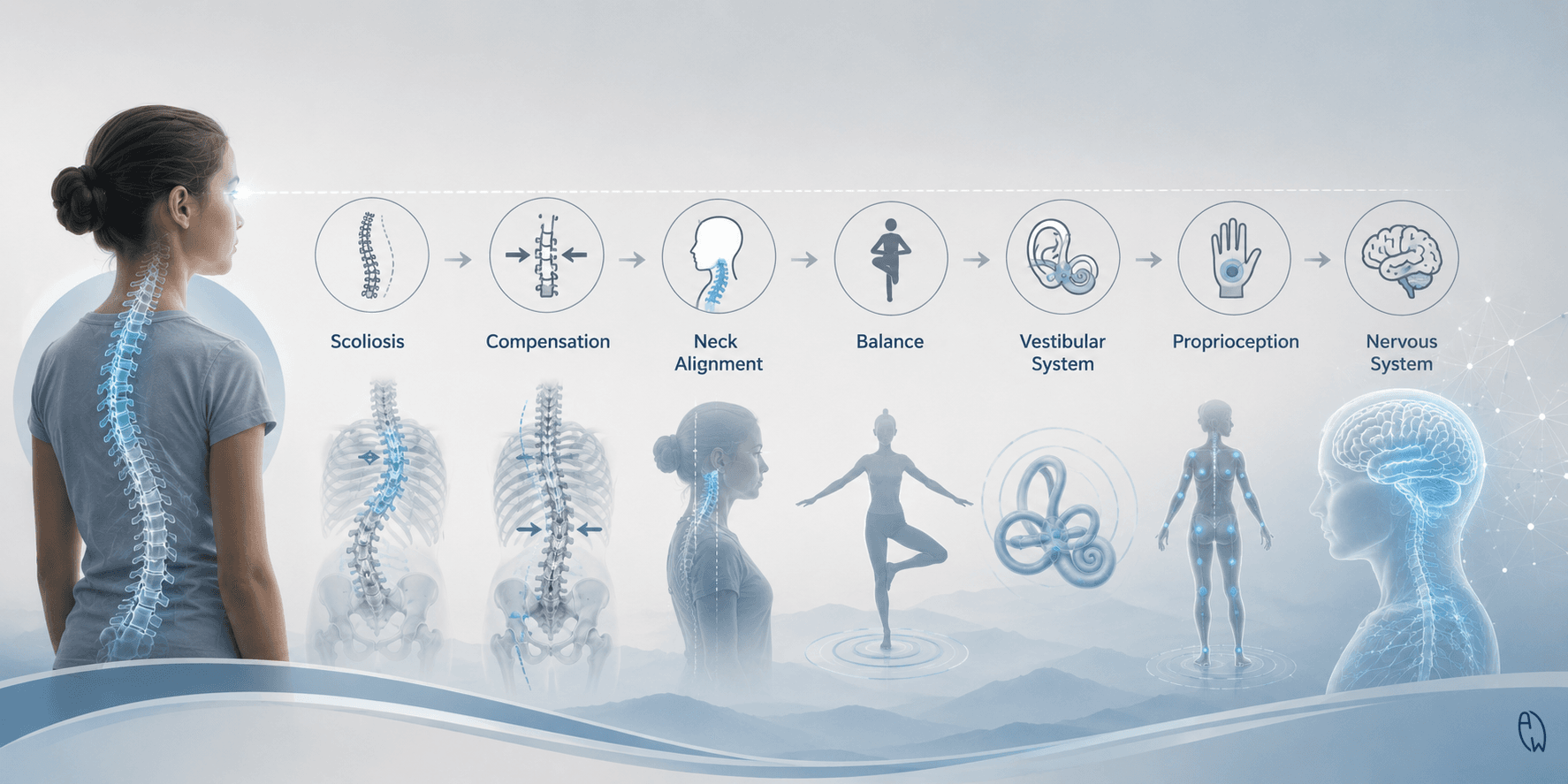
The spine functions as one integrated system. When one curve changes, the rest of the body often compensates.
This is where scoliosis becomes highly relevant.
Can Scoliosis Cause Reversal of Cervical Lordosis?
The short answer is yes.
Although scoliosis is commonly described as a sideways curve of the spine, it is actually a complex three-dimensional condition involving rotation, asymmetrical loading, muscular adaptation, and postural compensation.
The body constantly attempts to maintain balance.
One of its highest priorities is keeping the eyes level with the horizon.
When scoliosis changes the alignment of the spine, the body often creates compensatory patterns above and below the primary curve.
The neck is frequently involved in this process.
At All Well Scoliosis Centre, we commonly see scoliosis patients who also demonstrate:
-
Forward head posture
-
Straight neck syndrome
-
Loss of cervical lordosis
-
Reversal of cervical lordosis
-
Uneven shoulder height
-
Rib prominence
-
Pelvic imbalance
These findings are often interconnected rather than isolated problems.
The neck may be adapting to changes occurring elsewhere in the body.
What We Commonly See on Scoliosis X-Rays
One of the advantages of evaluating scoliosis through imaging is that it allows us to see the entire spine rather than focusing on one area.
A teenager may present with a relatively mild scoliosis curve, yet their X-ray may also reveal:
-
Significant forward head posture
-
Flattening of the cervical curve
-
Elevated shoulder position
-
Pelvic rotation
-
Rib asymmetry
An adult with scoliosis may complain primarily of neck pain, only to discover that years of compensation have altered the alignment of the cervical spine.
This is one reason why evaluating the whole spine is so important.
Symptoms are not always generated where they are felt.
Text Neck: Why Modern Lifestyle Makes the Problem Worse
One of the biggest contributors to cervical curve loss today is forward head posture, often called Text Neck.
Imagine holding a bowling ball close to your chest.
The weight feels manageable because it remains centered over your body.
Now imagine extending your arms and holding the same bowling ball farther away.
The ball has not changed weight, but it feels much heavier because your muscles must work significantly harder.
The same thing happens with the head.
An adult head weighs approximately five kilograms.
When the ears remain positioned over the shoulders, the spine can support this weight efficiently.
However, when the head drifts forward while looking at a phone, laptop, or tablet, the forces acting on the neck increase dramatically.
Initially, the muscles become fatigued.
Then the ligaments adapt.
Over time, the shape of the cervical spine itself may begin to change.
For patients already dealing with scoliosis, this additional stress can accelerate compensatory postural patterns.
What begins as a habit can eventually become a structural change.
The Nervous System Connection: It May Not Be Just a Spine Problem
One of the most fascinating aspects of scoliosis is that it may not be solely a spinal condition.
The nervous system continuously gathers information from three major sensory systems:
Vision
Your eyes help determine where you are in space.
Vestibular System
The balance organs inside the inner ear help detect movement and orientation.
Proprioception
Specialized receptors in muscles, joints, and ligaments tell the brain where the body is positioned.
Together, these systems help maintain posture and balance.
If one system is not functioning optimally, the body may create compensations elsewhere.
Research has suggested that some individuals with scoliosis may demonstrate differences in sensory processing, balance, and proprioception.
While scoliosis is not caused by a single factor, many experts believe the nervous system plays an important role in how posture is controlled and maintained.
This may help explain why some patients continue to struggle with posture even when they consciously try to "stand up straight."
The brain must first recognize what straight feels like before it can consistently maintain it.
A Patient Story We Commonly Encounter
A teenage student was referred to our clinic after a school screening identified scoliosis.
Her primary complaint was not back pain.
Instead, she suffered from frequent headaches, neck tension, and fatigue after studying.
Her X-rays revealed a mild thoracic scoliosis curve but a significant loss of cervical lordosis.
Years of studying with her head positioned forward over books, tablets, and computers had gradually altered her neck alignment.
As part of her treatment program, we addressed both the scoliosis and the cervical spine through scoliosis-specific rehabilitation, postural retraining, chiropractic care, and home exercises.
Over time, her posture improved, her headaches became less frequent, and she developed a better awareness of her body position throughout the day.
This type of presentation is becoming increasingly common among both adolescents and adults.
Symptoms Associated with Reversal of Cervical Lordosis
Not everyone experiences symptoms immediately.
However, over time, patients may develop:
-
Neck pain
-
Shoulder pain
-
Upper back tightness
-
Tension headaches
-
Reduced neck mobility
-
Muscle spasms
-
Numbness or tingling
-
Fatigue
-
Poor posture
-
Balance difficulties
In more severe cases, nerve irritation may contribute to neurological symptoms.
How We Approach Treatment at All Well Scoliosis Centre
At All Well Scoliosis Centre, our goal is not simply to reduce pain.
We aim to improve spinal function, posture, balance, and long-term quality of life.
Because every patient is different, treatment is customized based on clinical findings and imaging.
A comprehensive treatment plan may include:
Scoliosis-Specific Rehabilitation
Exercises designed to improve posture, muscular balance, and spinal stability.
Chiropractic Care
Specific spinal corrections aimed at improving alignment and mobility.
Neurological Retraining
Activities designed to help the brain recognize and maintain healthier movement patterns.
Soft Tissue Therapy
Addressing muscle tension and connective tissue restrictions.
Postural Education
Improving ergonomics and reducing habits that contribute to forward head posture.
Corrective Bracing
When appropriate, scoliosis bracing may help support structural correction and stabilization.
Home Exercise Programs
Long-term improvement depends on consistency outside the clinic.
Looking Beyond the Curve
One of the greatest misconceptions about scoliosis is that it is simply a crooked spine.
In reality, scoliosis affects posture, movement, balance, coordination, muscle function, and sometimes the way the brain interprets body position.
A loss of cervical lordosis may be one visible sign that the body has been compensating for years.
This is why we believe every scoliosis assessment should evaluate the entire spine, not just the primary curve.
Because the neck, thoracic spine, lumbar spine, pelvis, muscles, and nervous system are all connected.
Conclusion
Can scoliosis cause reversal of cervical lordosis?
In many cases, yes.
As the body adapts to spinal asymmetries, compensatory changes often develop throughout the spine, including the neck.
Modern habits such as prolonged screen use and forward head posture can further contribute to the problem.
A reversal of cervical lordosis is more than an X-ray finding. It may reflect broader changes in posture, balance, movement, and nervous system function.
At All Well Scoliosis Centre, we take a comprehensive approach that looks beyond the curve itself. Through detailed assessment, imaging, scoliosis-specific rehabilitation, chiropractic care, postural retraining, and individualized treatment plans, we help patients improve spinal function and develop healthier movement patterns for the future.
Because when it comes to scoliosis, every curve—and every compensation—tells part of the story.