Scoliosis Treatment: Why Weight Distribution Matters More Than You Think
Understanding Scoliosis Beyond the Spine
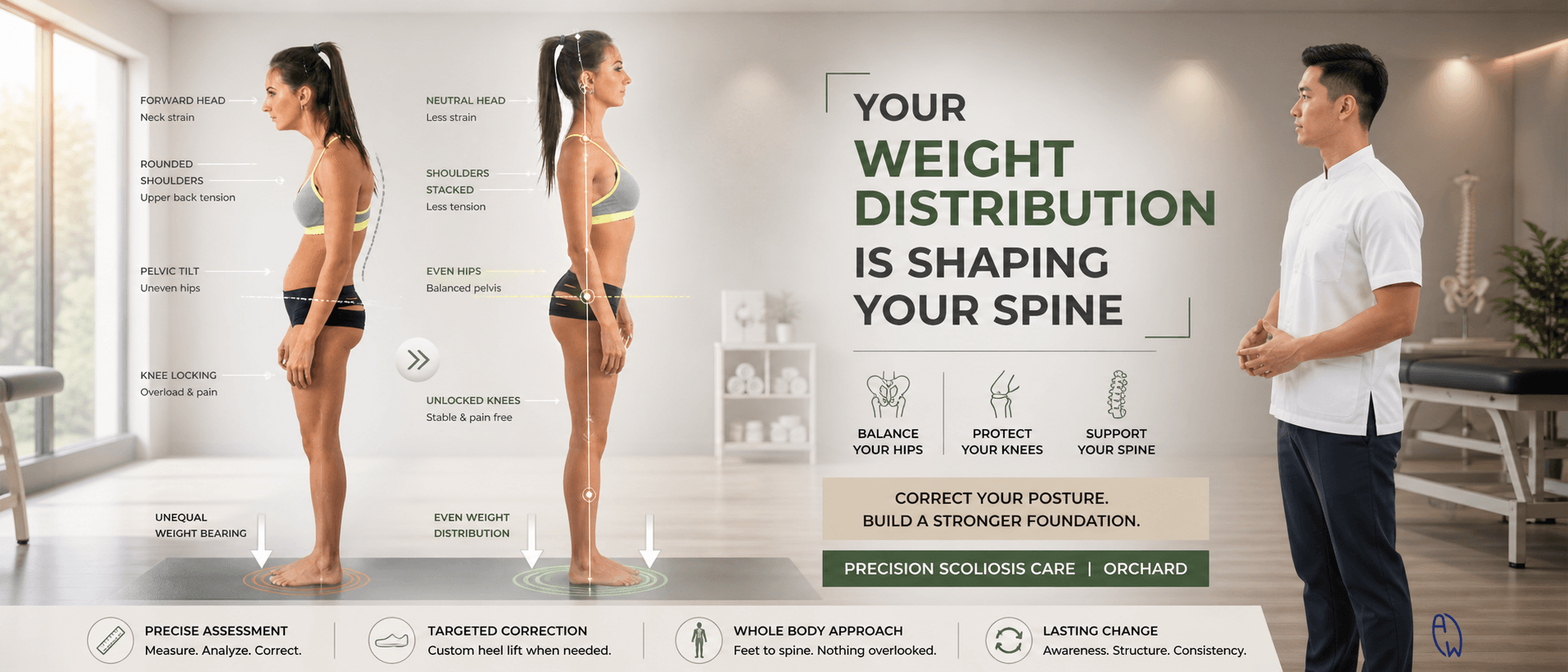
Scoliosis is often seen as a spinal condition, but in reality, it is a full-body biomechanical issue. The spine does not shift randomly—it adapts to how your body distributes weight every single day.
When your weight is uneven, your entire structure compensates:
-
Your hips become uneven
-
Your pelvis may rotate
-
Your knees start to absorb abnormal load
-
Your spine curves to keep you upright
This is how imbalance begins—and why treating scoliosis requires more than just looking at the spine.
The Real Cause: Uneven Weight Distribution
Most people are unaware that they:
-
Stand heavier on one leg
-
Shift their pelvis unconsciously
-
Drop one shoulder
-
Lock one knee for stability
These habits create asymmetrical loading, which forces the body to adapt.
Over time, this leads to:
-
Knee pain (especially on the overloaded side)
-
Hip tightness or imbalance
-
Pelvic tilt and rotation
-
Progressive spinal deviation
Your body is not failing—it is compensating.
Why Your Knee Starts Hurting
Knee pain is often misunderstood.
In many cases, the knee is not the problem—it is the victim of imbalance.
When your weight is uneven:
-
One knee takes more load than it should
-
That knee begins to lock or hyperextend
-
Muscles become overworked and strained
This creates pain without injury.
Unless you correct the root cause (your alignment), the knee will continue to suffer.
The Common Mistake: Comfort Over Correction
Many people turn to insoles or podiatry solutions that:
-
Mold to the feet
-
Provide cushioning
-
Improve short-term comfort
But comfort is not correction.
Most solutions do not assess:
-
Whether your hips are level
-
If your pelvis is rotating
-
How your spine is compensating
-
Which side actually needs more support
Without this, you may feel better temporarily—but your structure remains imbalanced.
Our Clinical Approach: Precision Matters
In our clinic, we assess the entire body—not just the feet.
We measure:
-
Hip height differences (in millimeters)
-
Pelvic tilt and rotation
-
Weight distribution patterns
-
Spinal compensation
Why We Use a One-Sided Heel Lifter
Instead of generic insoles, we often prescribe a heel lifter on one side only.
This is because:
-
Most imbalances are asymmetrical
-
One side requires more support than the other
-
Correcting this helps level the hips
-
A balanced pelvis reduces spinal strain
But this must be precise.
Even a few millimeters can:
-
Improve alignment significantly
-
Or worsen the imbalance if done incorrectly
This is why proper measurement is critical.
How Imbalance Leads to Structural Collapse
When you don’t know how to distribute your weight correctly:
-
You lean into one side
-
Your pelvis shifts
-
Your rib cage compensates
-
Your spine curves to adapt
Over time, your structure becomes loopsided and inefficient.
This is how scoliosis progresses—not just from the spine, but from the ground up.
Posture Is the Easiest Indicator
Posture tells you everything—if you know what to look for.
Signs of imbalance:
-
Uneven hips
-
One shoulder lower than the other
-
Forward head posture
-
Knee locking on one side
Correct posture is not about being stiff—it is about balanced stacking:
-
Head over shoulders
-
Shoulders over ribs
-
Ribs over hips
-
Hips over feet
You Don’t Need a Mirror—You Need Awareness
You can’t rely on mirrors all the time. But once you understand your body, you don’t need one.
Start asking:
-
Where is my weight right now?
-
Are both feet equally loaded?
-
Are my hips level?
-
Am I locking one knee?
Awareness is the first step to correction.
Your Body Can Relearn Alignment
The body is highly adaptable.
With:
-
Proper guidance
-
Consistent correction
-
Targeted support (like precise heel lifts)
Your body can:
-
Rebalance itself
-
Reduce strain on joints
-
Improve posture naturally
-
Support the spine more efficiently
Over time, the corrected posture becomes your new normal.
Final Thoughts: Fix the Foundation First
Scoliosis is not just about the curve—it is about how your body carries weight.
If you ignore:
-
Weight distribution
-
Hip alignment
-
Pelvic positioning
Your spine will continue to compensate.
But if you correct the foundation:
-
Your knees are protected
-
Your hips become stable
-
Your spine becomes supported
Awareness + precision + consistency = long-term structural change.