Never Forget the 3 R’s of Scoliosis Treatment Success: A 13-Year-Old’s Journey of Grit
Responsibility, resilience and repetition—how one determined 13-year-old approached scoliosis treatment with remarkable grit.
Scoliosis is often measured in degrees.
We talk about Cobb angles, spinal curves, growth, skeletal maturity and treatment options. We compare X-rays and monitor changes over time.
But behind every X-ray is a person.
A child.
A teenager.
Someone with school, friends, hobbies, dreams, tired days and happy days.
And sometimes, one of the most important parts of a scoliosis journey cannot be seen on an X-ray at all.
Grit.
This is the story of one remarkable 13-year-old girl who demonstrated exactly that.
She is always full of energy and smiles. She is creative, expressive and full of personality, as her artwork clearly shows.
But like any young person going through treatment, there are times when she gets tired.
What stands out is what she does next.
She doesn't give up.
She keeps going.
And her effort has become an important part of her scoliosis treatment journey.
The 3 R’s of Scoliosis Treatment Success
There are three simple words that capture the attitude she has demonstrated throughout her journey:
Responsibility.
Resilience.
Repetition.
These three qualities cannot determine exactly how a child's spine will grow. Scoliosis remains an individual condition, and biological factors are not completely within anyone's control.
But these qualities can influence how consistently a young person participates in their treatment.
And that matters.
1. RESPONSIBILITY — Take Ownership
Scoliosis treatment is not something that simply happens to a patient.
It is a partnership.
The clinician provides assessment, guidance and treatment. Parents provide support and encouragement. But the young person also has a role to play.
For someone undergoing scoliosis bracing, responsibility can mean:
-
Wearing the brace according to the prescribed plan
-
Attending scheduled reviews
-
Communicating when something is uncomfortable or difficult
-
Following the recommended routine
-
Asking questions and understanding the purpose of treatment
-
Taking an active role in their own care
Responsibility does not mean being perfect.
There will be difficult days.
There will be days when a teenager does not feel like wearing the brace. There may be nights when it feels uncomfortable or inconvenient.
Taking responsibility means recognising that the choices within our control still matter.
You may not be able to control everything about your scoliosis, but you can take ownership of the things you can control.
That is an important lesson—not only for scoliosis, but for life.
2. RESILIENCE — Rise Again When Things Get Difficult
Scoliosis treatment is not always easy.
A brace can become part of a teenager's daily routine. It can affect sleep, clothing choices, activities and simply how comfortable someone feels at the end of a long day.
And sometimes, the hardest part is not physical.
It is emotional.
A teenager may wonder:
"Why me?"
"How long do I have to do this?"
"Will my spine get better?"
"Do I really have to wear this tonight?"
Those feelings are understandable.
Resilience does not mean never feeling tired or frustrated.
It means experiencing those feelings and still finding a way forward.
That is what makes this young patient's attitude so inspiring.
She gets tired.
But she continues.
She has challenging days.
But she keeps going.
And somehow, she still finds a reason to smile.
That is resilience.
3. REPETITION — Keep Doing the Right Things
One good day does not create a treatment result.
One night in a brace does not determine the long-term course of scoliosis.
One exercise session does not transform the spine.
Meaningful progress is built through consistent actions repeated over time.
Wear the brace.
Follow the plan.
Attend the review.
Make adjustments when needed.
Keep participating.
Then do it again.
And again.
And again.
That is the less glamorous side of treatment.
There is no single magical moment when everything suddenly changes.
Instead, there are hundreds of ordinary moments when a young person chooses to continue doing what has been recommended.
Repetition turns individual actions into a routine.
And consistency gives the treatment its opportunity to work as intended.
What Her X-Rays Show
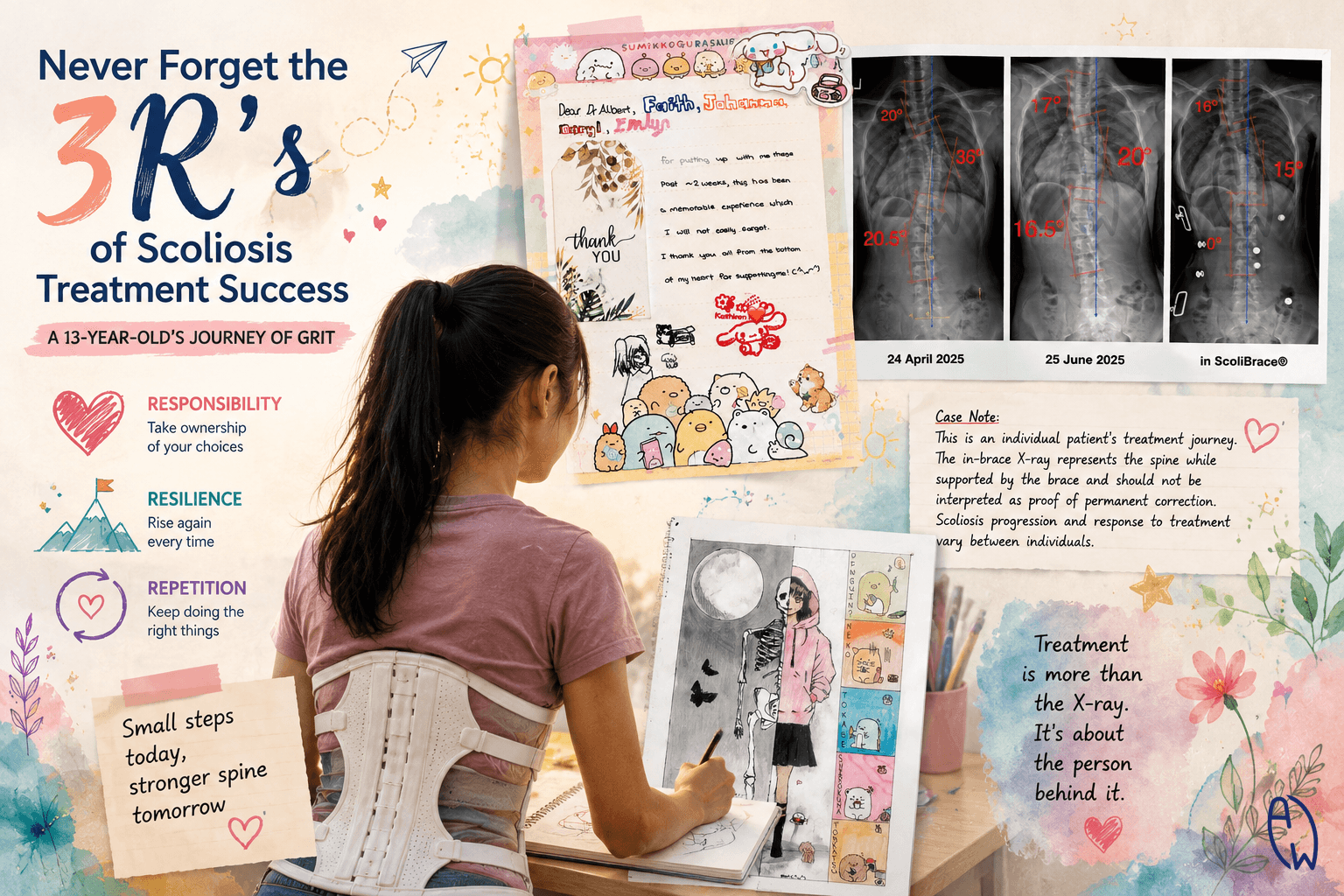
Her X-rays provide an important visual part of her journey.
On 24 April 2025, the measurements displayed on the radiograph were approximately:
36° thoracic curve
20.5° lumbar curve
On 25 June 2025, the displayed measurements were approximately:
20° thoracic curve
16.5° lumbar curve
There is also an in-brace X-ray, with displayed measurements of approximately:
15° thoracic curve
0° lumbar curve
The Cobb angle is the standard radiographic measurement used to quantify the magnitude of a scoliosis curve, but it is important to remember that a single measurement does not tell the entire story.
For a deeper explanation of what Cobb angles mean and how they are interpreted, read our guide to Cobb Angle in Scoliosis: Measurement, Severity & Treatment.
An In-Brace X-Ray Is Not the Same as Permanent Correction
This is an important distinction when looking at this patient's X-rays.
When a scoliosis brace is being worn, it applies corrective forces to the spine. An in-brace X-ray allows the treatment team to see how the spine responds while those corrective forces are being applied.
Therefore, a smaller Cobb angle on an in-brace X-ray should not automatically be interpreted as permanent correction.
The purpose of bracing in a growing child is broader than simply producing a dramatic X-ray on one particular day. For appropriately selected growing adolescents, bracing is generally used to help manage the risk of curve progression during growth.
This is why the long-term trend matters.
Not simply:
"What is the number today?"
But:
"How is this young person's spine changing as she grows?"
Scoliosis progression is influenced by multiple factors, including growth, skeletal maturity, curve magnitude, curve pattern and other individual characteristics.
"Can Scoliosis Get Worse? 7 Factors That Determine Spinal Progression - ALL WELL Scoliosis Centre"
The X-Ray Shows the Curve. The Journey Shows the Person.
It is easy to look at these images and focus on the numbers.
36°. 20°. 16.5°. 15°. 0°.
But there is another story happening behind those measurements.
There is a 13-year-old girl who has continued to participate in her treatment even when she is tired.
That part cannot be measured in degrees.
Her effort cannot be converted into a Cobb angle.
Her determination cannot be seen on an X-ray.
Yet those qualities are part of her journey.
This is why scoliosis care should never be reduced to a number.
The X-ray measures the spine. It does not measure the child.
The Difference Between Providing Treatment and Participating in Treatment
A well-designed treatment plan is important.
A properly fitted brace is important.
Regular follow-up is important.
Monitoring growth and spinal changes is important.
But there is also a young person at the centre of all of this.
Someone who has to put the brace on.
Someone who has to sleep in it.
Someone who has to go to school and live her normal life while undergoing treatment.
Someone who sometimes feels tired.
That is why participation matters.
A brace can provide corrective forces.
A clinician can provide the treatment strategy.
Parents can provide encouragement.
But the patient still has to live the treatment every day.
That takes effort.
And in this case, she has shown plenty of it.
Her Artwork Tells Another Part of Her Story
Perhaps one of the most beautiful parts of this patient's journey is not found in the X-rays at all.
It is found in her artwork.
Her colourful drawings, handwritten messages and imaginative characters show us something that a radiograph never could.
They show who she is beyond scoliosis.
She is creative.
She is expressive.
She is young.
She has her own personality, interests and imagination.
Her scoliosis is part of her story—but it does not define her.
That distinction is especially important when treating children and teenagers.
We want them to receive appropriate treatment and take their health seriously.
But we also want them to continue growing into themselves.
To laugh.
To create.
To learn.
To make friends.
To dream.
To enjoy being 13.
Grit Does Not Mean Being Perfect
There is an important point worth making here.
When we talk about grit, we should never make a child feel that they have failed simply because they have a difficult day.
Grit does not mean:
"I must never complain."
It does not mean:
"I must never feel tired."
And it does not mean:
"If my curve progresses, it must be because I didn't try hard enough."
That would be unfair and medically inaccurate.
Scoliosis is complex.
Even patients who follow their treatment carefully can have different outcomes because biological factors influence spinal growth and curve behaviour.
Effort matters, but effort does not give anyone complete control over scoliosis.
What grit does mean is something much simpler:
When things become difficult, you don't let one difficult day become the reason you stop trying.
That is the kind of grit this young patient has demonstrated.
Success Isn't Built by One Big Decision
We often think success comes from one major decision.
But in reality, meaningful progress is usually built from many small decisions repeated over time.
That is why the 3 R’s are so powerful.
RESPONSIBILITY
Take ownership of the things within your control.
RESILIENCE
Rise again when treatment becomes difficult.
REPETITION
Keep doing the right things consistently.
Together:
Take ownership.
Keep rising.
Keep going.
These three qualities cannot determine exactly how a child's spine will grow.
But they can help a young person participate actively and consistently in their treatment.
And that matters.
A Message to Parents
If your child has scoliosis, it is natural to focus on the X-ray.
You want to know:
Is the curve getting better?
Is the brace working?
Will the scoliosis progress?
What will happen as my child grows?
These are important questions.
But remember to look beyond the X-ray too.
Look at the child.
Is your child learning to take responsibility?
Are they learning how to cope when treatment becomes difficult?
Are they gradually developing healthy routines?
Are they still enjoying their childhood?
Support is not about demanding perfection.
It is about helping a young person understand that treatment is something they can participate in—not something that defines them.
Celebrate effort.
Celebrate consistency.
Celebrate courage.
And when difficult days come, help them start again.
For more on the factors that can influence scoliosis progression during growth, see our article on what actually determines whether scoliosis gets worse.
A Message to Young People With Scoliosis
If you are a teenager wearing a scoliosis brace, remember this:
You are allowed to get tired.
You are allowed to feel frustrated.
You are allowed to have days when you don't feel like doing it.
You don't have to be perfect.
But when you can, come back to the things that matter.
Take responsibility for what you can control.
Be resilient when things become difficult.
Repeat the right actions.
One day at a time.
Her Effort Made a Difference
When we look at this young patient's X-rays, we can see changes in spinal alignment.
But when we look at her story, we see something else.
We see a 13-year-old who continues to show up.
A girl who is full of energy.
A girl who smiles.
A girl who gets tired.
And a girl who doesn't give up just because she is tired.
Her effort is an important part of her journey.
Not because effort guarantees a particular result.
Not because every patient will have the same outcome.
But because taking an active role in treatment is something every young patient can strive toward.
And perhaps that is the real lesson behind her story.
The treatment provides the opportunity.
The clinician provides the guidance.
The brace provides the corrective forces.
But the patient brings the commitment to the journey.
Never Forget the 3 R’s
RESPONSIBILITY
Take ownership of your choices and the things within your control.
RESILIENCE
Rise again every time life—or treatment—knocks you down.
REPETITION
Keep doing the right things until they become part of your routine.
Success isn't built by one big decision.
It is built by taking responsibility, staying resilient through challenges, and repeating the actions that move you forward.
Take ownership.
Keep rising.
Keep going.
And never forget that sometimes, the greatest strength in a treatment journey isn't measured in degrees.
It is measured in grit.
And this young 13-year-old has shown us plenty of it. ❤️
Case Note
This is an individual patient's treatment journey. The X-ray measurements shown in this article are the measurements displayed on the provided images. The in-brace X-ray represents the spine while supported by the brace and should not be interpreted as proof of permanent correction. Scoliosis progression and response to treatment vary between individuals, and this case should not be interpreted as a guarantee of similar results for another patient.
Frequently Asked Questions
Can a scoliosis brace reduce the Cobb angle?
A scoliosis brace can change spinal alignment while it is being worn, which can be seen on an in-brace X-ray. However, in-brace correction should not automatically be interpreted as permanent correction. Long-term results depend on growth, skeletal maturity, curve characteristics and other individual factors.
Does a scoliosis brace guarantee that a curve will not progress?
No. Bracing can help manage the risk of progression in appropriately selected growing adolescents, but it cannot guarantee a particular outcome. Continued monitoring remains important throughout growth.
Does wearing the brace consistently matter?
Yes. Following the prescribed brace-wearing schedule allows the treatment to be carried out as intended. Consistency is an important part of bracing, although scoliosis outcomes are also influenced by biological factors outside a patient's control.
Is a lower Cobb angle always better?
The Cobb angle is an important measurement, but it is not the only consideration. Clinicians also consider the curve pattern, spinal balance, skeletal maturity, growth potential and changes over time. (All Well Scoliosis Centre)
What is the most important thing parents can do?
Support your child without making scoliosis the centre of their identity. Encourage treatment consistency, listen when they are struggling and communicate with the treating team when problems arise.
Most importantly, remind them:
They are more than their X-ray.