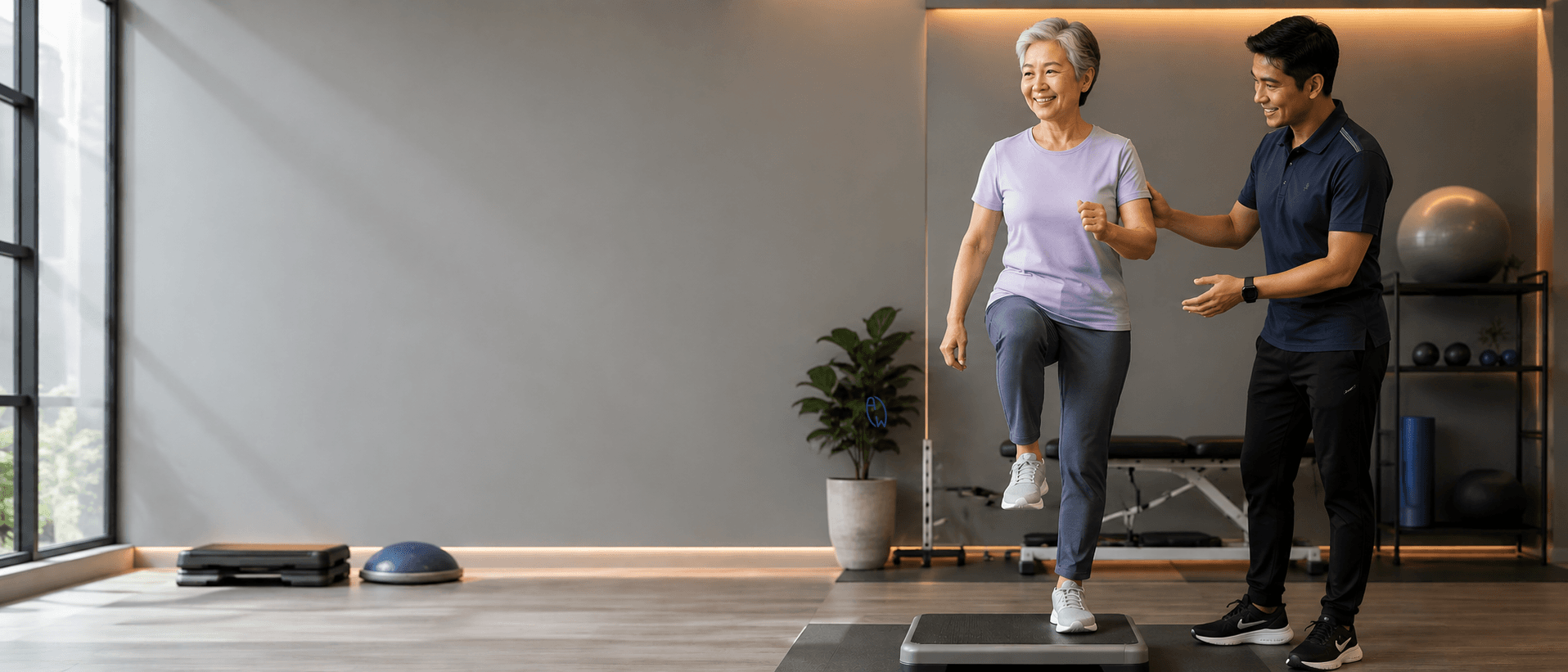
Falls, Balance & Aging: What Modern Research Says About Staying Independent
For many older adults, the fear of falling changes the way they move long before an actual fall happens.
They begin:
-
Looking down while walking
-
Holding onto walls or furniture
-
Avoiding stairs
-
Taking smaller, slower steps
-
Losing confidence in their own body
What many people do not realize is this:
Balance decline is not always “just aging.”
The latest research is very clear — balance CAN improve with the right type of training.
Modern Evidence Strongly Supports Balance Training for Older Adults
Current research consistently shows that exercise programs combining:
-
Strength training
-
Dynamic balance training
-
Functional movement retraining
-
Stepping strategies
-
Turning practice
-
Progressive mobility exercises
can significantly reduce fall risk and improve independence in older adults.
A large systematic review published in the British Journal of Sports Medicine found that exercise programs focused on balance and functional movement reduced falls by approximately 21%, while programs that highly challenged balance achieved even greater improvements. British Journal of Sports Medicine – Exercise to Prevent Falls in Older Adults
This is important because many seniors are still commonly told to simply “be careful” or are only given very basic seated exercises that do not fully prepare the body for real-life movement.
Real life requires people to:
-
Turn quickly
-
Recover from small trips
-
Navigate uneven surfaces
-
Climb stairs safely
-
Carry groceries while walking
-
React to sudden movement changes
The body must practice these movements safely — not avoid them entirely.
Why Balance Often Declines With Age
One of the biggest contributors to balance decline is not age alone, but the combination of:
-
Muscle weakness
-
Reduced movement over time
-
Previous injuries or physical trauma
-
Chronic medical conditions
-
Fear of falling
-
Loss of movement confidence
A history of physical trauma combined with underlying medical comorbidities can significantly impact mobility, balance, and functional independence.
Often, the warning signs begin subtly:
-
Stumbling more frequently
-
Feeling unstable during turning
-
Looking down constantly while walking
-
Hesitating on stairs
-
Avoiding uneven ground
-
Feeling unsafe without support
These signs are frequently dismissed as “normal aging” when they may actually reflect declining strength, coordination, and balance control.
Seniors Are Often Under-Challenged, Not Fragile
One of the biggest misconceptions about aging is the belief that older adults should avoid challenging movement altogether.
In reality, many seniors are simply under-challenged.
When movement is avoided:
-
Muscles weaken further
-
Coordination declines
-
Reaction time slows
-
Confidence decreases
-
Fear gradually takes over
Over time, this creates a cycle where inactivity accelerates physical decline.
Modern evidence no longer supports complete movement avoidance. Instead, research strongly favors safe, progressive exercise programs that appropriately challenge balance and mobility. Exercise & Sports Science Australia Position Statement on Falls Prevention
The answer is not to do less.
The answer is to:
-
Train safely
-
Rebuild strength
-
Challenge balance progressively
-
Improve movement confidence
-
Restore functional independence
This is how independence is protected as we age.
Strength Training Plays a Major Role in Fall Prevention
Muscle strength is one of the most important foundations for balance control.
Daily activities such as:
-
Standing up from a chair
-
Climbing stairs
-
Walking outdoors
-
Recovering from a trip or stumble
all require adequate lower body strength and coordination.
Research published in the Journal of Clinical Medicine found that strength-based exercise programs significantly improve balance, mobility, and fall prevention outcomes in older adults.
Lower limb strengthening in particular has been shown to improve:
-
Walking stability
-
Functional mobility
-
Confidence during movement
-
Overall independence
Functional Balance Training Matters More Than Basic Exercise
Effective balance rehabilitation should go beyond simple seated exercises.
Research supports training that includes:
-
Multi-directional stepping
-
Weight shifting
-
Turning drills
-
Gait retraining
-
Dynamic postural control
-
Functional strengthening
A systematic review published in Life Journal found that balance- and strength-based interventions improved gait control, confidence, sensorimotor function, and fear of falling in older adults. Life Journal – Balance and Strength Exercise Interventions for Fall Prevention
The goal is not simply exercise.
The goal is helping seniors move better in real-world environments.
Because true independence is measured by whether someone can:
-
Walk confidently outdoors
-
Navigate stairs safely
-
Recover from small balance mistakes
-
Continue participating in daily life without fear
Movement Is Essential for Healthy Aging
The latest evidence continues to reinforce one powerful message:
Movement matters.
Consistency matters.
Training matters.
Aging does NOT automatically mean losing mobility, confidence, or independence.
The body remains adaptable throughout life when movement is trained appropriately and consistently.
At All Well Scoliosis Centre, we believe seniors deserve more than being told to “be careful” We have a number of seniors — some with scoliosis and some without — who come regularly for this type of balance and strength training.
What is encouraging is that many of them have proven that when they consistently perform the recommended exercises, under proper supervision and with appropriate progressive challenges, they genuinely feel better physically and mentally.
Many are retired and finally have the time to focus on their health and movement again.
Sometimes I jokingly ask them,
“Why do you still want to do all this 'torture'?”
And their answers are often surprisingly similar:
-
“I feel less pain.”
-
“I have more energy.”
-
“I feel stronger mentally.”
-
“I feel more alive.”
-
“I can move better now.”
This is why we strongly believe it is never too late to start moving again.
The body still responds to training.
The nervous system still adapts.
Confidence can still be rebuilt.
Aging does not automatically mean decline.
With safe guidance, consistency, and the right type of challenge, many older adults can become stronger, steadier, more energetic, and more independent than they thought possible.
They deserve the opportunity to:
-
Move better
-
Feel stronger
-
Rebuild confidence
-
Regain trust in their body again
Because many older adults are not fragile.
They are simply under-trained, under-challenged, and waiting for the right support.
If this resonated with you, save it and share it with someone who needs this reminder today.