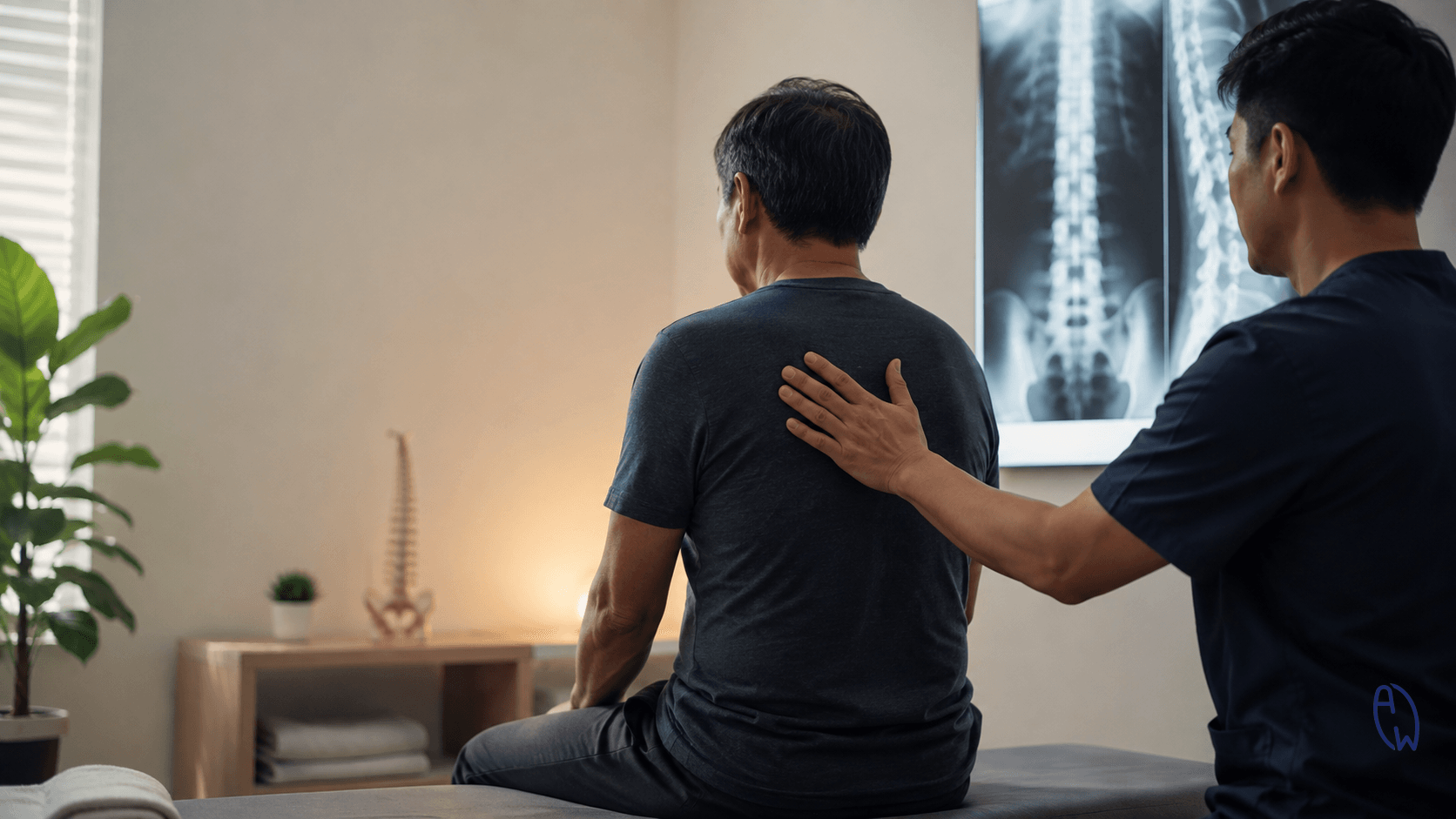
Bamboo Spine: When You Cannot Change the Spine, But You Can Still Help Someone Feel Better
There are patients who come into a clinic hoping to change something.
They want their posture corrected. They want their spine straighter. They want their stiffness to go away.
And then there are patients who come in knowing that their spine has already changed.
Recently, I met a patient with what is commonly called bamboo spine.
From the beginning, I knew this would be different.
I knew I could not change the structural changes that had already taken place in his spine. I could not promise to reverse spinal fusion. And I did not want to force movement into a spine that had become severely stiff.
So I told him honestly:
“I cannot change your spine. But perhaps I can help you feel better.”
He understood.
He went ahead with the session.
Afterward, he told me that he felt less stiff.
It was a simple sentence.
But it stayed with me.
What Is a Bamboo Spine?
“Bamboo spine” is a term commonly used to describe the characteristic appearance that can develop in the spine in advanced ankylosing spondylitis, a chronic inflammatory condition that primarily affects the spine and sacroiliac joints.
Over time, inflammation can lead to new bone formation around the spinal structures. Parts of the spine may gradually become connected or fused, reducing normal spinal movement.
On an X-ray, these changes can create a continuous, segmented appearance that resembles a stalk of bamboo.
Hence the name: bamboo spine.
But bamboo spine is not simply another way of saying “a stiff back.”
There is an important difference between a back that feels tight and a spine that has undergone significant structural change.
Someone may feel stiff because of muscular tension, prolonged sitting, reduced activity, or temporary irritation.
With advanced ankylosing spondylitis, however, stiffness can also reflect structural changes and spinal fusion.
That distinction matters.
Because when the structure has changed, we also need to change our expectations.
When the Spine Has Already Changed
One of the most important things I have learned from working with people is that not every problem should be approached with the assumption that it can be corrected.
Sometimes the body has changed.
Sometimes the condition has been present for years.
Sometimes the goal is no longer about returning the body to what it was before.
The goal becomes:
What can we still do to help this person live more comfortably with the body they have today?
That is a very different question.
For someone with ankylosing spondylitis, appropriate medical care remains important. Depending on the individual, management may include medication, exercise, physiotherapy and other forms of medical or rehabilitative care.
Exercise and maintaining appropriate mobility are also important parts of long-term management.
This is something I believe strongly in when working with people who have spinal conditions: the presence of a spinal condition does not automatically mean a person should stop moving.
The type and intensity of activity, however, should be appropriate for the individual's condition.
For more on why movement and strength remain important even when someone has a spinal condition, see our guide on [Lifestyle Adjustments for Scoliosis: Small Changes That Support a Healthier Spine] But even with appropriate medical management and exercise, someone may still experience periods of discomfort or stiffness.
That is where the conversation becomes more individual.
I Told Him What I Could — and Could Not — Do
Before his session, I wanted him to understand my limitations.
I told him:
“I cannot adjust your spine back to normal.”
I did not want to give him false hope.
I could not promise to undo spinal fusion.
I could not promise to straighten or restructure his spine.
And I would not want to approach a severely stiff or fused spine by simply trying to force movement into it.
But there was something else I could offer.
Perhaps I could help him feel more comfortable.
Perhaps I could help reduce some of the surrounding muscular tension.
Perhaps appropriate hands-on care could give him a temporary sense of ease.
Perhaps the experience of being cared for would itself be meaningful.
I did not know exactly what would happen.
And I did not promise that I did.
We simply tried.
Then He Said, “I Feel Less Stiff.”
After the session, he told me that he felt less stiff.
I was glad to hear it.
But I also knew what that statement did not mean.
It did not mean his bamboo spine had disappeared.
It did not mean the fused segments of his spine had become normal again.
It did not mean that the underlying ankylosing spondylitis had been treated.
It meant that, at that moment, he felt better.
And sometimes that distinction is important.
A person can experience relief without their underlying structural condition being reversed.
The way we experience stiffness and discomfort is influenced by much more than bone and X-rays. Muscles, soft tissues, movement, fatigue, stress, relaxation and the nervous system can all influence how the body feels.
So I was happy with his result.
Not because I had changed his spine.
But because perhaps, for a little while, his body felt easier to live in.
But Was I Really Helping Him?
This was the question I kept asking myself.
Because I knew my limitations.
And then he kept coming back.
Sometimes the interval between his sessions was quite short.
I even told him:
“You should also try other forms of care.”
I meant it.
I did not want him to rely entirely on one approach.
Someone living with ankylosing spondylitis may benefit from a broader treatment plan involving appropriate medical care, exercise, physiotherapy and other strategies suited to their condition.
This is something I believe applies to spinal care generally.
There are times when one therapy alone is unlikely to address everything a person needs. Different approaches may serve different purposes, whether the goal is symptom management, rehabilitation, strengthening, mobility or long-term monitoring.
We have written more about this idea in **Scoliosis Treatment: Why One Therapy Alone Is Usually Not Enough But he told me that this was what helped him the most.
That made me wonder.
Why?
Was it the session itself?
Was it the temporary feeling of less stiffness?
Was it the conversation?
Was it because the clinic felt welcoming?
Was it because he did not feel judged?
Or perhaps it was something much simpler.
Human touch.
Maybe Relief Does Not Always Look Like Correction
We often think that helping someone means fixing something.
If the spine is crooked, we want to straighten it.
If the muscle is tight, we want to release it.
If something hurts, we want the pain gone.
There is nothing wrong with wanting improvement.
But some conditions teach us humility.
Bamboo spine is one of them.
There may be structural changes that cannot simply be reversed.
There may be limitations that need to be respected.
And there may be no honest way to promise a complete correction.
But that does not mean there is nothing left to offer.
Sometimes relief is not dramatic.
It might be getting out of bed with slightly less stiffness.
It might be moving a little more comfortably.
It might be sleeping better.
It might simply be leaving a session thinking:
“My body feels a little easier today.”
That may not be a cure.
But it is still something.
Sometimes People Need to Feel Seen
This is something I sometimes tell my staff at All Well.
We can become very focused on the body.
The spine.
The muscles.
The posture.
The X-ray.
The diagnosis.
The treatment.
But the person sitting in front of us is more than all of those things.
Sometimes someone walks into a clinic carrying a condition that has already taken something away from them.
Perhaps movement.
Perhaps confidence.
Perhaps comfort.
Perhaps the feeling that their body is still their own.
And maybe they do not always need another person to tell them what is wrong with them.
Maybe they need someone to listen.
Someone to explain without judging.
Someone to touch without making them feel like a problem to be fixed.
Someone to say:
“I understand that I cannot change everything. But I am still here to help with what I can.”
Perhaps that is part of care too.
We Cannot Always Heal the Body
There is a difference between healing a condition and helping a person live with it.
For someone with ankylosing spondylitis and significant spinal stiffness, appropriate medical management remains essential.
Supportive care may also have a place when the goal is clearly understood.
The goal is not to reverse spinal fusion.
It is not to claim that hands-on treatment can cure ankylosing spondylitis.
It is not to replace rheumatology, physiotherapy, exercise or evidence-based medical treatment.
The goal may simply be comfort.
A temporary reduction in stiffness.
A sense of relaxation.
A little more ease.
And perhaps the feeling that someone is taking the time to care.
Knowing what we cannot do is part of being responsible.
But knowing what we can still do is part of being human.
Perhaps We Can Help in More Ways Than We Realise
I sometimes wonder whether we underestimate the importance of a welcoming clinic.
A person may come in because their back hurts.
But perhaps they return because they feel comfortable here.
Perhaps they appreciate the conversation.
Perhaps they know they will not be judged.
Perhaps they like being listened to.
Perhaps their body responds well to gentle, appropriate hands-on care.
Perhaps it is a combination of all of these things.
We may never know exactly which part matters most.
And maybe we do not need to.
Because healthcare is ultimately about people.
Not just spines.
Not just muscles.
Not just X-rays.
People.
And sometimes, before someone can feel better, they need to feel seen.
Knowing Our Limits Is Part of Good Care
I think there is an important lesson in treating someone with a complex spinal condition.
Good care is not about promising everything.
It is about understanding what is possible, what is not, and what the person actually needs.
A practitioner who tells someone with a fused spine that they can “put everything back into place” may be offering hope, but they are also creating an expectation that may not be realistic.
I would rather be honest.
I would rather say:
“I cannot change this part of your spine. But let's see what we can do to make you feel better.”
That may sound like a smaller promise.
But I think it is a more meaningful one.
Because trust begins when we are willing to acknowledge our limits.
This May Be My Ithaca
There is something about Ithaca that has stayed with me.
In Homer's Odyssey, Odysseus spends years travelling toward home.
Ithaca is the destination.
But perhaps the meaning of the journey is not only about arriving.
Perhaps it is about what the journey teaches us along the way.
For me, maybe my Ithaca is not a place where every spine becomes straight.
It is not a place where every patient leaves completely healed.
It is not a place where I suddenly discover how to fix every condition that walks through the door.
Perhaps my Ithaca is something quieter.
It is the belief that even when I cannot change someone's condition, I may still be able to make their journey a little easier.
A little less stiffness.
A little less discomfort.
A conversation.
A welcoming room.
A pair of hands.
A place where someone does not feel judged.
A place where they can simply be a person for a while, rather than a diagnosis.
And perhaps, sometimes, the most important thing we can give another person is not the promise that we can fix them.
It is the assurance that:
“I see you.”
Maybe that is enough.
Maybe that is what I am learning along the way.
Perhaps this is my Ithaca.
If You Have Been Diagnosed With Bamboo Spine
If you have been diagnosed with ankylosing spondylitis or have been told that you have a “bamboo spine,” it is important to understand that this describes significant structural changes in the spine and is not simply ordinary back stiffness.
Appropriate medical follow-up is important. Treatment for ankylosing spondylitis may include medication, exercise, physiotherapy and other forms of care depending on the individual's symptoms, disease activity and level of spinal involvement.
Exercise and maintaining appropriate mobility are generally important parts of long-term management, but activities should be appropriate for the individual's condition.
If you have significant spinal fusion, severe stiffness, a history of spinal fracture, neurological symptoms or other complications, seek advice from your doctor or physiotherapist before beginning a new exercise or hands-on treatment approach.
Complementary care may help some people manage comfort or stiffness, but it should not be presented as a way to reverse spinal fusion or cure ankylosing spondylitis.
Frequently Asked Questions About Bamboo Spine
What is bamboo spine?
Bamboo spine is a term used to describe the characteristic appearance of a spine affected by advanced ankylosing spondylitis, where new bone formation can bridge parts of the spine and contribute to spinal fusion.
Is bamboo spine the same as ankylosing spondylitis?
Not exactly. Ankylosing spondylitis is the underlying inflammatory condition. “Bamboo spine” describes a characteristic structural or X-ray appearance that can develop in more advanced disease.
Can bamboo spine be reversed?
Established spinal fusion is not something that should be expected to simply reverse through manipulation or exercise. Management generally focuses on controlling inflammation, maintaining mobility and function, and managing symptoms.
Can exercise help someone with bamboo spine?
Appropriate exercise can be an important part of managing ankylosing spondylitis. It can help maintain mobility, strength, posture and physical function. The type and intensity of exercise should be individualised.
Can hands-on treatment help bamboo spine?
Some people may experience temporary relief of muscular tension or stiffness from appropriate hands-on care. However, this should not be confused with changing or reversing spinal fusion. Any hands-on approach should take the person's spinal condition and risks into account.
Can a bamboo spine become flexible again?
If parts of the spine have become structurally fused, those fused segments cannot simply be made to move normally again. The focus is usually on maintaining movement in the areas that remain mobile and preserving overall function.
A Note From All Well
Every person who walks into All Well has a different story.
Some conditions can be significantly improved.
Some can be managed.
Some cannot be reversed.
Our responsibility is to understand the difference.
We do not believe in promising what we cannot deliver. We believe in meeting people where they are, understanding their limitations, and helping where we genuinely can.
Sometimes that means helping the body.
And sometimes, perhaps, it means helping the person feel a little more comfortable, a little more welcome, and a little less alone.
Because care is not always about changing what has happened to someone's body.
Sometimes, it is simply about helping them feel better in the body they have today.
This article is based partly on a clinical experience. The patient's identity and personal details have been omitted or changed to protect privacy. This article is for educational purposes and does not replace diagnosis or treatment by a qualified healthcare professional.