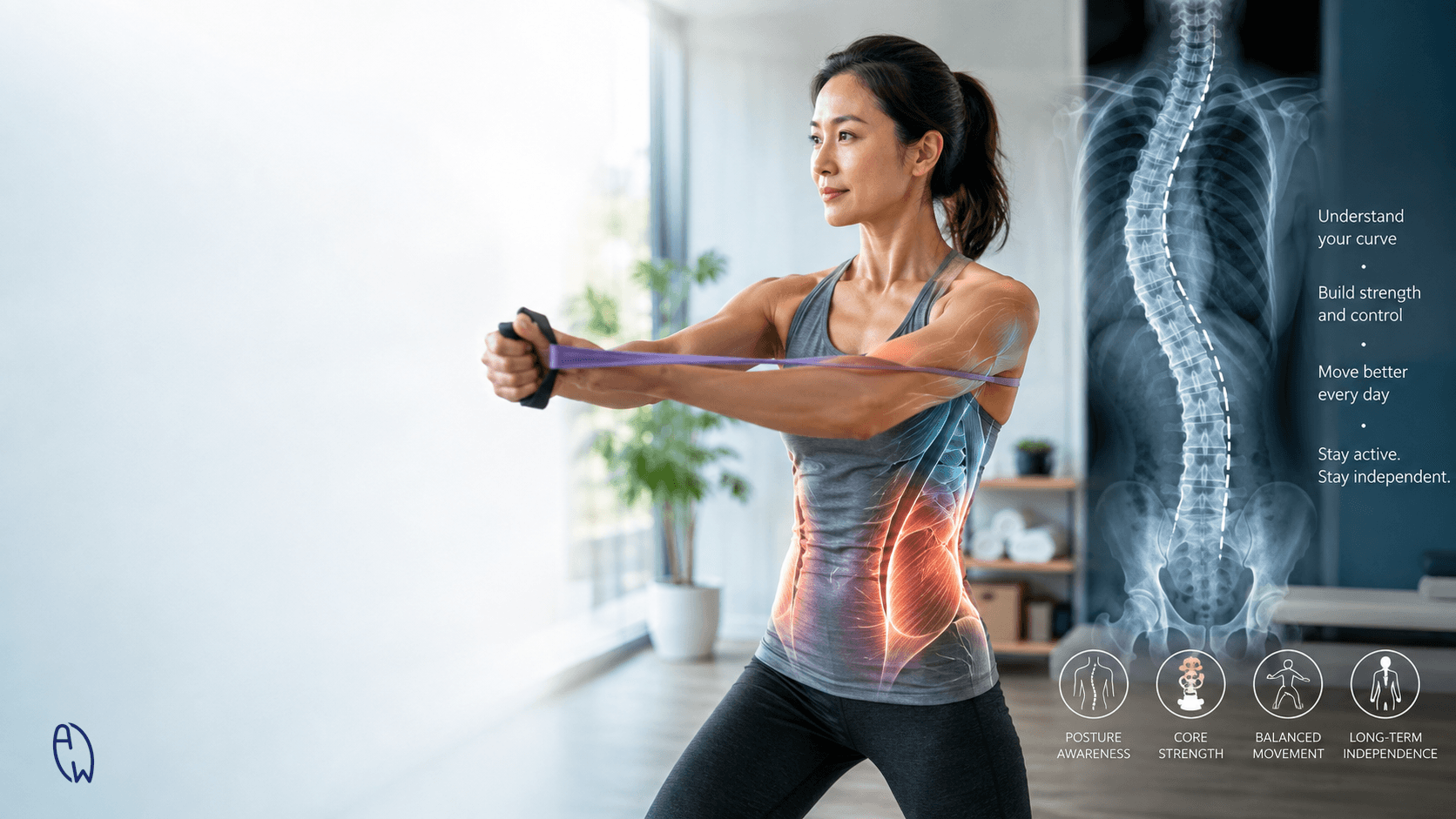
I Have Scoliosis. Should I Be Afraid to Exercise?
A guide for adults with scoliosis: why staying active can help build strength, support movement and protect the independence you want to keep as you age.
One question comes up again and again from patients:
“I have scoliosis. Can I exercise?”
And sometimes the question is even more cautious:
“Should I stop exercising because I have scoliosis?”
My answer is usually simple:
For many adults with scoliosis, movement is not something to fear.
In fact, staying physically active can be an important part of maintaining strength, mobility and physical capacity throughout adulthood.
Your spine doesn't work alone.
It works together with your muscles, joints and nervous system to help you stand, walk, bend, lift and move through everyday life.
The important question is therefore not:
“Should I exercise?”
It is:
“How should I exercise for my particular spine?”
That distinction matters.
Why Are So Many People With Scoliosis Afraid to Exercise?
The fear is understandable.
Some people with scoliosis were diagnosed when they were young and were given restrictions based on their individual circumstances.
Others have heard from friends, family or the internet that certain activities will “make scoliosis worse.”
Some worry about lifting weights.
Others are afraid of running.
Some avoid bending.
Others are nervous about twisting.
And some people eventually stop exercising altogether because they simply don't know what is appropriate for them.
Over time, avoiding movement can create another challenge.
You may become less conditioned.
Your muscles may become weaker.
Your confidence in movement may decrease.
And activities that were once easy may begin to feel more demanding.
This does not mean that everyone with scoliosis should exercise in exactly the same way.
It means we should understand your spine before deciding what your spine needs.
What If You Have Scoliosis But Don't Have Pain?
This is something I want to emphasize because many adults with scoliosis have little or no pain.
They work.
They exercise.
They travel.
They raise families.
They participate in sports.
They live active lives.
Having a scoliosis diagnosis does not automatically mean that your spine is deteriorating or that you need to stop doing the things you enjoy.
At the same time, feeling well today doesn't mean you have to ignore your physical health.
Strength, mobility, balance and physical capacity are things worth maintaining throughout adulthood.
So if you have scoliosis but feel perfectly fine, the message isn't:
“You must start treatment because something is wrong.”
It is:
“Understand your spine, stay active and make informed decisions about your body.”
If you want to understand the broader considerations of adult scoliosis, read our guide to Adult Scoliosis Treatment: Managing Pain, Mobility & Long-Term Spine Health.
Scoliosis Does Not Look the Same in Everyone
This is the first thing I want every new reader to understand.
There is no single “scoliosis body.”
Two people can both be diagnosed with scoliosis and have completely different:
-
Curve patterns
-
Cobb angles
-
Vertebral rotation
-
Spinal flexibility
-
Postural balance
-
Muscle strength
-
Symptoms
-
Physical abilities
-
Exercise preferences
-
Treatment goals
One person may have a thoracic curve.
Another may have a thoracolumbar curve.
Another may have multiple curves.
Another may have a significant curve but very little discomfort.
Someone else may have a smaller curve but experience considerable muscular fatigue or pain.
So before deciding that you should avoid a particular movement, understand what your own spine looks like.
Understand Your Curve Before You Exercise
If you are a new reader and you have never had your scoliosis properly assessed, one useful place to start is with appropriate clinical assessment and imaging.
An X-ray can help you understand:
-
Where your curve is
-
How large the curve is
-
Which vertebrae are involved
-
Whether you have one curve or multiple curves
-
How your spine is aligned
-
Whether there is significant rotation
-
Which areas may require particular attention
The Cobb angle is commonly used to quantify scoliosis on an X-ray.
You can learn more in our guide to Cobb Angle in Scoliosis: Measurement, Severity & Treatment.
But remember:
The Cobb angle is only one part of the picture.
Scoliosis is a three-dimensional condition involving more than a sideways curve.
Our article on Why Scoliosis Is Three-Dimensional explains why one measurement cannot describe the entire scoliosis experience.
Don't Exercise Blindly. Exercise With Awareness.
Imagine driving a car without knowing which direction the wheels are pointing.
You can still drive.
But understanding the position of the wheels gives you much better control.
Your body is similar.
You can exercise without knowing exactly how your spine is curved.
But understanding your curve can help you become more aware of:
Where you are.
Where you tend to shift.
Where you need better control.
Which movements feel comfortable.
Which movements may need modification.
And perhaps most importantly:
How you can use your muscles more intelligently.
That is where scoliosis-specific exercise becomes particularly interesting.
Can Exercise Make Scoliosis Worse?
This is probably the biggest fear behind the question.
Exercise itself should not automatically be viewed as something that damages a scoliosis spine.
For many adults, maintaining strength and physical capacity is valuable.
But that does not mean every exercise is appropriate for every person.
The type of activity, intensity, technique, symptoms and individual spinal condition all matter.
Someone with significant pain, neurological symptoms, recent injury or other medical concerns may need additional assessment before starting or changing an exercise program.
This is why I don't believe in giving every scoliosis patient the exact same exercise list.
Your spine deserves an individualized approach.
Why Your Muscles Matter in Scoliosis
Think about what your spine has to deal with every day.
You stand.
You walk.
You sit.
You bend.
You reach.
You carry things.
You climb stairs.
You lift your children.
You work.
You travel.
You exercise.
Your spine doesn't perform these activities alone.
Your muscles are constantly helping control movement and maintain stability.
That is why strength matters.
For many adults with scoliosis, developing appropriate muscular strength and endurance can be an important part of staying active and maintaining function.
And one area that often receives particular attention is the core and trunk musculature.
When Your Core Is Strong, Your Back Can Feel More Supported
I want to be careful with this statement.
A strong core does not mean your scoliosis will automatically disappear.
It does not mean strengthening your abdominal muscles will straighten your spine.
But stronger and better-coordinated trunk muscles can contribute to the support and control your body needs during movement.
For someone who wants to remain active, this can be extremely valuable.
You may not be trying to become an athlete.
You may simply want to:
-
Carry your child
-
Play with your children
-
Go hiking
-
Swim
-
Travel
-
Work comfortably
-
Lift weights
-
Play sports
-
Walk without feeling fragile
-
Maintain your independence as you age
Your goals matter.
General Exercise vs Scoliosis-Specific Exercise
This distinction is important.
General exercise helps you develop overall physical capacity.
It may include:
-
Walking
-
Swimming
-
Resistance training
-
Pilates
-
Yoga
-
Cycling
-
Running
-
Sports
-
Other activities you enjoy
Scoliosis-specific exercise, on the other hand, is individualized around the person's scoliosis pattern, posture, movement and treatment goals.
The two are not necessarily alternatives.
You may benefit from both.
Think of general exercise as helping you build the physical capacity to live your life, while scoliosis-specific exercise can help you become more aware of how you move and how you can better control your body around your individual spinal curve.
Our guide to Pilates, Yoga, Weights or Swimming for Adults With Scoliosis explores common forms of exercise in more detail.
This Is Where PSSE Comes In
One approach we use at All Well Scoliosis Centre is Physiotherapeutic Scoliosis-Specific Exercise (PSSE).
PSSE is different from simply telling someone:
“Go strengthen your back.”
The exercises are individualized according to factors such as the person's scoliosis pattern, posture, movement and treatment goals.
Our detailed guide to Scoliosis-Specific Exercises (PSSE) explains the approach in greater detail.
At All Well, one of the programs we use is ScoliBalance®.
The philosophy is not to fight your body.
It is to help you understand it.
Teaching Your Muscles to Work With Your Spine
This is how I like to explain it to patients.
Your muscles are receiving information from your nervous system all day long.
They help determine how you stand.
How you shift your weight.
How you stabilize yourself.
How you move.
With scoliosis, the body may develop habitual patterns around the curve.
Some muscles may become more active.
Others may contribute differently.
Your weight distribution may change.
Your posture may adapt.
Over time, some of these patterns can become automatic.
PSSE gives you an opportunity to become more conscious of those patterns.
Rather than simply telling your body:
“Move.”
you learn:
“Move this way.”
“Find this position.”
“Shift your weight here.”
“Expand this area.”
“Stabilize here.”
“Control this movement.”
In that sense, you are learning to teach your muscles a different movement strategy.
I sometimes describe it to patients as learning to “talk” to their muscles.
Not because the muscles literally understand words.
But because through repeated, intentional movement, you can develop better awareness and control.
Can You “Fix” Your Own Scoliosis?
This is where terminology matters.
I would not tell a patient:
“You can fix your scoliosis yourself.”
That creates an unrealistic expectation.
Structural scoliosis is not something you can simply straighten through willpower.
But you can learn to influence aspects of your posture, movement, muscular control and functional balance.
And for some people, those changes can be meaningful.
The aim of PSSE is therefore not simply:
“Make the X-ray straight.”
It is also about helping the patient understand and actively participate in their own body.
That is an important difference.
Learning to Balance Your Body Around Your Curve
One of the goals of scoliosis-specific exercise is developing greater awareness of how your body is positioned around your individual curve.
You may begin to notice:
-
Which direction you naturally shift
-
How you distribute your weight
-
How your shoulders and pelvis relate to one another
-
How you hold your trunk
-
How you breathe
-
How you stabilize yourself during movement
-
Which muscles you rely on
-
Which movements require more control
This doesn't mean forcing your body into a rigid “perfect posture.”
It means learning how to find a more controlled and balanced position that is appropriate for you.
Awareness comes before control.
And control comes through practice.
Your Body Can Learn New Movement Patterns
Think about learning to ride a bicycle.
At first, you have to consciously think about balance.
Eventually, the movement becomes much more automatic.
The body learns.
Scoliosis-specific exercise similarly involves repeated practice and motor learning.
You practice a particular posture.
You repeat a movement.
You learn where your weight should be.
You develop better awareness.
You become more familiar with the position.
The objective is to make appropriate movement strategies easier to reproduce during daily activities.
That takes time.
And this is another reason why we should never promise that every patient will see the same result.
What If I Love Being Active?
Then scoliosis does not necessarily mean you need to give up the activities you enjoy.
This is something I hear from active adults:
“I don't want to stop doing the things I love.”
And I understand why.
Exercise isn't just about physical health.
It may be part of someone's identity.
It may be how they manage stress.
It may be their hobby.
It may be how they spend time with friends.
It may be how they feel strong.
The goal should not automatically be:
“Stop doing everything.”
Instead, the goal is often:
“Understand your body well enough to keep doing what is appropriate for you.”
That may mean modifying certain movements.
It may mean improving strength first.
It may mean changing technique.
It may mean temporarily reducing intensity.
Or it may mean continuing your activity while incorporating a scoliosis-specific program alongside it.
Can You Lift Weights With Scoliosis?
This is another common question:
“Can I lift weights if I have scoliosis?”
There is no universal answer that applies to every person.
Resistance training can be a valuable way to develop strength.
But technique, loading, exercise selection, symptoms and individual circumstances matter.
Someone completely new to resistance training should not necessarily begin with heavy loads.
Someone with significant symptoms may require assessment first.
Someone who has been strength training successfully for years may have very different needs.
The important principle is:
Scoliosis does not automatically make you fragile.
But it does mean you should understand your body and train appropriately.
Can You Run, Swim, Do Yoga or Pilates With Scoliosis?
Again, the answer is not simply “yes” or “no.”
Different activities place different demands on the body.
Some people with scoliosis run regularly without problems.
Others prefer swimming.
Some enjoy Pilates.
Some practice yoga.
Some lift weights.
Some do a combination.
The key questions are:
What does your body tolerate?
What are your goals?
Do you have symptoms?
Do you have any medical restrictions?
Can the activity be performed appropriately?
There is no universal “best exercise for scoliosis.”
There is only the exercise—or combination of exercises—that makes sense for the individual.
Don't Wait Until Your Body Becomes Weak
This is one reason I encourage adults to think about strength before they desperately need it.
As we age, maintaining physical capacity becomes increasingly important.
Muscle mass and strength can become harder to maintain.
Balance can change.
Mobility can decrease.
Recovery can take longer.
And everyday activities can become more physically demanding.
If you already have scoliosis, maintaining your physical capacity can be particularly meaningful.
Not because exercise guarantees that your scoliosis will never progress.
But because being stronger gives you more physical capacity to work with.
If you want to understand how scoliosis may change over time, read Can Scoliosis Get Worse With Age?.
Independence Is a Long-Term Goal
When I talk to adults with scoliosis, one of the most important goals isn't always reducing the Cobb angle.
Sometimes it is much simpler:
“I want to stay independent.”
That might mean being able to:
-
Carry groceries
-
Drive
-
Travel
-
Work
-
Exercise
-
Garden
-
Play with your children
-
Play with your grandchildren
-
Get up from the floor
-
Climb stairs
-
Carry a child
-
Move through everyday life without feeling afraid of your own body
Strength and physical capacity can become increasingly valuable as we age.
And if you love being active today, maintaining that ability may be one of the best reasons to care for your body now.
Exercise Should Support Your Life—Not Take It Away
This is particularly important for adults.
If you love hiking, the goal should not automatically be to make you stop hiking.
If you love swimming, the goal is not necessarily to stop swimming.
If you enjoy resistance training, scoliosis does not automatically mean you can never lift weights.
If you are a parent, your goal may simply be to remain strong enough to carry your children.
If you are approaching your later years, your goal may be maintaining independence.
Your treatment plan should make sense within the context of your actual life.
Your Body Will Thank You Later
You don't exercise because your spine is “bad.”
You exercise because your body is something you will depend on for the rest of your life.
Your muscles will help you.
Your joints will help you.
Your nervous system will help you.
And your spine will have to work with all of them.
So rather than being afraid of movement, learn to understand it.
Rather than asking:
“What exercise should every person with scoliosis do?”
ask:
“What does my body need?”
That question can lead you in a much better direction.
What If My Curve Is Large?
A larger Cobb angle does not automatically mean:
“You cannot exercise.”
Nor does it tell us exactly how someone will feel or function.
A person's curve needs to be considered alongside the rest of their clinical picture.
For example:
-
Is the curve flexible?
-
Is there significant rotation?
-
Are there degenerative changes?
-
Is there pain?
-
Is there neurological involvement?
-
How strong is the person?
-
What activities do they want to perform?
-
What movements cause difficulty?
-
What are their treatment goals?
This is why two people with similar Cobb angles may receive different recommendations.
What If I Have Been Afraid to Exercise for Years?
You are not alone.
Some people have spent years being told—or believing—that movement is dangerous for their spine.
Starting again can therefore feel intimidating.
You don't necessarily need to go from zero to an intense workout.
Start by understanding your body.
Learn how you stand.
Learn how you move.
Build strength progressively.
Pay attention to how your body responds.
And seek appropriate professional guidance if you are uncertain about what is suitable for you.
For some people, the first achievement isn't lifting a heavier weight.
It is simply realizing:
“My body is capable of more than I thought.”
Start With Your X-Ray. Then Learn Your Body.
If you are newly diagnosed with scoliosis—or you've lived with it for years but never really understood your curve—I would start there.
Understand your spine.
Know where the curves are.
Understand your posture.
Understand where your body tends to shift.
Learn which muscles need better control.
Learn how to balance your body around your individual spinal curve.
Then learn how to move.
That is where scoliosis-specific exercise such as PSSE and ScoliBalance® can become useful.
Not because someone can promise to “fix” your spine.
But because you can become an active participant in how your body moves.
The Goal Isn't a Perfect Spine. It's a Stronger You.
This is perhaps the most important message.
You do not need a perfectly straight spine to live a strong and active life.
You do not need to be pain-free every day to exercise.
You do not need to compare your X-ray with somebody else's.
And you do not need to achieve the same result as another patient.
Every curve is different.
Every body is different.
Every starting point is different.
Every person's motivation, circumstances and ability to participate are different.
Some people will progress quickly.
Some slowly.
Some may see meaningful changes in movement and function without a dramatic X-ray change.
Some may primarily aim to maintain their current ability.
And some may eventually require other forms of treatment.
None of those journeys makes a person a failure.
The goal is to help you understand your own body and make informed decisions about how you want to care for it.
Your Future Self Is Counting on You
Maybe you are 30.
Maybe you're 40.
Maybe you're 50.
Maybe you're already 70.
It isn't too late to start understanding your body.
You don't have to become an athlete.
You don't have to spend hours in the gym.
You don't have to love exercise.
You simply need to find a way to keep your body moving and strong in a way that is appropriate for you.
Because the strength you build today may be part of the physical capacity you rely on tomorrow.
Your body has carried you this far.
Give it the support it deserves.
Your future self may thank you for it.
Frequently Asked Questions About Exercise and Scoliosis
Should I stop exercising if I have scoliosis?
Not necessarily. Scoliosis alone does not automatically mean you should stop exercising. Many adults with scoliosis remain active. Exercise should be individualized according to your curve, symptoms, physical condition and goals.
Can exercise make scoliosis worse?
Exercise does not automatically make scoliosis worse. However, the suitability of a particular exercise depends on the individual. If you have significant pain, neurological symptoms, recent injury or other medical concerns, appropriate assessment is important.
What is the best exercise for scoliosis?
There is no single best exercise for everyone with scoliosis. Walking, swimming, resistance training, Pilates, yoga and other activities may be appropriate depending on the individual. Scoliosis-specific exercise such as PSSE can provide an individualized approach.
Can I lift weights with scoliosis?
Many people with scoliosis can participate in resistance training. Exercise selection, technique, loading and individual symptoms should be considered, particularly if you are new to strength training or have significant symptoms.
Can strengthening my core straighten my spine?
A stronger core does not automatically straighten structural scoliosis. However, appropriate strengthening and motor-control exercises may help improve stability, movement and functional capacity.
What is PSSE?
PSSE stands for Physiotherapeutic Scoliosis-Specific Exercises. It refers to individualized exercise approaches designed around a person's scoliosis pattern and physical presentation.
What is ScoliBalance®?
ScoliBalance® is an exercise-based scoliosis rehabilitation program that uses individualized scoliosis-specific exercises to address posture, movement and muscular control.
Should I get an X-ray if I have scoliosis?
If you have been diagnosed with scoliosis but do not understand your curve or have never had an appropriate assessment, clinical evaluation and appropriate imaging may help you understand your spinal structure and guide individualized recommendations.
Can adults with scoliosis stay active as they age?
Yes. Many adults with scoliosis remain physically active. Maintaining appropriate strength, mobility and physical capacity can be valuable for preserving function and independence as you age.
Can scoliosis be corrected without surgery?
Some people may experience improvements in posture, function, movement and, in selected cases, radiographic measurements through non-surgical care. However, outcomes vary significantly, and non-surgical treatment should not be presented as a guaranteed cure.
Read Can Scoliosis Be Corrected Without Surgery? What Non-Surgical Treatment Can Do.
Final Thoughts
If you have scoliosis, you don't have to live in fear of your body.
You don't automatically need to stop exercising.
You don't need to treat your spine as if it is fragile.
But you do need to understand it.
Get to know your curve.
Understand your posture.
Learn where your body tends to compensate.
Build appropriate strength.
Learn how to control your movement.
And if you need help, learn how scoliosis-specific exercise can teach you to work with your own body rather than against it.
Because your spine isn't something you can simply replace.
You are going to need it for the rest of your life.
So keep moving. Keep learning. Keep getting stronger.
And especially if you love being active and wish to remain independent as you grow older—
your body will thank you for it.
A Note About Exercise and Scoliosis
This article provides general educational information and is not a substitute for individual medical assessment. Exercise recommendations should be individualized, particularly for people experiencing significant pain, neurological symptoms, recent injury or other medical conditions.
Having scoliosis does not automatically mean that every exercise is appropriate, nor does it mean that every person will experience the same response to exercise or scoliosis-specific rehabilitation.
Every curve is different. Every body is different. Every patient's goals, circumstances, motivation and ability to participate are different.
The purpose of assessment is not to tell everyone what they cannot do.
It is to understand what may be appropriate for you.