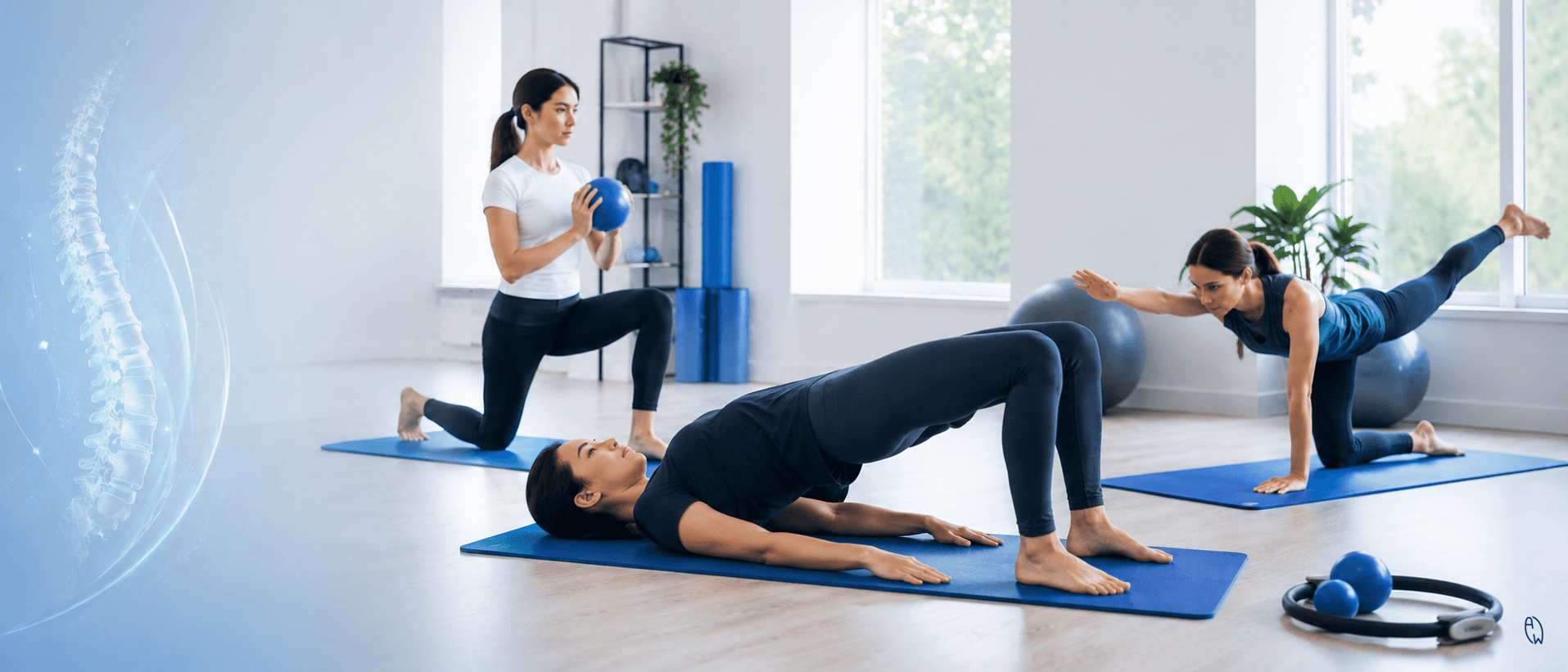
Scoliosis-Specific Exercises (PSSE): A Personalized Approach to Managing Scoliosis
Understanding Scoliosis-Specific Exercise
When people are diagnosed with scoliosis, one of the most common questions they ask is:
"Can exercise help my scoliosis?"
For many years, the common belief was that exercise had little effect on scoliosis. While this may be true for general exercise programs that are not specifically designed for spinal deformities, research over the past two decades has shown that specialised scoliosis-specific exercise programs can play an important role in conservative scoliosis management.
Today, Physiotherapeutic Scoliosis-Specific Exercises (PSSE) are recognised internationally as an evidence-based approach that may help improve posture, spinal stability, movement patterns, and overall quality of life for individuals living with scoliosis.
What Are Scoliosis-Specific Exercises?
Scoliosis is not simply a side-to-side curve of the spine.
It is a complex three-dimensional condition involving:
-
Sideways spinal curvature
-
Vertebral rotation
-
Changes in spinal alignment from front-to-back
-
Muscular imbalances
-
Altered breathing mechanics
-
Postural compensation patterns
Because scoliosis affects the body in multiple planes, traditional strengthening exercises alone may not adequately address the condition.
Scoliosis-Specific Exercises (PSSE) are customised rehabilitation programs designed to address the unique curve pattern, posture, and biomechanics of each individual patient.
Unlike generic fitness routines, these exercises are tailored specifically to:
-
The patient's Cobb angle
-
Curve location and pattern
-
Skeletal maturity
-
Age
-
Functional limitations
-
Postural presentation
-
Treatment goals
The aim is not simply to exercise more, but to move more efficiently and intentionally.
Goals of Scoliosis-Specific Exercise Programs
Every scoliosis case is different, and treatment goals vary depending on age and curve severity.
Potential goals of scoliosis-specific exercise programs may include:
Improving Postural Alignment
Many individuals with scoliosis develop compensatory postures that place additional stress on the spine and surrounding tissues.
Specific exercises can help improve body awareness and encourage more balanced spinal positioning.
Enhancing Spinal Stability
The muscles surrounding the spine play an important role in supporting posture and movement.
Targeted exercises may help improve muscular control and spinal stability.
Supporting Muscular Endurance
Daily activities require the spine and postural muscles to work continuously.
Improving endurance may help reduce fatigue and improve overall function.
Improving Breathing Mechanics
Spinal rotation can influence rib cage movement and breathing efficiency.
Many scoliosis-specific exercise programs incorporate breathing strategies designed to improve chest wall mobility and respiratory function.
Maintaining Flexibility and Mobility
Stiffness can contribute to discomfort and movement restrictions.
Appropriate mobility exercises may help maintain flexibility while supporting spinal health.
Promoting Long-Term Spinal Health
Developing better movement habits and postural awareness may help patients maintain function and confidence throughout life.
Does Exercise Correct Scoliosis?
This is an important question.
While scoliosis-specific exercise programs have shown promising results in research, no exercise program can guarantee curve correction for every patient.
The outcomes depend on several factors, including:
-
Age
-
Cobb angle
-
Skeletal maturity
-
Curve flexibility
-
Consistency with exercise
-
Individual response to treatment
For many patients, the primary benefits of scoliosis-specific exercise include:
-
Improved posture
-
Better body awareness
-
Enhanced spinal stability
-
Reduced discomfort
-
Improved function
-
Increased confidence in movement
In some cases, particularly among growing adolescents with flexible curves, specialised exercise programs may contribute to improved curve management when used appropriately.
What Does the Research Say?
Growing scientific evidence supports the use of Physiotherapeutic Scoliosis-Specific Exercises (PSSE) as part of a comprehensive scoliosis treatment plan.
Research has demonstrated that specialised scoliosis rehabilitation programs may help:
-
Improve postural control
-
Improve trunk symmetry
-
Enhance quality of life
-
Improve spinal function
-
Support brace treatment outcomes
-
Help maintain corrective changes achieved through bracing
International scoliosis treatment guidelines increasingly recognise PSSE as an important conservative treatment option, particularly when delivered by trained and certified providers.
Scoliosis-Specific Exercise and Bracing
For patients who require scoliosis bracing, exercise and bracing are often complementary rather than competing treatments.
Research suggests that combining scoliosis-specific exercises with bracing may help:
-
Improve brace compliance
-
Maintain spinal flexibility
-
Strengthen supportive musculature
-
Reinforce corrective postures
-
Support long-term treatment outcomes
The exercises help patients actively participate in their treatment rather than relying solely on passive support from the brace.
Who Can Benefit from Scoliosis-Specific Exercise?
Scoliosis-specific rehabilitation may be appropriate for a variety of patients, including:
Children and Adolescents
Early intervention may be beneficial for younger patients who are still growing, particularly when there is a family history of scoliosis or signs of progression.
Adults with Scoliosis
Adults may benefit from targeted rehabilitation to help:
-
Improve posture
-
Manage discomfort
-
Enhance movement efficiency
-
Improve balance
-
Maintain spinal function
Patients Wearing Braces
Exercise programs may complement brace treatment and support overall treatment goals.
Individuals with Kyphosis
Many scoliosis-specific rehabilitation principles can also be adapted for individuals with postural or structural kyphosis.
What Is ScoliBalance®?
ScoliBalance® is a Physiotherapeutic Scoliosis-Specific Exercise (PSSE) program designed to address scoliosis and kyphosis in children, adolescents, and adults.
The program focuses on creating a customised rehabilitation strategy based on the unique characteristics of each patient's spine.
Key components may include:
Individual Biomechanical Assessment
Each patient's spinal curve pattern and posture are carefully evaluated to determine the most appropriate corrective exercises.
Active Self-Correction
Patients learn how to recognise and actively correct their own postural imbalances throughout daily activities.
Mirror-Image Exercises
Specific movements may be prescribed to counteract the body's scoliosis-related compensations.
Functional Integration
Corrective strategies are integrated into real-life activities to improve carryover beyond the clinic setting.
Home Exercise Program
Patients learn exercises that can be performed independently at home to reinforce treatment outcomes.
Potential Benefits of ScoliBalance®
Depending on the individual case, ScoliBalance® may help:
-
Slow or stabilise curve progression
-
Improve postural alignment
-
Improve coronal and sagittal balance
-
Support brace treatment outcomes
-
Improve muscular balance
-
Enhance spinal flexibility
-
Improve body awareness
-
Reduce discomfort
-
Improve standing balance
-
Reduce fall risk in older adults
-
Improve confidence in movement
As with all conservative scoliosis treatments, results vary from person to person and should be discussed with a qualified scoliosis professional.
The Importance of Individualised Care
No two scoliosis curves are identical.
What works for one patient may not be appropriate for another.
Effective scoliosis rehabilitation requires:
-
Thorough assessment
-
Accurate diagnosis
-
Individualised exercise prescription
-
Ongoing monitoring
-
Consistent patient participation
For this reason, scoliosis-specific exercises should be prescribed and supervised by clinicians trained in scoliosis management whenever possible.
Is Scoliosis-Specific Exercise Right for You?
Whether you are a parent of a child recently diagnosed with scoliosis, an adolescent currently wearing a brace, or an adult looking to improve posture and spinal function, scoliosis-specific rehabilitation may be worth exploring.
A comprehensive scoliosis assessment can help determine whether a scoliosis-specific exercise program such as ScoliBalance® may be appropriate for your individual situation.
At All Well Scoliosis Centre, we believe every patient deserves a personalised treatment approach based on their age, spinal curve pattern, goals, and lifestyle. Through evidence-informed rehabilitation strategies, we aim to help patients move better, feel stronger, and take an active role in their spinal health journey.
References
-
Marchese R, Du Plessis J, Pooke T, McAviney J. The Improvement of Trunk Muscle Endurance in Adolescents with Idiopathic Scoliosis Treated with ScoliBrace® and the ScoliBalance® Exercise Approach. Journal of Clinical Medicine. 2024;13(3):653. This study reported improvements in trunk muscle endurance among adolescents treated with a combination of ScoliBrace® and ScoliBalance® rehabilitation.
-
Negrini S, Donzelli S, Aulisa AG, et al. 2016 SOSORT Guidelines: Orthopaedic and Rehabilitation Treatment of Idiopathic Scoliosis During Growth. Scoliosis and Spinal Disorders. 2018;13:3. These international guidelines support the use of Physiotherapeutic Scoliosis-Specific Exercises (PSSE) as part of conservative scoliosis management.
-
ScoliBalance® Patient Information – ScoliCare. ScoliBalance® is a Physiotherapeutic Scoliosis-Specific Exercise (PSSE) program designed for children, adolescents, and adults with scoliosis and kyphosis. The program incorporates individualized 3D posture correction, exercise rehabilitation, and home-based practice.