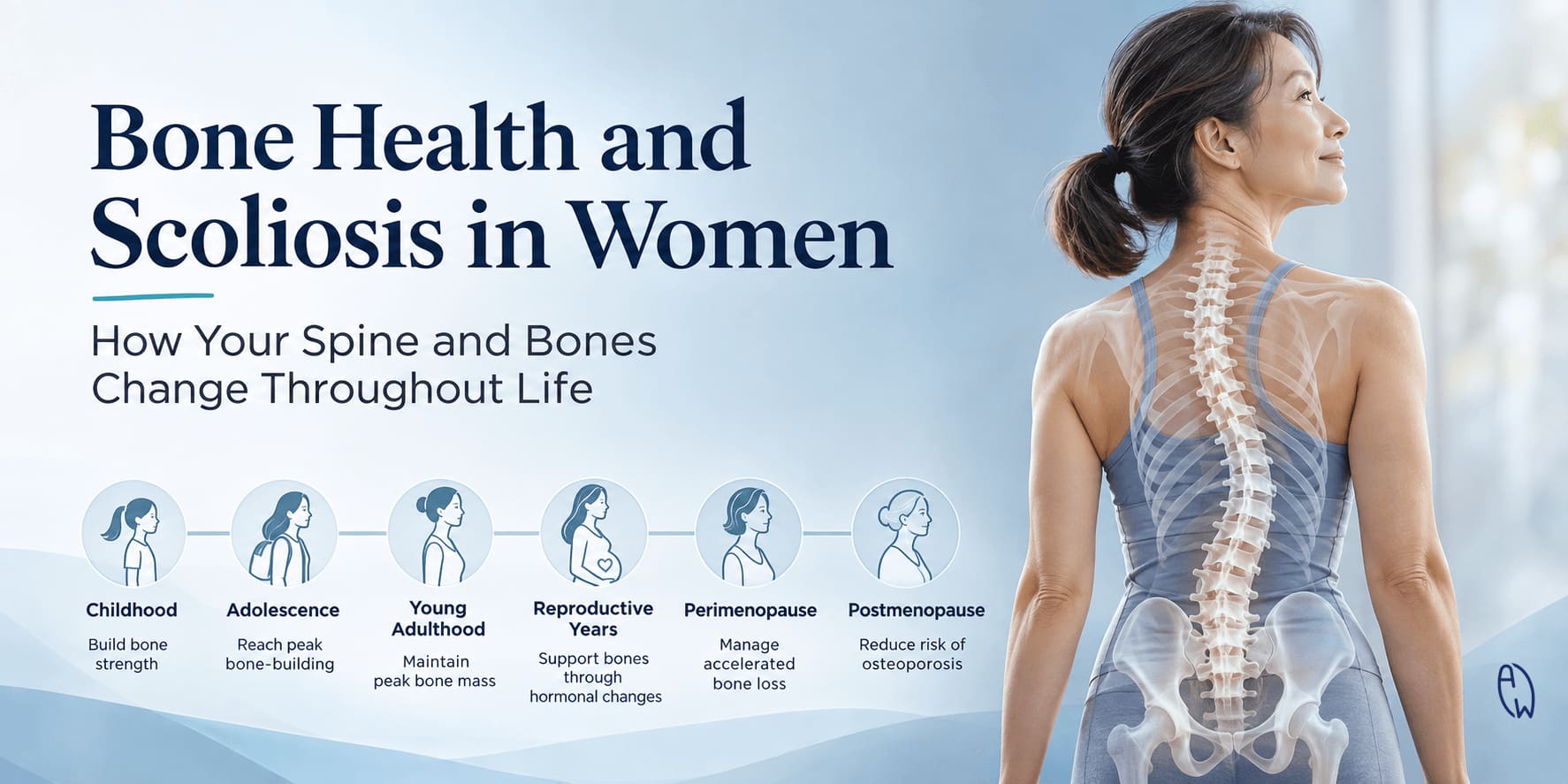
Bone Health and Scoliosis in Women: How Your Spine and Bones Change From Adolescence to Menopause
Estimated reading time: 10–12 minutes
Introduction: Bone Health Is More Than Preventing Osteoporosis
When we think about bone health, we often associate it with ageing, osteoporosis and the risk of fractures. However, maintaining healthy bones is a lifelong process that begins during childhood and continues throughout adulthood.
For women, this journey is particularly important because hormonal changes, especially the decline in oestrogen during perimenopause and menopause, can accelerate bone loss and affect the musculoskeletal system.
There is another important consideration: the relationship between bone health and scoliosis.
Some women discover they have scoliosis during their teenage years, while others develop spinal curvature later in adulthood. Some have lived with adolescent idiopathic scoliosis for decades, while others experience degenerative changes in the spine as they age.
Although these conditions have different origins, they share an important consideration: the health of the bones, muscles and supporting structures that maintain spinal stability.
Research has identified an association between adolescent idiopathic scoliosis and lower bone mineral density in some patients. In adulthood, osteoporosis can further complicate spinal health by weakening vertebrae, increasing the risk of compression fractures and contributing to changes in spinal alignment.
This means that looking after bone health is particularly important for women living with scoliosis.
Understanding how bones change throughout life can help women make better decisions about nutrition, exercise, hormonal health and appropriate medical assessments.
1. Childhood: Building the Foundation for Strong Bones and a Healthy Spine
Bone health begins long before adulthood.
During childhood, bones grow rapidly in length, size and density. The skeleton is constantly adapting to physical activity, nutrition and hormonal signals.
A substantial proportion of peak bone mass is accumulated during childhood and adolescence. The stronger the foundation established during these years, the better the potential for maintaining healthy bones later in life.
What does this mean for children with scoliosis?
Scoliosis commonly develops during the growth years, particularly around puberty. Adolescent idiopathic scoliosis is a three-dimensional spinal deformity involving changes in spinal curvature and vertebral rotation.
Its exact cause remains incompletely understood, and it should not simply be attributed to poor posture, weak muscles or nutritional deficiencies.
However, research suggests that some adolescents with idiopathic scoliosis have lower bone mineral density than their peers without scoliosis.
A systematic review and meta-analysis published in 2023, involving 32 case-control studies, reported lower bone mineral density measurements and a higher prevalence of osteopenia and osteoporosis in individuals with idiopathic scoliosis compared with controls.
This does not mean every child with scoliosis has weak bones. Nor does it establish that low bone density causes scoliosis. It does, however, highlight the importance of considering bone health as part of the broader picture of musculoskeletal development.
Supporting healthy bone development
Children need:
-
Adequate calcium from milk, yoghurt, cheese, tofu and other calcium-rich foods.
-
Sufficient vitamin D to support calcium absorption.
-
Adequate protein for normal growth and tissue development.
-
Regular physical activity, including running, jumping, dancing and sports.
-
Sufficient food intake to support growth and physical activity.
Weight-bearing activities are particularly useful because bones respond to the mechanical forces placed upon them.
For children with scoliosis, exercise should also consider spinal control, muscle coordination, balance and individual physical capabilities.
The objective is not simply to build stronger bones, but to support healthy development of the entire musculoskeletal system.
2. Adolescence: Peak Bone-Building Years and the Development of Scoliosis
Adolescence is one of the most important periods for both spinal development and lifelong bone health.
During puberty, the body experiences rapid skeletal growth, changes in body composition and significant hormonal fluctuations.
Girls generally experience their growth spurt earlier than boys. Oestrogen plays an important role in skeletal maturation and bone development.
Peak bone mass is usually achieved by early adulthood, although the exact timing varies between individuals and skeletal sites.
Why bone health matters in adolescent scoliosis
Adolescent idiopathic scoliosis (AIS) is commonly identified between the ages of 10 and 18.
During this period, a spinal curve may progress as the child grows, particularly when substantial growth remains.
Several factors need to be considered when evaluating an adolescent with scoliosis:
-
Skeletal maturity and remaining growth potential.
-
Curve magnitude and location.
-
Bone mineral density when clinically indicated.
-
Nutritional status and adequate energy intake.
-
Physical activity and muscle development.
-
Menstrual health and hormonal factors.
One frequently overlooked issue is inadequate energy intake.
The female athlete triad and bone health
Some teenage girls participate in intensive sports or training programmes without consuming enough calories to support their energy expenditure.
This can contribute to the Female Athlete Triad, which involves three interconnected conditions:
-
Low energy availability, with or without disordered eating.
-
Menstrual dysfunction.
-
Reduced bone mineral density.
Insufficient energy availability can disrupt reproductive hormone function, including oestrogen production. Over time, this may interfere with bone formation and increase the risk of stress injuries and fractures.
For a teenage girl with scoliosis, inadequate nutrition and poor bone development deserve attention, particularly during a period when the skeleton is still growing.
The important message: Building strong bones during adolescence is not just about preventing osteoporosis in later life. It is about establishing a healthy foundation for the spine and the entire musculoskeletal system.
3. Young Adulthood: Protecting Peak Bone Mass
By early adulthood, most women have accumulated much of their peak bone mass.
Bone is not a static structure. Throughout life, old bone tissue is continuously broken down and replaced through a process known as bone remodelling.
During young adulthood, bone formation and breakdown are generally balanced, helping maintain skeletal strength.
This is also the stage when some women who developed scoliosis during adolescence begin to understand how their spinal condition may affect them in adulthood.
Living with scoliosis beyond adolescence
Not every adolescent scoliosis curve continues to progress.
Some curves remain relatively stable after skeletal maturity, while others may progress over time. Progression is influenced by factors such as the original curve magnitude, curve pattern and individual spinal characteristics.
Women who have lived with scoliosis since their teenage years may experience changes in:
-
Spinal alignment and posture.
-
Trunk muscle endurance.
-
Back discomfort and fatigue.
-
Physical conditioning and mobility.
-
Overall strength and functional capacity.
These changes should not automatically be attributed to osteoporosis or scoliosis progression. A proper clinical assessment is important to understand the underlying cause.
How to protect bone health during this stage
Young adulthood is an opportunity to establish habits that protect bone and muscle health.
1. Resistance training
Strength training using free weights, resistance bands or bodyweight exercises helps maintain muscle strength and provides mechanical stimulation to bones.
2. Weight-bearing activity
Walking, jogging, dancing and other weight-bearing activities support skeletal health.
3. Adequate nutrition
Calcium, vitamin D and protein are important nutrients for maintaining healthy bones and supporting muscle function.
4. Avoid prolonged inactivity
A sedentary lifestyle can contribute to muscle weakness and reduced physical conditioning.
5. Maintain a healthy body weight
Very low body weight and restrictive eating patterns can negatively affect hormonal function and bone health.
For women with scoliosis, exercise programmes should also consider spinal alignment, asymmetry, mobility and individual functional limitations.
4. Reproductive Years: Pregnancy, Breastfeeding and Hormonal Health
During the reproductive years, oestrogen continues to play an important role in maintaining bone density.
However, pregnancy and breastfeeding introduce additional physiological demands.
Pregnancy and bone health
During pregnancy, the developing baby requires calcium for skeletal development.
The mother's body adapts to meet these demands through changes in calcium absorption and metabolism. In most women, these adaptations do not result in lasting skeletal damage.
Adequate calcium and vitamin D intake remain important throughout pregnancy.
Breastfeeding and temporary bone density changes
During breastfeeding, calcium is transferred into breast milk.
Oestrogen levels are also temporarily reduced, contributing to increased bone resorption.
As a result, women may experience a temporary reduction in bone mineral density during lactation. Bone density generally recovers after breastfeeding ends, although individual circumstances vary.
Pregnancy- and lactation-associated osteoporosis is an uncommon condition that can cause fragility fractures, particularly vertebral fractures, during late pregnancy or the postpartum period.
Women experiencing sudden or severe back pain during this period should seek medical assessment rather than assuming it is ordinary pregnancy-related discomfort.
What about women with scoliosis?
Pregnancy does not automatically cause scoliosis to worsen.
However, pregnancy changes body weight, posture, pelvic mechanics and the demands placed on the back and supporting muscles.
Women with pre-existing scoliosis may experience changes in back discomfort or physical tolerance during pregnancy.
Maintaining appropriate physical activity, adequate nutrition and good general conditioning can support musculoskeletal health.
Women with a history of significant spinal deformity, previous spinal surgery or unexplained severe back pain should discuss individual considerations with their healthcare providers.
5. Perimenopause: When Hormonal Changes Begin to Affect Bone Health
Perimenopause is the transitional period leading up to menopause.
During this stage, oestrogen levels fluctuate and eventually decline. These hormonal changes can influence sleep, body composition, muscle recovery and bone metabolism.
One of the most significant effects is accelerated bone loss.
Oestrogen normally helps regulate the balance between bone formation and bone resorption. As oestrogen levels decline, bone breakdown can begin to exceed bone formation.
This is why perimenopause is an important window for women to pay closer attention to bone health.
The connection between menopause and scoliosis
For women who have lived with scoliosis since adolescence, perimenopause introduces another consideration.
Their spinal condition may have been relatively stable for many years, but the musculoskeletal environment is changing.
Age-related changes in bone density and muscle mass may affect the spine's ability to tolerate physical loading.
This does not mean menopause directly causes an existing scoliosis curve to progress.
However, declining bone strength, reduced muscle conditioning and degenerative changes can influence overall spinal health.
For women who develop new spinal curvature during adulthood, it is also important to distinguish between longstanding adolescent idiopathic scoliosis and adult-onset degenerative scoliosis.
What should women pay attention to?
-
Changes in body weight and muscle mass.
-
Declining strength or physical endurance.
-
Reduced activity levels.
-
Persistent or worsening back discomfort.
-
Loss of height.
-
New postural changes.
-
Menstrual irregularities and early menopause.
These changes are not necessarily signs of osteoporosis or scoliosis progression, but they may warrant further evaluation.
Perimenopause should not be viewed simply as a period of hormonal decline. It is an opportunity to reassess bone health, muscle strength and long-term spinal function.
6. Postmenopause: Osteoporosis, Vertebral Fractures and Adult Scoliosis
After menopause, oestrogen levels remain relatively low.
Bone loss can continue, increasing the likelihood of osteopenia and osteoporosis.
Osteopenia refers to bone mineral density that is lower than normal but does not meet the diagnostic threshold for osteoporosis.
Osteoporosis is a condition characterised by reduced bone strength and an increased risk of fragility fractures.
Importantly, osteoporosis often develops without noticeable symptoms until a fracture occurs.
How does osteoporosis affect the spine?
The vertebrae are responsible for supporting the upper body and protecting the spinal cord.
When vertebral bone becomes weak, even relatively minor forces may cause compression fractures.
Vertebral fractures can result in:
-
Loss of vertebral height.
-
Increased thoracic kyphosis or a more rounded upper back.
-
Reduced overall spinal height.
-
Changes in spinal alignment.
-
Persistent back pain.
-
Reduced mobility and physical independence.
Multiple vertebral compression fractures can alter the shape and alignment of the spine.
In some individuals, these structural changes may contribute to secondary spinal deformity.
Osteoporosis and degenerative scoliosis
There are different forms of scoliosis in adulthood.
Some women have adolescent idiopathic scoliosis that continues into adulthood. Others develop new spinal curvature later in life due to age-related degeneration.
Adult degenerative scoliosis, also known as de novo degenerative scoliosis, commonly develops in association with age-related changes in the intervertebral discs and facet joints.
As discs lose height and spinal joints become more degenerated, the spine may gradually develop asymmetric loading and curvature.
Osteoporosis can complicate this process by reducing vertebral strength and increasing the risk of compression fractures.
It is important to understand that osteoporosis does not cause every case of degenerative scoliosis. However, both conditions can coexist and influence spinal health.
Why bone density assessment matters
For postmenopausal women, assessing osteoporosis risk is an important part of preventive healthcare.
Dual-energy X-ray absorptiometry (DXA) is the standard clinical method for measuring bone mineral density.
The hip and lumbar spine are commonly assessed.
In Singapore, the 2025 Agency for Care Effectiveness clinical guideline recommends assessing osteoporosis and fragility fracture risk, particularly in postmenopausal women. DXA testing should be considered according to individual risk factors and clinical assessment.
Women should not wait until they experience a fracture before discussing their bone health.
7. The Relationship Between Muscle Strength, Bone Health and Ageing
Healthy bones alone are not enough to maintain a healthy spine.
Muscles, tendons, ligaments and the nervous system work together to support movement, balance and spinal stability.
As women age, they may experience sarcopenia, the progressive loss of skeletal muscle mass and strength.
This is particularly relevant for women living with scoliosis.
Why muscle strength matters
The spinal column provides structural support, while the surrounding muscles help control movement and maintain posture.
The abdominal muscles, back extensors, gluteal muscles and other supporting muscle groups contribute to trunk stability and functional movement.
When muscle strength and endurance decline, everyday activities such as standing, walking, lifting and climbing stairs may become more demanding.
For women with scoliosis, asymmetric spinal mechanics may introduce additional challenges when maintaining muscular endurance and movement control.
However, muscle weakness should not be assumed to be the cause of scoliosis.
The relationship between spinal curvature, muscle function and bone health is complex and varies between individuals.
Bone, muscle and balance work together
There is an important connection between three components of healthy ageing:
Bone strength: Provides the structural foundation and helps reduce the risk of fractures.
Muscle strength: Supports movement, posture, joint control and functional independence.
Balance and coordination: Help the body respond to changes in position and reduce the risk of falls.
These systems should be considered together rather than treated as separate concerns.
For women with scoliosis, a well-designed exercise programme can address strength, mobility, balance and spinal control while taking individual spinal characteristics into account.
8. How Women Can Protect Bone Health at Every Age
The good news is that bone health can be supported throughout life.
Although some factors, such as genetics and age, cannot be changed, lifestyle choices can influence skeletal health and help reduce the risk of osteoporosis and fractures.
1. Get enough calcium
Calcium is an essential mineral for bone formation and maintenance.
According to Singapore's osteoporosis clinical guideline, recommended elemental calcium intake is approximately:
-
Adults aged 19–50: 800 mg daily.
-
Adults aged 51 and above: 1,000 mg daily.
Good dietary sources include:
-
Milk, yoghurt and cheese.
-
Calcium-fortified plant-based drinks.
-
Calcium-set tofu.
-
Sardines with edible bones.
-
Certain leafy green vegetables.
Diet should be the first consideration. Supplements may be appropriate when dietary intake is insufficient, but excessive supplementation is not necessarily beneficial.
2. Maintain adequate vitamin D
Vitamin D helps the body absorb calcium and supports normal muscle function.
Sources include:
-
Sensible sunlight exposure.
-
Fatty fish.
-
Egg yolks.
-
Fortified foods.
-
Supplements when clinically indicated.
Vitamin D requirements vary depending on age, health status and individual circumstances.
Women with osteoporosis or suspected vitamin D deficiency should discuss appropriate testing and supplementation with their healthcare providers.
3. Eat enough protein
Protein is essential for maintaining muscle mass and supporting the structural components of bone.
Good sources include:
-
Fish and seafood.
-
Eggs.
-
Lean meat and poultry.
-
Milk and yoghurt.
-
Soy products and legumes.
Adequate protein intake becomes increasingly important as women age and face a greater risk of muscle loss.
4. Perform weight-bearing exercise
Weight-bearing activities encourage bones to respond to mechanical loading.
Examples include:
-
Brisk walking.
-
Dancing.
-
Stair climbing.
-
Hiking.
-
Resistance-based exercise.
Exercise should be appropriate to an individual's fitness, bone health and spinal condition.
For women with severe osteoporosis or previous vertebral fractures, certain high-impact or loaded spinal movements may need modification.
5. Include resistance training
Resistance training helps preserve muscle mass and strength.
Examples include:
-
Squats and sit-to-stand exercises.
-
Resistance band training.
-
Weight training.
-
Modified Pilates exercises.
-
Supervised strength programmes.
For women with scoliosis, exercises can be adapted to address individual asymmetries, trunk control and functional needs.
6. Train balance and coordination
Balance exercises become increasingly important with age.
Activities such as Tai Chi, controlled single-leg exercises and appropriately supervised movement training can help improve balance and reduce fall risk.
This is particularly relevant for older women with scoliosis, osteoporosis or reduced mobility.
7. Avoid smoking and excessive alcohol consumption
Smoking and excessive alcohol intake are associated with poorer bone health and increased fracture risk.
Reducing these exposures is an important part of long-term prevention.
8. Maintain regular health assessments
Women with risk factors for osteoporosis should discuss appropriate screening with their healthcare providers.
Risk factors include:
-
Early menopause.
-
Family history of osteoporosis or fragility fractures.
-
Previous low-trauma fractures.
-
Low body weight.
-
Prolonged inactivity.
-
Smoking.
-
Long-term use of certain medications, including glucocorticoids.
-
Medical conditions associated with bone loss.
Women with scoliosis should also seek appropriate clinical assessment when they notice significant changes in posture, height, pain or physical function.
9. A Lifelong Approach to Bone Health and Scoliosis
Women do not need to wait until menopause or old age to start thinking about bone health.
For someone who developed scoliosis during adolescence, maintaining healthy bones and muscles is a long-term commitment that continues well beyond the teenage years.
For someone who develops scoliosis in adulthood, understanding the condition's underlying cause is equally important.
The approach should consider more than the spinal curve alone.
A comprehensive assessment may include:
-
Spinal alignment and curvature.
-
Bone mineral density and fracture risk when indicated.
-
Muscle strength and endurance.
-
Balance and functional movement.
-
Nutritional status.
-
Hormonal and medical history.
-
Age-related degenerative changes.
At All Well Scoliosis Centre, we believe that spinal health should be understood within the context of the whole musculoskeletal system.
Scoliosis care should not focus exclusively on the appearance of the spine. Understanding how the spine, muscles and supporting structures work together is important when considering long-term function and quality of life.
For women, this perspective becomes particularly relevant as they move through different stages of life, from adolescence and reproductive years to perimenopause, menopause and healthy ageing.
The goal is not simply to maintain a straight spine. It is to preserve strength, mobility, function and independence throughout life.
Frequently Asked Questions (FAQ)
1. Does scoliosis increase the risk of osteoporosis?
Research has identified an association between adolescent idiopathic scoliosis and lower bone mineral density in some patients. However, this does not mean everyone with scoliosis will develop osteoporosis. Bone health should be evaluated according to individual risk factors.
2. Can osteoporosis make scoliosis worse?
Osteoporosis can weaken vertebrae and increase the risk of compression fractures. These fractures can change spinal alignment and contribute to secondary spinal deformity. However, osteoporosis does not directly cause every type of scoliosis.
3. Can scoliosis develop during menopause?
Menopause itself is not an established direct cause of scoliosis. However, age-related disc degeneration, joint changes and vertebral fractures can contribute to new spinal curvature in older adults. This is known as adult degenerative scoliosis or de novo degenerative scoliosis.
4. Can women with scoliosis develop osteoporosis?
Yes. Women with scoliosis can develop osteoporosis, just like women without scoliosis. Age, menopause, genetics, nutritional status, activity levels and other medical factors all influence bone health.
5. Does exercise help women with scoliosis and osteoporosis?
Appropriately selected exercise can help maintain muscle strength, physical function, balance and bone health. However, exercise should be tailored to the individual's spinal condition and fracture risk. Women with established osteoporosis may need to avoid certain high-impact activities or heavily loaded spinal flexion and twisting movements.
6. Should women with scoliosis have a bone density test?
Not every woman with scoliosis automatically requires a DXA scan. However, postmenopausal women and those with additional osteoporosis risk factors should discuss bone density assessment with their healthcare providers.
7. Can calcium and vitamin D prevent scoliosis?
There is no established evidence that calcium or vitamin D supplementation prevents idiopathic scoliosis or corrects an existing spinal curve. Both nutrients are important for normal bone health and should be consumed in adequate amounts.
8. Does menopause cause existing scoliosis to progress?
Menopause does not automatically cause scoliosis progression. However, declining bone density, muscle loss and age-related spinal degeneration can influence spinal health. Women with existing scoliosis should seek reassessment if they notice meaningful changes in posture, pain or physical function.
Final Thoughts
Bone health is a lifelong investment.
The foundations established during childhood and adolescence influence skeletal health in adulthood. The habits developed during young adulthood help preserve bone and muscle, while the hormonal changes associated with menopause make continued attention to bone health increasingly important.
For women living with scoliosis, this journey deserves additional consideration.
Whether scoliosis first appeared during adolescence or developed later in adulthood, maintaining healthy bones, strong muscles and functional movement can support long-term spinal health.
Healthy ageing is not just about living longer. It is about maintaining the strength and independence to keep moving well throughout life.