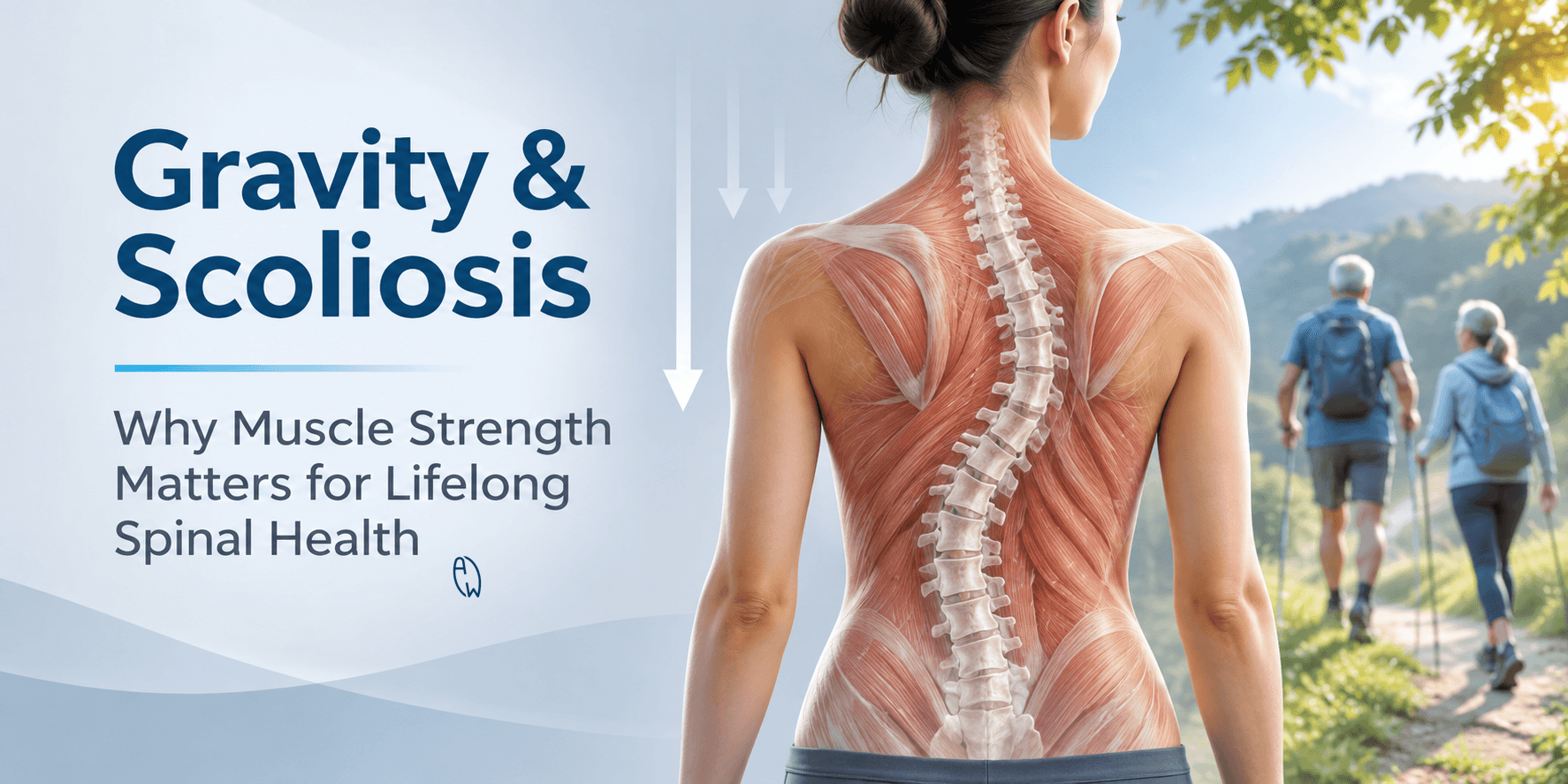
Gravity and Scoliosis: Why Muscle Strength Matters for Long-Term Spinal Health
Estimated reading time: 7 minutes
Gravity never stops working on your spine.
From the moment you get out of bed until you lie down at night, your body continuously manages the forces acting upon it. Every step, every movement and every attempt to maintain an upright posture requires coordination between your bones, muscles, joints and nervous system.
But what happens when your spine is already structurally imbalanced?
For someone living with scoliosis, maintaining postural control can involve additional biomechanical challenges. The three-dimensional curvature of the spine changes how mechanical forces are distributed across the body, potentially influencing muscle activity, movement patterns and balance.
This raises an important question:
How well is your body equipped to support your spine against the demands of gravity?
Gravity itself does not cause scoliosis. However, understanding how the body responds to mechanical loading is an important part of maintaining long-term spinal health.
And one of the most important factors we can actively work on is muscle strength.
1. Gravity and Scoliosis: Understanding the Biomechanical Challenge
The human spine is designed to support the weight of the head and trunk while allowing movement and flexibility.
Its natural curves, intervertebral discs, ligaments and surrounding muscles work together to distribute loads and maintain stability.
In scoliosis, the spine develops a three-dimensional deformity involving lateral curvature and vertebral rotation. This changes the geometry of the spine and can influence how mechanical forces are distributed across the spinal structures.
The body often adapts to these changes through muscular compensation.
Some muscles may become more active, while others may be less efficiently recruited. Differences in muscle length, strength and coordination can influence how a person maintains posture and controls movement.
Over time, these adaptations may contribute to muscular fatigue, discomfort and altered movement patterns.
It is important to understand that scoliosis progression is multifactorial. Age, skeletal maturity, curve magnitude, curve pattern and other biological factors all influence how a spinal curve may change.
Muscle strengthening alone cannot guarantee that a scoliosis curve will stop progressing.
However, maintaining appropriate muscular strength and coordination can help improve the body's ability to manage everyday physical demands.
2. Why Muscle Strength Matters in Scoliosis
Your spine does not work alone.
Every time you stand, walk, bend, reach or lift something, your muscles help control movement and maintain stability.
The muscles surrounding your spine, abdomen, pelvis and hips form an interconnected support system.
Developing appropriate muscular strength and endurance can help improve several aspects of physical function.
1. Supporting Postural Control
The muscles surrounding the spine and pelvis help maintain an upright position. Better muscular endurance and coordination can improve your ability to sustain posture during prolonged sitting, standing and walking.
2. Improving Functional Stability
The deep and superficial trunk muscles work together to control spinal movement. Developing appropriate strength and motor control can improve movement efficiency and the ability to manage physical tasks.
3. Maintaining Mobility
Strength and mobility should go hand in hand. Appropriate exercise helps maintain joint movement, muscular capacity and the ability to perform everyday activities.
4. Improving Balance and Body Awareness
Balance involves more than muscle strength. It requires coordination between the visual, vestibular and proprioceptive systems, together with the muscles responsible for controlling movement.
Exercises incorporating balance, coordination and body awareness can help improve postural control.
5. Building Long-Term Physical Resilience
Muscle strength contributes to overall physical capacity. It helps people manage daily activities, remain physically active and maintain independence as they age.
The objective is not simply to build bigger muscles. It is to develop a body that can move efficiently and respond to the physical demands of everyday life.
3. Muscle Strength, Bone Health and Ageing: The Connection We Should Not Ignore
Muscles and bones are not independent structures. They work together as part of an integrated musculoskeletal system.
Every time a muscle contracts, it generates forces that act on the bones. Similarly, weight-bearing activities and resistance training expose bones to mechanical loading, stimulating the processes involved in maintaining bone strength.
This relationship becomes increasingly important as we age.
Two conditions deserve particular attention.
Sarcopenia: The gradual loss of muscle strength and mass
Sarcopenia is an age-related condition characterised by declining muscle strength and, in more advanced cases, reduced muscle mass and physical performance.
You may begin noticing subtle changes:
-
Climbing stairs becomes more tiring.
-
Carrying groceries requires more effort.
-
Getting up from a chair becomes difficult.
-
Walking speed gradually decreases.
-
Balance and confidence during movement decline.
These changes can affect physical independence if left unaddressed.
Osteoporosis: When bones become more vulnerable to fractures
Osteoporosis is a skeletal condition characterised by reduced bone strength and increased fracture risk.
In the spine, weakened vertebrae may develop compression fractures, sometimes following relatively minor trauma.
These fractures can contribute to:
-
Loss of height.
-
Increased upper-back rounding.
-
Changes in spinal alignment.
-
Persistent back pain.
-
Reduced mobility and physical confidence.
Muscle loss and bone loss can occur together, creating additional challenges for maintaining physical function.
This is particularly relevant for people with scoliosis, especially older adults who may already have altered spinal biomechanics or degenerative changes.
How Can We Support Both Muscle and Bone Health?
A comprehensive approach should include:
Progressive resistance training
Exercises using weights, resistance bands or body weight help maintain muscle strength and provide mechanical loading that supports bone health.
Weight-bearing activities
Walking, stair climbing and other appropriate weight-bearing activities can contribute to maintaining skeletal health.
Adequate nutrition
Protein supports muscle maintenance and repair, while calcium and vitamin D play important roles in bone health.
Balance and coordination training
Improving balance and functional movement can help reduce falls risk, which is particularly important for people with osteoporosis.
Exercise cannot completely prevent age-related muscle and bone loss. However, appropriately prescribed physical activity can help preserve physical capacity and support skeletal health.
The World Health Organization recommends that older adults undertake regular physical activity, including muscle-strengthening activities and multicomponent exercises incorporating balance and functional strength.
For a deeper understanding, explore our related articles:
-
Why We Shrink With Age: Spine Compression, Muscle Loss and Posture Changes
-
Why Muscle Mass Is Your Best Life Insurance Policy for Longevity and Healthy Ageing
The important message is that building muscle is not just about looking stronger today. It is about preparing your body for the decades ahead.
4. What About Muscle Strength After Scoliosis Surgery?
An important misconception is that once scoliosis surgery has been performed, the work is finished.
Spinal fusion can correct part of the spinal deformity and stabilise the fused segments. However, surgery does not eliminate the need for muscular conditioning.
The muscles surrounding the spine, hips and trunk continue to play important roles in movement, balance and functional performance.
Post-surgical rehabilitation, when appropriately guided by the treating medical team, helps patients gradually rebuild strength, mobility and confidence in movement.
The goal is not simply to have a straighter spine on an X-ray.
It is also to maintain a body that can function well.
5. Building Strength: A Long-Term Commitment
Muscle development does not happen overnight.
It requires consistency, progressive training and an understanding of how the body responds to exercise.
For people with scoliosis, exercise should be individualised according to their curve pattern, physical capacity, age, symptoms and treatment history.
Depending on individual needs, a programme may incorporate:
Core strengthening
Developing trunk muscle endurance and control to support functional movement.
Postural exercises
Improving awareness and control of spinal alignment during different positions and activities.
Scoliosis-specific exercises
Using approaches such as Physiotherapeutic Scoliosis-Specific Exercises (PSSE) to address individual curve patterns through three-dimensional self-correction, stabilisation and movement training.
Resistance training
Developing overall muscular strength and physical capacity.
Balance and coordination training
Improving postural control, proprioception and confidence during movement.
For growing children and adolescents, scoliosis-specific exercises may form part of a broader management plan that includes clinical monitoring and bracing when indicated.
For adults, maintaining strength and physical function becomes increasingly important throughout the ageing process.
Importantly, general exercise and scoliosis-specific exercise serve complementary purposes. Neither should be assumed to replace other indicated scoliosis treatments.
You can also read our guide:
Can I Exercise With Scoliosis? A Guide for Adults
6. Beyond Spinal Correction: Building a Stronger Body
At All Well Scoliosis Centre, we believe scoliosis care should look beyond the Cobb angle.
Radiographic measurements are important for monitoring spinal curvature, but they do not tell the entire story of a person's physical health.
How well can you move?
How effectively can you maintain balance?
Do you have the strength and endurance to manage everyday activities?
Can you continue doing the things you enjoy?
These questions matter too.
Our approach considers spinal structure, muscular function, movement patterns and individual physical needs.
Depending on the patient's condition, management may incorporate scoliosis-specific exercises, bracing and other appropriate supportive interventions.
For older adults, this becomes particularly important. The focus should extend beyond spinal alignment to include mobility, bone health, muscular capacity, fall prevention and independence.
Explore our article:
Strength, Stability and Support for the Ageing Spine
We believe that the future of spinal health should not focus exclusively on treating existing problems. It should also encourage people to develop the physical capacity needed to remain active throughout life.
The goal is not simply to make the spine look straighter. It is to help the person build a stronger, more capable body.
Final Thoughts: Gravity Will Always Be There. Build the Strength to Meet It.
Gravity is a constant part of human life.
We cannot eliminate it, but we can influence how well our bodies respond to its demands.
We can build muscle strength.
We can maintain bone health.
We can improve balance and coordination.
We can preserve mobility and physical capacity.
And we can make choices today that support our ability to remain active and independent in the future.
Whether you are a teenager managing scoliosis, an adult balancing work and family responsibilities, or an older person hoping to maintain independence, your musculoskeletal health deserves attention.
Do not wait until weakness, stiffness or loss of mobility begins to interfere with your life.
Start building your foundation now.
A healthy spine is not just about alignment. It is about strength, movement, function and the ability to keep doing what you love.
Stay strong. Stay active. Build your foundation for lifelong spinal health.
Scientific References
-
Negrini S, et al. 2016 SOSORT guidelines: Orthopaedic and rehabilitation treatment of idiopathic scoliosis during growth. Scoliosis and Spinal Disorders. 2018;13:3. https://doi.org/10.1186/s13013-017-0145-8
-
World Health Organization. WHO Guidelines on Physical Activity and Sedentary Behaviour. 2020. https://www.who.int/publications/i/item/9789240015128
-
World Health Organization. Physical Activity and Sedentary Behaviour: Guidelines for Older Adults. 2020. https://pmc.ncbi.nlm.nih.gov/articles/PMC7719906/
-
Brooke-Wavell K, et al. Strong, steady and straight: UK consensus statement on physical activity and exercise for osteoporosis. British Journal of Sports Medicine. 2022. https://doi.org/10.1136/bjsports-2021-104634
-
Scoliosis Research Society. Living with Scoliosis. https://www.srs.org/Patients/Diagnosis-And-Treatment/Living-with-Scoliosis