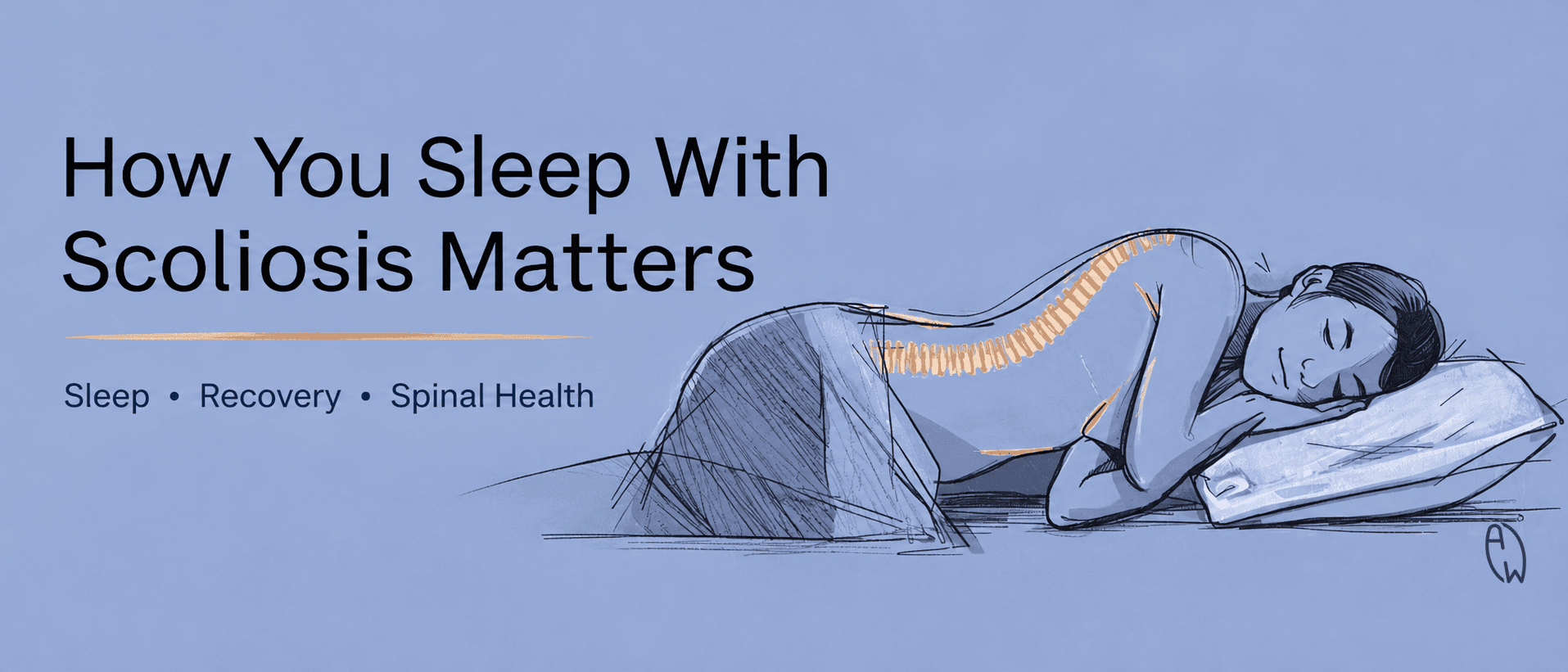
How Scoliosis Affects Sleep: The Connection Between Spinal Health, Recovery and Brain Health
Estimated reading time: 12–14 minutes
Why sleeping comfortably with scoliosis can be difficult, why your whole body matters, and how better sleep habits can support long-term spinal health.
Have you ever gone to bed feeling exhausted, only to spend the next hour adjusting your pillow, changing sleeping positions and trying to find a comfortable position for your back?
For many people living with scoliosis, sleeping comfortably is not always straightforward.
You might find yourself sleeping on one side, switching to the other, placing a pillow between your knees or adding another cushion to support your lower back. Sometimes, you finally find a comfortable position, only to wake up a few hours later with muscle tension or discomfort.
It raises an important question: Why can something as natural as sleeping become so challenging for people with scoliosis?
Scoliosis is more than a sideways curvature of the spine. It is a three-dimensional spinal deformity involving lateral curvature and vertebral rotation. Depending on the curve pattern, it can influence the position of the rib cage, shoulders, pelvis and surrounding muscles.
These changes may affect how your body distributes pressure and responds to prolonged positions, including when you are lying in bed.
However, there is something else we should consider.
Spinal health is not just about what happens during the day. It is also about how well your body recovers at night.
At All Well Scoliosis Centre, we encourage patients to look beyond their treatment sessions. Exercise, appropriate bracing, nutrition, relaxation and quality sleep all have a place in a comprehensive approach to spinal health.
In this guide, we explore the relationship between scoliosis and sleep, practical ways to improve sleeping comfort, the role of spinal bracing, and why recovery is just as important as rehabilitation.
1. Why Is Sleeping Difficult for People With Scoliosis?
Not everyone with scoliosis experiences sleeping difficulties. Some individuals sleep comfortably, while others experience discomfort, frequent waking or difficulty finding a suitable position.
The experience varies depending on several factors, including:
-
The location and magnitude of the spinal curve.
-
The degree of vertebral and rib cage rotation.
-
Muscle function and physical conditioning.
-
Associated back or joint discomfort.
-
Sleeping habits and mattress support.
-
Other medical conditions that may affect sleep.
Changes in spinal and body mechanics
A scoliotic spine does not simply bend sideways. It also involves rotation, which can change the shape and alignment of the surrounding structures.
These changes may contribute to:
Uneven muscular loading
Muscles surrounding the spine may experience different mechanical demands depending on the curve pattern. Some muscles may work harder to maintain balance and stability.
Rib cage asymmetry
Vertebral rotation can change the position of the ribs, potentially affecting how the chest and trunk rest against a mattress.
Pelvic imbalance
Changes in spinal alignment may influence pelvic positioning and the distribution of pressure around the hips.
Pressure sensitivity
Some individuals may experience discomfort when prolonged pressure is placed on particular areas, especially around the shoulders, ribs and hips.
Difficulty finding a comfortable position
Certain sleeping positions may feel less comfortable because of the individual's spinal and trunk asymmetry.
It is important to understand that these are possible contributors, not symptoms experienced by everyone with scoliosis.
The relationship between pain and sleep
Pain and sleep have a two-way relationship.
Discomfort can make it difficult to fall asleep or remain asleep. At the same time, insufficient sleep can increase pain sensitivity and make it harder to manage discomfort.
A 2022 study published in Sleep Science investigated sleep quality among 91 adolescents with idiopathic scoliosis.
Researchers found that 64.8% of participants experienced poor sleep quality. Higher pain scores were associated with poorer sleep quality. Interestingly, the magnitude of the spinal curve was not associated with sleep quality in this study.
This finding is worth remembering.
The Cobb angle does not tell the entire story of a person's experience with scoliosis.
Two people with similar curve measurements may have very different experiences when it comes to pain, physical function and sleep.
This is why a comprehensive assessment should consider more than spinal measurements alone.
2. The Best Sleeping Position for Scoliosis: Is There One?
One of the most frequently asked questions is:
"Which side should I sleep on if I have scoliosis?"
The honest answer is that there is no universally proven sleeping position that corrects scoliosis or works for everyone.
You may have heard recommendations to sleep on the concave side of your curve, avoid the convex side or always sleep on your back.
However, these recommendations should not be treated as universal clinical rules.
A person with a right thoracic curve may have different comfort requirements from someone with a left lumbar curve or a double major curve.
The objective is not to force your spine into a theoretically perfect position while sleeping. It is to find a comfortable position that allows your body to relax without unnecessary pressure or twisting.
Sleeping on your back
For some people, sleeping on the back provides a comfortable starting position.
You can experiment with:
-
A pillow that supports the natural curvature of your neck.
-
A small pillow beneath your knees if it reduces lower back tension.
-
A mattress that supports your trunk and pelvis without excessive sinking.
The goal is comfortable support rather than forcing the spine into a particular shape.
Sleeping on your side
Side sleeping is another option.
If you prefer this position, consider:
-
Using a pillow that keeps your head and neck comfortably supported.
-
Placing a pillow between your knees to reduce uncomfortable pelvic rotation.
-
Choosing a mattress that accommodates your shoulders and hips.
-
Using a body pillow if it helps prevent unwanted twisting.
You do not need to force yourself to sleep on the concave or convex side of your curve. There is insufficient evidence to recommend one side for everyone.
What about sleeping on your stomach?
Stomach sleeping usually requires the neck to remain rotated for prolonged periods. Depending on the individual, it may also increase extension through the lower back.
This can be uncomfortable for some people, particularly those who already experience neck or back discomfort.
However, stomach sleeping is not automatically harmful to every person with scoliosis.
If you regularly wake up with discomfort, experimenting with back or side sleeping may be worthwhile.
Remember: comfort and individual support matter more than following a rigid sleeping-position rule.
3. Your Pillow Is Not the Whole Story: Why Whole-Body Support Matters
The market for specialised pillows has grown considerably.
There are cervical pillows, contour pillows, ergonomic pillows, memory foam pillows and even customised pillows designed around individual neck measurements.
Some of these products can be helpful. But I want patients to understand something:
You cannot solve a whole-body alignment problem by focusing on your neck alone.
Your body is interconnected.
The cervical spine, thoracic spine, lumbar spine and pelvis work together. When you lie down, the support your body receives should be considered as a whole.
Imagine purchasing an expensive cervical pillow that supports your neck beautifully, but your mattress allows your pelvis to sink excessively.
Your neck may feel supported, but your lower back and pelvis may still be uncomfortable.
The reverse can also happen. Your mattress may feel supportive, but your pillow may be too high or too low, creating unnecessary tension around your neck.
Neither situation is ideal.
What should you look for?
Rather than spending money on the most expensive pillow or mattress, consider these practical questions:
-
Does your pillow support your neck without pushing your head too far forward or backward?
-
Does your mattress accommodate your shoulders and hips?
-
Does your lower back feel comfortable rather than excessively arched or flattened?
-
Do you wake up with less discomfort than when you went to bed?
-
Can you change positions comfortably throughout the night?
A medium-firm mattress may work well for some people, but mattress preference is individual. There is no single mattress material or firmness proven to correct scoliosis.
Money can buy a more expensive pillow. It cannot guarantee better spinal alignment.
4. Can You Wear a Scoliosis Brace While Sleeping?
For some patients, yes.
Bracing is an important part of conservative scoliosis management, particularly for growing adolescents who have a risk of curve progression.
However, not all scoliosis braces are designed to be worn during sleep.
Some are prescribed for daytime use, some for nighttime use, and others for extended daily wear.
The prescribed wearing schedule depends on the type of brace, the patient's age, curve characteristics and treatment objectives.
How ScoliBrace fits into scoliosis management
At All Well Scoliosis Centre, we use ScoliBrace® as part of an individualised scoliosis management approach.
ScoliBrace is a custom-designed, three-dimensional corrective brace intended to address individual spinal and trunk asymmetry.
Its design considers:
-
The location and pattern of spinal curves.
-
The three-dimensional shape of the trunk.
-
The position of the rib cage and pelvis.
-
Individual pressure and relief zones.
-
The intended correction strategy.
Depending on the prescription and treatment plan, some patients may be required to wear their brace during sleep.
A properly fitted brace should provide the intended corrective support while remaining as comfortable and tolerable as possible.
However, wearing a brace at night does not automatically mean that it is suitable for everyone.
The prescribed wearing schedule should always be followed.
If your brace causes persistent pain, skin irritation, breathing discomfort or difficulty sleeping, speak with your treating clinician about reassessment and possible adjustments.
The objective of bracing is not simply to wear a brace for as many hours as possible. It is to follow an appropriate corrective strategy with proper fit, monitoring and compliance.
5. Sleep Is an Essential Part of Spinal Recovery
This is one of the areas I wish more patients would pay attention to.
When patients come to our centre, they put considerable effort into their rehabilitation.
They participate in corrective exercises, spinal rehabilitation, physical conditioning and other components of their individualised treatment programme.
But what happens after they leave?
The body still needs time to recover.
Sleep is not simply a period when the body switches off. It is an active biological process involving tissue repair, immune regulation, hormonal activity, memory consolidation and nervous system function.
During sleep:
-
The body supports muscle repair and recovery.
-
The brain processes and consolidates memories.
-
Attention and cognitive function are restored.
-
Hormonal and metabolic processes are regulated.
-
The nervous system undergoes important changes associated with recovery and adaptation.
Sleep and muscle recovery
Exercise provides a stimulus for adaptation. The recovery period allows the body to respond to that stimulus.
Adequate sleep supports muscle protein synthesis, tissue repair and the regulation of hormones involved in recovery.
This is particularly relevant for patients undertaking physically demanding rehabilitation programmes.
You cannot expect your body to adapt optimally to physical challenges while consistently depriving it of adequate recovery.
Rehabilitation is not just about how much exercise you complete. It is also about whether your body has sufficient time and resources to adapt.
6. Sleep and Adolescent Scoliosis: Why Growing Bodies Need More Rest
This deserves particular attention because many scoliosis patients are children and teenagers.
Adolescence is a period of significant physical and neurological development.
During these years, the body undergoes changes involving:
-
Rapid skeletal growth.
-
Bone mineralisation.
-
Muscle development.
-
Hormonal regulation.
-
Brain maturation.
-
Emotional and cognitive development.
Sleep supports many of these processes.
Sleep, growth and bone health
During adolescence, the skeleton is still developing. Adequate nutrition, physical activity, hormonal regulation and sufficient sleep all contribute to healthy growth and development.
Sleep is associated with normal growth hormone secretion and plays an important role in the regulation of physiological processes involved in development.
However, we should be careful not to suggest that sleeping longer directly corrects scoliosis or prevents curve progression. There is no established evidence that sleep duration alone controls the progression of an adolescent's spinal curve.
What we can say is that sleep is an important part of maintaining overall health during a critical developmental period.
How much sleep do teenagers need?
According to the American Academy of Sleep Medicine:
Age group
Recommended sleep
6–12 years -----> 9–12 hours
13–18 years -------> 8–10 hours
Adults -------> At least 7 hours
These recommendations are based on health outcomes in the general population, not specifically on scoliosis.
For teenagers, consistently obtaining sufficient sleep supports attention, memory, learning, emotional regulation and physical health.
This matters even more when we consider the demands placed on young people today: school, examinations, screen exposure, extracurricular activities and rehabilitation appointments.
Parents should not underestimate the importance of a consistent bedtime.
A teenager undergoing scoliosis management needs more than corrective exercises and appropriate bracing. They also need sufficient rest, proper nutrition and a supportive home environment.
7. Your Brain Needs Sleep Too: The Importance of Melatonin and Circadian Rhythm
We often talk about spinal health in terms of bones, muscles, joints and movement.
But the nervous system deserves equal attention.
Your brain is constantly processing information from your surroundings, movements and body.
Sleep provides important opportunities for memory consolidation, learning, emotional regulation and cognitive restoration.
Think of sleep as a period when your brain organises information gathered throughout the day, strengthens important memories and regulates processes that support healthy brain function.
What is melatonin?
Melatonin is a hormone produced primarily by the pineal gland in response to signals from the body's internal biological clock.
It plays an important role in regulating the sleep-wake cycle.
As evening approaches and environmental light decreases, melatonin production normally increases, signalling to the body that it is time to prepare for sleep.
Exposure to bright light at night, particularly from electronic devices, can interfere with the body's natural circadian signals.
This is why maintaining a consistent sleep schedule and reducing bright light exposure before bedtime can be helpful.
Melatonin is not simply a sleeping pill. It is a hormone involved in regulating biological timing.
Melatonin supplements may be appropriate in certain circumstances, such as specific circadian rhythm disturbances, but they are not necessary for everyone and should not replace healthy sleep habits.
For children and teenagers, melatonin supplementation should only be considered with appropriate medical guidance.
8. Magnesium, Nutrition and Sleep: Do Supplements Help?
Magnesium is involved in hundreds of biochemical reactions in the human body.
It contributes to:
-
Normal muscle and nerve function.
-
Energy production.
-
Protein synthesis.
-
Bone health.
-
Regulation of normal physiological processes.
Because of its role in nervous system function, magnesium is frequently discussed in relation to relaxation and sleep.
Some patients ask whether magnesium supplementation can help them sleep better or recover more effectively after exercise.
There is some research suggesting potential benefits, particularly in certain populations. However, the evidence is not conclusive.
A 2026 systematic review of randomised controlled trials found inconsistent results for magnesium supplementation and sleep outcomes. The researchers concluded that current evidence is insufficient to recommend magnesium routinely as a treatment for insomnia.
Should you consider magnesium?
Magnesium supplementation may be worth discussing with a qualified healthcare professional if your dietary intake is inadequate or there is a clinical reason to suspect insufficiency.
However, supplementation should not be treated as a universal solution for poor sleep.
Consider obtaining magnesium through a balanced diet that includes:
-
Dark leafy green vegetables.
-
Nuts and seeds.
-
Legumes.
-
Whole grains.
-
Fish.
If supplementation is being considered, take into account your medical history, kidney function, existing medication and total magnesium intake.
More is not necessarily better.
What about vitamin D?
Vitamin D deserves attention for a different reason.
It plays an important role in calcium absorption, bone mineralisation and normal muscle function.
Adequate vitamin D is particularly relevant to bone health throughout life, including during adolescence when the skeleton is still developing and later adulthood when maintaining bone strength becomes increasingly important.
However, sunlight exposure and vitamin D supplementation should be understood separately.
Natural daylight in the morning helps regulate the circadian rhythm and reinforces the body's sleep-wake cycle.
Sunlight also enables the skin to produce vitamin D, but the amount produced varies according to skin pigmentation, age, clothing, time of day, UV exposure and other factors.
Getting outdoor daylight in the morning is a useful habit for sleep-wake regulation. It does not guarantee adequate vitamin D levels.
Vitamin D intake should be supported through appropriate dietary sources and supplementation when indicated.
9. Why I Encourage Patients to Sleep Earlier and Get Morning Daylight
One of the recommendations I regularly emphasise to patients is simple:
Do not underestimate the importance of a consistent bedtime and morning routine.
You do not need an expensive recovery device or an elaborate wellness routine to start improving your sleep habits.
Start with consistency.
Establish a regular bedtime
Try to go to bed and wake up at approximately the same time every day.
For adults, the general recommendation is at least seven hours of sleep each night. Many adults benefit from seven to nine hours.
For teenagers, the recommended amount is eight to ten hours.
Going to bed earlier can be particularly helpful if it allows you to obtain sufficient sleep while maintaining a consistent wake-up time.
There is no universal bedtime that is best for everyone. Your schedule, age and individual sleep needs matter.
Get natural daylight in the morning
Morning daylight helps synchronise your circadian rhythm.
Try to spend some time outdoors after waking up, whether through a morning walk, light exercise or simply enjoying your breakfast outside.
This is especially useful for people who spend most of their day indoors.
You do not need to stare directly at the sun or deliberately expose yourself to intense sunlight. Practise sensible sun protection, particularly in Singapore's tropical climate.
Create a relaxing evening routine
Give your body an opportunity to wind down.
You can try:
-
Reducing screen exposure before bedtime.
-
Keeping your bedroom cool, quiet and dark.
-
Avoiding caffeine late in the day.
-
Avoiding heavy meals close to bedtime.
-
Practising gentle breathing or relaxation exercises.
-
Avoiding intense exercise immediately before bed if it makes you feel more alert.
Relaxation is not wasted time. It is part of looking after your body.
10. Not Every Sleep Problem Is Caused by Scoliosis
This is an important distinction.
Although scoliosis may contribute to discomfort and sleeping difficulties, not every sleep problem experienced by someone with scoliosis is necessarily caused by their spinal curve.
Other factors may include:
-
Chronic musculoskeletal pain unrelated to scoliosis.
-
Stress and anxiety.
-
Sleep apnoea.
-
Restless legs syndrome.
-
Insomnia.
-
Medication effects.
-
Hormonal changes.
-
Irregular sleep schedules.
For example, someone may have scoliosis and also experience sleep apnoea. Treating the spinal curve alone would not address the underlying breathing disorder.
Likewise, persistent insomnia may require specific sleep-focused treatment rather than simply changing pillows or mattresses.
If sleep difficulties continue despite improving your sleeping environment and routine, consider a medical assessment.
A comprehensive approach means identifying the actual contributors rather than attributing every symptom to scoliosis.
11. When Should You Seek Professional Help?
Occasional difficulty sleeping is common. However, persistent sleep disturbances should not simply be accepted as part of having scoliosis.
Consider seeking professional assessment if you experience:
-
Persistent back or rib discomfort that interferes with sleep.
-
Frequent waking because of pain.
-
Persistent numbness, tingling or unusual sensations.
-
Increasing difficulty breathing when lying down.
-
Significant daytime fatigue despite sufficient time in bed.
-
Loud snoring, gasping or suspected sleep apnoea.
-
New or worsening neurological symptoms.
Sudden weakness, new bladder or bowel dysfunction, or severe breathing difficulty warrants urgent medical assessment.
A proper scoliosis assessment should consider the spinal curve, trunk rotation, posture, mobility, neurological findings and relevant symptoms.
Standing spinal radiographs may be indicated to measure the Cobb angle and monitor structural changes. Imaging should be selected based on clinical need rather than performed simply because someone is having difficulty sleeping.
If sleep problems persist, a medical assessment may also be necessary to investigate conditions unrelated to scoliosis.
12. A Practical Nightly Recovery Checklist for People With Scoliosis
Better sleep does not need to be complicated.
Here is a simple routine to start with.
During the evening
-
Finish demanding physical activity sufficiently before bedtime.
-
Eat a balanced dinner and avoid excessive caffeine late in the day.
-
Reduce screen exposure and bright lighting.
-
Practise gentle breathing or relaxation.
-
Follow your prescribed scoliosis brace schedule, if applicable.
Before sleeping
-
Use a pillow that comfortably supports your neck.
-
Check that your mattress provides comfortable support for your entire body.
-
Use additional pillows if they help support your knees, hips or trunk.
-
Find a comfortable position without forcing your spine into an unnatural posture.
-
Allow yourself sufficient time to sleep.
The following morning
-
Wake up at a reasonably consistent time.
-
Get natural daylight.
-
Include gentle movement or a morning walk.
-
Maintain your prescribed rehabilitation and exercise routine.
Consistency matters more than perfection.
Final Thoughts: Spinal Health Does Not End When You Go to Bed
Living with scoliosis can make something as ordinary as sleeping feel surprisingly complicated.
You may spend time searching for the perfect pillow, mattress or sleeping position. These things can certainly improve comfort, but they are only pieces of a much bigger picture.
Your spine does not function independently of the rest of your body.
Your muscles, nervous system, respiratory system, nutrition, physical activity and recovery habits all contribute to your overall health.
At All Well Scoliosis Centre, we believe scoliosis management should extend beyond what happens during a treatment session.
Corrective exercises, appropriate bracing, physical conditioning and individualised spinal care are important components of a management programme.
But so are the habits patients practise at home.
We encourage our patients to take sleep seriously, eat well, remain physically active, manage stress and maintain a healthy daily routine.
Do not underestimate the importance of recovery.
You can invest in the best treatment programme, purchase an expensive mattress and buy the most sophisticated ergonomic pillow. But if you consistently neglect sleep, relaxation and the everyday habits that support your health, you are overlooking an important part of the picture.
Your body needs more than treatment. It needs time, nourishment and recovery.
Take care of your spine during the day. Give your body the opportunity to recover at night.
Because better spinal health is not just about how you stand, sit or move.
It is also about how well you look after yourself when nobody is watching.
Frequently Asked Questions About Scoliosis and Sleep
1. Can scoliosis cause insomnia?
Scoliosis does not automatically cause insomnia. However, associated pain, discomfort, emotional distress and difficulty finding a comfortable position may contribute to sleep disturbances. Persistent insomnia should be assessed to identify its underlying causes.
2. What is the best pillow for scoliosis?
There is no scientifically established best pillow for scoliosis. Choose one that comfortably supports your neck without forcing it into excessive flexion or extension. Consider the support provided by your mattress and the rest of your body as well.
3. Should I sleep on the concave or convex side of my scoliosis curve?
There is insufficient clinical evidence to recommend one side universally. The most appropriate position depends on your curve pattern, symptoms and individual comfort.
4. Can I wear my ScoliBrace while sleeping?
Some scoliosis braces are prescribed for nighttime use, while others have different wearing schedules. Follow your individual prescription and consult your treating clinician if the brace causes discomfort or affects your sleep.
5. Does sleeping on a firm mattress help scoliosis?
Not necessarily. A mattress should provide comfortable support and distribute pressure appropriately. A medium-firm mattress may suit some individuals, but there is no evidence that a particular mattress firmness corrects scoliosis.
6. Does magnesium help people with scoliosis sleep better?
Magnesium is important for normal muscle and nerve function. Some research suggests potential benefits for sleep, but the evidence remains inconsistent. It is not an established treatment for scoliosis-related sleep problems or insomnia.
7. Why is morning sunlight important?
Natural morning light helps regulate the circadian rhythm, which influences when your body feels alert and sleepy. Sunlight also contributes to vitamin D production, although morning daylight alone does not guarantee adequate vitamin D levels.
8. How many hours should someone with scoliosis sleep?
Sleep requirements are generally the same as for people without scoliosis. Adults should aim for at least seven hours, while teenagers generally need eight to ten hours each night.
9. Can poor sleep make scoliosis worse?
There is currently insufficient evidence that poor sleep directly causes scoliosis curves to progress. However, inadequate sleep can affect pain sensitivity, physical recovery, concentration and general well-being. Sleep should be considered an important part of overall health, even though it is not a substitute for appropriate scoliosis management.
References and Further Reading
-
Yakut Y, Pelin Z, Yagci G. (2022). An investigation of sleep profiles in individuals with idiopathic scoliosis. Sleep Science, 15(2), 172–178. https://doi.org/10.5935/1984-0063.20220038
-
Mah J, Pitre T. (2021). Oral magnesium supplementation for insomnia in older adults: A systematic review and meta-analysis. BMC Complementary Medicine and Therapies, 21, 125. https://doi.org/10.1186/s12906-021-03297-z
-
Lopresti AL, Smith SJ, Drummond PD. (2026). Magnesium supplementation for sleep in adults: A systematic review of randomized controlled trials. Journal of Dietary Supplements. https://doi.org/10.1080/19390211.2026.2719670
-
Paruthi S, et al. (2016). Recommended amount of sleep for pediatric populations: A consensus statement of the American Academy of Sleep Medicine. Journal of Clinical Sleep Medicine, 12(6), 785–786. https://doi.org/10.5664/jcsm.5866
-
Scoliosis Research Society. Bracing. https://www.srs.org/Patients/Diagnosis-And-Treatment/Bracing
-
Centers for Disease Control and Prevention. About Sleep. https://www.cdc.gov/sleep/about/
-
National Institutes of Health. Healthy Sleep. https://health.nih.gov/health-topics-a-z/healthy-sleep