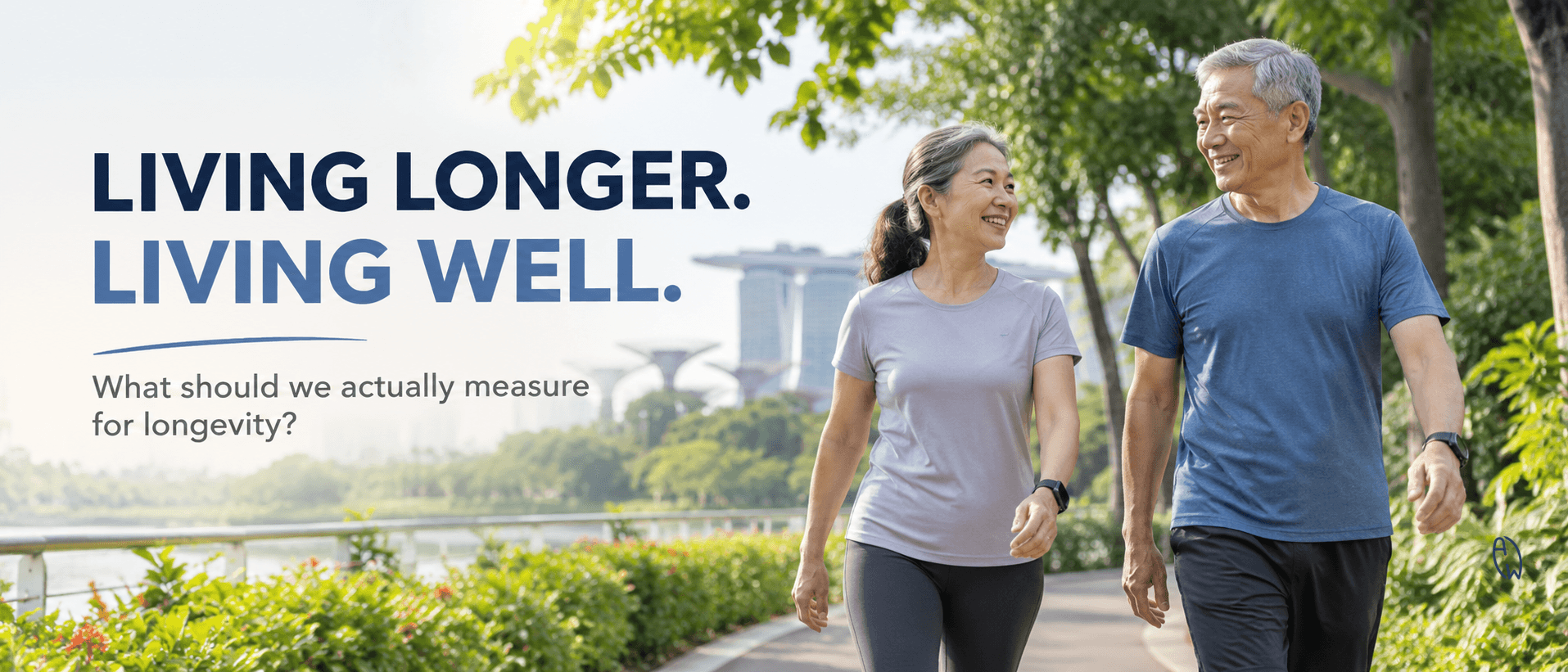
What Should You Actually Test for Longevity? Beyond Biological Age, Muscle, Bone and Spinal Health
Reading Time: 4 minutes
If your blood tests look healthy but you can no longer climb stairs comfortably, struggle to get up from the floor or have difficulty maintaining your balance, are you truly ageing well?
Longevity is becoming an increasingly popular topic. From biological-age testing to advanced blood panels, people are looking for ways to understand how well their bodies are ageing and how long they might live.
But there is another important question we should ask:
Are we measuring the things that allow us to remain healthy, mobile and independent as we grow older?
Living longer is one goal. Being physically capable of enjoying those extra years is another.
1. Biological age: Are you ageing faster than your years?
Biological-age tests aim to estimate how well your body is ageing compared with your chronological age.
Some use blood-based biomarkers, while others examine DNA methylation through epigenetic clocks. Additional assessments may look at inflammation, metabolic health and other indicators.
These technologies are promising, but they are not definitive measures of how long someone will live. Their results should be interpreted alongside established health assessments, medical history and lifestyle factors.
Biological age can offer useful information, but it is only one part of the picture.
2. Cardiovascular fitness: How well can your body use oxygen?
Cardiovascular health remains one of the foundations of healthy ageing.
Blood pressure, cholesterol, blood glucose, HbA1c and kidney function help assess important aspects of metabolic and cardiovascular health. Depending on individual risk, additional markers such as ApoB and lipoprotein(a) may also be useful.
Another important measure is VO₂ max — the maximum amount of oxygen your body can use during intense exercise.
VO₂ max reflects the integrated performance of the heart, lungs, circulation and working muscles. It is an important indicator of cardiorespiratory fitness and has been associated with health outcomes.
It also reminds us that physical fitness cannot be fully understood through blood tests alone.
3. Muscle and bone health: Are you maintaining your physical strength?
Muscle loss is a major concern as we age.
Age-related loss of muscle mass and strength, known as sarcopenia, can affect walking speed, balance, coordination and the ability to perform everyday activities.
Useful functional assessments include:
-
Grip strength
-
Sit-to-stand performance
-
Walking speed
-
Balance testing
Bone health matters just as much. A person may feel strong but still have reduced bone density. When clinically appropriate, a DXA scan can help assess bone mineral density and osteoporosis risk.
Resistance training, weight-bearing activity and adequate nutrition support both muscle and bone health.
We previously explored this in our article, 4 Muscle Groups That Matter Most for Quality of Life After 60.
The goal is not simply to build muscle for appearance. It is to preserve the strength needed to live independently.
4. Spinal health: What happens when pain and posture are overlooked?
Spinal health is another important part of healthy ageing, yet it is often overlooked in discussions about longevity.
As we age, changes in the spine may include disc degeneration, reduced disc height, joint changes and altered posture. Bone loss and declining muscle strength can also affect spinal support and stability.
Scoliosis deserves attention too.
Some adults discover they have scoliosis that began during adolescence but was never diagnosed. Others develop adult degenerative scoliosis as the spine changes with age.
Possible signs include uneven shoulders or hips, visible spinal asymmetry and difficulty maintaining an upright posture. However, scoliosis does not always cause pain, and back pain does not automatically mean someone has scoliosis.
Persistent or recurring back pain should not simply be dismissed as a normal part of ageing.
Pain medication can be useful for short-term symptom relief when appropriate. However, it does not necessarily identify or address the underlying cause of pain. If discomfort keeps returning, worsens or affects daily activities, a proper clinical assessment is important.
Back pain can have many causes, including muscular strain, disc degeneration, spinal stenosis, osteoporosis-related fractures and scoliosis.
When scoliosis is suspected, a standing spinal X-ray may be recommended following clinical assessment. The Cobb angle is used to measure the degree of spinal curvature.
Routine imaging is not necessary for every episode of back pain. The decision should be guided by symptoms, examination findings and clinical indications.
Understanding what is happening matters more than simply masking discomfort.
5. Exercise: The foundation of healthier ageing
No single supplement, blood test or biological-age assessment can replace regular physical activity.
A well-rounded exercise routine should include:
-
Resistance training to maintain muscle strength.
-
Weight-bearing exercise to support bone health.
-
Aerobic activity to improve cardiovascular fitness.
-
Balance and coordination training to reduce functional decline and support mobility.
The World Health Organization recommends that adults aim for 150–300 minutes of moderate-intensity aerobic activity each week, alongside muscle-strengthening activities at least twice weekly.
For older adults, multicomponent activities that emphasise functional balance and strength are also recommended at least three days a week.
Exercise should be adapted to individual ability, health conditions and physical limitations. People with scoliosis or osteoporosis may need a more individualised approach.
Read more: Coordination, Mobility and Strength: The Real Key to Longevity.
The real measure of longevity is how well you live
Longevity testing can provide valuable insights into biological age, cardiovascular health and metabolic risk. But we should not overlook the physical foundations that allow us to enjoy a longer life.
Can you walk comfortably? Maintain your balance? Carry your groceries? Get up from a chair without assistance? Remain active without constantly managing pain?
These everyday abilities are meaningful measures of health.
At All Well Scoliosis Centre, we believe spinal health belongs in the broader conversation about preventive health and healthy ageing. The spine does not function in isolation. It works together with muscles, joints, bones and the nervous system to support movement and everyday function.
For people living with scoliosis, maintaining strength, mobility and appropriate physical activity is also an important part of long-term care. Learn more in our guide: Can I Exercise With Scoliosis? A Guide for Adults.
We should not wait until strength declines, mobility becomes limited or pain interferes with daily life before paying attention to our physical health.
The goal of longevity is not simply to add more years to life. It is to preserve the ability to move, participate, contribute and enjoy those years.
Because living longer and living well are not necessarily the same thing.
Scientific References
-
Levine BD. (2008). VO₂ max: What do we know, and what do we still need to know? The Journal of Physiology, 586(1), 25–34. https://pmc.ncbi.nlm.nih.gov/articles/PMC2375567/
-
Cruz-Jentoft AJ, et al. (2019). Sarcopenia: Revised European consensus on definition and diagnosis. Age and Ageing, 48(1), 16–31. https://pmc.ncbi.nlm.nih.gov/articles/PMC6322506/
-
World Health Organization. (2020). WHO Guidelines on Physical Activity and Sedentary Behaviour. https://www.who.int/publications/i/item/9789240015128