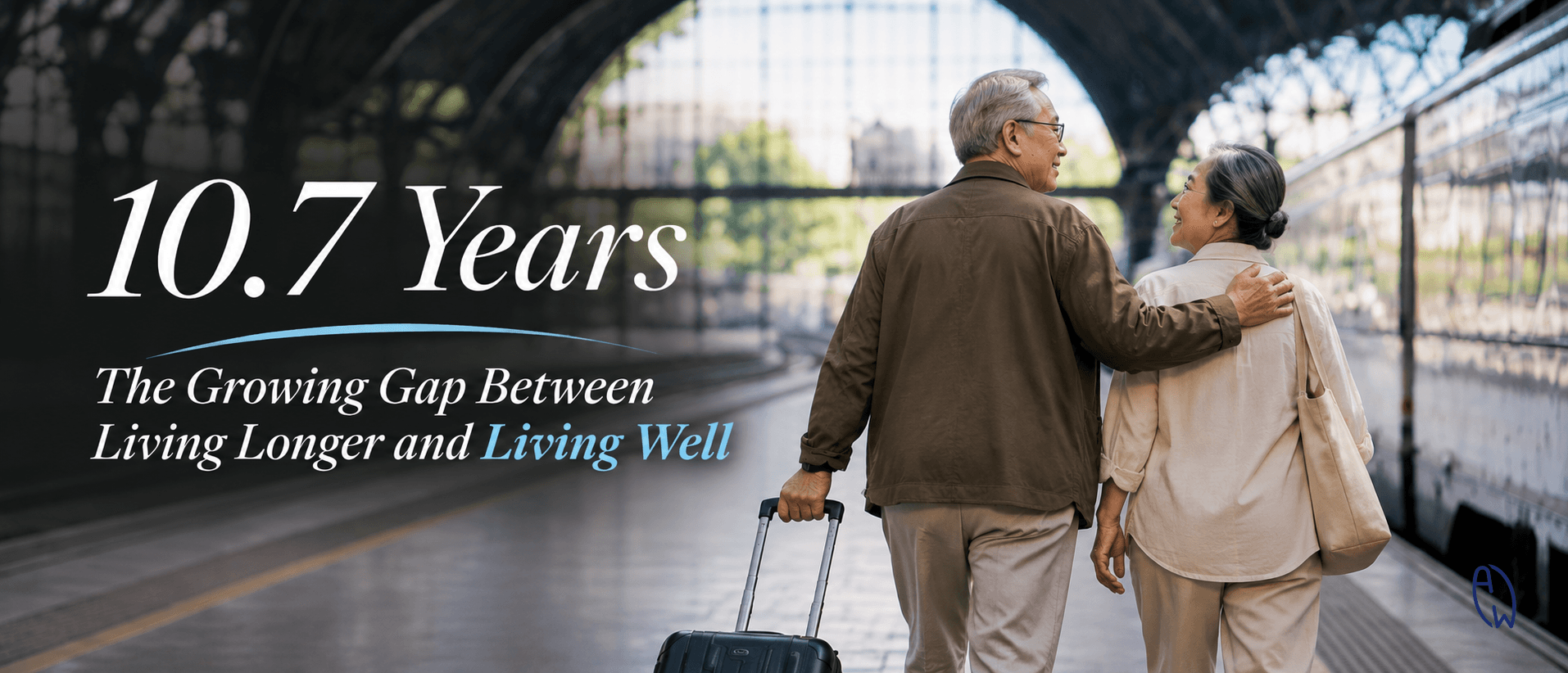
10.7 Years: The Growing Gap Between Living Longer and Living Healthier
We are living longer than ever before. But are we staying healthy enough to enjoy those extra years?
Imagine reaching 85 years old, but spending the last decade struggling with persistent back pain, weak muscles, poor balance or difficulty walking.
You may have lived a long life. But have you been able to enjoy it?
This is the growing challenge of modern healthcare: the difference between lifespan and healthspan.
A major study published in The Lancet Public Health in 2026 reveals an important global trend. People are living longer, but the number of years they spend in good health has not increased at the same pace.
The findings are particularly relevant to Singapore, one of the world's longest-living populations.
What Is the Difference Between Lifespan and Healthspan?
Although these terms are often used together, they describe two different aspects of ageing.
-
Lifespan refers to how long a person lives.
-
Healthspan refers to the number of years a person lives in good health, with minimal limitations from illness or disability.
The difference between these two measures is known as the morbidity gap.
According to the Global Burden of Disease (GBD) 2023 study, the global morbidity gap increased from 8.8 years in 1990 to 10.7 years in 2023.
This means that, on average, people are living approximately 10.7 years with some degree of ill health or disability.
Importantly, this does not mean everyone will experience exactly 10.7 years of illness at the end of life. The research shows that the gap widens across adulthood, rather than being concentrated only in the final years.
In other words, the challenge of healthy ageing begins much earlier than most people realise.
Singapore: Living the Longest Does Not Always Mean Living Healthiest
Singapore has achieved remarkable improvements in life expectancy.
According to the GBD 2023 study, Singapore ranked first globally for both life expectancy and healthy life expectancy.
-
Life expectancy: 85.4 years
-
Healthy life expectancy: 74.1 years
-
Difference: approximately 11.2 years
Despite these impressive figures, Singapore's morbidity gap has increased from 8.9 years in 1990 to 11.2 years in 2023.
There is also an important gender difference.
Women in Singapore have a higher life expectancy than men, at 87.5 years compared with 83.1 years. However, women also spend more years in poor health:
-
Women: 12.1 years
-
Men: 10.4 years
This reflects a wider health paradox observed internationally: women tend to live longer, but often experience more years with illness or disability.
Singapore's experience raises an important question.
Are we simply extending life, or are we helping people maintain their physical abilities, independence and quality of life for longer?
What Actually Takes Away Our Healthy Years?
One of the most interesting findings from the Lancet study is that the conditions responsible for poor health are not limited to heart disease, cancer or diabetes.
Globally, five major groups of conditions accounted for 57.4% of the morbidity gap in 2023.
They included:
1. Musculoskeletal conditions
Musculoskeletal disorders, particularly low back pain, were the largest contributor to the global morbidity gap.
Persistent back pain, joint problems and movement limitations can affect walking, sleeping, working and everyday activities.
2. Mental health conditions
Depression and anxiety can affect motivation, concentration, sleep, relationships and the ability to participate in daily life.
3. Sensory conditions
Age-related hearing loss and other sensory problems can affect communication, balance, safety and social participation.
4. Unintentional injuries
Falls are particularly concerning among older adults. A fall can result in fractures, prolonged inactivity, reduced confidence and loss of independence.
5. Other chronic diseases
Non-communicable diseases, including cardiovascular and metabolic conditions, contribute to the overall burden of poor health.
The important lesson is that a person does not need to have a life-threatening disease to experience a significant reduction in quality of life.
Persistent back pain, reduced muscle strength, poor balance and difficulty performing everyday activities can gradually affect independence.
Being alive is one thing. Being able to move, function and participate in life is another.
Why Musculoskeletal Health Matters as We Age
Our musculoskeletal system includes our muscles, bones, joints, ligaments and connective tissues.
Together, these structures allow us to move, maintain posture, support our body and perform everyday activities.
As we age, changes in these systems can gradually affect our physical capabilities.
1. Muscle loss and reduced strength
Age-related muscle loss, known as sarcopenia, is an important contributor to physical decline.
Muscle strength is essential for much more than lifting weights. It allows us to climb stairs, get out of a chair, carry groceries, maintain balance and recover from physical challenges.
The European Working Group on Sarcopenia in Older People (EWGSOP2) identifies low muscle strength as the primary indicator of probable sarcopenia.
Without appropriate resistance exercise and adequate nutrition, muscle strength and physical performance can decline over time.
2. Spinal degeneration and persistent back pain
The spine undergoes structural changes throughout life.
Intervertebral discs may lose hydration, spinal joints may develop degenerative changes, and some individuals develop degenerative scoliosis.
However, structural degeneration does not automatically mean pain or disability.
Many people have age-related spinal changes without experiencing significant symptoms.
The important consideration is how the spine functions, how well the surrounding muscles support it, and whether an individual can maintain comfortable movement and daily activities.
3. Reduced balance and coordination
Balance is not controlled by one system alone.
It requires the integration of several systems, including:
-
Vision, which helps us understand our surroundings.
-
The vestibular system, which provides information about head movement and spatial orientation.
-
Proprioception, which allows us to sense the position and movement of our body.
-
Muscular control, which helps us maintain stability and respond to changes in position.
As these systems change with age, balance may become less effective and the risk of falling may increase.
Maintaining balance and coordination is therefore an important part of healthy ageing.
4. Reduced physical activity
Pain, fatigue and fear of movement can cause people to become less active.
Unfortunately, prolonged inactivity can create a cycle:
Less movement leads to reduced muscle strength and conditioning. This makes everyday activities more difficult, potentially resulting in even less movement.
Over time, this cycle can contribute to reduced mobility and independence.
This is why maintaining physical function should be a priority long before significant limitations develop.
Can We Influence How Well We Age?
Not every aspect of ageing is within our control. Genetics, existing medical conditions and environmental factors all play a role.
However, many important contributors to poor health are modifiable.
The GBD 2023 study identified high fasting blood glucose, high BMI, occupational risks, high systolic blood pressure and dietary risks among Singapore's leading risk factors contributing to the morbidity gap.
Several practical habits can help support healthier ageing.
1. Build and maintain muscle strength
Resistance training helps preserve muscle mass, strength and physical function.
Examples include:
-
Bodyweight exercises such as squats and modified push-ups.
-
Resistance band exercises.
-
Weight training.
-
Functional exercises such as sit-to-stand movements.
For most adults, muscle-strengthening activities should be performed at least twice a week, involving the major muscle groups.
The exercises should be appropriate for the individual's fitness level and physical condition.
2. Move regularly
Walking, cycling, swimming and other aerobic activities support cardiovascular and metabolic health.
The World Health Organization recommends that adults aim for 150–300 minutes of moderate-intensity aerobic activity each week, or an equivalent amount of vigorous activity.
Regular movement also helps maintain physical conditioning and joint mobility.
3. Look after your spinal health
Maintaining appropriate physical activity, muscle strength, mobility and movement habits can help support spinal function.
Persistent back pain, progressive postural changes or difficulties with movement should not automatically be dismissed as an inevitable part of ageing.
Early assessment can help identify contributing factors and guide appropriate management.
4. Support metabolic health
A balanced diet, adequate protein intake and healthy body weight can support muscle maintenance and metabolic function.
It is also important to monitor blood pressure, blood glucose and cholesterol as part of preventive healthcare.
These factors are particularly relevant because metabolic health influences long-term cardiovascular risk and overall physical well-being.
5. Protect balance and coordination
Balance should be trained just like muscle strength.
Appropriate exercises may include:
-
Single-leg standing with support.
-
Heel-to-toe walking.
-
Controlled sit-to-stand exercises.
-
Functional movement and coordination training.
For older adults, the WHO recommends incorporating multicomponent activities that emphasise functional balance and strength on at least three days a week to improve functional capacity and help prevent falls.
People with a history of falls or significant balance difficulties should seek appropriate assessment before attempting challenging exercises independently.
6. Prioritise sleep and mental well-being
Sleep and mental health are essential components of long-term health.
Poor sleep, chronic stress and untreated mental health difficulties can affect physical recovery, motivation, activity levels and overall well-being.
Healthy ageing should address both physical and psychological health.
Healthy Ageing Should Start Before Old Age
One common misconception is that ageing-related physical decline only needs attention when someone reaches their 60s or 70s.
In reality, the foundations of healthy ageing are built much earlier.
Muscle strength, cardiovascular fitness, bone health, spinal function and metabolic health are influenced by habits developed throughout adulthood.
Waiting until chronic pain, poor balance or significant muscle loss develops may mean there is more ground to recover.
Prevention, early assessment and appropriate rehabilitation are therefore important throughout life.
We should not wait until climbing stairs becomes difficult before thinking about leg strength. We should not wait until a fall occurs before paying attention to balance. And we should not wait until persistent back pain affects daily activities before taking spinal health seriously.
Healthy ageing is not something we start doing at 70. It is something we build throughout life.
The Bigger Picture: Living Longer Should Also Mean Living Better
The 10.7-year global morbidity gap is more than a statistic. It is a reminder that healthcare should not focus exclusively on preventing death or treating disease.
We should also pay attention to the conditions that affect how people move, function and experience everyday life.
At All Well Scoliosis Centre, we believe spinal and musculoskeletal health deserve attention as part of this broader conversation.
Our approach to scoliosis care combines personalised assessment, spinal rehabilitation, corrective bracing where appropriate, and targeted exercises to support posture, strength and physical function.
Although no single treatment can prevent ageing or guarantee a longer healthspan, maintaining physical function is an important part of supporting quality of life.
Ultimately, the goal should not simply be to add more years to life.
It should be to preserve the ability to walk comfortably, maintain balance, stay physically active, enjoy everyday activities and remain independent for as long as possible.
Because longevity is not just about how long we live. It is also about how well we live.
References
-
Hay SI, et al. (2026). Global, regional, and national trends in the morbidity gap and contributing diseases, injuries, and risk factors, 1990–2023: A systematic analysis for the Global Burden of Disease Study 2023. The Lancet Public Health, 11(8), e487–e505. https://doi.org/10.1016/S2468-2667(26)00098-8
-
National University of Singapore, Yong Loo Lin School of Medicine (2026). Singapore has the world's longest, healthiest lives — but also more years in poor health.
-
Ministry of Health, Singapore (2026). Gap between average and healthy life expectancy of Singapore residents and trends over past 10 years.
-
World Health Organization (2020). WHO Guidelines on Physical Activity and Sedentary Behaviour.
-
Cruz-Jentoft AJ, et al. (2019). Sarcopenia: Revised European consensus on definition and diagnosis. Age and Ageing, 48(1), 16–31. https://doi.org/10.1093/ageing/afy169