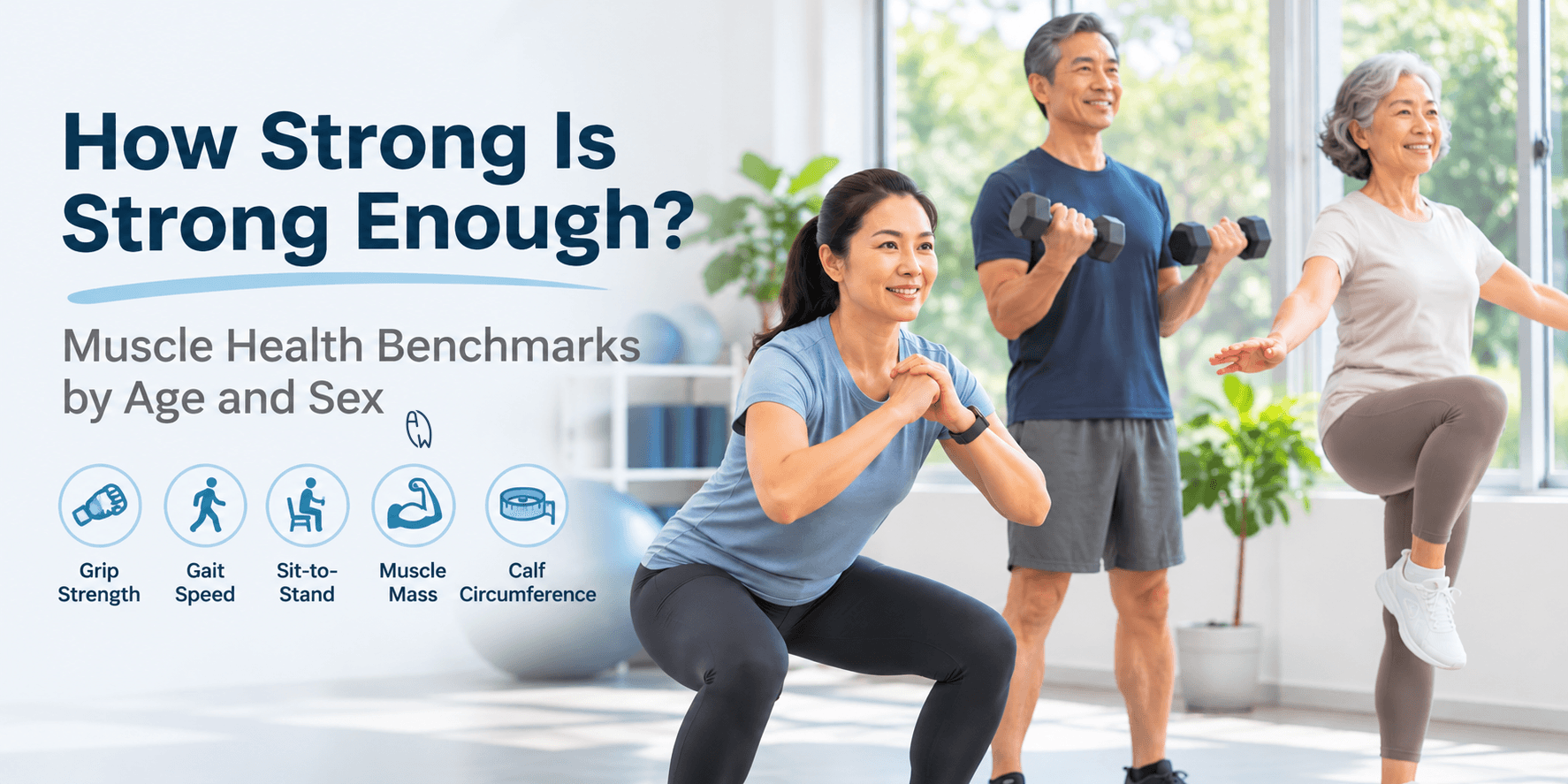
How Strong Is Strong Enough? Muscle Health Benchmarks by Age and Sex
Five ways to measure muscle health, understand age-related muscle loss and maintain strength as you get older.
Are You as Strong as You Should Be for Your Age?
You may walk every day, eat well and exercise regularly. But are you maintaining enough muscle strength as you age?
Being active does not always mean having good muscle health. You can walk several kilometres daily and still have weak leg muscles or gradually lose muscle mass without noticing.
Muscles do much more than help us move. They support posture, balance, joint stability, metabolism and everyday independence.
A major 2026 pan-Asian study involving more than 277,000 participants in its grip-strength analysis has established age- and sex-specific reference values for five important indicators of muscle health.
For people in Singapore and across Asia, this offers a more relevant way to understand physical strength and healthy ageing.
Why Muscle Health Matters
Age-related loss of muscle strength and function is associated with a condition called sarcopenia.
It can make everyday activities increasingly difficult, including:
-
Climbing stairs.
-
Getting up from a chair.
-
Carrying groceries.
-
Maintaining balance.
-
Walking comfortably.
Importantly, muscle mass and muscle strength are not the same. Having more muscle does not automatically mean having better muscle function.
This is why assessing muscle health requires more than looking at body weight or appearance.
Five Ways to Measure Muscle Health
The 2026 study examined five important indicators. Together, they provide a broader picture of physical strength and resilience.
1. Handgrip Strength: A Snapshot of Muscle Strength
Handgrip strength is measured using a handheld instrument called a dynamometer.
Although it measures the force generated by your hand, grip strength is also associated with broader muscle strength and physical function. It is commonly used in sarcopenia screening.
How to improve it:
-
Farmer's carries.
-
Resistance-band rows.
-
Dumbbell exercises.
-
Handgrip exercises.
The takeaway: A simple handgrip test can provide useful information about your physical strength.
2. Gait Speed: How Efficiently Do You Walk?
Walking speed tells us more than how quickly we move.
It reflects how well our muscles, joints, balance and nervous system work together.
Slower walking speed can sometimes indicate declining physical function.
How to improve it:
-
Brisk walking.
-
Stair climbing.
-
Step-ups.
-
Lower-body resistance exercises.
The takeaway: Walking speed is a useful indicator of mobility and physical resilience.
3. Five-Times Sit-to-Stand: Are Your Legs Strong Enough?
This simple test measures how quickly you can stand up from a chair and sit down five consecutive times.
It provides insight into lower-body strength, power, balance and coordination.
A shorter completion time generally indicates better performance.
How to improve it:
-
Chair squats.
-
Controlled lunges.
-
Step-ups.
-
Repeated sit-to-stand exercises.
The takeaway: Strong legs help you maintain independence in everyday activities.
4. Skeletal Muscle Mass: Your Muscle Reserve
Skeletal muscle mass refers to the amount of muscle tissue in your body.
It can be estimated using body composition analysis (BIA) or measured using DXA scanning.
Muscle supports movement, metabolism, glucose regulation and physical recovery.
As we age, muscle mass can gradually decline, particularly without sufficient resistance training.
How to maintain it:
-
Progressive resistance training.
-
Adequate protein intake.
-
Sufficient overall nutrition.
-
Good sleep and recovery.
The takeaway: Maintaining muscle mass gives your body greater physical reserve as you age.
5. Calf Circumference: A Simple Screening Tool
Calf circumference is measured using a measuring tape around the widest part of the calf.
A smaller measurement may sometimes indicate reduced muscle reserve, particularly in older adults.
However, it can also be affected by body fat, swelling and fluid retention. It is therefore a screening indicator, not a diagnosis.
How to support calf strength:
-
Standing calf raises.
-
Stair climbing.
-
Incline walking.
-
Lower-body resistance exercises.
The takeaway: Even a simple measurement can provide useful clues about muscle health.
What Is a Good Muscle Strength Benchmark?
There is no single number that defines good muscle health for everyone.
Age and sex influence muscle strength, which is why the new Asian reference values are important.
For example, the study found that median handgrip strength generally decreases across older age groups. Among adults aged 40–44, the median was approximately 24 kg for women and 41 kg for men.
These are population reference values, not minimum health requirements. Individual results should be interpreted according to the appropriate age and sex group.
The study also provides percentile values, allowing people to understand how their measurements compare with others of similar age and sex.
An important distinction: Singapore contributed participants to the research, but pooled Asian reference values should not be confused with Singapore-specific benchmarks.
The more useful questions are:
-
Am I maintaining my strength?
-
Am I becoming stronger or gradually weaker?
-
Can I perform everyday activities comfortably?
-
How have my measurements changed over time?
Being average does not necessarily mean being optimally healthy. The goal should be to maintain good physical function throughout life.
Is Walking Enough to Maintain Muscle?
Walking is excellent for cardiovascular health, endurance and general mobility.
However, walking alone may not provide enough resistance to maintain all major muscle groups.
A balanced exercise routine should include:
-
Walking or cycling: Supports cardiovascular fitness.
-
Resistance training: Maintains muscle strength and mass.
-
Balance exercises: Improve stability and coordination.
-
Mobility exercises: Help maintain comfortable joint movement.
-
Functional exercises: Improve everyday physical ability.
The World Health Organization recommends muscle-strengthening activities involving all major muscle groups at least twice a week.
Consistency matters more than exercising intensely every day.
For people with scoliosis, exercise should also consider individual spinal conditions, symptoms and movement limitations. Read our guide on exercising with scoliosis as an adult for more information.
Nutrition Matters Too
Muscles need adequate nutrition to repair and maintain themselves.
Protein is particularly important because it supplies the amino acids required for muscle maintenance and recovery.
Good sources include:
-
Eggs, fish and chicken.
-
Milk and yoghurt.
-
Tofu and tempeh.
-
Beans and lentils.
Vitamin D also contributes to normal muscle function and bone health.
However, nutrition works best alongside resistance training. Simply eating more protein without providing muscles with an appropriate training stimulus is unlikely to maximise muscle development.
For more information, read our Scoliosis Nutrition Guide: Vitamin D, Calcium and Bone Health.
The Connection Between Muscle Health, Posture and Scoliosis
Muscles play an important role in supporting the spine, pelvis and overall movement.
For people with scoliosis, differences in spinal alignment and muscle activation may influence posture, balance and movement patterns.
Maintaining muscle strength and coordination is therefore particularly relevant.
An appropriate exercise programme may include:
-
Core and trunk muscle endurance.
-
Hip and pelvic stability.
-
Postural awareness.
-
Balance and coordination.
-
Scoliosis-specific exercises (PSSE), where appropriate.
However, muscle weakness does not simply cause scoliosis, and general strengthening exercises alone cannot correct a structural spinal curve.
At All Well Scoliosis Centre, we recognise that spinal health involves more than alignment. Muscle function, movement control and physical conditioning are also important parts of maintaining overall function.
You may also find our article on Hip Joint Biomechanics and Scoliosis useful for understanding how the hips and surrounding muscles contribute to standing and walking.
Balance is another important part of physical resilience. Read Why Do Some People With Scoliosis Have Poor Balance? to learn more about the relationship between the brain, proprioception and movement.
Four Steps to Better Muscle Health
A practical approach to maintaining muscle health is simple:
-
Measure: Assess your strength, mobility and muscle reserve.
-
Identify: Understand which areas need improvement.
-
Improve: Follow an appropriate exercise and nutrition programme.
-
Reassess: Repeat comparable measurements to monitor progress.
This helps shift the focus from simply exercising to understanding whether your physical capacity is actually improving.
Frequently Asked Questions
1. At what age does muscle loss begin?
Muscle changes can begin during adulthood, although the rate of decline varies. Reduced activity, inadequate nutrition, illness and ageing can all contribute.
2. Can walking alone prevent muscle loss?
Walking supports cardiovascular health and mobility, but resistance training is important for maintaining and developing muscle strength.
3. Is muscle mass more important than muscle strength?
Both matter. Muscle mass describes the quantity of muscle tissue, while strength reflects its ability to produce force. Physical performance also provides important information about functional health.
4. How can I tell whether I have sarcopenia?
A healthcare professional may assess grip strength, chair-rise performance, muscle quantity and physical function. No single home measurement is sufficient to diagnose sarcopenia.
5. Can muscle strength improve after 60?
Yes. Older adults can still develop muscle strength through appropriately prescribed progressive resistance training.
6. Does scoliosis affect muscle strength?
Scoliosis can be associated with differences in trunk muscle structure, activation and movement patterns. However, these vary between individuals and require individual assessment.
Final Thoughts: Stronger Ageing Starts Today
We often monitor cholesterol, blood pressure and blood sugar, but how often do we measure our muscle strength?
The ability to walk comfortably, climb stairs, maintain balance and get up from a chair independently is an important part of healthy ageing.
The new Asian reference values provide a useful starting point for understanding these abilities.
Do not wait until you feel weak before paying attention to your muscles.
At All Well Scoliosis Centre, we believe that good spinal health should go hand in hand with strength, coordination, balance and overall physical function.
The goal is not simply to live longer. It is to remain strong enough to enjoy the life we are living.
References
-
Grgic, J., et al. (2026). Asian Reference Values for Handgrip Strength, Gait Speed, Five-Times-Sit-to-Stand Test, Muscle Mass and Calf Circumference. Journal of Cachexia, Sarcopenia and Muscle, 17(1), e70216. https://doi.org/10.1002/jcsm.70216
-
World Health Organization. (2020). WHO Guidelines on Physical Activity and Sedentary Behaviour. https://www.who.int/publications/i/item/9789240015128
-
Cruz-Jentoft, A. J., et al. (2019). Sarcopenia: Revised European consensus on definition and diagnosis. Age and Ageing, 48(1), 16–31. https://doi.org/10.1093/ageing/afy169