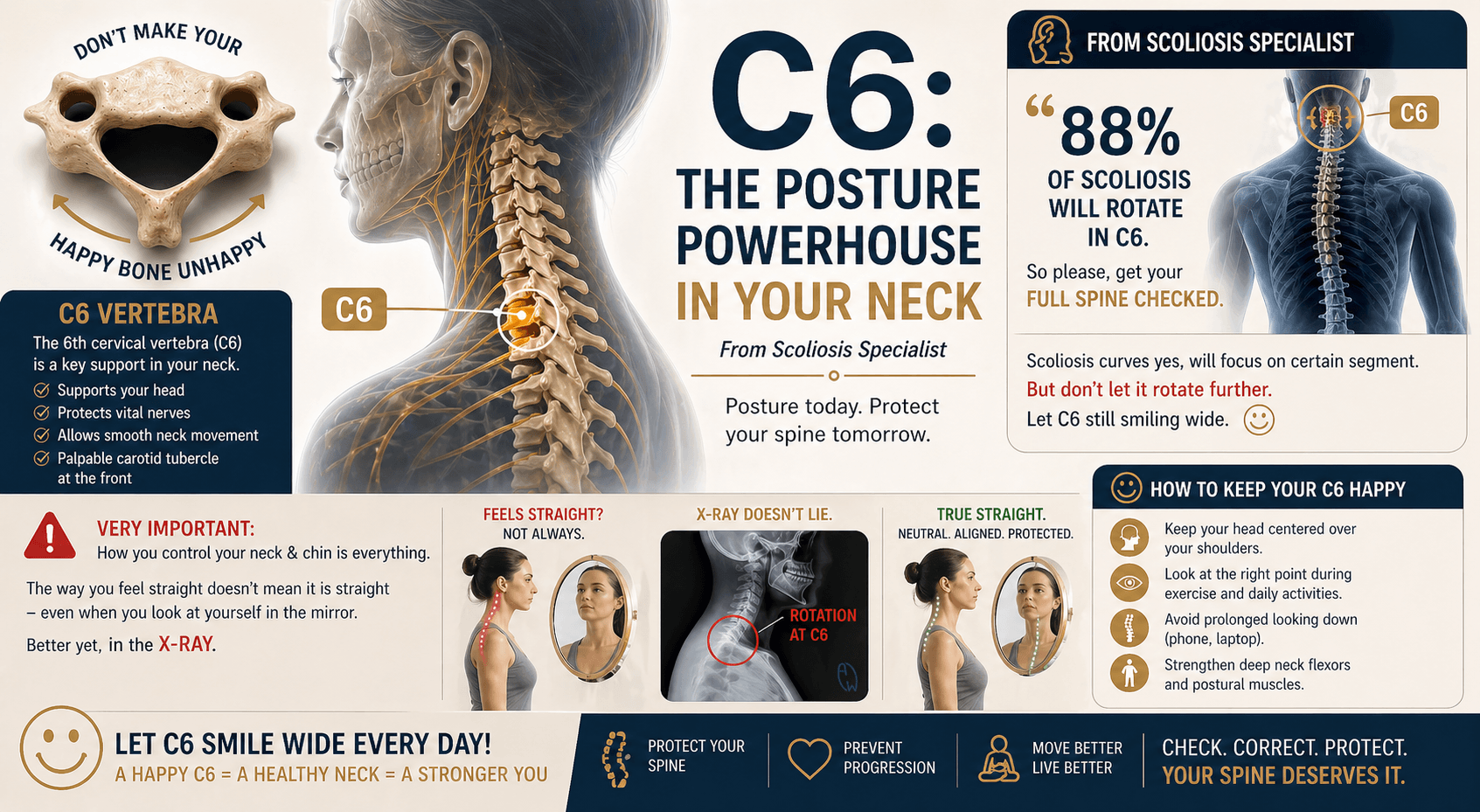
C6 Vertebra: The “Happy Bone” Behind Neck Pain, Posture & Scoliosis
When it comes to neck pain, posture, and spinal health, one structure stands out more than most—the C6 vertebra.
Often called the “happy bone,” C6 plays a powerful role in supporting your head, protecting vital nerves, and maintaining proper alignment. But modern habits—and especially scoliosis—can quickly turn this “happy bone” into a major source of dysfunction.
What Is the C6 Vertebra?
The C6 vertebra is the sixth bone in your cervical spine (neck), located slightly above the shoulder level.
It is responsible for:
-
Supporting the weight of your head
-
Protecting the spinal cord within the spinal canal
-
Allowing smooth neck movement
-
Acting as a transition point between neck mobility and upper back stability
Because of its position, C6 is exposed to constant movement and mechanical stress, making it highly sensitive to posture and alignment changes.
Why C6 Is Called the “Happy Bone”
The natural shape of the C6 vertebra resembles a wide smile.
When your posture is balanced:
-
The vertebra sits evenly
-
Movement is smooth
-
Muscles work symmetrically
But when posture is poor or the spine is imbalanced:
-
That “smile” becomes tilted or rotated
-
One side becomes overloaded
-
Pain and dysfunction begin
👉 In simple terms:
A balanced C6 = a “smiling” spine.
A rotated C6 = an unhappy one.
The Strong Link Between C6 and Scoliosis
Many people think scoliosis only affects the mid or lower back. But clinically, the cervical spine—especially C6—plays a major compensatory role.
From a Scoliosis Specialist Perspective:
Up to 88% of scoliosis cases involve rotation at the C6 level.
Here’s why:
-
Scoliosis causes the spine to curve and rotate
-
The body tries to keep your head and eyes level
-
The neck compensates to maintain balance
-
C6 becomes a key adjustment point
This leads to:
-
Increased rotational stress
-
Muscle imbalance
-
Higher risk of pain and stiffness
👉 This is why you must check the entire spine—not just the visible curve.
Don’t Let Your “Happy Bone” Become a Twisted Smile
In scoliosis and poor posture:
-
Its “smile” becomes uneven or looped to one side
-
Compensation patterns worsen over time
Scoliosis curves will focus on certain segments—yes.
But if left unchecked, they will also influence areas like C6.
👉 The goal is clear:
Do not let C6 rotate further.
Why “Feeling Straight” Doesn’t Mean You Are Straight
This is one of the most important clinical truths patients need to understand.
The way you feel is not always the way you are aligned.
With postural adaptation and scoliosis:
-
Your brain adjusts to imbalance
-
“Straight” can feel normal—even when it’s not
-
Mirror checks can still be misleading
👉 The most accurate assessment comes from:
-
Professional posture analysis
-
Clinical evaluation
-
Imaging such as X-ray
X-ray doesn’t lie.
Neck & Chin Control: The Hidden Key to Protecting C6
Your daily habits directly affect C6—especially how you control your neck and chin position.
Common mistakes:
-
Pushing the chin forward
-
Looking down at your phone for long periods
-
Rotating slightly during exercise
These create:
-
Increased compression
-
Asymmetrical loading
-
Progressive rotation at C6
Why “Where You Look” Matters During Exercise
Your eyes guide your head.
Your head guides your spine.
If your gaze is incorrect:
-
Your head shifts forward or rotates
-
C6 becomes misaligned
-
Muscles activate unevenly
If your gaze is correct:
-
Your head stays centered
-
Your spine aligns properly
-
Movement becomes efficient and safe
👉 In scoliosis patients, this becomes even more critical—
because small deviations create bigger imbalances.
How to Keep Your C6 Healthy and Stable
1. Check Your Full Spine
Don’t focus only on one curve—C6 may already be compensating.
2. Train Your Posture Daily
Keep your head stacked over your shoulders.
3. Control Your Chin Position
Avoid forward head posture and unnecessary rotation.
4. Fix Your Screen Habits
Bring your phone up—don’t bring your head down.
5. Exercise With Awareness
Your gaze, alignment, and control matter more than intensity.
Is Manual Therapy Safe for Neck Pain? What Research Says
Neck pain is one of the most common symptoms associated with dysfunction in both the cervical and thoracic spine. In fact, research shows that the neck does not work in isolation—it is closely connected to the upper back.
A clinical study published by the National Institutes of Health highlights an important finding:
The mobility of the thoracic spine plays a significant role in neck movement and function.
This means that when the upper back (thoracic spine) becomes stiff or restricted, the neck—especially segments like the C6 vertebra—is forced to compensate more, leading to increased strain and discomfort.
Why Thoracic Spine Treatment Helps Neck Pain
Manual therapy targeting the thoracic spine has been widely recommended because it:
-
Improves overall spinal mobility
-
Reduces compensatory stress on the cervical spine
-
Enhances movement efficiency
-
Helps decrease pain and stiffness in the neck
By restoring motion in the thoracic region, the cervical spine—particularly C6—can function more naturally without overload.
Is Manual Manipulation Safe?
Based on current clinical research, manual therapy is considered safe and effective when performed by a properly trained professional.
However, safety does not come from the technique alone—it comes from:
-
Proper assessment of the full spine
-
Clinical reasoning and experience
-
Individualized treatment planning
👉 In other words, treatment should never be “one-size-fits-all.”
What Patients Need to Understand
It’s important to approach care with both confidence and awareness:
-
Trust your provider—but ensure they perform a thorough evaluation
-
Understand that treatment may involve areas beyond where you feel pain
-
Recognize that improving the thoracic spine can significantly reduce neck strain
Especially in conditions like scoliosis, where compensation patterns are present, addressing the entire spine—not just the neck—is essential.
Final Thought
Neck pain is rarely just a “neck problem.” It’s often part of a larger movement system involving both the cervical and thoracic spine.
When manual therapy is applied correctly:
-
It restores balance
-
Reduces compensation
-
Supports long-term spinal health
The key is not just the treatment—but the expertise behind it.
The C6 vertebra may be small, but it carries a big responsibility.
-
It supports your head
-
It compensates for scoliosis
-
It reflects your daily habits
Don’t let it become a twisted, overworked joint.
✔ Get your full spine checked
✔ Don’t rely only on how you feel
✔ Correct posture early
✔ Prevent further rotation
Because at the end of the day:
A happy C6 = a healthier neck, better posture, and a stronger spine.