What Is Central Sensitization?
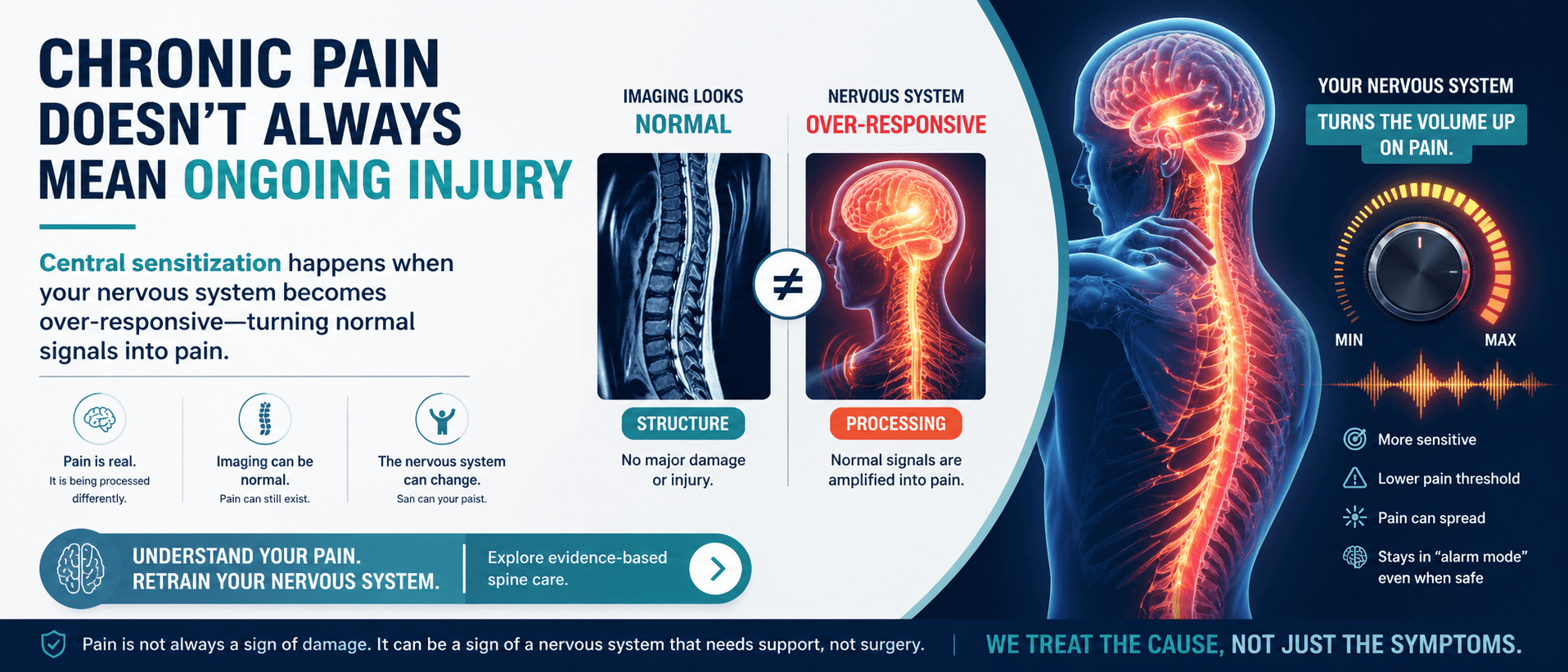
Central sensitization is a condition where your nervous system turns up the volume on pain.
Instead of pain accurately reflecting tissue damage, the brain and spinal cord become over-responsive, amplifying normal signals into pain. This means even light movement, pressure, or daily activity can feel painful — not because the body is being harmed, but because the pain-processing system has become hypersensitive.
Why Chronic Back Pain Isn’t Always About Injury
In acute injuries, pain serves a clear purpose — it protects you while tissues heal. But in chronic back pain, the story changes.
Many patients come in with:
-
Persistent pain lasting months or years
-
MRI or X-ray reports that look “normal” or show minimal findings
-
Symptoms that don’t match the severity of structural issues
This is where central sensitization becomes important.
The issue is not always ongoing injury.
It’s that the central nervous system (brain + spinal cord) has learned to stay in a heightened state of alert.
Think of it like a car alarm that goes off even when there’s no real threat.
How the Nervous System Amplifies Pain
When central sensitization develops, several changes occur:
1. Lower Pain Threshold
The body becomes more sensitive. Stimuli that were previously painless — like sitting, bending, or even light touch — can now trigger discomfort.
2. Increased Signal Amplification
The spinal cord and brain boost incoming signals, making them feel more intense than they actually are.
3. Persistent “Alarm Mode”
The nervous system stays in a protective state, even after tissues have healed.
4. Pain Spreading Beyond the Original Area
Patients may notice pain expanding to other regions — not because of new injury, but because of neural sensitization.
“My Scan Is Normal, So Why Does It Hurt?”
This is one of the most frustrating experiences for patients.
You’re told:
-
“Your MRI looks fine.”
-
“There’s nothing structurally wrong.”
Yet the pain is very real.
Here’s the key truth:
Pain is always real — but it is not always a direct measure of damage.
In central sensitization, the pain is being processed differently, not imagined. The brain interprets normal signals as threats, producing genuine discomfort.
What Causes Central Sensitization?
It doesn’t happen overnight. It’s usually the result of multiple factors over time:
-
Previous injuries that never fully resolved
-
Repetitive strain or poor movement patterns
-
Chronic stress and nervous system overload
-
Fear of movement (kinesiophobia)
-
Lack of proper rehabilitation after injury
Over time, the nervous system “learns” pain — and keeps repeating it.
Why Understanding Central Sensitization Changes Treatment
If chronic back pain is treated purely as a structural issue, patients often get stuck in a cycle of:
-
Repeated imaging
-
Passive treatments
-
Temporary relief with no long-term change
But once we understand central sensitization, the approach shifts.
Treatment is no longer just about the tissue
It becomes about retraining the nervous system.
Effective Treatment Approach for Central Sensitization
1. Education First
Patients need to understand:
-
Their pain is real
-
Their body is not “broken”
-
The nervous system can change and adapt
This alone can reduce fear and improve outcomes.
2. Graded Movement and Exercise
Avoiding movement reinforces sensitivity.
Instead, we introduce:
-
Controlled, progressive exercises
-
Spine-safe loading strategies
-
Movement confidence rebuilding
This helps “turn the volume down” over time.
3. Nervous System Regulation
Chronic pain is closely tied to stress and heightened alertness.
Strategies include:
-
Breathing control
-
Relaxation techniques
-
Sleep optimization
4. Consistency Over Quick Fixes
Central sensitization doesn’t resolve with one session.
It requires:
-
Repetition
-
Patience
-
Structured progression
Central Sensitization and Scoliosis / Spine Patients
In patients with scoliosis or long-standing spinal conditions, central sensitization is especially common.
Why?
Because:
-
The body has been adapting for years
-
Muscles are working asymmetrically
-
Pain signals have been reinforced repeatedly
This is why some patients continue to experience pain even after structural corrections or interventions.
The Takeaway
Central sensitization explains why:
-
Pain can persist without clear structural damage
-
Imaging doesn’t always match symptoms
-
Chronic back pain needs a different treatment approach
Your pain is real — but the system processing it has become overactive.
And the good news is:
The nervous system can be retrained.
Final Thought
When patients understand that pain is not always equal to damage, everything changes:
-
Fear decreases
-
Movement improves
-
Recovery becomes possible
This is where modern, evidence-based spine care needs to focus — not just on fixing structure, but on resetting how the body experiences pain.