This X-Ray Disappointed Everyone. It Became One of Our Most Important Scoliosis Lessons.
When we took this patient's first post-intensive X-ray, nobody in the room was celebrating.
Not the patient.
Not her parents.
Not even us.
After days of intensive scoliosis rehabilitation, the changes were smaller than everyone had hoped.
The spine had improved.
But not dramatically.
For many clinics, this is the type of case that never makes it onto social media.
It doesn't create a dramatic before-and-after image.
It doesn't generate headlines.
It doesn't fit the narrative that every scoliosis patient experiences a remarkable correction after treatment.
But we believe these are exactly the cases worth sharing.
Because they teach something many families need to hear:
Scoliosis treatment is not simply about what happens during an intensive program.
It is about what happens afterwards.
And sometimes the most important change is not in the spine.
Sometimes it is in the patient.
Do We Only Share the Good Scoliosis Cases?
Every now and then someone asks us:
"Do you only post successful scoliosis cases?"
It's a fair question.
After all, social media often shows the best outcomes.
The biggest corrections.
The most dramatic transformations.
But scoliosis is one of the most complex conditions to manage.
Every patient is different.
Every curve is different.
Every growth pattern is different.
Every level of commitment is different.
If scoliosis were easy, there would be no need for scoliosis specialists, corrective bracing, rehabilitation programs, or spinal fusion surgery.
The truth is that scoliosis outcomes vary.
Some patients improve quickly.
Some improve slowly.
Some stabilize.
Some struggle.
And some teach us lessons we never forget.
This patient is one of them.
A 14-Year-Old Girl Who Didn't Think Scoliosis Was a Big Deal
When she first arrived at our clinic, she was 14 years old.
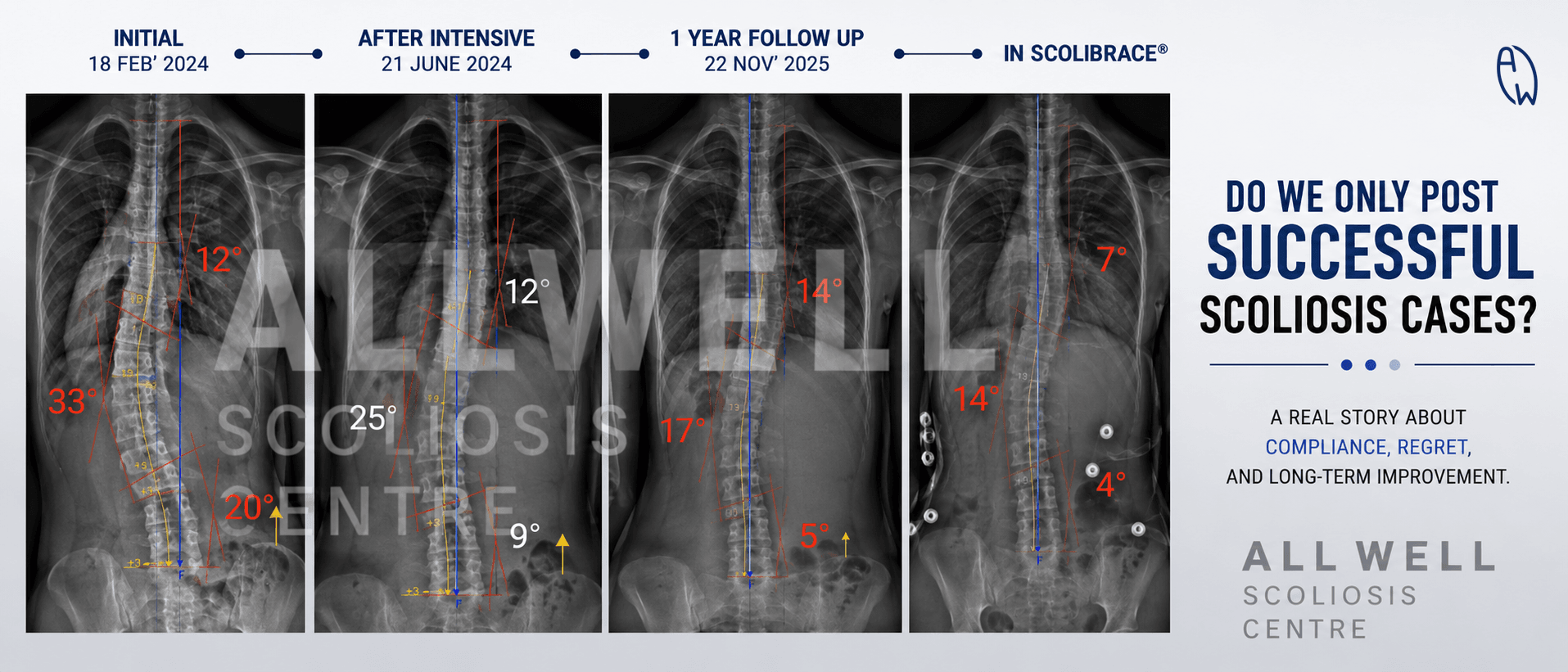
Her X-rays revealed a scoliosis pattern measuring approximately:
-
33° thoracic scoliosis
-
20° lumbar scoliosis
There was also noticeable spinal rotation and postural imbalance.
From a clinical perspective, this was a spine that required attention.
From her perspective?
Not really.
Like many teenagers, scoliosis was not at the top of her priority list.
She wasn't worried about Cobb angles.
She wasn't worried about vertebral rotation.
She wasn't worried about future progression.
She was worried about being 14.
-
School.
-
Friends.
-
Exams.
-
Appearance.
-
Clothes.
-
Acne.
-
Social life.
The scoliosis was hidden beneath the surface.
She couldn't see it.
She couldn't feel most of it.
And because she couldn't see it, she underestimated it.
This is one of the biggest challenges in adolescent scoliosis care.
Many teenagers feel relatively normal despite having significant spinal deformity.
Unfortunately, scoliosis progression does not always wait until symptoms appear.
Why Symptoms Don't Always Match the X-Ray
One of the biggest misconceptions about scoliosis is that larger curves always cause severe symptoms.
That isn't necessarily true.
This patient had no significant pain.
She reported:
-
Occasional soreness
-
Fatigue during prolonged walking
-
Reduced endurance when running longer distances
Yet she was still functioning relatively well.
This is common in Adolescent Idiopathic Scoliosis (AIS).
Many teenagers with moderate scoliosis experience surprisingly few symptoms despite measurable spinal curvature and rotation.
The absence of pain does not mean the absence of progression.
This is why regular scoliosis screening, clinical evaluation, and X-ray monitoring remain important during growth years.
The Intensive Program Didn't Produce the Result Everyone Wanted
The patient completed our intensive scoliosis rehabilitation program.
She received:
-
Scoliosis-specific rehabilitation
-
Corrective exercises
-
Postural retraining
-
Home exercise instruction
-
Ongoing treatment recommendations
The same effort was given by our team that we provide to every patient.
But there was one challenge.
The motivation wasn't coming from her.
She attended because her parents wanted her to.
Not because she fully understood why it mattered.
And motivation matters.
Because scoliosis rehabilitation is not passive.
Exercises must be performed.
Corrective positions must be repeated.
Habits must be maintained.
The patient must participate.
When we performed the follow-up X-ray after the intensive phase, the results were modest.
The thoracic curve improved from approximately:
33° → 25°
The lumbar curve improved from approximately:
20° → 9°
Those are positive changes.
But the most encouraging finding was not necessarily the Cobb angle reduction.
It was the improvement in rotational control and spinal stability.
Scoliosis is not simply a side-to-side curve.
It is a three-dimensional condition involving:
-
Lateral curvature
-
Vertebral rotation
-
Postural imbalance
Reducing rotational stress can be an important step toward long-term spinal stability.
As clinicians, we recognized that progress.
But something more important was about to happen.
The Day This Stopped Being Her Parents' Problem
When she saw her follow-up X-ray, something changed.
Not because we explained it differently.
Not because her parents pressured her.
Not because we gave a motivational speech.
The X-ray spoke for itself.
For the first time, she understood that scoliosis was not her parents' problem.
It was hers.
She realized she had not fully committed.
She knew she could have worked harder.
She knew she had underestimated the condition.
And perhaps for the first time, she understood that the outcome was not entirely determined by the clinic.
This was the moment her motivation shifted.
Until then, she was operating on external motivation.
She attended because her parents wanted her to attend.
She exercised because she was told to exercise.
She followed instructions because somebody else wanted her to.
But sustainable change rarely happens that way.
Real change often begins when motivation becomes internal.
When the patient decides:
"I want this for myself."
That realization may have been more important than any treatment we provided.
Understanding Compliance in Scoliosis Treatment
This is where many conversations about scoliosis become oversimplified.
People compare X-rays online without understanding that no two patients have identical compliance.
Two patients may have:
-
Similar Cobb angles
-
Similar ages
-
Similar curve patterns
-
Similar treatment plans
Yet achieve very different outcomes.
Why?
Because compliance matters.
Research consistently shows that outcomes are influenced by:
-
Brace wear time
-
Exercise adherence
-
Follow-up attendance
-
Daily posture habits
-
Long-term consistency
Treatment plans do not work because they exist.
They work because they are followed.
The Real Improvement Happened During Maintenance Care
Instead of becoming discouraged, she made a decision.
She chose to take ownership.
After seeing her X-ray, she became significantly more committed to her treatment plan.
She started attending maintenance care regularly.
Sometimes every other week.
At minimum, once a month.
She became more engaged.
More accountable.
More consistent.
And that is when the next chapter began.
One Year Later: The X-Ray Told a Different Story
More than a year after the intensive program, repeat imaging showed continued improvement.
The thoracic curve improved further to approximately:
14°
The lumbar curve improved further to approximately:
5°
When assessed in her ScoliBrace®, the correction was even greater:
-
Thoracic curve approximately 7°
-
Lumbar curve approximately 4°
Just as importantly, the rotational control remained significantly improved compared with her initial presentation.
These changes did not occur because of the intensive program alone.
They occurred because she continued showing up.
Month after month.
Appointment after appointment.
Exercise after exercise.
Choice after choice.
Does Scoliosis Improvement Last?
One of the most common questions families ask is:
"If scoliosis improves, won't it just come back?"
This case taught us something important.
The better question may be:
"Will the habits that created the improvement continue?"
Because scoliosis management is more similar to:
-
Orthodontics
-
Physical fitness
-
Athletic training
-
Weight management
Than it is to taking a course of antibiotics.
The spine responds to what we repeatedly ask it to do.
Long-term outcomes are often influenced by long-term behaviours.
The Most Important Lesson From This Case
This story is not really about Cobb angles.
It is not really about bracing.
It is not really about exercises.
And it is not really about X-rays.
It is about ownership.
A teenager underestimated her scoliosis.
She entered treatment without strong personal motivation.
Her initial results were less impressive than they could have been.
She experienced disappointment.
She reflected.
She took responsibility.
And once she became an active participant in her own care, the spine continued moving in the right direction.
Not overnight.
Not perfectly.
But steadily.
So Did This Case Improve?
We encourage you to study the X-rays carefully.
Look beyond the numbers.
Look at the timeline.
Look at the stabilization.
Look at the rotational changes.
Look at what happened after the patient decided to show up for herself.
Did the scoliosis improve?
Did it stabilize?
Did the rehabilitation make a difference?
We'll leave that judgment to you.
But if there is one lesson this case teaches, it is this:
People often ask whether scoliosis treatment is permanent.
This case taught us that the better question may be:
Are the habits that created the improvement permanent?
Because the intensive program started the journey.
But the patient's commitment changed the destination.