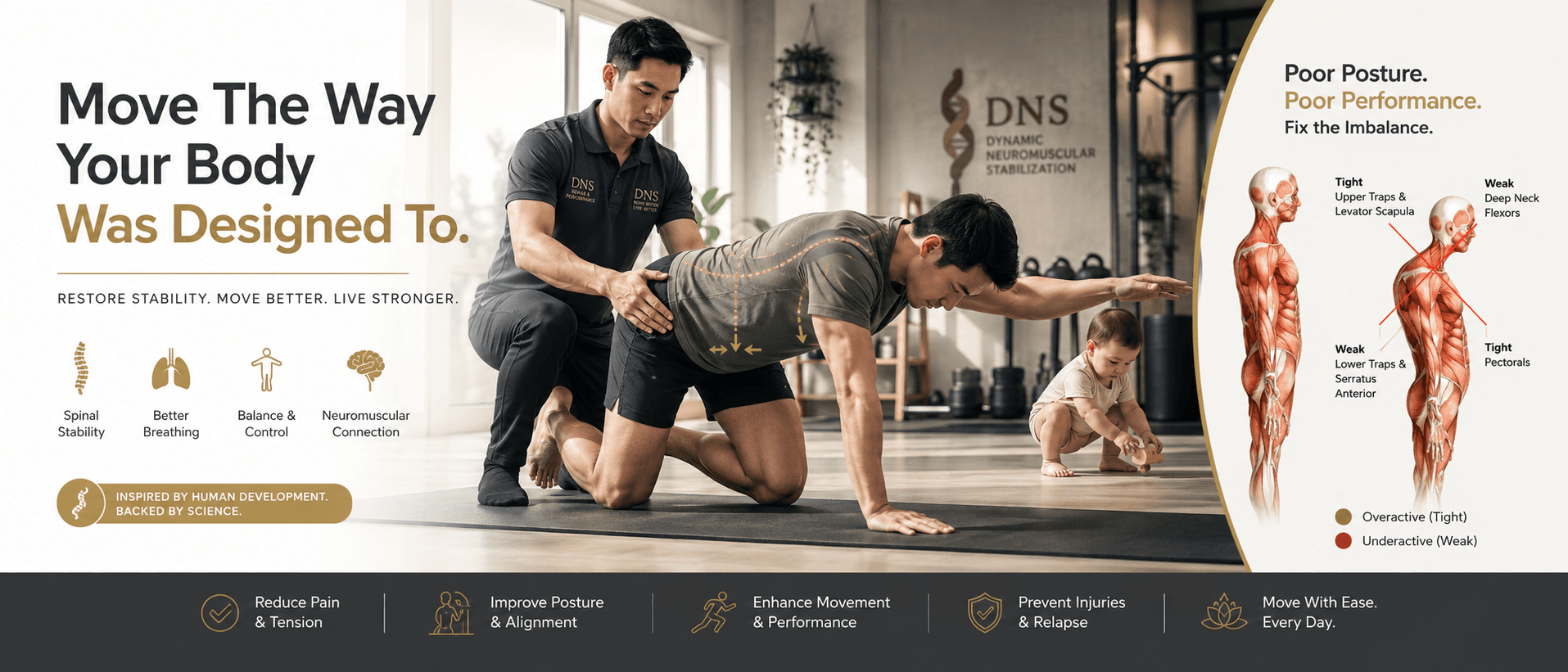
Dynamic Neuromuscular Stabilization (DNS): What Babies Can Teach Adults About Pain, Balance, and Human Movement
Understanding Developmental Kinesiology and Why the Body Sends Warning Signals Before Injury Happens
Modern healthcare often focuses on symptoms after pain appears. But the human body usually communicates long before serious injury develops. Tight hips, unstable balance, shaking muscles during exercise, neck tension, knee pain, poor posture, or chronic stiffness are often early neurological warning signs — not random problems.
This is where Dynamic Neuromuscular Stabilization (DNS) becomes increasingly important.
DNS is a rehabilitation and movement approach based on developmental kinesiology, the scientific study of how human movement naturally develops from infancy. Research published in rehabilitation and sports medicine literature explains that healthy babies are born with genetically programmed movement patterns that teach the body how to stabilize, breathe, balance, and move efficiently. These patterns form the foundation of lifelong spinal stability and movement control.
The problem is that many adults gradually lose these natural movement strategies through sedentary lifestyles, stress, repetitive postures, poor breathing mechanics, stiffness, and modern work habits.
Babies Naturally Understand Balance and Stability
Observe a healthy baby picking up a toy from the floor.
The movement is smooth, balanced, coordinated, and efficient. Babies instinctively squat deeply without straining the knees or lower back. Their breathing remains relaxed while the spine stays stable and organized.
Babies naturally know how to:
-
Stabilize their spine
-
Coordinate breathing with movement
-
Shift weight efficiently
-
Activate deep core muscles
-
Maintain balance
-
Move without unnecessary tension
According to DNS research, this happens because the nervous system develops movement in a precise sequence:
-
Breathing control
-
Head stabilization
-
Rolling
-
Crawling
-
Sitting
-
Kneeling
-
Standing
-
Walking
Each stage builds neurological stability for the next stage of movement development.
These developmental patterns are not random. They are part of the body’s original movement blueprint controlled by the brain, spinal cord, and nervous system.
Stability Must Come Before Strength
One of the core principles of Dynamic Neuromuscular Stabilization is that the body must stabilize properly before generating force.
Modern adults often skip foundational movement control and jump directly into intense exercise, heavy lifting, repetitive workouts, or prolonged sitting without adequate mobility and stabilization capacity.
The brain may think:
-
“I’m strong enough.”
-
“I can push harder.”
-
“I can sit longer.”
-
“I can keep training through pain.”
But the nervous system may already be struggling.
DNS research emphasizes that healthy movement depends on:
-
Proper diaphragm function
-
Core stabilization
-
Coordinated breathing
-
Joint centration
-
Neuromuscular control
-
Efficient weight distribution
Without these foundations, the body compensates.
Over time this may contribute to:
-
Chronic back pain
-
Neck tension
-
Knee overload
-
Hip stiffness
-
Poor posture
-
Recurrent injuries
-
Reduced athletic performance
-
Movement inefficiency
Pain is often the final stage of dysfunction — not the beginning.
Breathing Is More Important Than Most People Realize
DNS research highlights that the diaphragm is not only a breathing muscle.
It is also one of the body’s primary stabilization muscles.
When functioning properly, the diaphragm works together with:
-
The pelvic floor
-
Deep abdominal muscles
-
Spinal stabilizers
Together these systems create intra-abdominal pressure that stabilizes the spine before movement occurs.
Poor breathing patterns can disrupt spinal stability and increase compensation throughout the body.
This is why many people with chronic pain also demonstrate:
-
Shallow chest breathing
-
Rib flare
-
Poor posture
-
Neck tension
-
Reduced core control
The body loses its natural stabilization strategy.
Sedentary Living Disconnects Adults From Natural Movement
Babies spend much of their day moving, exploring, rolling, crawling, balancing, and adapting to gravity.
Modern adults often do the opposite.
Long hours of sitting, screen time, stress, repetitive work positions, and lack of movement variability slowly change how the nervous system controls movement.
The body becomes:
-
Stiffer
-
Less adaptable
-
Less coordinated
-
More compressed
-
Less efficient under load
Adults frequently attempt movements their nervous system is no longer prepared to stabilize efficiently.
This creates compensation patterns that may overload muscles and joints.
The body then begins sending warning signals.
Muscle Shaking During Exercise Is Not Always “Normal”
One major issue in modern fitness culture is normalizing excessive muscle shaking during exercise.
When the thighs, calves, or core shake aggressively during balancing exercises, Pilates, or isometric holds, many people assume this simply means the workout is effective.
However, DNS principles suggest excessive trembling may indicate:
-
Poor neuromuscular coordination
-
Insufficient stabilization
-
Lack of progressive adaptation
-
Nervous system fatigue
-
Weak foundational control
The body may actually be communicating:
-
“This movement is too advanced.”
-
“Your stabilizers are not coordinating efficiently.”
-
“You skipped foundational movement progression.”
-
“The nervous system cannot control this load properly yet.”
This does not mean exercise should stop.
It means movement progression should be gradual and intelligent.
The nervous system adapts best when mobility, balance, stabilization, and coordination improve before aggressive loading is added.
DNS Retrains the Brain Through Developmental Movement
Dynamic Neuromuscular Stabilization does not focus only on isolated muscle strengthening.
Instead, DNS retrains the brain and spinal cord to restore efficient movement patterns.
DNS rehabilitation commonly uses developmental positions inspired by infancy, including:
-
Three-month stabilization positions
-
Rolling patterns
-
Crawling mechanics
-
Deep squat positioning
-
Diaphragmatic breathing exercises
-
Reflexive core activation
The goal is to improve:
-
Spinal stability
-
Joint positioning
-
Balance
-
Breathing efficiency
-
Movement coordination
-
Weight distribution
-
Nervous system control
Rather than forcing movement through compensation, DNS aims to rebuild the body’s original stabilization strategies.
Your Nervous System Is Always Communicating
The spinal cord is not simply a structure supporting posture.
It is the communication highway between the brain and body.
Every movement provides feedback regarding:
-
Joint position
-
Muscle tension
-
Balance
-
Stability
-
Pressure distribution
-
Coordination
When movement quality declines, the nervous system adapts by creating compensations to help the body continue functioning.
At first these compensations may seem harmless.
But over years they can contribute to chronic dysfunction and pain.
Many people continue ignoring these warning signs because modern culture encourages productivity over body awareness.
We often suppress symptoms while continuing the same movement habits that created the dysfunction.
Mobility and Control Should Precede Heavy Strength Training
One of the most important lessons from DNS and developmental kinesiology is that strength should be built on top of movement quality.
A body lacking mobility and stabilization becomes vulnerable under load.
This is why progression matters:
-
Restore mobility
-
Improve breathing mechanics
-
Rebuild stabilization
-
Develop balance
-
Add controlled strength
-
Progress gradually
The body adapts more effectively through progressive exposure rather than sudden overload.
Final Thoughts
Dynamic Neuromuscular Stabilization reminds us that the human body was designed to move intelligently from birth.
Babies naturally demonstrate efficient posture, balance, breathing, and coordination because their nervous system follows a developmental sequence that prioritizes stability before movement.
Modern lifestyles often disconnect adults from these foundational movement patterns.
DNS is not about moving like a baby again.
It is about restoring the neurological foundations that allow the body to move with better control, less compensation, improved balance, and greater long-term resilience.
Sometimes pain is not the body failing.
Sometimes it is the nervous system asking us to move differently and pay attention before bigger problems develop.