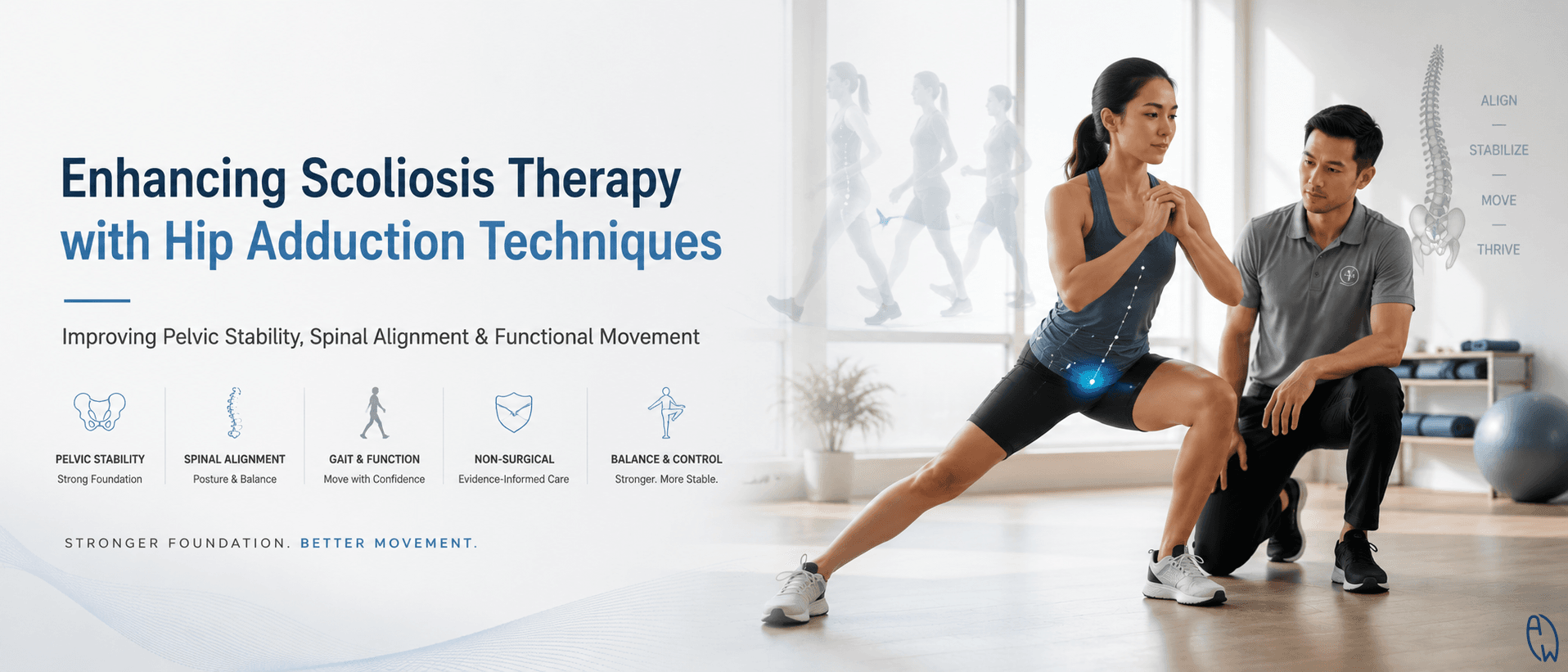
Copenhagen Planks, Hip Adduction, and Scoliosis: Why Integrated Adductor Training Matters for Spinal Alignment and Real Movement
Many people today are strengthening their inner thighs using exercises like the Copenhagen plank or adduction machines.
And while these exercises can absolutely be helpful, they are only one piece of the puzzle.
Your adductors do not work alone in real life.
They work together with the:
-
glutes
-
pelvis
-
pelvic floor
-
core muscles
-
diaphragm
-
feet
-
spinal stabilizers
These muscles coordinate constantly when you stand, walk, run, climb stairs, balance on one leg, or transfer weight from side to side.
This is especially important for people with scoliosis, pelvic imbalance, hip instability, or movement asymmetries.
That is why modern scoliosis rehabilitation is moving beyond isolated strengthening and focusing more on integrated movement training.
What Are the Adductors?
The adductors are the muscles located along the inner thigh. Their primary role is to help bring the leg inward, but their real function goes much deeper than that.
In everyday movement, the adductors help:
-
stabilize the pelvis
-
control the femur
-
assist balance
-
support gait mechanics
-
transfer force during walking and running
-
coordinate trunk and hip movement
They are highly active during:
-
single-leg stance
-
walking
-
running
-
lunging
-
stair climbing
-
rotational movement
This means the adductors are not simply “inner thigh muscles.” They are part of a larger stability and movement system.
Why Hip Adduction Matters for Spinal Alignment
Hip adduction is important in scoliosis rehabilitation because the relationship between the hips, pelvis, and spine is closely connected.
Your pelvis acts as the foundation for your upper body.
If that foundation is weak, unstable, or asymmetrical, it may influence how the spine positions itself over time. In some individuals, poor pelvic control can contribute to compensation patterns that place more stress on the spine and surrounding muscles.
The hip adductors help stabilize the pelvis and maintain alignment during movement.
When these muscles are weak, poorly coordinated, or overcompensating on one side, the body may begin shifting load unevenly through the hips, pelvis, and spine.
This is why strengthening and retraining the adductors may become an important part of a comprehensive scoliosis rehabilitation program.
But strengthening alone is not enough.
The goal is not just stronger muscles.
The goal is better coordination, posture, balance, and movement efficiency.
The Problem With Isolation-Only Training
Exercises such as:
-
adduction machines
-
side-lying hip adduction
can help improve isolated muscle strength and awareness.
Isolation has value.
It teaches the brain how to activate specific muscles.
But your body does not function in isolation during daily life.
Your adductors need to work dynamically with the:
-
glutes
-
deep core system
-
pelvic floor
-
trunk stabilizers
-
feet and ankles
If the body only learns to activate these muscles lying on the floor or sitting on a machine, it may not fully transfer into walking, running, posture, or athletic movement.
This is where integrated rehabilitation becomes essential.
Why Integrated Movement Training Matters
Integrated exercises teach the adductors how to stabilize, coordinate, and produce force while the body moves naturally.
Examples include:
Split squat
Split squats help train:
-
pelvic control
-
hip stability
-
trunk positioning
-
single-leg loading
The adductors work together with the glutes and core to control the pelvis during hip flexion and extension.
Lateral lunge
Lateral lunges challenge frontal plane stability and help the body absorb force more efficiently.
They also improve:
-
inner thigh coordination
-
balance
-
side-to-side control
-
athletic movement capacity
Single-leg deadlift
Single-leg hinges train:
-
posterior chain strength
-
pelvic stability
-
foot control
-
balance mechanics
This teaches the adductors to function within the entire movement system rather than in isolation.
Walking and Running
Running may actually be one of the most functional forms of adductor integration.
Every step requires coordination between:
-
the feet
-
pelvis
-
spine
-
hips
-
trunk
-
breathing system
If the adductors cannot stabilize efficiently during gait, compensations may appear elsewhere in the body.
How This Relates to Scoliosis
Scoliosis is not simply a sideways spinal curve.
It often affects:
-
pelvic alignment
-
rib cage positioning
-
weight distribution
-
gait mechanics
-
breathing patterns
-
muscular balance
-
rotational control
In many cases, one side of the body works differently from the other.
One adductor may become tight and overactive while the opposite side becomes weak or poorly coordinated.
This is why scoliosis rehabilitation should not always focus on symmetrical strengthening alone.
Modern scoliosis rehabilitation often includes:
-
individualized exercise programming
-
breathing correction
-
gait retraining
-
pelvic stabilization
-
trunk control
-
rotational awareness
-
movement integration
The goal is to improve how the entire body works together.
Building a Stronger Foundation for the Spine
When hip adductor strength and coordination improve, that stability often transfers upward into the trunk and back muscles.
A more stable pelvis may help:
-
support better posture
-
reduce excessive spinal compensation
-
improve movement efficiency
-
reduce muscular tension
-
improve balance and walking mechanics
This whole-body approach has become an important part of modern non-surgical scoliosis management.
By improving stability from the feet, hips, and pelvis upward, the body may distribute load more efficiently and reduce unnecessary stress on the spine.
Over time, this may contribute to:
-
improved spinal awareness
-
better posture
-
reduced discomfort
-
improved athletic movement
-
more confidence in daily activity
Combining Hip Adduction With Modern Scoliosis Rehabilitation
To sum up, adding hip adduction exercises into scoliosis therapy may help improve movement quality, pelvic control, spinal stability, and overall functional outcomes.
When integrated with more comprehensive rehabilitation approaches such as the CLEAR Scoliosis Institute method, scoliosis-specific corrective exercise, breathing mechanics, and customized bracing like ScoliBrace, treatment becomes more individualized and function-focused.
This approach does not simply target one muscle group.
It aims to help the entire body move and function more efficiently as a connected system.
Hip adduction exercises alone are not a cure for scoliosis.
However, when used strategically within a full rehabilitation program, they may become an important tool for improving posture, pelvic stability, gait mechanics, and spinal support.
Every scoliosis pattern is unique.
That is why proper assessment, movement analysis, and imaging such as X-rays are important to fully understand the structural picture rather than only chasing symptoms.
Isolation Builds Awareness. Integration Builds Function.
Copenhagen planks are useful. But they should not be the final destination.
The goal is not simply stronger inner thighs.
The goal is a body that can:
-
stabilize dynamically
-
coordinate efficiently
-
move confidently
-
distribute load properly
-
support the spine during real-life movement
Whether you are an athlete, runner, office worker, or someone living with scoliosis, integrated movement rehabilitation may help improve how your body moves, balances, and adapts over time.
Strength matters.
But coordinated strength matters even more.