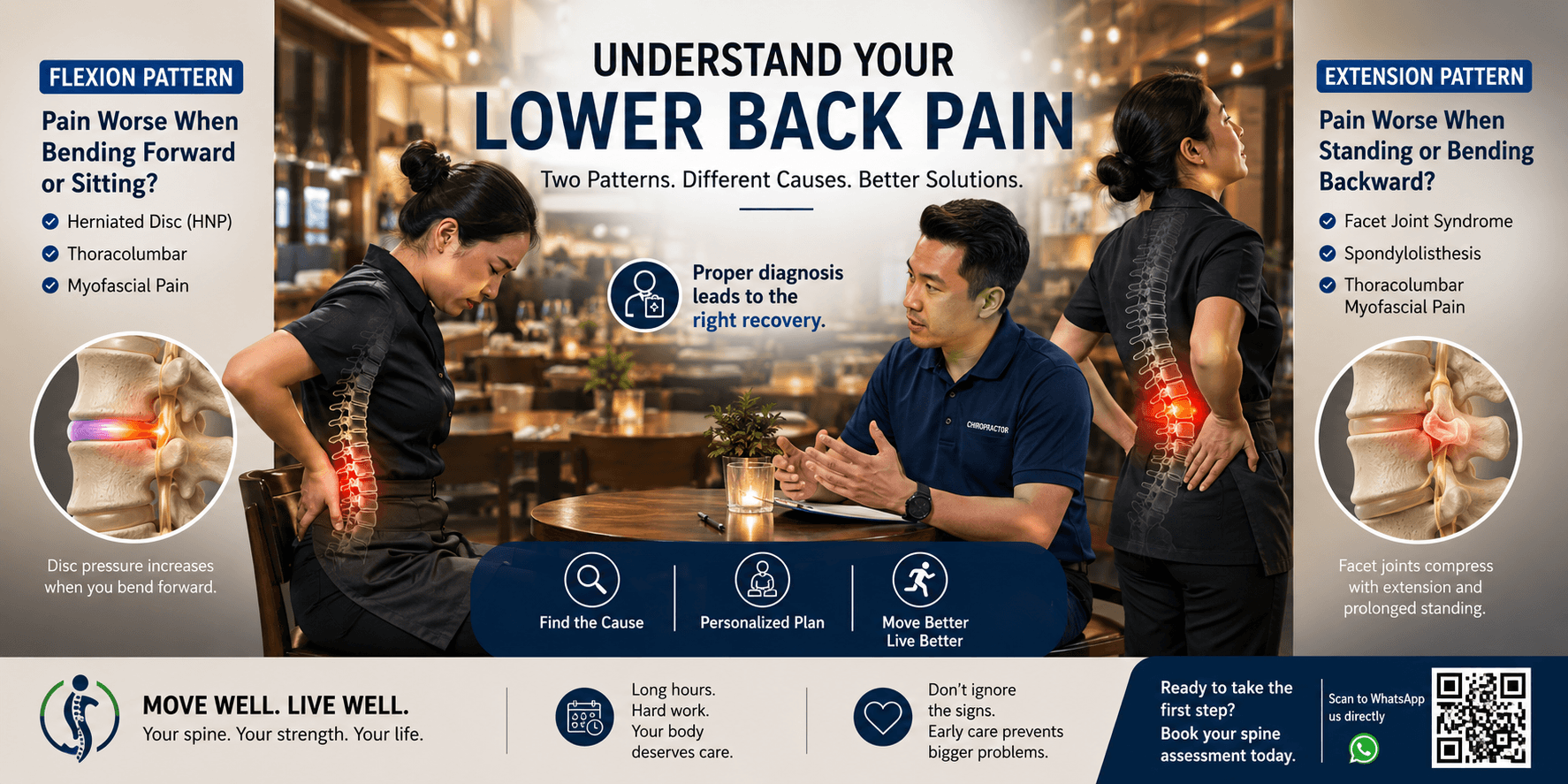
Flexion Pattern vs Extension Pattern Low Back Pain: Why Proper Diagnosis Matters
Lower back pain is one of the most common complaints I encounter as a chiropractor. Recently, while having dinner with my wife at a restaurant, the manager approached me after learning about my profession. She shared that she worked nearly 12 hours a day, 6 days a week — constantly standing, walking, lifting, bending, and managing the restaurant floor.
Like many people suffering from chronic back pain, she asked:
“Can you give me a quick fix?”
The truth is, there is rarely a true “quick fix” for persistent lower back pain. What matters most is understanding what type of back pain you are experiencing and identifying the underlying cause properly.
Not all lower back pain is the same.
Two individuals may point to the exact same painful area, yet the structures causing the pain may be completely different. One person may feel relief when bending backward, while another may worsen significantly with the same movement.
This is why proper assessment and diagnosis are essential.
Why Asking the Right Questions Matters
Instead of immediately recommending stretches or exercises, I asked her several important questions:
-
Is the pain worse in the morning after waking up?
-
Does prolonged sitting aggravate the symptoms?
-
Does standing too long increase discomfort?
-
Do you feel relief when bending forward?
-
Or do you feel better bending backward?
These questions help differentiate two very common mechanical lower back pain presentations:
-
Flexion Pattern Low Back Pain
-
Extension Pattern Low Back Pain
Understanding the movement pattern helps guide:
-
safer exercise recommendations
-
posture correction strategies
-
rehabilitation planning
-
imaging recommendations if necessary
-
long-term recovery approaches
1. Flexion Pattern Low Back Pain
What Is a Flexion Pattern?
A flexion pattern occurs when symptoms worsen during forward bending, prolonged sitting, slouching, or sustained spinal flexion.
This pattern is commonly seen in:
-
office workers
-
drivers
-
students
-
restaurant staff
-
individuals with prolonged sitting habits
Common Conditions Associated With Flexion Pattern
Herniated Disc (HNP / Slipped Disc)
Disc-related problems are commonly aggravated by:
-
prolonged sitting
-
repeated bending
-
poor posture
-
lifting with a rounded back
The lumbar discs already experience high mechanical pressure during sitting. Over time, repetitive flexion loading may sensitize the discs and surrounding tissues.
Thoracolumbar Myofascial Pain
Tightness and trigger points around the thoracolumbar fascia can also contribute to this presentation, especially in people with:
-
weak spinal endurance
-
poor posture
-
sedentary lifestyles
-
prolonged sitting habits
Common Symptoms
People with flexion pattern pain often report:
-
pain after prolonged sitting
-
difficulty standing upright after sitting
-
morning stiffness
-
discomfort while tying shoes
-
pain radiating into the buttock or leg
-
temporary relief with walking or gentle backward bending
Typical Movement Response
Individuals with flexion-based lower back pain often worsen with:
-
slouching
-
prolonged sitting
-
repetitive forward bending
-
lifting with poor mechanics
Many experience temporary relief with gentle extension movements because these positions may reduce stress on irritated spinal discs and posterior soft tissues.
Clinically, repeated forward loading can progressively sensitize lumbar discs, ligaments, and thoracolumbar fascia, particularly in individuals with poor posture, weak spinal stability, and insufficient movement variability throughout the day.
2. Extension Pattern Low Back Pain
What Is an Extension Pattern?
An extension pattern is a type of lower back pain that worsens when the spine moves into excessive backward bending, prolonged standing, or lumbar compression.
People with this pattern often feel discomfort during:
-
prolonged standing
-
walking for extended periods
-
arching backward
-
standing upright after long activity
-
stomach sleeping
-
activities involving spinal compression
Many individuals feel temporary relief when:
-
sitting down
-
bending forward
-
leaning onto a shopping cart
-
bringing the knees toward the chest
Common Conditions Associated With Extension Pattern
Facet Joint Syndrome
The facet joints are small stabilizing joints located at the back of the spine. Excessive standing or extension can increase joint compression and irritation.
Spondylolisthesis
Spondylolisthesis occurs when one vertebra shifts forward relative to another. Extension movements may increase stress on unstable spinal segments and aggravate symptoms.
Thoracolumbar Myofascial Pain
Myofascial pain can also appear in extension patterns due to muscular overcompensation and prolonged spinal loading.
Common Symptoms
People with extension pattern pain commonly experience:
-
pain while standing too long
-
stiffness after prolonged walking
-
localized lower back discomfort
-
increased pain during backward bending
-
relief when sitting or bending forward
Unlike flexion-related pain, extension pattern pain is usually associated with compression of the posterior spinal structures, especially the facet joints and surrounding tissues.
This presentation is frequently seen in:
-
restaurant workers
-
nurses
-
hairstylists
-
retail workers
-
individuals who stand for long hours daily
Why Proper Assessment and Imaging Matter
After hearing the restaurant manager’s symptoms, I suggested obtaining an X-ray if she wanted a clearer understanding of what was happening.
Her response was simple:
“I have no time.”
Unfortunately, this is something I hear very often.
Many people continue pushing through pain until the symptoms begin affecting:
-
sleep
-
walking ability
-
work performance
-
energy levels
-
mood
-
overall quality of life
By the time daily activities become severely limited, recovery often becomes more difficult.
Proper assessment does not automatically mean surgery is necessary. In many cases, imaging and clinical evaluation simply help determine:
-
whether spinal instability exists
-
if degeneration is present
-
which exercises are safe
-
which movements should temporarily be avoided
-
whether specialist referral is needed
Why Massage Alone May Not Be Enough
Many individuals assume all back pain is “just muscle tightness.”
While massage therapy may temporarily reduce tension and improve circulation, persistent symptoms may indicate deeper structural or mechanical issues.
Ongoing lower back pain may involve:
-
disc irritation
-
joint dysfunction
-
nerve involvement
-
spinal instability
-
faulty movement patterns
-
muscular compensation strategies
Pain is often the body’s warning signal that something requires attention.
Ignoring symptoms for months or years may eventually increase the risk of long-term degeneration and more aggressive interventions later.
There Is No True Quick Fix
Healthcare providers can help improve movement quality, reduce mechanical stress, and guide rehabilitation strategies.
However, meaningful recovery still requires:
-
proper diagnosis
-
movement correction
-
consistent exercise
-
lifestyle modification
-
recovery time
-
long-term spinal care
A random stretch copied from social media may help one individual while significantly aggravating another.
This is why identifying whether your pain follows a flexion pattern or extension pattern is extremely important.
When Should You Get Your Lower Back Checked?
Consider seeking professional assessment if:
-
pain persists for several weeks
-
symptoms repeatedly return
-
pain radiates into the legs
-
numbness or weakness develops
-
standing or sitting becomes difficult
-
sleep is affected
-
daily activities become limited
Early intervention may help reduce long-term spinal degeneration and improve overall quality of life.
Your Body Deserves Better
Many hardworking people ignore pain while prioritizing work, responsibilities, and family.
But your body is the vehicle that carries you through life.
You deserve better than waiting until the pain becomes so severe that independence is lost and daily function becomes difficult.
Listen to your body early.
Move better.
Recover smarter.
And give yourself the opportunity to age with strength, resilience, and dignity.