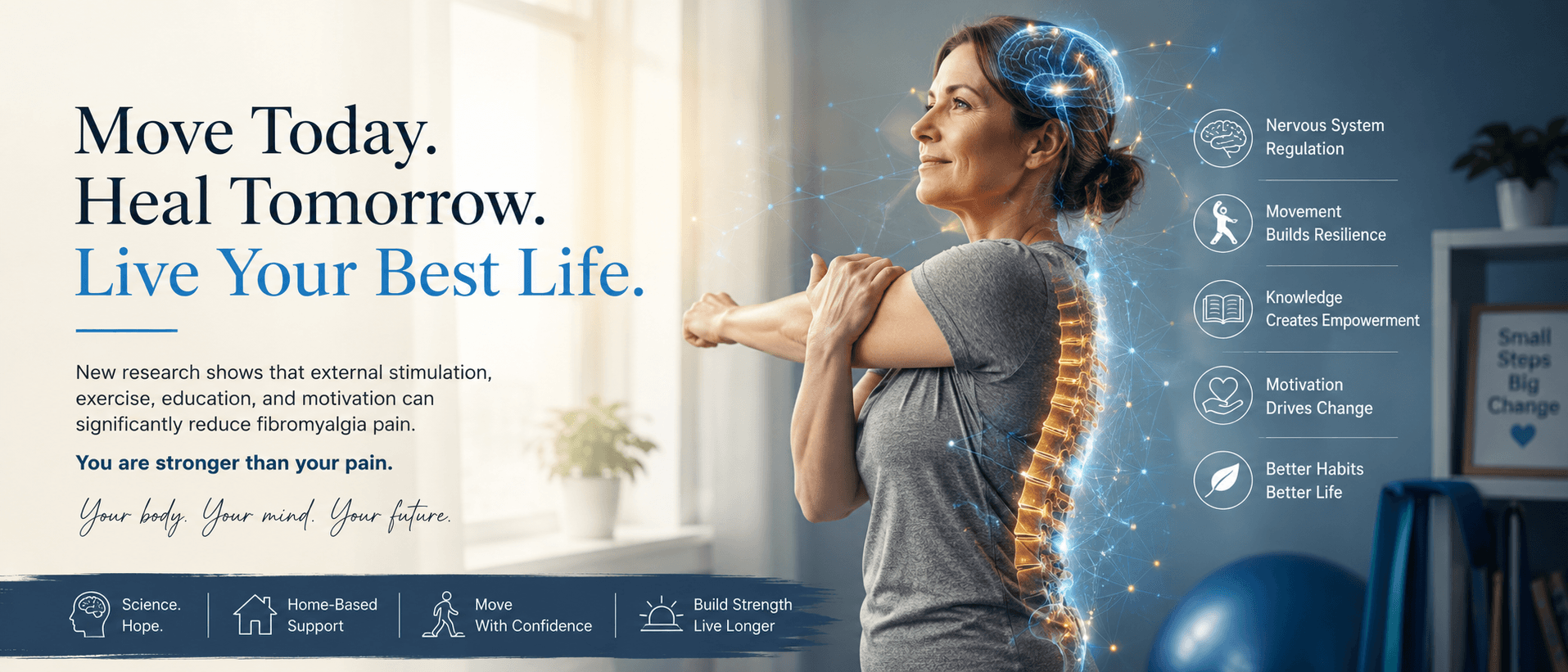
Transcranial Stimulation for Fibromyalgia: Why Movement, Mindset, and Nervous System Health Matter
Fibromyalgia is one of the most misunderstood chronic pain conditions today. Millions of people live with daily body aches, fatigue, poor sleep, brain fog, and emotional exhaustion — often without clear answers. Many patients go from one treatment to another searching for relief, only to feel frustrated when medications provide limited improvement.
New research published in JAMA Network Open offers something worth paying attention to: a comprehensive home-based approach using transcranial direct current stimulation (tDCS), movement, education, and motivation may significantly reduce fibromyalgia pain and improve quality of life.
This research is important because it reinforces something many rehabilitation professionals already observe in clinical practice: the brain, nervous system, movement, emotions, and lifestyle are deeply connected.
What Is Fibromyalgia?
Fibromyalgia is a chronic condition characterized by:
-
Widespread musculoskeletal pain
-
Fatigue
-
Sleep disturbances
-
Brain fog and cognitive difficulties
-
Increased sensitivity to pain
-
Emotional stress and mood changes
Research estimates that fibromyalgia affects approximately 2.0–5.8% of the population worldwide. Unfortunately, there is currently no cure. Even with medications, only about 10–15% of patients achieve more than a 50% reduction in pain symptoms.
That means many people continue living in a cycle of discomfort, inactivity, stress, and hopelessness.
What Did the Research Show?
Researchers investigated whether a home-based treatment strategy could help reduce fibromyalgia symptoms more effectively.
The program combined:
-
Transcranial direct current stimulation (tDCS)
-
Exercise guidance
-
Pain neuroscience education
-
Motivational interviewing
The results were encouraging.
Participants receiving active tDCS experienced at least a 50% reduction in pain scores in 62.5% of cases, compared to only 37.5% in participants receiving sham stimulation.
This matters because it shows that pain management does not only happen through medication. The nervous system itself can be influenced through non-invasive stimulation, education, movement, and mindset-based interventions.
What Is tDCS?
Transcranial Direct Current Stimulation, commonly called tDCS, is a non-invasive technique that applies low electrical currents to specific areas of the brain.
The goal is to help regulate neuronal excitability and improve how the central nervous system processes pain signals.
Fibromyalgia is believed to involve abnormal pain processing within the central nervous system. In simple terms, the brain and nervous system may become overly sensitive, amplifying pain signals even when tissue damage is minimal.
This is why many fibromyalgia patients feel pain everywhere despite normal scans or blood tests.
The research suggests that calming and retraining the nervous system may help reduce this amplified pain response.
A Bigger Message Beyond the Technology
While we currently do not offer Transcranial Direct Current Stimulation in our clinic, this research still gives us something powerful to think about.
It shows that the nervous system responds to external stimulation, movement, education, and lifestyle changes more than many people realize.
For many years, chronic pain treatment has focused heavily on medication. While medication can sometimes help manage symptoms, more people are beginning to understand that medication is not the only pathway toward improvement.
The body is adaptable.
The brain is adaptable.
The nervous system is adaptable.
This research is not simply about electricity or devices. It is about understanding that healing often requires a combination of:
-
movement,
-
motivation,
-
education,
-
consistency,
-
physical activity,
-
emotional resilience,
-
and hope.
This is also why concepts such as Preventive Care are becoming increasingly important in modern rehabilitation. Waiting until symptoms become unbearable is not always the best approach. Supporting the body before breakdown happens may help preserve function, movement quality, and long-term resilience.
Why Movement Matters When You Feel Pain
One of the biggest mistakes people make during chronic pain is completely stopping movement.
Pain creates fear.
Fear creates inactivity.
Inactivity creates weakness.
Weakness often creates even more pain.
This cycle can continue for years.
When your body stops moving, muscles weaken, joints stiffen, circulation decreases, metabolism slows down, and the nervous system may become even more sensitive.
Movement is not punishment.
Movement is communication to the nervous system.
When you begin moving again — even gently — you stimulate circulation, activate muscles, improve coordination, and remind the brain that the body is still capable and resilient.
Sometimes, when pain begins, the answer is not always complete rest. Sometimes the body needs appropriate stress to adapt and become stronger again.
This is one reason why approaches such as DNS / Dynamic Neuromuscular Stabilization continue gaining attention. Developmental movement patterns, breathing mechanics, posture, and controlled movement all influence how the nervous system coordinates the body. The brain and muscles constantly communicate with one another.
Your Body Needs Healthy Physical Stress
The human body adapts to challenge.
Muscles become stronger when they are used.
Bones become stronger when they are loaded.
The nervous system becomes more resilient when movement is consistent.
Building muscle is not only about appearance. Muscle acts as a metabolic organ that helps regulate blood sugar, inflammation, hormone balance, and energy usage.
When you eat, your body can either:
-
utilize nutrients to repair and build tissue,
-
or store excess energy as stagnant fat tissue.
Sedentary lifestyles combined with chronic stress may contribute to inflammation, poor recovery, metabolic dysfunction, and worsening pain sensitivity.
This is why physical activity matters not just for fitness, but for longevity and nervous system health.
The Connection Between Pain, Emotions, and Hopelessness
In clinical settings, chronic pain is not always purely structural.
Some people may not have major spinal problems, severe injuries, or significant tissue damage. Yet they still experience persistent pain throughout the body.
Why?
Because the nervous system is influenced by emotional health, stress, sleep, fear, isolation, motivation, and purpose.
Many people slowly lose movement because life becomes emotionally heavy:
-
prolonged stress,
-
repeated disappointments,
-
burnout,
-
sadness,
-
hopelessness,
-
lack of passion,
-
fear of pain,
-
or loss of motivation.
When life becomes stagnant, the body often follows.
People move less.
Exercise less.
Sleep worse.
Socialize less.
Think worse.
Then the body begins hurting more.
This research reinforces the idea that chronic pain management must address the whole person — not only symptoms.
Longevity Requires Both Mindset and Movement
Longevity is not simply about surviving longer. It is about maintaining function, independence, resilience, and quality of life.
A growth mindset combined with physical activity is powerful medicine.
The nervous system responds to what you repeatedly do every day:
-
how you move,
-
how you think,
-
how you recover,
-
how you manage stress,
-
and whether you continue challenging yourself.
This does not mean ignoring pain or forcing aggressive exercise. It means understanding that the body often adapts positively when given gradual, meaningful movement and purpose.
The research on home-based fibromyalgia care demonstrates something important:
people can improve when they actively participate in their recovery journey.
You Do Not Have to Lose Hope
Pain is real.
Fatigue is real.
Emotional exhaustion is real.
But the nervous system is also capable of change.
You do not always have to rely entirely on medication alone.
There are multiple ways to support healing and improve quality of life.
Sometimes recovery begins with very small decisions:
-
taking a walk,
-
rebuilding strength,
-
improving sleep,
-
reconnecting with purpose,
-
learning about your condition,
-
moving despite fear,
-
or simply believing that improvement is still possible.
The body was designed to move.
The brain was designed to adapt.
Even when life becomes difficult, the human body still responds to positive stimulation, movement, challenge, and consistency.
This research gives hope that chronic pain should not automatically mean giving up on life, passion, movement, or growth.
The goal is not simply to survive with pain.
The goal is to regain function, confidence, resilience, and meaning again.
Now the decision becomes:
What kind of future do you want to build for yourself moving forward?