Can Non-Invasive Scoliosis Treatment Actually Correct Spinal Curves, or Does It Just Manage Pain?
The short answer is yes, selected patients can demonstrate measurable improvements in spinal curvature without surgery. However, the degree of improvement depends on age, curve flexibility, spinal structure, treatment approach and consistency.
Non-invasive scoliosis treatment is not limited to managing pain. Some conservative approaches aim to improve spinal alignment, muscular control, posture and physical function. In selected cases, changes in spinal curvature can also be measured through standing X-rays.
However, there is an important distinction between reducing a measured spinal curve, improving alignment while wearing a corrective brace and achieving lasting structural correction.
For adults with longstanding scoliosis, complete correction is not always possible. Age-related degeneration, vertebral rotation, spinal stiffness and the severity of the curve all influence treatment outcomes.
At All Well Scoliosis Centre in Singapore, we believe treatment progress should be assessed through more than pain scores or visual posture changes. Where clinically appropriate, we compare standing spinal X-rays to evaluate measurable changes in the Cobb angle.
Our approach combines the CLEAR Institute protocol, ScoliBrace™, ScoliBalance® exercises and individualised rehabilitation through our 14-day intensive scoliosis programme.
We also recognise that treatment does not end when the intensive programme finishes. Long-term maintenance, appropriate bracing, home exercises and patient participation are essential parts of conservative scoliosis management.
The important question is not simply whether your back feels better. It is whether your spinal alignment and physical function have improved, how those changes are measured, and whether the improvements can be maintained.
1. Why Is There Still Debate About Non-Surgical Scoliosis Correction?
Scoliosis is a three-dimensional spinal deformity involving lateral curvature, vertebral rotation and changes in overall spinal alignment.
It is not simply a muscular imbalance or a postural problem.
The Cobb angle, measured on a standing spinal X-ray, is the standard method used to quantify the magnitude of a scoliosis curve.
Traditional scoliosis management includes:
-
Observation and periodic monitoring.
-
Scoliosis-specific exercises.
-
Corrective bracing.
-
Pain management and rehabilitation.
-
Surgery for selected patients with significant deformity or functional limitations.
The disagreement often arises when discussing whether conservative treatment can change the actual spinal curve.
Many conventional rehabilitation programmes focus primarily on pain reduction, mobility and muscular strengthening. These are valuable outcomes, but they do not necessarily demonstrate structural improvement.
However, saying that a particular treatment has insufficient evidence is different from saying that measurable changes in spinal alignment are impossible without surgery.
These are not the same statement.
At All Well Scoliosis Centre, we welcome objective discussion of radiographic outcomes. If a patient demonstrates a measurable change in spinal alignment, the findings should be examined using appropriate imaging, consistent measurement techniques and clinical context.
We believe the discussion should be based on measurable outcomes rather than assumptions about whether a treatment involves surgery.
2. What Does Research Say About Non-Surgical Treatment for Adult Scoliosis?
Adult scoliosis deserves particular attention because it behaves differently from scoliosis during adolescence.
There are two important groups:
Adult idiopathic scoliosis
These are patients who developed scoliosis during childhood or adolescence and continue to have the condition into adulthood.
Adult degenerative scoliosis
This develops later in life, often because of age-related changes in the intervertebral discs, facet joints and spinal structures. It commonly affects the lumbar spine and may be associated with spinal stenosis, nerve irritation and changes in spinal balance.
For adults, treatment objectives may include managing pain, maintaining mobility, improving muscular support, reducing disability and monitoring curve progression.
Importantly, adult conservative scoliosis management is not limited to pain medication.
Research 1: Conservative treatment for symptomatic adult degenerative scoliosis
A systematic review by Schoutens and colleagues, published in Pain Medicine in 2020, examined non-surgical treatment outcomes in adults aged 50 and above with symptomatic degenerative scoliosis.
The review included six studies.
The researchers found:
-
Some evidence that bracing may help slow curve progression.
-
Observational evidence suggesting yoga may influence curve progression.
-
Evidence that certain injections may improve radiating pain and disability.
-
Limited high-quality evidence for most non-operative interventions.
The authors concluded that the available evidence was insufficient to make strong recommendations for or against several conservative treatments.
This is an important finding.
It does not establish that conservative treatment cannot influence adult scoliosis. It demonstrates that more rigorous research is needed to determine which interventions work, for whom and over what period.
Reference: Schoutens C, et al. (2020). Outcomes of Nonsurgical Treatments for Symptomatic Adult Degenerative Scoliosis: A Systematic Review. Pain Medicine, 21(6), 1263–1275.
Read the systematic review on PubMed.
Research 2: Can bracing help adults with scoliosis?
One particularly interesting area of adult scoliosis research is corrective bracing.
Palazzo and colleagues published a retrospective study in 2017 involving 38 adults with progressive idiopathic or degenerative scoliosis.
The patients had a mean age of approximately 61 years when bracing began. They were prescribed custom-moulded lumbar-sacral braces, with a recommended minimum wearing time of six hours daily.
The researchers compared the rate of curve progression before and after bracing.
The results showed:
-
Overall curve progression decreased from approximately 1.28° per year before bracing to 0.21° per year after bracing.
-
In degenerative scoliosis, progression decreased from approximately 1.47° to 0.24° per year.
-
In adult idiopathic scoliosis, progression decreased from approximately 0.70° to 0.24° per year.
These findings are particularly relevant because they suggest that bracing may help manage curve progression even after skeletal maturity.
However, this was a retrospective observational study, not a randomised controlled trial. It demonstrated an association with slower progression, not proof that all adult spinal curves can be reversed.
Reference: Palazzo C, et al. (2017). Effects of Bracing in Adult With Scoliosis: A Retrospective Study. Archives of Physical Medicine and Rehabilitation, 98(1), 187–190.
Research 3: What does adult spinal rehabilitation contribute?
A review published in the Turkish Journal of Physical Medicine and Rehabilitation in 2020 examined rehabilitation approaches for adult spinal deformity.
It discussed the role of:
-
Back and abdominal muscle strengthening.
-
Neuromuscular re-education.
-
Active postural self-correction.
-
Exercise-based rehabilitation.
-
Bracing for selected patients.
-
Postoperative rehabilitation.
These interventions are relevant because adult scoliosis is not only a question of spinal shape. It can also affect how someone walks, balances, moves and performs everyday activities.
Reference: Taşkıran ÖÖ. (2020). Rehabilitation in Adult Spinal Deformity. Turkish Journal of Physical Medicine and Rehabilitation, 66(3), 231–243.
Research 4: What does the 2025 adult spinal deformity review tell us?
A comprehensive narrative review published in the Journal of Clinical Medicine in December 2025 examined non-operative treatment for adult spinal deformity.
It included research on bracing, physiotherapy, multidisciplinary rehabilitation and injections.
The review found that:
-
Selected bracing studies reported reduced rates of curve progression.
-
Rehabilitation programmes demonstrated improvements in pain and disability.
-
Results varied between studies.
-
More robust research is still needed.
The authors concluded that bracing, physiotherapy and multidisciplinary rehabilitation can provide useful non-operative management options for selected adults, particularly those who are unsuitable for surgery or prefer conservative care.
Reference: Zlatanos CG, et al. (2025). Nonoperative Treatment of Adult Spinal Deformity: A Comprehensive Narrative Review. Journal of Clinical Medicine, 14(24), 8864.
What can we conclude from adult scoliosis research?
The research supports several important points:
-
Adult scoliosis can be managed through non-operative approaches.
-
Bracing may help slow curve progression in selected adults.
-
Exercise and multidisciplinary rehabilitation can improve pain and physical function.
-
Some studies have reported changes in curve progression, but evidence for actual curve reduction remains limited.
-
There is insufficient evidence to claim that every non-invasive treatment can permanently correct an established adult spinal deformity.
This is why clinical outcomes should be measured rather than assumed.
3. Real X-Ray Evidence: Can We See a Measurable Change in Spinal Curvature?
At All Well Scoliosis Centre, we believe patients should be able to understand their treatment progress through objective measurements.
One of the most meaningful ways to explain this is through an actual clinical radiographic comparison.
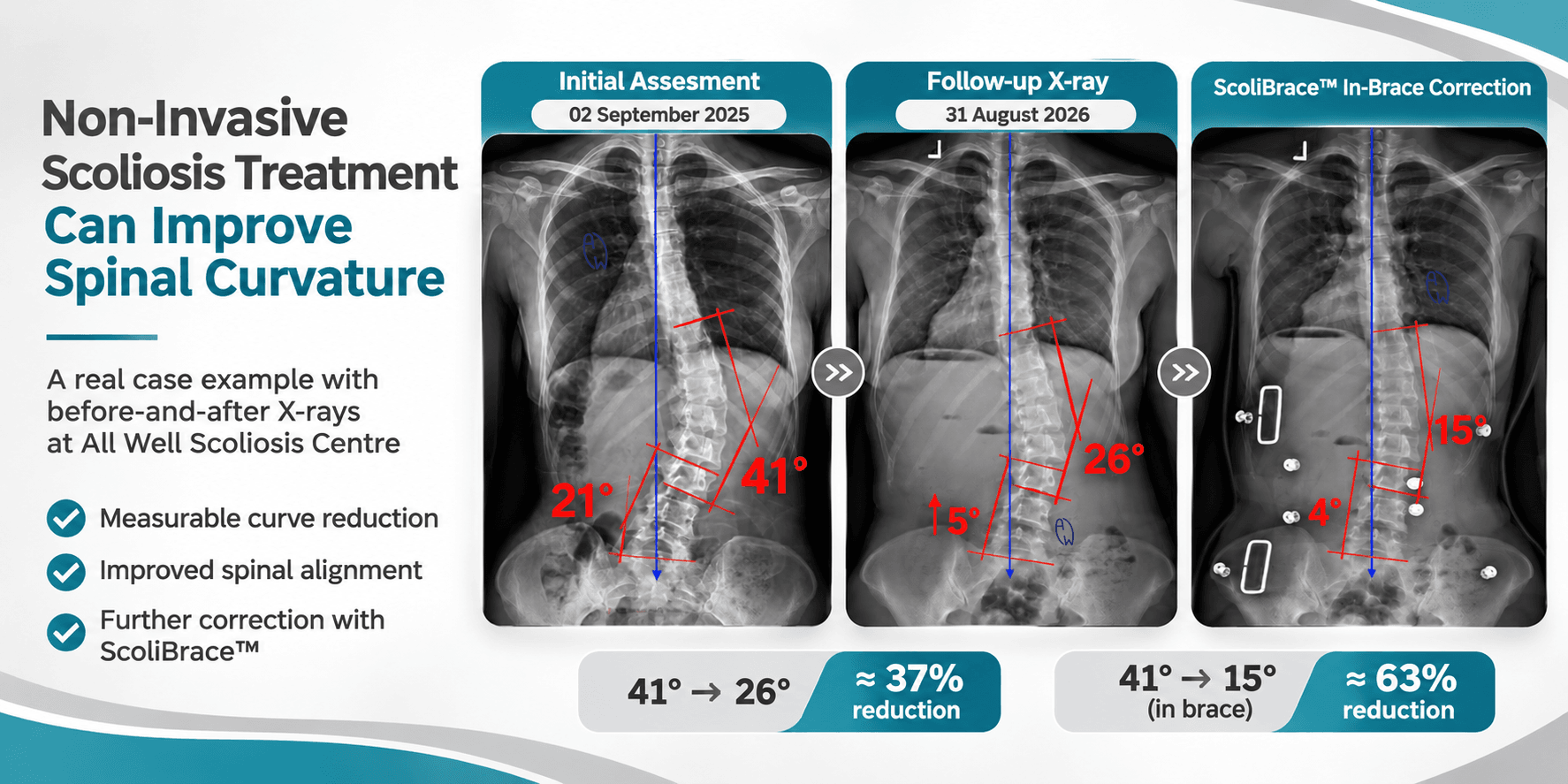
The following case shows three stages of spinal assessment.
Initial assessment — 2 September 2025
The original standing spinal X-ray showed:
-
Primary curve: 41°
-
Secondary curve: 21°
Follow-up assessment — 31 August 2026
The subsequent X-ray showed:
-
Primary curve: 26°
-
Secondary curve: 5°
The primary curve decreased from 41° to 26°, representing an approximately 37% reduction.
The secondary curve decreased from 21° to 5°.
Assessment while wearing ScoliBrace™
The third X-ray, taken while wearing the customised corrective brace, showed:
-
Primary curve: 15°
-
Secondary curve: 4°
Compared with the original 41° primary curve, the in-brace measurement of 15° represents an approximately 63% reduction.
The secondary curve measured approximately 81% lower, from 21° to 4°.
What is the difference between the 37% and 63% reductions?
This distinction is important.
The 37% reduction compares the initial 41° measurement with the subsequent 26° measurement.
The 63% reduction compares the original 41° measurement with the 15° measurement while wearing ScoliBrace.
The in-brace measurement demonstrates additional correction with external support. It should not be interpreted as proof that the spine has permanently maintained a 15° curve without the brace.
Similarly, the follow-up measurement should be interpreted in the context of imaging conditions, treatment history and clinical assessment.
Figure 1. Standing spinal X-rays dated 2 September 2025 and 31 August 2026, followed by an additional assessment while wearing ScoliBrace™. Measurements displayed on the images show primary and secondary curve changes.
Why is this case important?
It demonstrates why we believe scoliosis treatment should be evaluated through actual measurements.
Instead of relying exclusively on whether someone feels better or looks straighter, we can examine the radiographic findings and discuss what has changed.
We do not suggest that every patient will experience the same outcome.
One case cannot establish the effectiveness of an entire treatment programme or predict the results of other patients.
However, it provides a useful clinical example of measurable changes in spinal alignment and the additional correction demonstrated while wearing a corrective brace.
We are happy to show patients their X-rays, explain the measurements and discuss the limitations of the results.
4. Why We Take Before-and-After X-Rays
At All Well Scoliosis Centre, we do not want patients to depend entirely on how their back feels or looks after treatment.
We want to assess what has changed.
Our assessment may include:
-
Initial Cobb angle measurements.
-
Overall spinal alignment.
-
Curve location and pattern.
-
Vertebral rotation.
-
Pelvic alignment.
-
Postural balance.
-
Muscular function and physical capabilities.
Why are comparable X-rays important?
A standing spinal X-ray provides a two-dimensional view of a three-dimensional spinal deformity.
The Cobb angle can be influenced by patient positioning, selection of end vertebrae and measurement technique.
Research has demonstrated that measurement variability can occur between observers and between repeated assessments.
For meaningful comparisons, we aim to use:
-
Comparable standing positions.
-
Consistent imaging protocols.
-
The same curve and end vertebrae where appropriate.
-
Consistent measurement methods.
-
Qualified interpretation of the radiographs.
A small change in degrees should not automatically be interpreted as a genuine treatment-related improvement.
We also recognise that an immediate change after an intensive programme does not necessarily establish permanent structural correction.
Longer-term follow-up is needed to understand whether the improvement is maintained.
Our philosophy is simple: if we are going to discuss spinal correction, we should be prepared to examine the X-rays.
5. How Does All Well Scoliosis Centre Approach Non-Surgical Scoliosis Treatment?
We do not believe scoliosis should be addressed through one isolated treatment.
Scoliosis involves spinal structure, muscle function, movement patterns and postural control. Our programme therefore combines different approaches according to the individual's clinical presentation.
CLEAR Institute protocol: Mix, Fix and Set
The CLEAR Institute protocol provides a structured approach to scoliosis rehabilitation.
Its Mix-Fix-Set framework involves:
-
Mix: Preparing the body through warm-up activities and selected therapies.
-
Fix: Applying individually selected procedures and positioning techniques.
-
Set: Reinforcing treatment through corrective exercises and rehabilitation.
The objective is to address spinal mobility, muscular function and postural control.
At All Well, CLEAR is incorporated into our wider scoliosis management programme rather than being treated as a standalone adjustment.
Learn more about the CLEAR Institute protocol.
ScoliBrace™: Individualised corrective bracing
Bracing can provide external support and help guide spinal alignment.
ScoliBrace uses a customised three-dimensional design based on the patient's individual spinal curve pattern and body shape.
In growing patients, bracing is primarily used to reduce the risk of curve progression.
In selected adults, a brace may be considered to provide support, improve comfort and assist with postural management. The objectives and evidence differ from those for growing adolescents.
Brace selection, fit and wearing schedules must be individualised.
ScoliBalance®: Teaching patients to control their posture
ScoliBalance is a scoliosis-specific exercise programme that helps patients understand and practise individualised three-dimensional corrective strategies.
The programme focuses on:
-
Postural awareness.
-
Active self-correction.
-
Muscular control.
-
Breathing coordination.
-
Balance and functional movement.
-
Integrating corrective positions into daily activities.
The goal is to help patients become more aware of how they position and move their bodies.
This is particularly relevant for adults who have spent many years adapting to an asymmetrical spinal posture.
Learn more about ScoliBalance.
Why combine these approaches?
Each component has a different purpose.
CLEAR provides a structured treatment and rehabilitation framework.
ScoliBrace provides external support when indicated.
ScoliBalance develops active postural correction and muscular control.
Together, these methods form part of an individualised rehabilitation strategy.
However, evidence supporting one component should not automatically be treated as proof of the effectiveness of the entire combined programme. The specific outcomes of our combined protocol should be evaluated independently.
6. What Can You Expect From Our 14-Day Intensive Scoliosis Programme?
Our intensive programme is designed for patients who want a structured period of scoliosis rehabilitation rather than relying exclusively on occasional weekly sessions.
The programme typically runs for 14 days, with two treatment sessions daily.
Patients may participate in approximately 6–8 hours of guided activities each day, depending on their individual programme.
The treatment may include:
-
Spinal mobility and preparation.
-
Selected corrective procedures.
-
Neuromuscular rehabilitation.
-
Scoliosis-specific exercises.
-
Rotational breathing and postural training.
-
Custom brace assessment where appropriate.
-
Functional movement training.
What happens before and after the programme?
Before treatment
We assess the patient's spinal condition, review available X-rays, measure the Cobb angle where appropriate and establish individual treatment objectives.
During treatment
Patients participate in the intensive rehabilitation programme and learn how to understand and control their spinal positioning.
After treatment
We conduct a follow-up clinical assessment and, when indicated, obtain comparable standing X-rays to evaluate changes in spinal alignment.
This allows us to discuss whether the Cobb angle has changed, whether postural control has improved and what further rehabilitation may be appropriate.
Read more about our 14-Day Intensive Scoliosis Treatment Programme.
Does everyone achieve the same reduction?
No.
Treatment outcomes depend on several factors:
-
Age and skeletal maturity.
-
Initial Cobb angle.
-
Curve pattern and location.
-
Spinal flexibility.
-
Degree of vertebral rotation.
-
Existing degenerative changes.
-
Physical condition.
-
Consistency with the prescribed programme.
We have observed patients demonstrating measurable reductions in spinal curvature following treatment. However, individual results vary, and we do not guarantee a particular percentage of curve reduction.
A short-term radiographic change must also be distinguished from sustained structural improvement.
We believe patients deserve honest measurements rather than promises.
7. The Most Important Question: How Do You Maintain the Improvement?
This is where the real commitment begins.
Imagine completing an intensive scoliosis programme and seeing an improvement in your spinal alignment.
What happens when you return home?
Do you stop exercising? Do you stop practising your corrective positions? Do you abandon the habits you developed during treatment?
A short intensive programme can provide an opportunity to learn and practise new movement strategies, but it cannot replace long-term physical conditioning.
This is why our programme includes a maintenance strategy.
Option 1: Weekly clinic follow-up
Patients can return to the clinic once a week for continued rehabilitation and guidance.
These sessions provide opportunities to review exercise technique, assess physical function and adjust the treatment plan where necessary.
Option 2: Home-based exercise programme
For patients who prefer to continue at home, we prescribe individualised exercises based on their needs and capabilities.
Patients may also be prescribed selected home rehabilitation equipment to support their exercise routine.
The intention is to make ongoing rehabilitation practical and sustainable.
Option 3: Prescribed corrective bracing
Where clinically indicated, patients may continue using a customised corrective brace.
Brace requirements differ between individuals. Wearing schedules should be determined according to the patient's assessment, goals and response.
Option 4: Ongoing progress monitoring
Follow-up assessments help us evaluate functional changes and determine whether further intervention is required.
Repeat X-rays should be based on clinical need and an appropriate imaging schedule, not taken unnecessarily.
We can provide the treatment, guidance and tools. But maintaining your progress requires your participation.
The objective is to help patients become more independent and capable of managing their physical health.
8. Does Choosing Non-Invasive Treatment Mean You Should Avoid Spinal Fusion?
Absolutely not.
Spinal fusion has an established role in treating selected patients with significant scoliosis, progressive deformity, neurological compromise or substantial functional limitations.
For some patients, surgery may be the most appropriate treatment.
However, spinal fusion is a major operation and should be considered carefully.
It involves permanently joining selected vertebrae using bone grafts and instrumentation to stabilise the spine and correct alignment.
Depending on the procedure, patients may need:
-
Hospitalisation and postoperative monitoring.
-
Pain management.
-
Wound care.
-
Gradual rehabilitation.
-
Temporary activity restrictions.
-
Long-term follow-up.
Potential complications include infection, blood clots, implant problems, non-union and neurological injury.
Patients should also understand that surgery does not eliminate the need for postoperative rehabilitation.
After surgery, the body still needs time to recover, rebuild strength and adapt to changes in spinal mechanics.
Fusion can also change the distribution of movement and loading across the spine, which is one reason long-term monitoring matters.
We are not against surgery when it is medically indicated.
But we believe patients should understand the potential benefits, risks, recovery requirements and reasonable non-surgical alternatives before making a decision.
A moderate Cobb angle alone does not determine whether someone needs spinal fusion. Symptoms, progression, spinal balance, nerve involvement and overall health must also be considered.
If you have progressive weakness, significant numbness, new bladder or bowel dysfunction or other concerning neurological symptoms, seek prompt medical assessment rather than delaying care for conservative treatment.
9. Can You Improve Your Quality of Life Without Having a Perfectly Straight Spine?
This is an important question, especially for adults with longstanding scoliosis.
The goal of treatment should not be to make every patient's spine look identical to someone without scoliosis.
Quality of life includes much more than a Cobb angle.
It includes whether you can:
-
Walk comfortably.
-
Exercise with confidence.
-
Maintain your balance.
-
Build muscular strength.
-
Participate in activities you enjoy.
-
Maintain independence as you age.
-
Manage discomfort and improve daily function.
Some patients may achieve measurable improvements in spinal alignment. Others may experience meaningful improvements in function and comfort without a significant change in their Cobb angle.
Both outcomes matter, but they should be reported honestly and separately.
For many adults, improving physical capacity and maintaining mobility are worthwhile treatment goals, even when complete curve correction is not achievable.
We want patients to understand that having scoliosis does not mean they must stop moving, exercising or enjoying life.
10. Our Position: Patients Deserve to Understand Their Options
At All Well Scoliosis Centre, we understand that adults with scoliosis often arrive with years of frustration.
Some have been managing back discomfort for decades. Others have been told that their spinal curve is unlikely to change without surgery.
We do not claim that every spinal curve can be corrected through non-invasive treatment.
We also do not believe that the absence of surgery automatically means treatment can only manage pain.
If measurable changes in spinal alignment are observed, they should be documented and discussed. If a patient improves functionally but their Cobb angle remains unchanged, that should also be communicated honestly.
We are open to discussing our clinical observations with other healthcare professionals and reviewing before-and-after radiographs.
We would rather have an informed discussion based on actual measurements than an argument based on assumptions.
Our objective is to give patients an opportunity to explore conservative care, understand their spine and develop the physical capabilities needed to maintain their health over time.
You do not necessarily have to choose between doing nothing and undergoing surgery.
There may be other options worth investigating, depending on your individual condition.
Not choosing surgery does not mean choosing to do nothing.
Sometimes, the most valuable investment you can make in your future is the time, energy and discipline you dedicate to keeping your body strong, mobile and capable.
Your spine is part of your life. Your treatment should help you continue living it.
Frequently Asked Questions
Can non-invasive scoliosis treatment actually reduce the Cobb angle?
Some conservative treatment studies have reported improvements in Cobb angle or reduced rates of curve progression. However, evidence varies significantly between treatment methods. A reduction should be confirmed through comparable radiographs, and individual outcomes cannot be guaranteed.
Can adult scoliosis be corrected without surgery?
Selected adults may experience measurable improvements in spinal alignment, posture and physical function through conservative management. However, longstanding rigid curves and significant degenerative deformities may not be fully correctable without surgery.
Does non-surgical scoliosis treatment only manage pain?
No. Conservative treatment can also target muscular strength, postural control, balance, mobility and, in selected cases, spinal alignment. However, improvements in these areas should not automatically be interpreted as structural curve correction.
Does chiropractic adjustment alone correct scoliosis?
Chiropractic adjustments alone have not been established as a reliable method for permanently correcting structural scoliosis. Some treatment approaches combine manual procedures with scoliosis-specific exercises, bracing and rehabilitation. These components should be evaluated according to their individual evidence.
Why does All Well Scoliosis Centre perform X-rays before and after treatment?
Standing spinal X-rays allow clinicians to assess spinal alignment and measure the Cobb angle. When clinically appropriate, we compare pre-treatment and post-treatment images to evaluate whether measurable changes have occurred.
How long is the All Well intensive scoliosis programme?
The intensive programme typically lasts 14 days, with two sessions daily. Patients then continue with an individualised maintenance plan that may include weekly clinic visits, home exercises, prescribed bracing and rehabilitation equipment.
Can adults wear scoliosis braces?
Yes. Selected adults may benefit from bracing for support, comfort or curve management. However, the objectives and evidence differ from adolescent bracing, which primarily aims to reduce progression during growth. An individual assessment is necessary.
Will my scoliosis return after treatment?
There is no guarantee that a reduction in spinal curvature will remain unchanged. Long-term outcomes depend on the underlying condition, curve characteristics, physical conditioning and maintenance. Ongoing monitoring is important.
Should I consider spinal fusion if I have moderate scoliosis?
Not necessarily. Surgery is not determined by Cobb angle alone. Symptoms, curve progression, spinal balance, nerve involvement, functional limitations and overall health all matter. Discuss your options with an appropriately qualified spine specialist.
Can I stop taking pain medication after non-invasive scoliosis treatment?
Some patients may experience reduced discomfort and require less medication. However, medication changes should always be discussed with the prescribing doctor.
Medical References
-
Schoutens C, Cushman DM, McCormick ZL, Conger A, van Royen BJ, Spiker WR. (2020). Outcomes of Nonsurgical Treatments for Symptomatic Adult Degenerative Scoliosis: A Systematic Review. Pain Medicine, 21(6), 1263–1275. PubMed.
-
Palazzo C, Montigny JP, Barbot F, et al. (2017). Effects of Bracing in Adult With Scoliosis: A Retrospective Study. Archives of Physical Medicine and Rehabilitation, 98(1), 187–190. PubMed.
-
McAviney J, Mee J, Fazalbhoy A, Du Plessis J, Brown BT. (2020). A Systematic Literature Review of Spinal Brace/Orthosis Treatment for Adults With Scoliosis Between 1967 and 2018: Clinical Outcomes and Harms Data. BMC Musculoskeletal Disorders, 21, 87. Full text.
-
Taşkıran ÖÖ. (2020). Rehabilitation in Adult Spinal Deformity. Turkish Journal of Physical Medicine and Rehabilitation, 66(3), 231–243. Full text.
-
Zlatanos CG, Hassanin MA, Aly A, Salem KM, Quraishi NA. (2025). Nonoperative Treatment of Adult Spinal Deformity: A Comprehensive Narrative Review. Journal of Clinical Medicine, 14(24), 8864. Full text.
-
Gstoettner M, et al. (2007). Inter- and Intraobserver Reliability Assessment of the Cobb Angle: Manual Versus Digital Measurement Tools. European Spine Journal, 16, 1587–1592. PubMed.
-
Scoliosis Research Society. Diagnosis and Treatment.
-
Scoliosis Research Society. Adult Scoliosis.