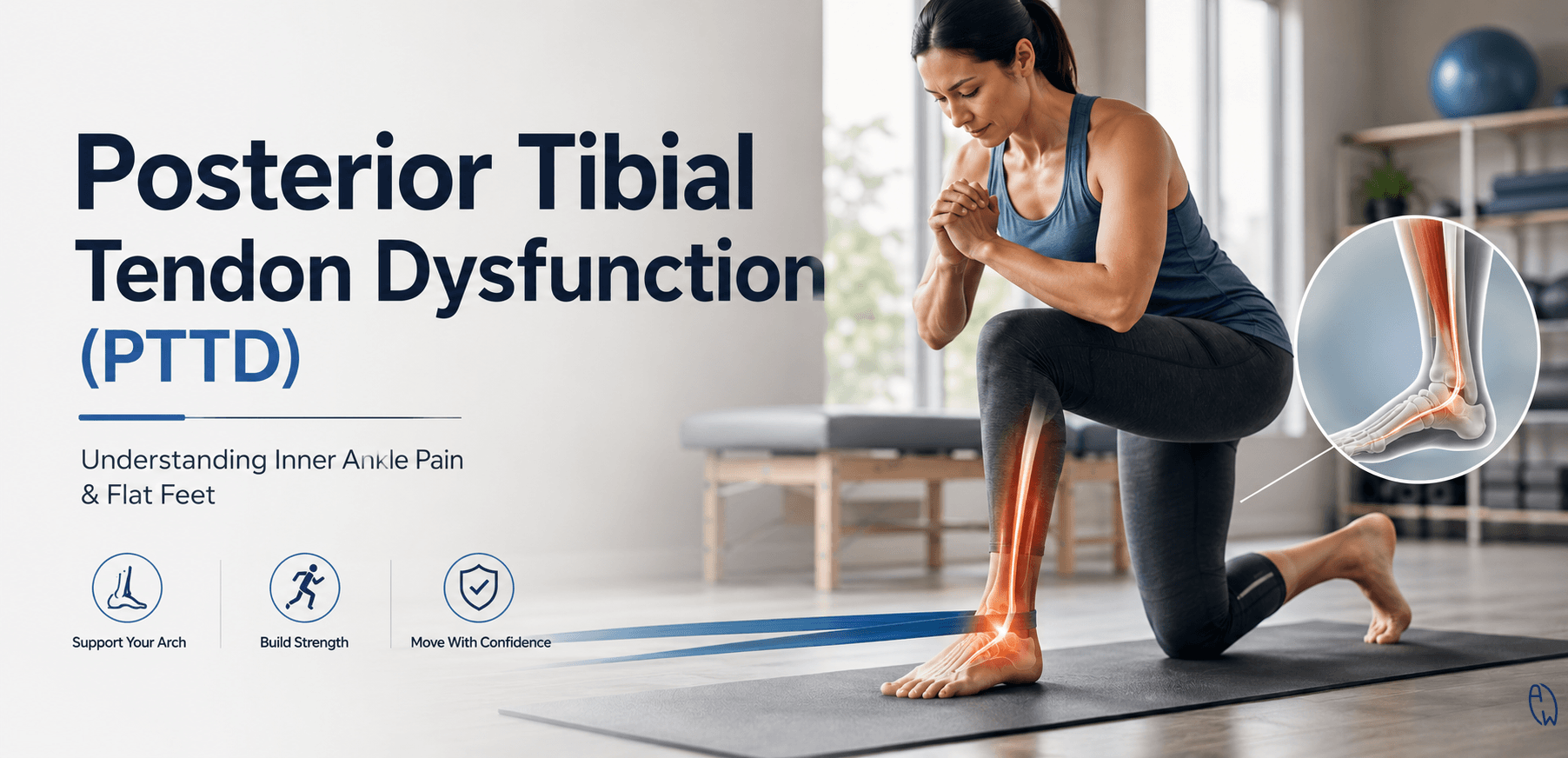
Posterior Tibial Tendon Dysfunction (PTTD): The Hidden Cause of Inner Ankle Pain and Adult Flat Feet
Struggling with inner ankle pain, collapsing arches, or foot fatigue when walking? You may be dealing with Posterior Tibial Tendon Dysfunction (PTTD), also known as Posterior Tibial Tendinopathy — one of the most common causes of adult-acquired flatfoot.
The posterior tibial tendon plays a major role in keeping your foot stable, absorbing shock, and supporting your arch with every step. When this tendon becomes irritated, weak, or overloaded, it can gradually affect the way you walk, stand, and move.
At All Well Scoliosis Centre, we often see how poor foot mechanics can influence the entire body chain — including the knees, hips, pelvis, and spine.
What Is Posterior Tibial Tendon Dysfunction (PTTD)?
The posterior tibialis tendon runs along the inside of the ankle and foot. It connects the calf muscle to bones in the foot and helps:
-
Support the medial (inner) arch
-
Control foot stability during walking
-
Assist with shock absorption
-
Help the ankle move inward (inversion)
-
Help point the foot downward (plantar flexion)
When the tendon becomes inflamed, overstretched, weak, or injured, it may no longer support the arch properly. Over time, this can lead to:
-
Inner ankle pain
-
Swelling along the tendon
-
Weakness when walking
-
Foot fatigue
-
Flattening of the arch
-
Adult-acquired flatfoot deformity
Common Symptoms of PTTD
People with Posterior Tibial Tendon Dysfunction often notice symptoms gradually worsening over time.
Common signs include:
-
Pain along the inside of the ankle or foot
-
Swelling near the inner ankle bone
-
Flattening of the arch
-
Difficulty standing on tiptoes
-
Weakness during walking or running
-
Feet turning outward while walking
-
Increased fatigue after long periods of standing
In later stages, the condition can affect balance, walking mechanics, and even contribute to knee, hip, or lower back discomfort.
Why Does PTTD Happen?
PTTD usually develops from either overuse or underuse.
Common contributing factors:
-
Flat feet
-
Poor foot stability
-
Weak calf and ankle muscles
-
Sudden increase in walking or exercise
-
Obesity
-
Aging-related tendon degeneration
-
Poor footwear support
-
Previous ankle injuries
-
Long hours of standing
-
Sedentary lifestyle causing muscle weakness
Athletes, runners, healthcare workers, teachers, and people who spend long hours on their feet are commonly affected.
Why Early Treatment Matters
PTTD is considered a progressive condition. This means that if ignored, the tendon may continue weakening over time, causing the arch to collapse further.
Early intervention can help:
-
Reduce pain and inflammation
-
Improve tendon strength
-
Restore arch stability
-
Improve walking mechanics
-
Prevent long-term foot deformity
Exercises for Posterior Tibial Tendon Dysfunction (PTTD)
Rehabilitation exercises should focus on:
-
Strengthening the posterior tibialis muscle and tendon
-
Improving ankle inversion strength
-
Restoring plantar flexion control
-
Enhancing arch stability
-
Improving lower limb balance and coordination
1. Figure 4 Inversion Exercise
This exercise targets the posterior tibialis directly by strengthening ankle inversion control.
How to do it:
-
Sit comfortably with one ankle crossed over the opposite knee in a “figure 4” position.
-
Use a resistance band around the forefoot.
-
Slowly turn the foot inward against resistance.
-
Return slowly with control.
Benefits:
-
Strengthens the posterior tibialis tendon
-
Improves ankle control
-
Supports arch stability
2. Offset Front Rack Split Squat with Wall Push
This exercise trains full lower-body stability while activating foot and arch control.
How to do it:
-
Stand in a split squat position facing a wall.
-
Hold a weight in a front rack position on one side.
-
Push gently into the wall while lowering into the squat.
-
Keep the foot arch stable throughout the movement.
Benefits:
-
Improves lower limb alignment
-
Builds ankle and foot stability
-
Enhances balance and tendon resilience
3. Heel Raise with Ball Squeeze
A powerful exercise for activating the calf muscles and supporting the inner arch.
How to do it:
-
Place a small ball between the heels.
-
Gently squeeze the ball.
-
Rise onto the toes slowly.
-
Lower down with control.
Benefits:
-
Strengthens calf and foot stabilizers
-
Improves arch support
-
Activates inner ankle musculature
4. Low Inversion with Tibial Control
This movement improves coordination between the ankle and shin mechanics.
How to do it:
-
Sit or stand with the foot slightly elevated.
-
Slowly invert the foot while controlling shin alignment.
-
Focus on smooth and controlled movement.
Benefits:
-
Enhances tendon control
-
Improves lower leg alignment
-
Builds functional ankle strength
The Foot-Spine Connection
Many people do not realize that collapsed arches and unstable feet can influence the entire body chain.
Poor foot mechanics may contribute to:
-
Knee pain
-
Hip compensation
-
Pelvic imbalance
-
Altered walking mechanics
-
Lower back discomfort
At All Well Scoliosis Centre, we believe movement assessment should go beyond the painful area alone. The feet, posture, balance, and spine often work together as one system.
When Should You Seek Professional Help?
You should seek assessment if:
-
Pain persists for weeks
-
The arch continues flattening
-
Walking becomes difficult
-
Swelling worsens
-
You feel unstable during movement
-
Exercises increase symptoms
Early rehabilitation is often more effective before significant tendon degeneration occurs.
Final Thoughts
Posterior Tibial Tendon Dysfunction (PTTD) is more than just foot pain. It is a condition that can gradually affect your posture, movement quality, balance, and overall mobility.
The good news is that with proper strengthening, movement retraining, and early intervention, many people can improve function, reduce pain, and regain confidence in walking and exercise again.
If you are experiencing inner ankle pain, collapsing arches, or persistent foot fatigue, it may be time to look deeper into how your feet and body are working together.