Posture Correction for Scoliosis: Why Strength and Movement Matter Beyond Aesthetics
Relearning how to sit, stand, walk and kneel helped this patient develop better postural control, build strength and regain greater freedom in everyday life.
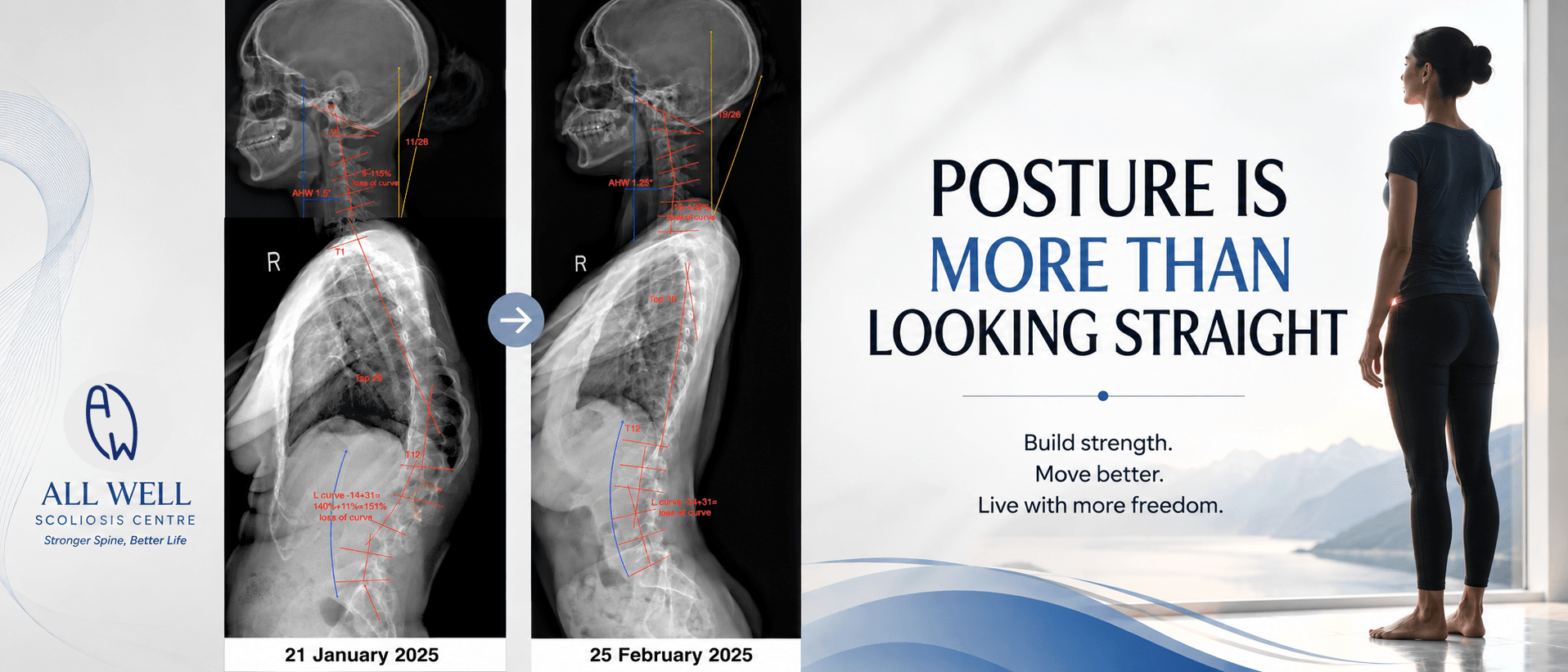
A lateral standing X-ray can show us how the spine and posture have changed.
But an X-ray cannot show everything.
It cannot show how many times a person had to remind herself to sit differently.
It cannot show the hours spent learning how to activate the front and back of her core.
It cannot show the discipline required to practice better posture while walking, standing and kneeling.
And it certainly cannot show the purpose behind all that work.
For this patient, posture correction for scoliosis was never simply about looking straighter.
It was about becoming more capable of living her life.
A Lateral Standing X-Ray Comparison: 21 January to 25 February 2025
The two lateral standing X-rays provide an objective comparison of her spinal alignment and posture over approximately five weeks.
The images show changes in the annotated cervical and thoracolumbar measurements.
But the X-ray is only one part of the story.
The more meaningful change was happening in her daily life.
She was learning how to use her body differently.
She had to relearn how to:
-
Sit with better postural awareness
-
Stand without collapsing into her familiar posture
-
Walk with greater control
-
Activate her abdominal and back muscles
-
Maintain better trunk alignment
-
Kneel more upright
-
Move without unnecessarily overloading certain areas
-
Apply what she learned during everyday activities
This is an important distinction.
A patient can be told to “stand straight” in seconds. Learning how to control the body well enough to do it consistently can take much longer.
Posture Correction for Scoliosis Is Not Just About Looking Better
When people hear the word posture, they often think about appearance.
Shoulders back.
Head up.
Stand tall.
Look confident.
But posture is much more than aesthetics.
Posture is connected to how we organize our body while we sit, stand and move.
For someone with scoliosis or another persistent spinal alignment issue, improving movement control may be about making everyday activities more manageable—not simply creating a better-looking silhouette.
That is why rehabilitation should not stop when the patient leaves the treatment room.
The real test is what happens when she goes home.
Can she sit?
Can she stand?
Can she walk?
Can she exercise?
Can she kneel?
Can she perform the activities that are meaningful to her?
That is where posture becomes functional.
Five Times a Day Became Five Opportunities to Practice
One particularly meaningful part of this patient's story is her prayer routine.
She prays five times a day.
For her, this created five regular opportunities to practice the movement and postural control she had been learning.
Prayer was not simply another exercise.
It was part of her life.
And that made it meaningful.
She had to learn how to move into a kneeling position more effectively, maintain better alignment and eventually submit in prayer without feeling as sore.
That is a very different goal from simply wanting to “look straight.”
Her posture had become connected to something she deeply valued.
And that matters.
Because when rehabilitation is connected to a person's purpose, practice stops feeling like an endless list of exercises.
It becomes part of living.
Relearning Posture Requires More Than Awareness
Knowing what good posture looks like does not automatically give someone the strength or coordination to maintain it.
This is why posture correction can be challenging.
A person may understand:
“I need to sit differently.”
But understanding is only the beginning.
The body may have spent years using the same movement patterns.
Changing those patterns requires repeated practice, awareness, strength and motor control.
A useful way to think about the process is:
Awareness → Practice → Strength → Control → Repetition → Better movement habits
This is why we should not expect one exercise, one treatment session or one instruction to permanently change someone's posture.
The body needs time to learn.
And the patient needs opportunities to practice.
Why Both the Front and Back Core Matter
One of the things this patient had to learn was how to work both the front and back of her core.
Core training is not simply about doing abdominal exercises.
The trunk works as a system.
The abdominal muscles, back muscles, pelvis and surrounding musculature all contribute to controlling the trunk during movement.
For someone with scoliosis, the appropriate exercises should be individualized rather than assuming that one generic “scoliosis exercise” will work for everyone.
Research on core-based exercise in people with scoliosis has reported improvements in some outcomes, including small changes in Cobb angle and quality of life, although the researchers rated the overall evidence as low to very low quality. "Effect of core-based exercise in people with scoliosis: A systematic review and meta-analysis - PubMed"
That distinction is important.
Exercise can be valuable, but it should not be presented as a miracle cure.
The goal is to help the individual develop better strength, control, movement capacity and function.
Your Core Is Not Just About Your Stomach
When people hear “core,” they often think about abdominal muscles.
But functional trunk control is much bigger than having visible abs.
Your body needs to control your trunk when you:
-
Sit at a desk
-
Get out of a chair
-
Walk
-
Carry something
-
Bend down
-
Stand for a period of time
-
Climb stairs
-
Exercise
-
Kneel
-
Change position
This is why we should think about core strength as movement capacity, not simply appearance.
A stronger, better-controlled trunk can give a person more options in daily life.
And options matter.
When Your Body Becomes Weak, Everyday Life Can Become Harder
This is something many people don't think about until they experience it.
At first, weakness may seem insignificant.
You sit for a little less time.
You avoid certain movements.
You stop doing activities that feel uncomfortable.
You take more breaks.
You become less active.
Then the cycle can continue.
The less you use your body, the less confident you may become in using it.
And activities that were once automatic can gradually become challenges.
Something as simple as sitting for more than 10 minutes can become uncomfortable.
Standing for longer periods can feel exhausting.
Getting down onto the floor can feel difficult.
Getting back up can become a task.
Eventually, people may begin organizing their lives around what their bodies cannot comfortably do.
That is why strength matters.
Posture Correction Can Give You More Freedom
This is the part of posture correction that is often missed.
The goal isn't simply to stand straighter.
The goal is to have more physical capacity to participate in your life.
For this patient, standing taller was not the final destination.
Being able to kneel straighter mattered.
Being able to pray with less soreness mattered.
Being able to move with greater confidence mattered.
Being able to practice better mattered.
The X-ray gives us a picture of alignment.
Her daily activities give us a picture of function.
Together, they tell a much more complete story.
Find Your Reason to Get Better
Perhaps the most important lesson from this patient is not actually about posture.
It is about purpose.
She proudly said:
“I am practicing better.”
That sentence says a lot.
She was no longer simply waiting for someone else to correct her.
She was taking responsibility for what she could do herself.
And that is powerful.
Because lasting change usually requires more than knowing that something is good for you.
You need to know why you want to do it.
Your reason might be:
-
“I want to sit comfortably at work.”
-
“I want to travel without constantly thinking about my back.”
-
“I want to play with my children.”
-
“I want to exercise.”
-
“I want to remain independent as I age.”
-
“I want to kneel comfortably during prayer.”
-
“I want to continue doing the things I love.”
Your reason does not have to be the same as someone else's.
Find your why.
Because your why is what keeps you practicing when motivation disappears.
There Is No Shortcut to Building a Stronger Body
We live in a world that constantly promises shortcuts.
A pill.
A supplement.
A quick treatment.
A miracle exercise.
A procedure.
Something that promises results without requiring much from us.
But the human body does not work that way.
There is no medication or supplement that can replace the physical adaptations that come from appropriately training your muscles and movement.
There is no single quick exercise that can instantly create lasting strength.
And while surgery can play an important role for appropriately selected patients, surgery does not eliminate the need to maintain physical conditioning, strength and movement capacity afterward.
Your body still needs to be used.
The World Health Organization recommends that adults perform muscle-strengthening activities involving the major muscle groups on at least two days each week, alongside regular aerobic activity.
The CDC likewise recommends muscle-strengthening activity at least two days per week for adults. "Adult Activity: An Overview | Physical Activity Basics | CDC"
These are not recommendations about looking muscular.
They are recommendations about maintaining health and physical capacity.
Invest in Your Muscles
Think about muscle differently.
Muscle is not just something you see in the mirror.
It is part of your physical reserve.
Your muscles help you:
Stand.
Walk.
Lift.
Carry.
Climb.
Balance.
Move.
Get up.
Stay independent.
Physical activity is associated with better physical health and supports the ability to perform everyday activities. Adult Activity: An Overview | Physical Activity Basics | CDC
And as we get older, maintaining strength becomes increasingly important for preserving physical function and independence.
So perhaps one of the best investments you can make in yourself is not something you buy.
It is something you build.
Build your strength.
Build your movement.
Build your awareness.
Build your balance.
Build your confidence.
Build your physical capacity.
What This Scoliosis Posture Case Study Really Shows
This lateral standing X-ray comparison is not simply a “before and after.”
It represents a period of learning.
She had to understand her posture.
She had to practice it.
She had to strengthen her body.
She had to relearn movement.
And then she had to take those lessons outside the clinic and apply them to real life.
That is where rehabilitation becomes meaningful.
The X-ray can show us changes in alignment.
But the patient can tell us what those changes mean in her life.
For her, progress meant standing taller.
Kneeling straighter.
Praying with less soreness.
And proudly knowing that she was practicing better.
Frequently Asked Questions About Posture Correction and Scoliosis
Can posture correction help scoliosis?
Posture correction should not be presented as a guaranteed way to straighten a structural scoliosis. However, individualized rehabilitation can help a person develop better postural awareness, movement control, strength and functional capacity.
Is core strength important for people with scoliosis?
Core strength contributes to trunk stability and movement control. Exercise programs for people with scoliosis should be individualized according to their spinal pattern, physical condition, goals and clinical assessment.
Can scoliosis affect everyday activities?
It can. Depending on the individual, scoliosis and associated pain, stiffness, weakness or reduced physical capacity may make activities such as prolonged sitting, standing, walking or exercise more difficult.
How can I improve my posture with scoliosis?
Improving posture with scoliosis usually involves more than simply trying to “sit straight.” A suitable program may include postural awareness, individualized exercises, strengthening, movement retraining and practicing correction during everyday activities.
Does better posture mean my scoliosis is cured?
No. A change in posture or spinal alignment should not automatically be described as a cure. Scoliosis is a complex condition, and progress should be assessed using appropriate clinical and functional measures.
How long does it take to improve posture?
There is no universal timeline. Postural improvement depends on the individual's condition, strength, movement patterns, consistency and rehabilitation program. Relearning movement is a process that requires repeated practice.
The Real Goal: A Stronger Body and a Bigger Life
Maybe you started thinking about posture because you wanted to look better.
There is nothing wrong with that.
But perhaps your goal can become bigger.
Maybe you want to move without fear.
Maybe you want to sit through dinner comfortably.
Maybe you want to travel.
Maybe you want to exercise.
Maybe you want to play with your grandchildren one day.
Maybe you want to kneel during prayer without soreness.
Maybe you simply want to remain independent for as long as possible.
That is why posture matters.
Not because a straight back looks good in a photograph.
But because a body with better strength, control and capacity can give you more choices.
And more choices can give you more freedom.
Posture is not just about how you look when you stand.
It is about what you are able to do when you stand.
So find your purpose.
Build your strength.
Practice your movement.
And give your body the support it needs to keep doing the things that matter to you.
Because the best investment you can make in your longevity is not simply adding years to your life.
It is building the physical capacity to live those years with greater freedom.
Medical perspective
The X-ray measurements in this case study are presented as part of a clinical comparison and should not be interpreted in isolation. Radiographic alignment is only one aspect of scoliosis assessment; symptoms, function, physical examination and the individual's goals also matter. Exercise should be appropriately selected and individualized, particularly for people with scoliosis or other health conditions. "Effect of core-based exercise in people with scoliosis: A systematic review and meta-analysis - PubMed"