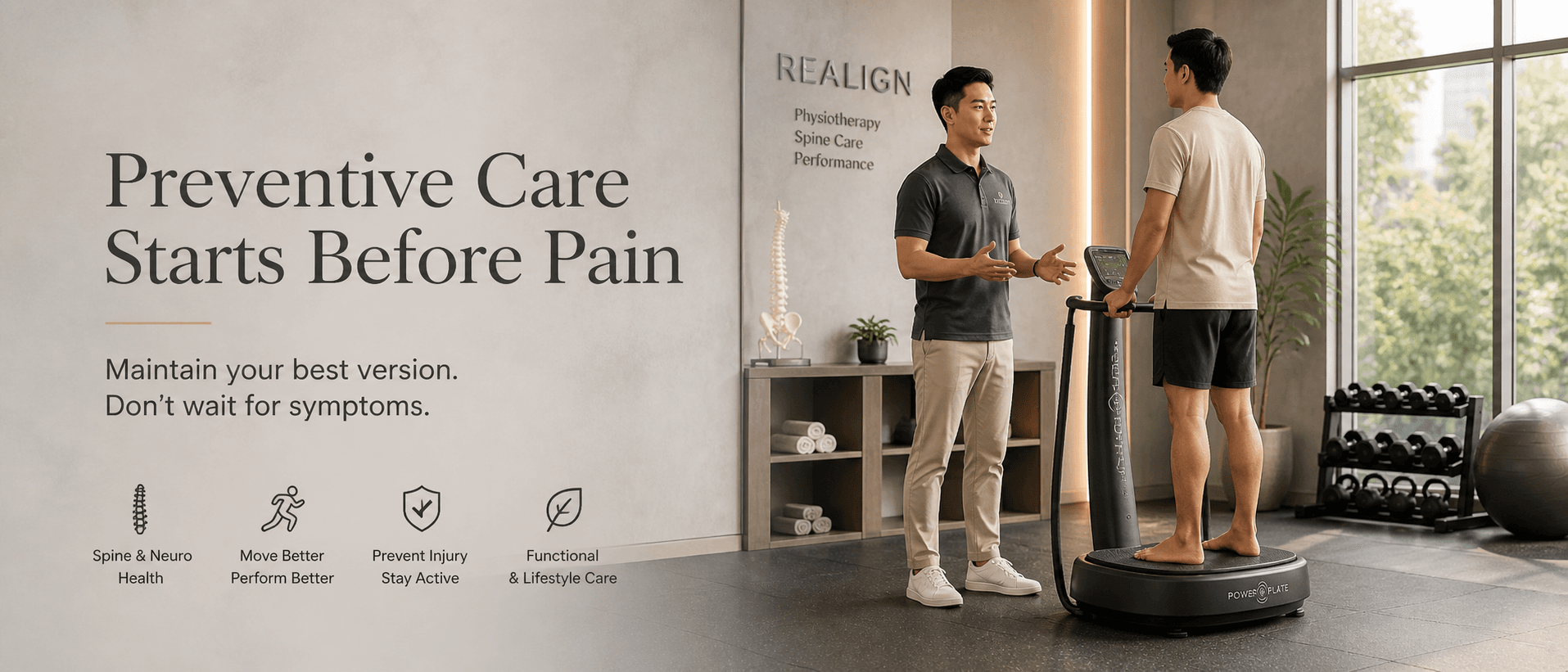
Preventive Care: Why You Don’t Need Pain to Start Taking Care of Your Spine and Health
You Don’t Need Pain to Seek Care
One of the most common questions patients ask is simple:
“Do I need to feel pain before I come in for a check?”
The answer is no.
By the time pain shows up, your body has often been compensating for months—or even years. Preventive care is about identifying dysfunction early, before it becomes injury, limitation, or chronic disease.
Your health is not defined by the absence of pain. It is defined by how well your body functions.
Preventive Care Is About Living at Your Full Capacity
My role is not to “fix” you only when something goes wrong.
My role is to help you live your best life according to your physical ability.
You decide what optimal health looks like:
-
Running your first marathon
-
Training for HYROX
-
Staying active and independent as you age
-
Avoiding long-term conditions like osteoporosis or sarcopenia
I’m here to guide the path—but you choose how far you want to go.
Recovery Care Is Not Just for Injuries
There’s a common misconception that care is only needed when something hurts.
But recovery is also:
-
Rest
-
Load management
-
Movement correction
-
Muscle conditioning
If your ego is always pushing you without listening to your body, your risk of requiring intensive intervention later becomes much higher.
Preventive care is about pacing—so your progress is sustainable, not destructive.
“Time Is Muscle”: The Foundation of Long-Term Health
My philosophy is simple:
Time is muscle.
Muscle is not just about aesthetics or strength. It plays a role in:
-
Heart function
-
Metabolism and digestion
-
Brain performance
-
Joint stability
-
Longevity
If you don’t use it, you lose it.
As we age, muscle mass naturally declines (sarcopenia), and bone density reduces (osteoporosis). Preventive care ensures you are building and maintaining capacity before decline begins.
Spine and Neuro Health: The Core of Movement
While scoliosis is my specialty, my broader focus is spine and neurological health.
Your spine is not just structural—it is the communication highway between your brain and body.
When spinal function is compromised:
-
Movement efficiency drops
-
Compensation patterns develop
-
Injury risk increases
-
Performance declines
Preventive assessments help detect:
-
Poor weight distribution
-
Postural imbalances
-
Early asymmetries (including scoliosis trends)
These are often invisible to the untrained eye—but critical for long-term health.
Preventive Care Across Life Stages
Young Adults & Athletes
-
Improve performance
-
Prevent overuse injuries
-
Optimize movement efficiency
Working Professionals
-
Address sedentary lifestyle effects
-
Reduce neck, back, and postural strain
-
Maintain energy and productivity
Aging Population
-
Prevent frailty and muscle loss
-
Maintain independence
-
Reduce fall and fracture risk
I often see elderly patients who feel powerless—not because aging is inevitable, but because preventive care came too late.
Surgery Is Not the First Question—Lifestyle Is
I am not against surgery. It has its place.
But before considering it, ask:
-
Does this align with my long-term lifestyle?
-
Have I explored conservative options?
-
What is life like after surgery—for real patients?
These are questions worth asking people who have actually gone through it.
Preventive care exists to reduce the likelihood of reaching that point unnecessarily.
Is Chiropractic and Conservative Care “Real Medicine”?
Yes.
Medicine is defined as the science and practice of:
-
Diagnosing
-
Treating
-
Preventing disease
Preventive care sits at the core of healthcare—not at the fringe.
While chiropractors may not prescribe drugs or perform surgery, the training is deeply rooted in:
-
Kinesiology
-
Musculoskeletal health
-
Nervous system function
-
Manual therapy
-
Evidence-based conservative care
The goal is not to replace other forms of medicine—but to complement them by addressing function before dysfunction becomes disease.
A Different Approach: Functional and Preventive Focus
My background emphasizes:
-
Functional movement
-
Nutrition and lifestyle
-
Spine and neuro health
-
Early intervention
Yes, my pharmacology exposure is limited compared to medical doctors.
That’s because my focus is different:
Build health first—so you rely less on intervention later.
Final Thought: Maintain Your Best Version
Preventive care is not about fear.
It is about ownership.
You don’t wait for your car to break down before servicing it.
Your body deserves at least the same level of attention.
We are here to:
-
Keep you aligned with your goals
-
Maintain your highest function
-
Help you stay consistent over time
Because the goal is not just to recover.
The goal is to never fall behind in the first place.