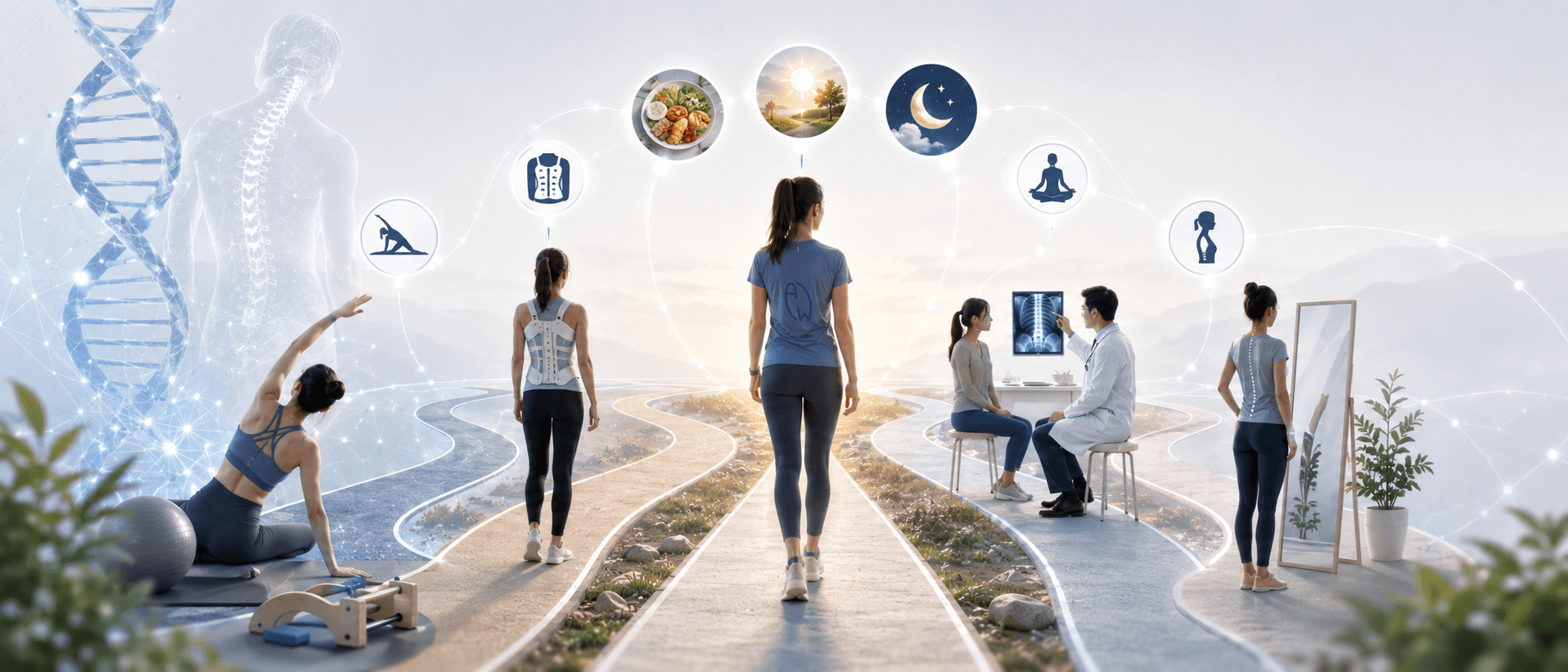
Part 5: Creating the Right Environment — How Daily Choices Shape the Scoliosis Journey
After learning about genetics, hormones, growth, and the brain, one question naturally comes next:
"If scoliosis is influenced by so many factors, what can I actually control?"
It is an important question.
Because understanding scoliosis should not leave someone feeling powerless.
Yes, we inherit our genes.
We cannot choose our DNA.
We cannot go back and change how our spine developed before birth.
But every day, we influence the environment our body lives in.
How we move.
How we eat.
How we sleep.
How we strengthen.
How aware we become of our posture.
These choices send signals to the body.
And the body is always listening.
Why Every Scoliosis Journey Looks Different
One of the biggest lessons genetics has taught us is that every human body is unique.
Even two people with similar scoliosis curves can have completely different experiences.
One person may feel strong and flexible.
Another may experience stiffness or fatigue.
One person may progress quickly during growth.
Another person's curve may remain stable for years.
Why?
Because scoliosis is influenced by many interacting factors:
-
Genetics
-
Growth
-
Hormones
-
Bone health
-
Muscle strength
-
Nervous system coordination
-
Lifestyle
-
Daily habits
This is why scoliosis is described as a multifactorial condition.
The X-ray tells us important information.
But the X-ray does not tell the entire story of the person living with that spine.
Why Scoliosis Can Feel Different From Day to Day
One of the biggest challenges with scoliosis is that it can feel inconsistent.
Some days you feel stronger.
Some days everything feels tighter.
A movement that felt easy yesterday suddenly feels awkward or uncomfortable.
And that is often when the self-doubt begins.
"Am I doing something wrong?"
The truth is, scoliosis is not always predictable.
Your body is not a machine that produces the exact same result every day.
Your spine exists inside a living system.
A system affected by:
-
Sleep
-
Stress
-
Hormonal changes
-
Activity level
-
Recovery
-
Muscle fatigue
-
Nutrition
This is one reason scoliosis can feel confusing.
But understanding creates confidence.
The more you understand your own curve pattern, your triggers, your strengths, and how your body responds, the easier it becomes to make decisions instead of constantly second-guessing yourself.
The goal is not to fear every change.
The goal is to learn from your body.
Your Body Adapts to What You Repeatedly Do
The human body has one incredible ability:
Adaptation.
Your body is constantly learning from what you ask it to do.
Exercise regularly, and muscles respond.
Practise a skill, and the brain becomes more efficient.
Repeat a movement pattern, and the nervous system remembers.
Your body does not ask:
"Is this perfect?"
It asks:
"Is this familiar?"
Then it adapts.
This is why daily habits matter.
The way you sit.
The way you stand.
The way you move.
The way you strengthen.
The way you recover.
All of these are messages repeated to your body every day.
The Other 23 Hours Matter
Rehabilitation does not only happen during an appointment.
Your body continues learning after you leave.
Your daily life becomes part of the process:
How you sit while studying.
How you work at your desk.
How you carry your bag.
How you exercise.
How you rest.
How you sleep.
This does not mean thinking about your spine every second.
That is unrealistic.
It means slowly developing awareness.
Because your brain cannot correct something it does not recognise.
Awareness comes first.
Correction follows.
Repetition creates learning.
Building the Best Environment for Your Body
Understanding adaptation does not mean we control everything.
It means we support what we can influence.
A healthy lifestyle does not erase genetics.
Exercise does not magically remove scoliosis.
Nutrition does not guarantee a curve will improve.
But your body still needs the right environment to function.
A growing and adapting body benefits from:
Movement
Regular activity helps maintain strength, coordination, and confidence.
Targeted exercise
Specific rehabilitation can help improve body awareness, muscle activation, and movement patterns.
Nutrition
Protein, calcium, vitamin D, and balanced nutrition provide important building materials for muscles and bones.
Sleep
Recovery supports hormone regulation, tissue repair, and learning.
Posture awareness
Not perfect posture.
Awareness.
Learning when your body is compensating and gradually teaching it new patterns.
Small choices repeated consistently can become powerful over time.
Responsibility Does Not Mean Blame
This is an important distinction.
Taking responsibility for your health does not mean blaming yourself for having scoliosis.
You did not choose your genetics.
You did not choose your growth pattern.
You did not choose how your spine developed.
But understanding your body gives you choices moving forward.
Responsibility means:
"I want to learn what I can influence."
Not:
"This happened because I did something wrong."
Those are very different messages.
Evidence, Not Guesswork
Hope matters.
But hope should be guided by understanding.
That is why monitoring is important.
Because scoliosis does not always communicate clearly.
Pain does not always equal progression.
No pain does not always mean nothing is changing.
Regular assessments and appropriate imaging help answer:
"How is my body responding?"
"Do we need to adjust?"
"What is the next best decision?"
Progress should not come from fear.
It should come from information.
There Is More Than One Scoliosis Story
Spend enough time reading about scoliosis, especially online, and you will quickly notice something:
Everyone has a different journey.
You may meet someone who discovered Pilates and felt that learning how to activate specific muscles helped them understand their body better.
You may meet someone who chooses bracing because they believe external support during growth is the right choice for them.
You may meet someone who focuses on strength training.
Someone who focuses on stretching.
Someone who finds support through mindfulness, lifestyle changes, or other approaches.
You may also meet someone who decides to monitor their condition with their spine specialist and chooses surgery when they feel it is the appropriate time.
Every person is making decisions based on their own experience, information, resources, and circumstances.
That is the reality of scoliosis.
There is no single story that represents everyone.
Learn. Ask Questions. Decide.
Today, we have access to more information than ever before.
That can be empowering.
It can also be confusing.
One person may say:
"This changed my life."
Another may say:
"This did nothing for me."
Someone else may believe their method is the only correct way.
But scoliosis is complex.
Your genetics are unique.
Your curve is unique.
Your goals are unique.
Your life is unique.
Research.
Learn.
Ask questions.
Understand your options.
If you have the opportunity and resources, explore different approaches.
Then choose what makes the most sense for your situation.
The most important thing is:
Do not become passive in your own journey.
Our Perspective at All Well
At All Well, our role is not to convince you that we are the only answer.
We understand there are many different approaches to scoliosis management.
And we may not be the right choice for everyone.
That is okay.
Our goal is to share our perspective based on our experience, clinical approach, and what we have learned from working with scoliosis patients over the years.
We believe in looking beyond the curve.
The spine matters.
But so does:
The person.
The muscles.
The nervous system.
The habits.
The lifestyle.
The goals.
Education allows people to make informed decisions.
And informed patients become active participants in their own care.
Your Genes May Start the Story. They Do Not Write the Ending.
After everything we have discussed, perhaps genetics teaches us something unexpected.
Not limitation.
Possibility.
Your genes influence your starting point.
But your body continues adapting throughout life.
Your muscles can change.
Your brain can learn.
Your habits can evolve.
Your understanding can grow.
Every nutritious meal.
Every exercise session.
Every night of quality sleep.
Every moment you become more aware of your body.
Every decision to keep trying.
They are small messages repeated over time.
None of them promise perfection.
But they create an environment where your body has the greatest opportunity to adapt.
Scoliosis may be part of your story.
But it does not have to become your entire identity.
Stay curious.
Stay involved.
Keep learning.
Keep asking questions.
And whatever path you choose—
Be well.