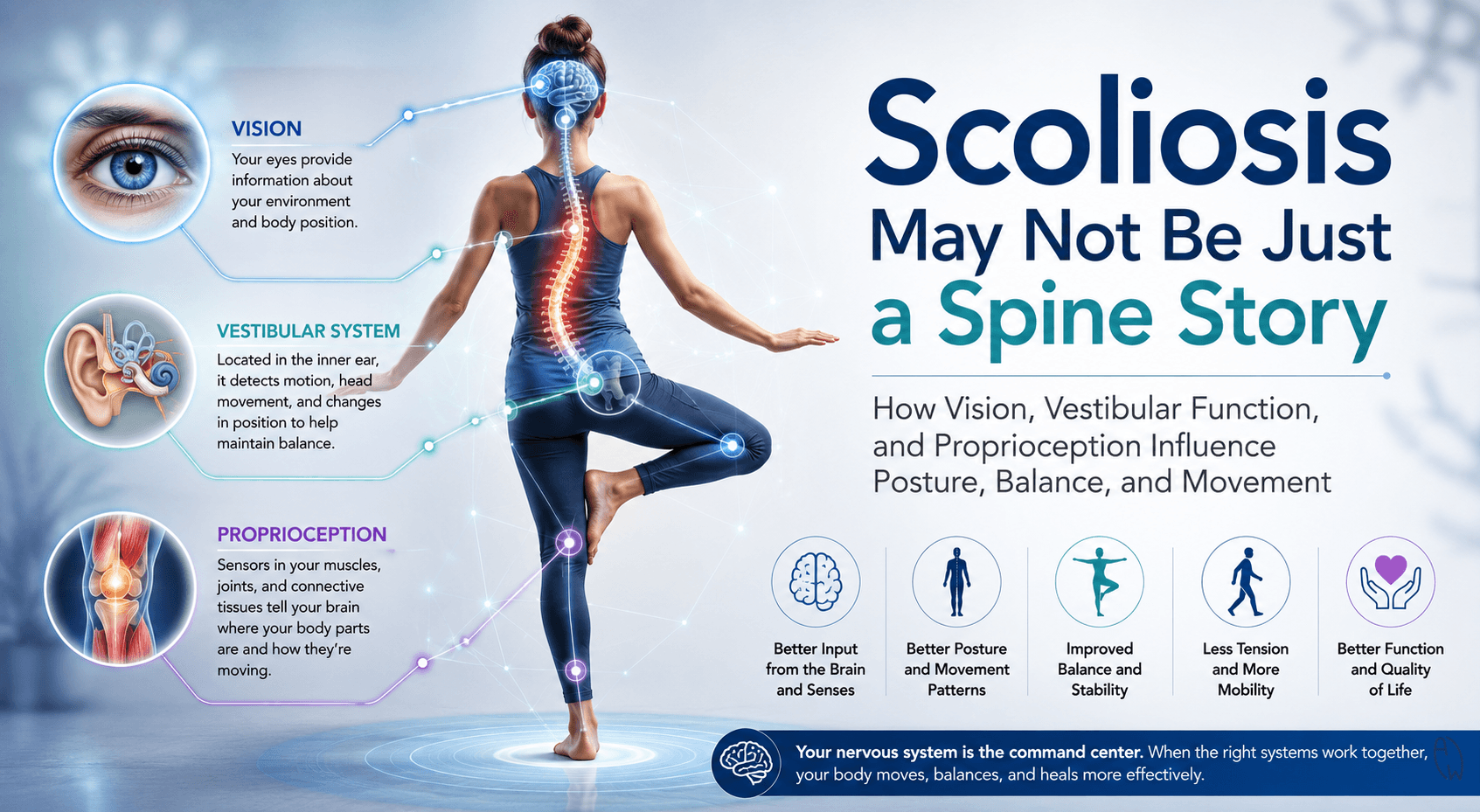
Scoliosis May Not Be Just a Spine Story: How Vision, Balance, and Body Awareness Influence Posture
When most people think about scoliosis, they think of a curved spine.
But what if scoliosis is not just a spine story?
Emerging research suggests that posture is influenced by much more than bones, joints, and muscles. The brain continuously gathers information from multiple sensory systems to determine where the body is in space, how it should move, and how it should maintain balance.
When these systems communicate effectively, movement feels effortless. When they don't, the body may develop compensatory strategies that can influence posture, muscle tension, and movement patterns over time.
The Brain's Internal GPS: Three Systems That Control Posture
Your brain relies on three major sensory systems to understand body position and movement:
Vision
Your eyes provide information about your surroundings and your relationship to them. Vision is often the dominant sensory system, helping the brain predict movement, orient the body, and maintain stability.
Vestibular System (Inner Ear)
The vestibular system acts as your balance center. Located within the inner ear, it detects head movement, acceleration, and changes in position relative to gravity.
It helps answer questions such as:
-
Am I moving?
-
Am I turning?
-
Am I tilting?
-
Am I standing upright?
Proprioception (Body Awareness)
Proprioception is your body's ability to sense joint position, muscle tension, and movement without consciously looking.
It allows you to know where your arms, legs, head, and spine are positioned at any given moment.
Together, these three systems act like an internal GPS, helping the brain organize posture, coordinate movement, and maintain balance.
How Proprioception Influences Your Balance
Balance isn't controlled by a single system. It is the result of constant communication between the visual, vestibular, and proprioceptive systems.
-
Your eyes provide information about the environment.
-
Your vestibular system detects movement and head position.
-
Your proprioceptive system tells your brain where your body parts are and how they are moving.
The brain combines information from all three sources to create an accurate map of your body in space.
When proprioceptive information becomes unclear or inaccurate, the brain has a harder time coordinating movement and maintaining stability.
You may experience:
-
Frequent clumsiness
-
Poor coordination
-
Difficulty balancing on uneven surfaces
-
Trouble judging distances
-
A sense of instability during movement
Healthy proprioceptive function allows the nervous system to make rapid, automatic adjustments that keep you upright.
This becomes especially important when:
-
Standing on one leg
-
Walking in the dark
-
Navigating uneven ground
-
Reacting to unexpected movements
When Proprioception Is Impaired
Problems with proprioception can appear in many different ways, including:
-
Poor coordination
-
Frequent ankle rolling or sprains
-
Difficulty balancing
-
Trouble with fine motor tasks such as handwriting or buttoning a shirt
-
Feeling unstable or "heavy" during movement
-
Increased risk of falls
Impaired proprioception is commonly seen following injuries such as ankle sprains, ligament injuries, and joint trauma.
It is also frequently observed in people with neurological conditions including:
-
Concussion
-
Stroke
-
Peripheral neuropathy
-
Vestibular disorders
When the brain receives reduced or inaccurate proprioceptive information, it often becomes more reliant on vision and vestibular input to compensate.
This can alter movement patterns and postural control throughout the body.
Not All Sensory Input Carries Equal Weight
One of the most important concepts in neuroscience and rehabilitation is that the brain does not treat all sensory information equally.
In most situations:
-
Vision is the dominant system.
-
Vestibular input is typically second.
-
Proprioception often adapts to what the higher-priority systems are communicating.
This hierarchy explains why visual information can dramatically affect posture and balance.
Think about stepping onto an escalator that isn't moving or walking off a boat after spending hours at sea. Your sensory systems briefly disagree, and your brain must decide which source of information to trust.
What Happens When Sensory Systems Conflict?
The brain's primary goal is survival and stability.
When visual input, vestibular signals, and proprioceptive feedback do not match, the nervous system must find a solution.
Your eyes may say one thing.
Your inner ear may say another.
Your body may respond with changes in:
-
Muscle tone
-
Joint positioning
-
Weight distribution
-
Rotation patterns
-
Stiffness
-
Protective movement strategies
Initially, these adaptations may be helpful.
They allow the body to function despite conflicting sensory information.
However, when these patterns persist for years, they can become deeply ingrained movement habits that influence posture and biomechanics.
The Vestibular System and Scoliosis
Research has found that vestibular dysfunction appears more frequently in some individuals with scoliosis compared to the general population.
This does not mean vestibular dysfunction directly causes scoliosis.
The relationship is likely far more complex.
However, these findings suggest that sensory processing may play an important role in how posture is regulated and maintained.
If the brain receives inconsistent information regarding balance and body position, it may adopt asymmetrical strategies to improve stability.
In some cases, asymmetry may represent the nervous system's attempt to create a stable solution rather than simply a structural problem.
Could Childhood Vision or Vestibular Weakness Influence Posture?
An interesting question that continues to emerge in both clinical practice and research is whether subtle sensory asymmetries beginning in childhood could influence postural development.
What happens if one eye consistently provides weaker information than the other?
What happens if one side of the vestibular system functions differently?
The nervous system may adapt by:
-
Shifting weight to one side
-
Rotating the trunk
-
Tilting the head
-
Altering muscle activation patterns
-
Changing walking mechanics
These adaptations can potentially travel through the entire kinetic chain—from the head and spine down to the pelvis, knees, ankles, and feet.
Many people compensate remarkably well for years.
Then an injury, illness, growth spurt, stressful life event, or simply aging may reduce the body's ability to maintain those compensations.
Suddenly, stiffness, tension, balance difficulties, or movement restrictions become more noticeable.
The issue may not be that the body suddenly changed.
Rather, the nervous system may no longer be able to rely on the same strategies that worked previously.
Why We Cover One Eye During Balance Training
Patients are often surprised when they are asked to perform balance exercises while one eye is covered.
There is a neurological reason for this.
Because vision is often the dominant sensory system, some individuals become overly dependent on visual information to maintain balance.
Temporarily reducing visual input forces the nervous system to rely more heavily on vestibular and proprioceptive feedback.
This can help clinicians identify sensory biases and improve the integration of balance systems.
If you have ever wondered why we covers one eye during an exercise, it is often because they are assessing how your brain processes sensory information—not simply testing your muscles.
A Different Way to Think About Scoliosis
Traditionally, posture problems are often approached by asking:
-
Which muscles are tight?
-
Which muscles are weak?
-
Which joints need correcting?
These questions remain important.
However, another question may be equally valuable:
Which sensory system is the brain struggling to trust?
If the nervous system receives clearer, more reliable information, it may gain access to better movement options and more efficient postural strategies.
Better Input Creates Better Movement
The body is constantly adapting to the information it receives.
For some individuals, improving visual function, vestibular performance, proprioceptive awareness, and sensory integration may help create more efficient movement patterns and reduce unnecessary tension.
Scoliosis is not simply a story about spinal curvature.
It is also a story about how the brain interprets sensory information, organizes movement, and creates stability in a constantly changing environment.
Understanding this broader perspective does not replace traditional scoliosis assessment or treatment. Instead, it adds another layer to the conversation—one that recognizes the powerful role the nervous system plays in shaping posture, balance, and movement throughout life.
The next time you look at a curved spine, consider looking beyond the spine itself.
Sometimes the question is not simply, "What muscle is tight?"
Sometimes the better question is:
"What sensory system is the brain struggling to trust?"
Because better input often creates better movement—and better movement can create better possibilities for long-term postural health.