Our Approach to Chiropractic Care
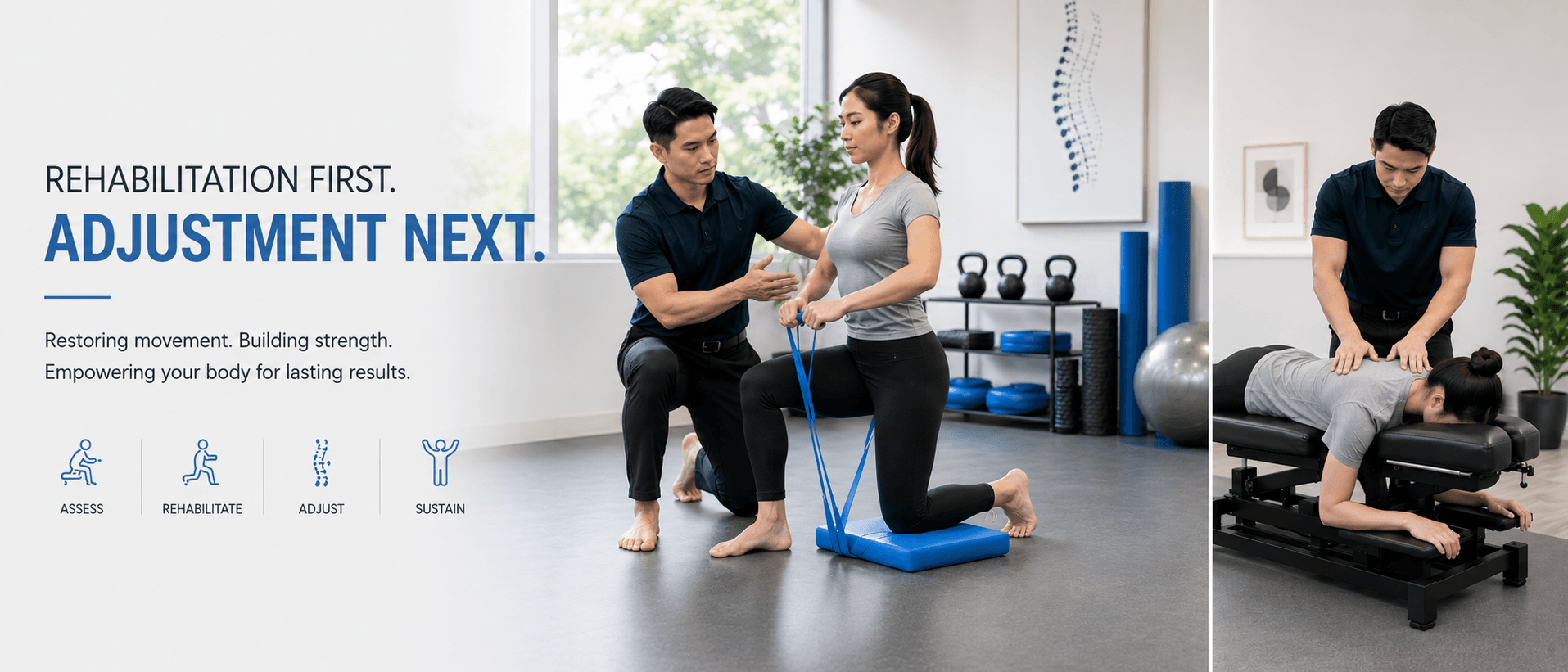
Rehabilitation First. Adjustment Second.
If you're looking for a quick 10-minute chiropractic adjustment, our approach may be different from what you're expecting.
At All Well Scoliosis Centre, we believe lasting recovery requires more than simply moving a joint or relieving pain for a few days. Our treatment combines chiropractic care, rehabilitation, physical therapy (physiotherapy)-based exercises, and patient education to help your body recover and stay well.
For most non-scoliosis conditions, appointments are at least 60 minutes, giving us the time to treat the cause of your problem—not just the symptoms.
Many patients tell us they didn't expect to be so actively involved during their chiropractic session. That's because our treatment often feels more like a guided rehabilitation session than a traditional chiropractic appointment.
We believe that's where lasting results begin.
Why Our Appointments Are Different
Pain is often the result of weeks, months, or even years of poor movement, muscle imbalance, repetitive strain, prolonged sitting, previous injuries, or postural habits.
A spinal adjustment can restore movement to a stiff joint, but if your muscles remain weak and your movement patterns don't change, the discomfort often returns.
That's why we spend time preparing your body before an adjustment.
Our goal isn't simply to help you feel better today.
Our goal is to help your body continue feeling better long after you leave our clinic.
Our Rehabilitation Programme
Every treatment plan is personalised after a thorough assessment.
Depending on your condition, your rehabilitation programme may include:
-
Chiropractic spinal adjustments
-
Physical therapy (physiotherapy)-based rehabilitation
-
Mobility and flexibility training
-
Strength and stability exercises
-
Core strengthening
-
Balance and coordination training
-
Postural correction
-
Functional movement retraining
-
Soft tissue therapy when appropriate
-
Ergonomic and workplace advice
-
Personalised home exercise programme
Every exercise has a purpose.
We don't ask you to exercise simply to make you tired.
We prescribe movement because we want your muscles, joints, and nervous system to work together more efficiently, allowing your body to support itself during everyday life.
What Happens During Treatment?
Although every treatment plan is customised, a typical appointment usually follows four simple steps.
Restore Mobility
We begin by improving movement where your joints and muscles have become stiff or restricted.
Build Strength
Next, we strengthen the muscles responsible for supporting your spine and improving your stability.
Retrain Movement
Pain often causes the body to compensate. Some muscles become overworked while others become weak. We help retrain your body to move more efficiently during everyday activities such as walking, sitting, lifting, working, and exercising.
Chiropractic Adjustment
Once your body has been prepared, we perform the spinal adjustment when appropriate.
Many people think the adjustment is the treatment.
We see it differently.
The adjustment is the finishing touch—not the entire treatment.
Why We Combine Chiropractic Care with Rehabilitation
Chiropractic adjustments improve joint movement.
Rehabilitation helps your body maintain those improvements.
Without improving strength, mobility, posture, and movement habits, many people simply return to the same patterns that contributed to their pain in the first place.
That's why our philosophy is simple:
Rehabilitation first. Adjustment next.
What About Physiotherapy and TCM?
One of the most common questions we hear is:
"Should I see a chiropractor, a physiotherapist, or a TCM practitioner?"
The truth is that every healthcare profession has its strengths.
Physiotherapy is commonly recommended by GPs, orthopaedic specialists, sports physicians, and hospitals for rehabilitation following injuries, surgery, and many musculoskeletal conditions. We share many of the same rehabilitation principles, including improving strength, mobility, balance, and movement quality.
Traditional Chinese Medicine (TCM) also plays an important role in Asia. Many patients grew up using acupuncture, cupping, herbal patches, or therapeutic massage, and some find these treatments helpful for relieving muscle tension or managing pain.
We respect every healthcare profession and believe they can complement one another when used appropriately.
However, regardless of whether you choose chiropractic care, physiotherapy, TCM, or another form of treatment, one important question remains:
Why did the pain develop in the first place?
If the underlying issue is poor posture, muscle weakness, repetitive strain, reduced mobility, or an underlying spinal condition, those contributing factors also need to be addressed.
Our rehabilitation programme focuses on improving how your body moves, functions, and supports itself so that improvements are more likely to last.
We don't believe healthcare has to be "Western" or "Eastern."
We believe it should be effective, evidence-informed, personalised, and focused on helping you move better for the long term.
Why We Practice This Way
After more than 20 years in clinical practice, we learned an important lesson.
Early in our careers, we practised the traditional high-volume model where appointments were short and focused mainly on spinal adjustments.
Patients often felt immediate relief.
But many returned with the same problem because the underlying causes had never changed.
When we founded All Well Scoliosis Centre, we made a conscious decision to practise differently.
Instead of asking,
"How quickly can we adjust this patient?"
We ask,
"How can we help this patient move better for years to come?"
That question shapes every treatment we provide today.
Your Recovery Is a Partnership
No chiropractor, physiotherapist, doctor, surgeon, or TCM practitioner can out-treat the habits you repeat every day.
The time you spend in our clinic is important.
The time you spend sitting, standing, lifting, exercising, working, and sleeping has an even greater impact on your long-term health.
That's why education is part of every appointment.
We want you to understand:
-
Why your condition developed
-
Which daily habits may be contributing to your symptoms
-
How to move more efficiently
-
Which muscles need strengthening
-
How to reduce unnecessary stress on your spine
Our goal is not to make you dependent on treatment.
Our goal is to help you become more confident, independent, and resilient.
Our Promise
At All Well Scoliosis Centre, we don't measure success by how many spinal adjustments you receive.
We measure success by how confidently you can move, work, exercise, and enjoy life with less pain and better function.
We don't chase quick fixes.
We help you build a stronger body, better movement, and lasting results.