How to Fix Scoliosis Naturally: Can You Really Correct Your Spine Without Surgery?
Last reviewed by: Dr Albert Winandar, Doctor of Chiropractic (DC)
Can you straighten a scoliosis spine naturally?
The answer is yes and no. It depends on the severity, type of scoliosis, age, spinal flexibility and whether other complications are present.
Some patients achieve measurable curve reduction through non-surgical treatment. Others may benefit more from stabilising their curves, improving posture, strengthening their muscles and maintaining better physical function. In more severe cases, surgery may need to be considered.
At All Well Scoliosis Centre, Singapore, this is one of the questions we hear most often from parents and adults.
Before deciding whether scoliosis can be corrected naturally, we need to understand something important: scoliosis is not simply a spine that bends sideways. It is a complex three-dimensional spinal condition.
Let's look at what is realistically possible.
1. Scoliosis Is More Than Just a Bent Spine
Scoliosis involves three-dimensional changes in the spine, including sideways curvature, vertebral rotation and alterations in the alignment of the rib cage.
The spine also protects the spinal cord, while nerve roots exit through openings between the vertebrae to carry signals between the brain and the rest of the body.
Depending on the severity and underlying cause, scoliosis may be associated with:
-
Uneven shoulders, waist or hips.
-
A prominent rib hump.
-
Muscle imbalance and fatigue.
-
Changes in walking patterns and body balance.
-
Back discomfort or pain.
-
Nerve-related symptoms in certain cases.
-
Breathing difficulties in some patients with severe thoracic deformities.
You may have seen people walking along the street with visibly uneven shoulders, a leaning trunk or a prominent hump on their back. Some have lived with these physical changes for decades.
Interestingly, not everyone experiences significant pain.
We see this among younger patients too. Some have noticeable spinal curves but report little or no pain. Others experience discomfort, muscle fatigue or difficulty maintaining certain positions.
Pain is not a reliable measurement of scoliosis severity. Someone with a substantial curve may experience relatively little pain, while another person with a smaller curve may experience considerable discomfort.
This is why looking at someone's posture or asking whether they have pain is not enough to understand their condition.
2. What Causes Scoliosis? Is It Just Bad Posture?
No. Scoliosis is not simply caused by sitting too long, carrying a heavy schoolbag on one shoulder or sleeping in the wrong position.
Poor posture may contribute to muscular discomfort and postural asymmetry, but it does not adequately explain structural scoliosis.
There are several recognised types:
Idiopathic scoliosis: The most common type, particularly among adolescents. Its exact cause is not fully understood, although genetic and biological factors are believed to contribute.
Congenital scoliosis: Develops when one or more vertebrae do not form or separate normally during pregnancy.
Neuromuscular scoliosis: Associated with underlying conditions affecting the nervous system or muscles, such as cerebral palsy or muscular dystrophy.
Degenerative scoliosis: Develops later in life, often due to age-related changes in spinal discs and joints.
Each type has different characteristics and treatment considerations.
This is why we cannot recommend the same exercises, adjustments or braces to everyone with scoliosis.
3. Can Scoliosis Actually Be Fixed Naturally?
When people search for how to fix scoliosis naturally, they may mean different things.
Some want to avoid surgery. Others want to correct their spinal curve through exercises, chiropractic treatment, bracing or lifestyle changes.
It is important to understand that these treatment goals are not identical.
Non-surgical scoliosis management may aim to achieve:
Curve reduction: A measurable reduction in the Cobb angle on comparable spinal X-rays.
Curve stabilisation: Preventing or limiting further progression, particularly in growing children and adolescents.
Improved postural alignment: Developing better postural awareness and control through individualised corrective exercises.
Improved physical function: Building muscle strength, endurance, balance and movement confidence.
Symptom management: Reducing discomfort, fatigue and limitations in daily activities.
A patient may become stronger and stand more comfortably without a substantial reduction in the structural curve. Another may demonstrate measurable curve improvement but still require ongoing exercises and monitoring.
Therefore, non-surgical scoliosis correction is possible in selected cases, but complete structural correction cannot be guaranteed.
4. What Determines Whether Your Scoliosis Can Improve Without Surgery?
There is no single Cobb angle that can tell us whether someone is suitable for non-surgical treatment.
Several factors need to be considered.
-
Cobb angle: The degree of curvature is important, but it does not tell the entire story.
-
Age and skeletal maturity: Children who are still growing require particular attention because their curves may progress during growth.
-
Curve flexibility: A flexible curve may respond differently to treatment compared with a rigid curve involving substantial vertebral rotation.
-
Type of scoliosis: Congenital, idiopathic, neuromuscular and degenerative scoliosis have different treatment considerations.
-
Associated complications: Nerve compression, respiratory impairment and significant spinal imbalance may require further medical investigation.
Two patients with similar Cobb angles may have very different treatment needs.
This is why we encourage patients to bring their latest standing full-spine X-rays for assessment rather than relying on photographs alone.
5. Why a Quick Chiropractic Adjustment Is Not Enough
This is something we have been trying to educate the public about for years.
Scoliosis is not a condition that can simply be corrected through a quick spinal adjustment.
An adjustment may help address selected joint mobility issues or discomfort. However, it does not, by itself, address all the structural and functional aspects of scoliosis.
Consider a patient with a rotated spine, uneven rib cage, altered muscle recruitment and reduced muscular endurance.
Even if an adjustment temporarily changes how the patient feels or moves, can they maintain better alignment when they return to school, sit at a desk, walk or exercise?
Can their muscles support the position? Do they understand how to perform corrective movements according to their individual curve?
These are important questions.
Scoliosis rehabilitation requires a structured approach that considers the spine, muscles, movement patterns and the patient's ability to practise and maintain appropriate corrections.
It is not about finding one adjustment that magically straightens the spine.
6. How Does All Well Scoliosis Centre Approach Non-Surgical Treatment?
At All Well Scoliosis Centre, we believe scoliosis care should involve more than treating the visible curve.
Our approach combines specialised methods according to the patient's individual needs.
CLEAR Institute Protocol – Mix, Fix and Set
The CLEAR approach follows a structured treatment sequence:
-
Mix: Preparatory activities to warm up the body.
-
Fix: Selected manual techniques and positioning procedures.
-
Set: Corrective exercises and rehabilitation to reinforce the treatment programme.
The objective is to combine spinal mobility work with active rehabilitation rather than relying on adjustments alone.
ScoliBalance® – Teaching the Body Better Postural Control
ScoliBalance focuses on individualised scoliosis-specific exercises.
Patients learn to recognise their spinal asymmetries, practise three-dimensional postural correction and develop better muscular control.
We want patients to understand how to apply what they learn outside the clinic, not simply rely on a therapist to guide every movement.
ScoliBrace™ – Three-Dimensional Corrective Bracing
For suitable patients, a customised three-dimensional brace may form an important part of the treatment plan.
Bracing is particularly important for selected growing adolescents because clinical evidence supports its role in reducing the risk of curve progression. Some patients may also demonstrate curve improvement.
The role of bracing in adults is different and requires individual assessment.
Not everyone needs all three approaches. The combination depends on age, curve pattern, clinical findings and treatment goals.
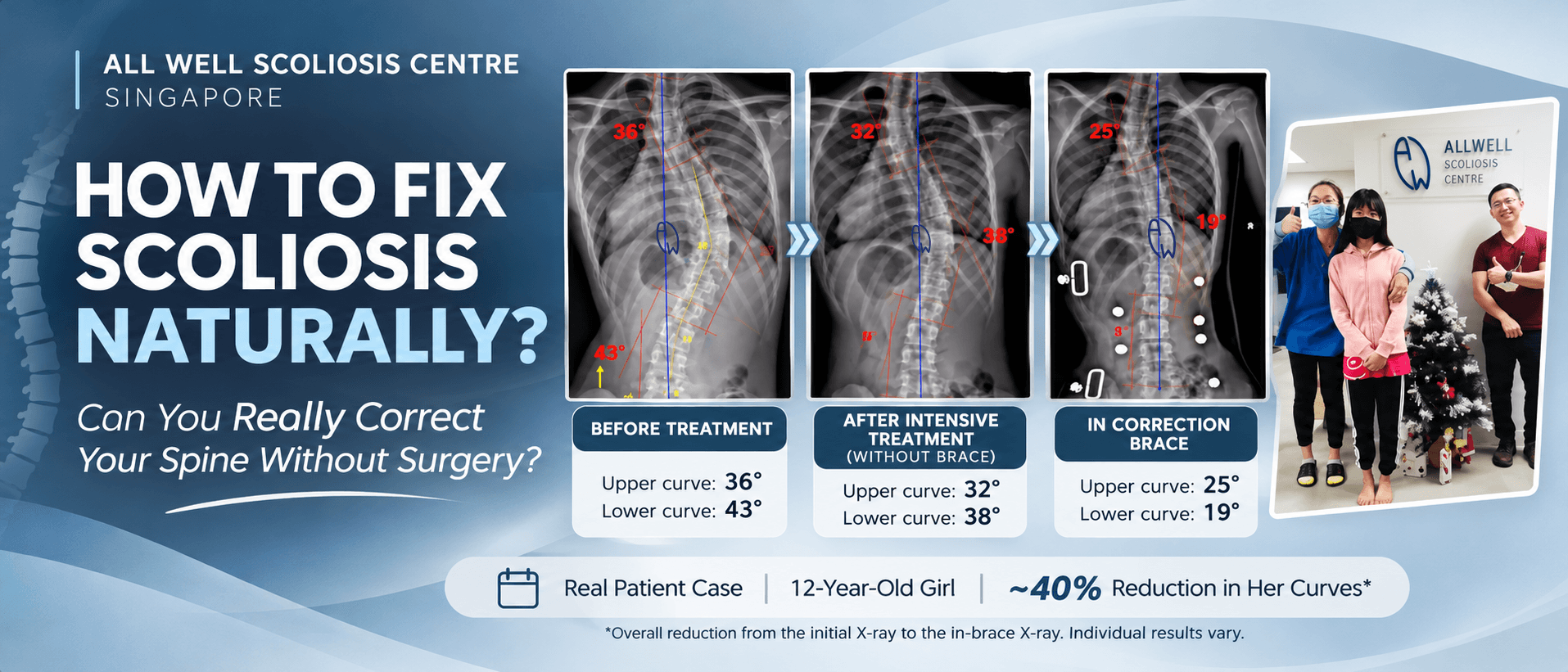
7. A Real Patient Case: From 36° and 43° to Further Correction in a Brace
Let's look at an actual patient case from All Well Scoliosis Centre.
In November 2020, a 12-year-old girl began an intensive scoliosis treatment programme.
Her initial spinal X-ray, taken on 11 November 2020, showed:
-
Upper curve: 36°.
-
Lower curve: 43°.
After intensive treatment – 17 December 2020 (without brace)
Her follow-up X-ray, taken without wearing her corrective brace, showed:
-
Upper curve: 32°.
-
Lower curve: 38°.
This represented recorded changes of 4° in the upper curve and 5° in the lower curve.
Cobb angle measurements have an inherent variability, commonly around 3–5 degrees. Therefore, these changes should be interpreted cautiously and alongside the full clinical assessment.
Subsequent X-ray – in correction brace
Her third X-ray, taken while wearing her corrective brace, showed:
-
Upper curve: 25°.
-
Lower curve: 19°.
Compared with her initial measurements, this represents approximately 31% reduction in the upper curve and 56% reduction in the lower curve while in the brace.
The original clinic record described approximately 40% reduction across her curves.
It is important to distinguish the two outcomes. The second X-ray demonstrates the recorded changes after intensive treatment without the brace. The third demonstrates additional correction while wearing the brace.
In-brace measurements do not establish that the same correction will remain when the brace is removed.
What can we learn from this case?
This case illustrates why scoliosis treatment should not be viewed as a single intervention.
It involves understanding the curve, working towards realistic treatment goals and using appropriate corrective strategies when indicated.
Every patient responds differently. We share this example not to promise that everyone can achieve the same results, but to demonstrate why individualised assessment and structured non-surgical care deserve consideration.
8. Why Scoliosis Treatment Requires Time, Discipline and Commitment
One thing that surprises many parents is how much time proper scoliosis rehabilitation can require.
At All Well Scoliosis Centre, our intensive programme involves extended treatment sessions, often approximately four hours per session, depending on the programme structure.
This is not four hours of continuous exercise.
The session incorporates different components, including preparatory activities, specialised treatment techniques, scoliosis-specific exercises, corrective positioning and supervised practice.
We want patients to understand their own bodies rather than simply receive treatment passively.
For younger patients, many families choose to schedule the intensive programme during school holidays so children can concentrate on treatment without rushing between school and the clinic.
It can be tedious. It requires patience.
Rehabilitation also does not end when patients leave the treatment room.
We encourage:
-
Discipline: Consistency with prescribed exercises and bracing recommendations.
-
Nutrition: Adequate nutrition to support bone health, muscle development and normal growth.
-
Sleep: Sufficient sleep to support recovery and normal development.
-
Physical activity: Appropriate exercise to maintain strength and endurance.
-
Follow-up: Regular reviews and imaging when clinically indicated.
These habits support overall health and rehabilitation. They should not be mistaken for treatments that independently reverse a structural scoliosis curve.
9. Can Severe Scoliosis Still Be Managed Without Surgery?
This is where we need to be particularly careful.
A large Cobb angle does not automatically tell us everything about a person's symptoms or functional abilities.
Some people with substantial curves remain active and report relatively little pain. However, being able to walk or carry out daily activities does not mean a severe curve is harmless.
Some severe curves may be associated with progressive spinal imbalance, respiratory limitations or neurological complications.
Non-surgical management may still have a role in selected patients, particularly in supporting strength, mobility, function and comfort.
However, it should not be presented as a guaranteed alternative to surgery.
Patients with significant or progressive curves, neurological symptoms or breathing difficulties should receive appropriate medical assessment. In some cases, a spinal surgeon's opinion is essential.
Our philosophy is not to promise that every scoliosis curve can be corrected without surgery. It is to understand what is realistically achievable and help patients explore appropriate treatment options.
Can Your Scoliosis Be Corrected Naturally? Let's Understand Your Curve.
If you or your child has been diagnosed with scoliosis, do not immediately assume that surgery is the only option.
Equally, do not assume that every curve can be reversed through exercises, adjustments or lifestyle changes.
Every spine is different.
Some patients may achieve meaningful curve reduction. Others may benefit more from stabilisation, improved alignment, stronger muscles and better daily function.
Don't guess what your spine needs. Let us understand your curve first.
At All Well Scoliosis Centre, we invite you to share your latest standing full-spine X-ray for a preliminary discussion about your scoliosis.
We can help you understand your curve, discuss whether non-surgical care may be suitable and explain what treatment goals may be realistic.
We would rather help you understand your options honestly than promise you a result that no one can guarantee.
Because scoliosis care should begin with understanding your spine, not guessing what it needs.
All Well Scoliosis Centre | Singapore
Specialising in non-surgical scoliosis care, individualised rehabilitation and three-dimensional corrective bracing.
Medical References
-
Scoliosis Research Society. Diagnosis and Treatment of Scoliosis. https://www.srs.org/Patients/Diagnosis-And-Treatment
-
Negrini S, et al. (2018). 2016 SOSORT guidelines: Orthopaedic and rehabilitation treatment of idiopathic scoliosis during growth. Scoliosis and Spinal Disorders, 13, 3. https://doi.org/10.1186/s13013-017-0145-8
-
Weinstein SL, et al. (2013). Effects of Bracing in Adolescents with Idiopathic Scoliosis. New England Journal of Medicine, 369, 1512–1521. https://doi.org/10.1056/NEJMoa1307337
-
National Institute of Arthritis and Musculoskeletal and Skin Diseases (NIAMS). Scoliosis. https://www.niams.nih.gov/health-topics/scoliosis