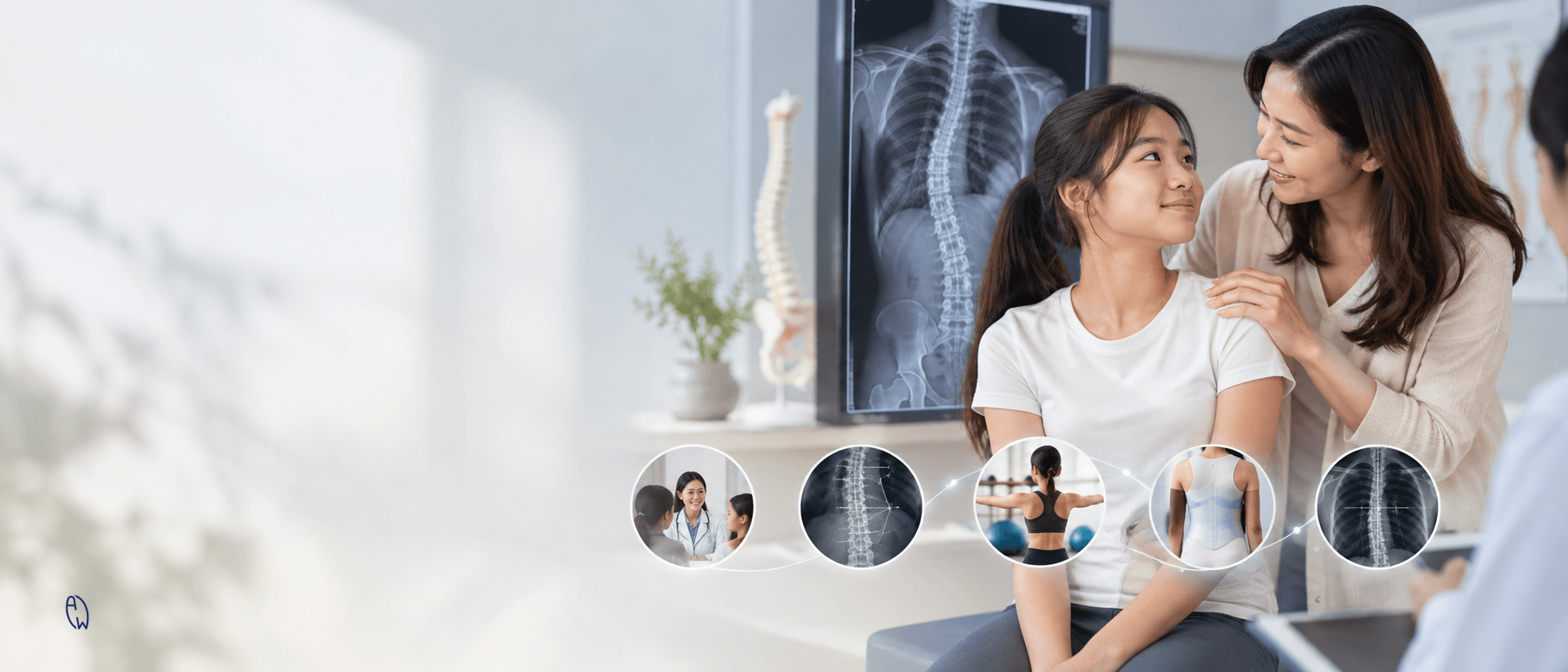
My Child Has Scoliosis—What Should I Do Next? A Singapore Parent's Guide
Your child has just been flagged for scoliosis at school. What happens next?
For many parents in Singapore, the discovery of scoliosis happens during a school health screening.
You may receive a letter or referral explaining that your child's spine needs further assessment. You may then be referred to the Student Health Centre, have an X-ray, and eventually meet an orthopaedic specialist.
Suddenly, unfamiliar terms become part of your vocabulary:
Cobb angle. Curve progression. Observation. Bracing. Surgery.
And one question usually comes first:
“What should I do now?”
If you are in this situation, you are not alone.
A school scoliosis screening is designed to identify children who may need further assessment. It is not, by itself, a complete diagnosis or a treatment recommendation. Singapore's Health Promotion Board explains that the forward-bending test can identify a possible spinal curve, but it does not measure the exact severity. Children who require further assessment may be referred to the Student Health Centre, and some may require an X-ray.
For parents, however, the medical pathway can sometimes leave you with more questions:
What does the Cobb angle actually mean?
Will the curve get worse?
Should we just wait and see?
Does my child need a brace?
Can exercise help?
What if we want to explore conservative treatment before considering surgery?
This guide explains what parents should understand after a scoliosis screening and how to think about the different management options.
Quick Answer: What Should I Do If My Child Has Scoliosis?
If your child has been flagged for scoliosis, don't panic and don't feel that you have to make every treatment decision immediately.
A sensible first step is to:
-
Follow the recommended medical assessment.
-
Understand whether scoliosis has actually been confirmed.
-
Obtain the X-ray and report if imaging has been performed.
-
Find out the Cobb angle and curve pattern.
-
Understand how much growth your child has remaining.
-
Ask about the likelihood of progression.
-
Understand why observation, bracing or another treatment has been recommended.
-
Ask whether scoliosis-specific exercise or other conservative options are appropriate.
-
Consider another professional opinion if you remain uncertain.
-
Choose a treatment pathway based on your child's individual situation—not fear.
There is not one treatment that is appropriate for every child with scoliosis.
What Happens After a Scoliosis Screening in Singapore?
Singapore's school health screening programme includes scoliosis screening for selected students.
During the screening, the child's back is examined while standing and during a forward-bending test. A scoliometer may be used to assess asymmetry. The Health Promotion Board states that this test identifies potential problems but does not determine the exact severity of the spinal curve. A positive screening result does not necessarily mean that the child definitely has scoliosis. Further assessment may be required.
This distinction is important.
A screening result is not the same as a diagnosis.
If your child has been referred, the next step is to understand exactly what has been found.
Don't jump straight from:
“My child failed the screening.”
to:
“My child needs a brace.”
There is an assessment process in between.
Step 1: Get a Proper Assessment
If scoliosis is suspected, further clinical assessment may be recommended.
If an X-ray is taken, ask for a copy of:
-
the X-ray images
-
the radiology report
-
the Cobb angle measurement
-
the doctor's assessment
-
any previous spinal imaging
Keep these records.
They become particularly useful if your child's spine needs to be monitored over several years or if you decide to seek another professional opinion.
A child's scoliosis should be evaluated in context—not simply by looking at one number.
Step 2: Understand the Cobb Angle
The Cobb angle is the measurement commonly used to quantify the degree of spinal curvature on an X-ray.
A Cobb angle of at least 10° is generally used to define scoliosis.
But parents should be careful not to treat the Cobb angle as a standalone prediction of their child's future.
For example, two children may both have a 25° curve but have very different clinical situations.
One may be close to skeletal maturity.
The other may have several years of growth remaining.
The location and pattern of the curve may also be different.
Previous X-rays may show that one curve has remained stable while another has changed.
So don't only ask:
“How many degrees is the curve?”
Also ask:
“How much growth does my child have remaining?”
“Has the curve changed compared with previous X-rays?”
“What is the pattern of the curve?”
“What is the estimated risk of progression?”
These questions provide much more context.
Step 3: Understand What “Wait and See” Really Means
One of the most difficult phrases for parents to hear is:
“Let's just monitor it.”
Parents may interpret this as:
“There is nothing we can do.”
But observation does not necessarily mean doing nothing.
For some children, monitoring is an appropriate management strategy. The purpose is to observe the spine as the child grows and determine whether the curve remains stable or progresses.
HealthHub describes observation as one of the management approaches used for scoliosis, alongside bracing and surgery depending on the individual situation.
The important question is therefore not simply:
“Are we treating it?”
but:
“What is the monitoring plan?”
Ask:
-
When should my child be reassessed?
-
When would another X-ray be considered?
-
What changes should we look for?
-
How much growth does my child have remaining?
-
What would cause the treatment plan to change?
Observation should come with a plan.
Parents should understand what is being monitored and when the next decision will be made.
Step 4: Ask About Progression Risk
Scoliosis is particularly important to monitor during growth.
A curve that is relatively small today may behave differently in a child who has substantial growth remaining compared with a child who is approaching skeletal maturity.
This is why growth is one of the most important pieces of the puzzle.
Ask your child's healthcare professional:
“Is my child still in a significant growth phase?”
“How much growth is left?”
“What factors increase the risk of progression?”
“How often should the curve be monitored?”
The answers help put the Cobb angle into context.
Step 5: Does My Child Need a Scoliosis Brace?
Not every child with scoliosis needs a brace.
But for appropriately selected growing children who are at meaningful risk of progression, bracing is an established conservative treatment.
The landmark BRAIST trial, published in the New England Journal of Medicine, compared bracing with observation in adolescents considered at high risk of progression. The study found that bracing significantly reduced progression to 50° or more, and greater brace-wearing time was associated with a higher rate of treatment success.
This is an important point for parents:
Bracing is not simply an alternative to surgery.
For selected growing children, its purpose is to help manage the risk of significant curve progression during growth.
But the question should not simply be:
“Does my child need a brace?”
It should be:
“Is bracing appropriate for my child, and if so, what type of bracing and follow-up are appropriate?”
Step 6: Not All Scoliosis Braces Are the Same
Parents researching scoliosis quickly discover that there are different brace designs and treatment philosophies.
The goal of a scoliosis brace is not simply to hold the child's back rigidly.
Depending on the brace design, the aim may include applying corrective forces to influence spinal alignment while the child grows.
Research supports bracing for appropriately selected adolescents, but outcomes depend on factors including patient selection, skeletal maturity, curve characteristics, brace use and compliance. The BRAIST trial also demonstrated a relationship between brace-wearing time and treatment success.
And there is another factor that parents sometimes overlook:
The child actually has to wear the brace.
Comfort, confidence, school life, sports, social situations and emotional wellbeing can all influence whether a young person is willing and able to follow a brace programme.
A 2026 systematic review of adolescents' experiences of scoliosis bracing highlighted challenges including discomfort, body image, social experiences and emotional impact, while emphasizing the importance of support and involvement in treatment decisions.
For that reason, good bracing care should consider both:
the X-ray
and
the child wearing the brace.
Step 7: Can Scoliosis-Specific Exercise Help?
This is another area that parents often discover when they start researching conservative scoliosis treatment.
But there is an important distinction:
General exercise is not the same as scoliosis-specific exercise.
Physiotherapeutic scoliosis-specific exercises, or PSSE, are structured around the individual's spinal pattern.
Depending on the approach, they may involve:
-
three-dimensional self-correction
-
postural awareness
-
breathing strategies
-
trunk stabilization
-
strengthening
-
neuromuscular control
-
maintaining a corrected position during movement
Research into PSSE has developed considerably.
A 2024 systematic review and network meta-analysis of 17 randomized controlled trials involving 857 patients found that PSSE improved Cobb angle, trunk rotation and quality of life compared with conventional rehabilitation in the included studies. However, the authors also noted differences between exercise approaches and the need to interpret the findings within the limitations of the available evidence.
Another 2024 systematic review and meta-analysis examining the three-dimensional effects of PSSE found positive effects on Cobb angle, angle of trunk rotation and thoracic kyphosis, while rating the overall evidence from moderate to very low depending on the study design and outcome. The authors specifically noted that more high-quality research is needed for moderate curves.
So the responsible message is not:
“Exercise will straighten your child's scoliosis.”
It is:
“Scoliosis-specific exercise may be an evidence-supported component of conservative management for appropriately selected children.”
That distinction matters.
Step 8: Does Poor Posture Cause Scoliosis?
No.
This is one of the most common misconceptions parents encounter.
Scoliosis should not be confused with ordinary poor posture.
A child does not develop adolescent idiopathic scoliosis simply because they:
-
sit badly
-
carry a school bag on one shoulder
-
sleep in a particular position
-
play sports
-
use a computer
-
spend too much time sitting
Singapore's HealthHub specifically states that scoliosis is a spinal deformity and should not be confused with poor posture.
So why do we talk about posture in conservative scoliosis care?
Because posture and postural control are different from the cause of scoliosis.
A child may develop habitual ways of standing, sitting or moving around their spinal asymmetry.
Conservative rehabilitation can therefore work on helping the child recognize and actively control their body position.
What Do We Mean by “Posture Correction”?
We don't mean:
“Just stand straight.”
That is too simplistic.
Instead, the focus may be on:
Recognize → Correct → Control → Strengthen → Integrate
The child learns to:
-
recognize their individual asymmetry,
-
find a more corrected position,
-
actively control that position,
-
develop strength and stability,
-
gradually integrate the strategy into everyday movement.
This is particularly relevant to scoliosis-specific exercise approaches, which emphasize three-dimensional self-correction and postural control.
The aim is not to tell a child that their scoliosis happened because they had “bad posture.”
It is to help the child develop greater awareness and control of their existing movement pattern.
What If We Are Not Satisfied With “Wait and See”?
This is a question we hear from parents.
After receiving an assessment, some families feel comfortable with observation.
Others want to understand whether there are conservative options that could be considered while their child is still growing.
Some seek another orthopaedic opinion.
Others investigate:
-
scoliosis-specific exercise
-
corrective bracing
-
rehabilitation
-
posture and movement retraining
-
a combination of conservative approaches
There is nothing unusual about wanting to understand your options.
But there is an important principle:
Seeking another opinion should be about understanding—not rejecting medical advice automatically.
A conservative clinic should not tell a parent:
“The hospital is wrong.”
Nor should a parent assume that a private conservative approach is automatically better.
Instead, ask:
“What is the evidence?”
“What is the goal of this treatment?”
“What are its limitations?”
“How will we measure whether it is helping?”
Those are better questions.
What If Surgery Has Been Discussed?
If your child's curve is severe or progressing, an orthopaedic surgeon may discuss surgery.
That conversation can be frightening.
But it is important to understand why surgery is being recommended rather than making a decision based on fear.
Ask:
-
What is the current Cobb angle?
-
Has the curve progressed?
-
How much growth does my child have remaining?
-
What is the curve pattern?
-
Why is surgery being recommended now?
-
What are the expected benefits?
-
What are the risks?
-
What would happen if we continued monitoring?
-
Are there appropriate conservative options for this particular child?
-
Would another specialist opinion be useful?
There are situations in which surgery is an appropriate and important treatment.
Conservative scoliosis care should never promise that surgery can always be avoided.
Some curves progress despite conservative management.
Some children ultimately require surgery.
Good conservative care should acknowledge that reality.
Where Does a Conservative Scoliosis Clinic Fit Into the Picture?
This is where parents sometimes become confused.
A conservative scoliosis clinic is not a replacement for an orthopaedic surgeon when surgery is indicated.
The role is different.
At All Well Scoliosis Centre, our focus is conservative, non-surgical scoliosis management.
Depending on the individual child, our approach may include:
-
scoliosis-specific exercises
-
ScoliBalance®
-
corrective bracing
-
ScoliBrace™
-
postural and movement retraining
-
CLEAR-based care
-
spinal decompression where clinically appropriate
-
ongoing objective monitoring
We do not believe every child should automatically receive every treatment.
The appropriate combination depends on the child's:
-
age
-
growth status
-
curve characteristics
-
physical presentation
-
goals
-
previous treatment
-
family preferences
Why We Take Time With Scoliosis
Scoliosis should not be treated like a quick appointment.
A growing child's spine can change.
Understanding that change requires more than looking at the spine for a few minutes.
At All Well, we take time to review:
-
the child's history
-
previous assessments
-
X-rays
-
Cobb angle
-
growth status
-
curve pattern
-
posture
-
movement
-
muscle control
-
treatment goals
-
family expectations
Even our non-scoliosis consultations typically involve substantially more time than a brief 10-minute appointment.
For scoliosis, the assessment needs to be even more comprehensive.
We don't want to guess.
We want to understand the child first.
More Than 20 Years of Scoliosis Experience
All Well Scoliosis Centre has more than 20 years of experience working with scoliosis.
Over that time, we have seen how differently families approach the same diagnosis.
Some parents want the most conservative option possible.
Some want to explore bracing.
Some prioritize exercise.
Some want another medical opinion.
Some are comfortable monitoring.
Some want to be as proactive as possible during their child's growth years.
There is no single answer that fits every family.
Our responsibility is to explain what we see, what the available evidence tells us, what the limitations are and what options may reasonably be considered.
Our Approach: Understand First. Treat Second. Measure Throughout.
One principle is particularly important to us:
We believe in objective monitoring.
If a child is undergoing conservative scoliosis management, parents should have a way to evaluate what is happening.
That may involve:
Initial assessment → individualized treatment → follow-up → objective reassessment
Where clinically appropriate, follow-up X-rays can be compared to evaluate changes in Cobb angle and spinal alignment.
But an X-ray is not the only thing we assess.
We may also look at:
-
posture
-
movement control
-
strength
-
body awareness
-
functional ability
-
ability to maintain a corrected position
A photograph can show that a child looks different.
An X-ray can provide structural measurements.
Functional assessment can tell us something different again.
Each provides a different piece of the picture.
What About ScoliBrace™?
At All Well, ScoliBrace™ is used as part of our corrective bracing approach for appropriately selected patients.
The philosophy behind corrective bracing is different from simply trying to hold the spine rigidly.
The brace is designed around the individual's three-dimensional spinal pattern, with corrective forces intended to influence alignment during growth.
But the brace is only one component.
For an appropriate child, a broader conservative programme may include:
Corrective brace + scoliosis-specific exercise + postural control + monitoring
The purpose is not to promise that every curve will become straight.
The purpose is to provide a structured conservative strategy and monitor how the child responds.
Every Family Has Different Priorities
This is something we strongly believe.
Parents have different:
-
priorities
-
budgets
-
expectations
-
risk tolerance
-
access to care
-
understanding of scoliosis
-
preferences regarding treatment
Children are different too.
One child may be highly motivated to exercise.
Another may struggle with wearing a brace.
One family may prefer observation.
Another may want to explore every appropriate conservative option.
These differences deserve respect.
Our role is not to pressure families into one pathway.
Our role is to help parents understand:
What do we know?
What are the options?
What does the evidence tell us?
What are the limitations?
How can we measure progress?
Then parents can decide how they want to move forward.
What Should I Bring to My Child's Scoliosis Consultation?
If you are seeing a scoliosis specialist or conservative scoliosis clinic, bring as much relevant information as possible.
Bring:
☐ School screening referral
☐ X-ray images
☐ Radiology report
☐ Previous X-rays
☐ Previous medical reports
☐ Current treatment recommendations
☐ Your child's growth information, if available
☐ A list of questions
If you already have an X-ray, bring the actual images—not just a photograph of the report.
The images can provide information that a written report does not fully communicate.
Questions Every Parent Should Ask
You don't need to ask all of these questions at once.
But these are useful questions to have available.
About the diagnosis
Does my child definitely have scoliosis?
What type of scoliosis is it?
What is the Cobb angle?
What is the curve pattern?
About growth
How much growth does my child have remaining?
Is my child approaching skeletal maturity?
About progression
Has the curve changed compared with previous X-rays?
What factors affect my child's risk of progression?
How often should the curve be monitored?
About treatment
Why are you recommending observation?
Would bracing be appropriate?
Would scoliosis-specific exercise be appropriate?
What is the goal of the recommended treatment?
How will we know whether it is working?
About surgery
Why is surgery being considered?
What happens if we monitor for longer?
Are there appropriate conservative options for this particular case?
Would another opinion be useful?
These questions can transform a frightening diagnosis into a much clearer decision-making process.
A Simple Parent's Roadmap
If you want to simplify everything, think about scoliosis management as a series of questions:
1. Is it actually scoliosis?
Confirm the diagnosis.
↓
2. How large is the curve?
Understand the Cobb angle and curve pattern.
↓
3. How much growth remains?
Growth can influence the risk of progression.
↓
4. Is the curve stable or changing?
Compare appropriate assessments over time.
↓
5. Does my child need active treatment?
Depending on the individual situation, this may include observation, bracing, exercise or other management.
↓
6. What is the goal?
Be clear about what the treatment is intended to achieve.
↓
7. How will we measure progress?
Use appropriate clinical and, when indicated, imaging measures.
↓
8. When should we reassess?
Have a clear follow-up plan.
This is a much more useful framework than simply asking:
“What is the best scoliosis treatment?”
Because there is no single best treatment for every child.
The Most Important Thing Parents Should Know
If your child has just been diagnosed with scoliosis, you do not need to make every decision in one appointment.
Start with the facts.
Understand the X-ray.
Understand the Cobb angle.
Understand your child's growth stage.
Understand whether the curve is stable or changing.
Understand what observation means.
Understand when bracing may be considered.
Understand the role of scoliosis-specific exercise.
Understand why surgery may or may not be recommended.
And if you still have questions, seek another appropriately qualified opinion.
At All Well Scoliosis Centre, we believe parents deserve information rather than pressure.
We are naturally supportive of conservative and non-surgical approaches where appropriate.
But we also believe in intellectual honesty.
We cannot promise that every curve can be reversed.
We cannot promise that every child can avoid surgery.
And we should not pretend that one treatment works for everyone.
What we can do is provide a structured, individualized approach that aims to manage scoliosis during growth, support active postural and movement control, use conservative tools such as exercise and bracing when appropriate, and objectively monitor the child's response.
Because a scoliosis diagnosis should not leave a parent with only one question:
“How many degrees is the curve?”
It should leave you asking:
“What does this mean for my child—and what should we do next?”
Frequently Asked Questions
What should I do if my child has scoliosis?
Start by confirming the diagnosis and understanding the X-ray, Cobb angle, curve pattern and growth status. Then discuss the appropriate management options, which may include observation, bracing, scoliosis-specific exercise or other treatment depending on the individual child.
What happens after a school scoliosis screening in Singapore?
A screening finding may lead to further assessment through the Student Health Centre. The forward-bending screening test identifies potential problems but does not measure the exact severity of the curve. Some children may require an X-ray or further clinical assessment.
Does a positive scoliosis screening mean my child definitely has scoliosis?
No. A positive screening result indicates that further assessment may be needed. It does not by itself establish the diagnosis or severity.
What is a Cobb angle?
The Cobb angle is an X-ray measurement used to quantify the degree of spinal curvature. It is an important measurement in scoliosis assessment, but it should be considered alongside factors such as age, growth, curve pattern and progression.
Does my child need a scoliosis brace?
Not necessarily. Bracing is generally considered for appropriately selected growing children who have a meaningful risk of progression. The decision depends on the child's individual clinical situation. Research from the BRAIST trial demonstrated that bracing reduced progression to 50° or more in adolescents at high risk of progression compared with observation.
Can scoliosis-specific exercise help children?
Research suggests that PSSE can improve certain measures of adolescent idiopathic scoliosis, including Cobb angle and trunk rotation, although the quality and strength of evidence vary among studies.
Can poor posture cause scoliosis?
No. Scoliosis should not be confused with ordinary poor posture. Singapore's HealthHub describes scoliosis as a spinal deformity rather than simply a postural problem.
Can children with scoliosis play sports?
Many children with scoliosis can remain physically active. The appropriate activities depend on the child's individual condition, treatment and symptoms. Specific concerns should be discussed with the child's healthcare professional.
Should I get a second opinion for my child's scoliosis?
If you are uncertain about the diagnosis or treatment plan, another appropriately qualified opinion can help you understand the available options and make a more informed decision.
Can conservative treatment guarantee that my child will avoid surgery?
No. Conservative treatment cannot guarantee that surgery will never be necessary. Some curves progress despite conservative management. The goal is to manage the child's individual risk and support the best achievable outcome rather than promise a particular result.
Medical Disclaimer
This article is for educational purposes only and does not replace medical diagnosis or treatment. Every child's scoliosis is different. Treatment decisions should consider the child's age, growth status, skeletal maturity, curve characteristics, imaging and clinical assessment. If your child has been referred through Singapore's school health screening programme, follow the recommended medical assessment and discuss treatment options with an appropriately qualified healthcare professional.
References
-
HealthHub Singapore. Health Screening for Primary School. Information on school-based scoliosis screening and referral.
-
Health Promotion Board Singapore. Forward Bending Test (FBT). Information on scoliosis screening and limitations of the screening test.
-
Weinstein SL, Dolan LA, Wright JG, Dobbs MB. Effects of Bracing in Adolescents with Idiopathic Scoliosis. New England Journal of Medicine. 2013;369:1512–1521.
-
Dong H, You M, Li Y, et al. Physiotherapeutic Scoliosis-Specific Exercise for the Treatment of Adolescent Idiopathic Scoliosis: A Systematic Review and Network Meta-analysis. American Journal of Physical Medicine & Rehabilitation. 2024;104(1):14–25.
-
You MJ, Lu ZY, Xu QY, et al. Effectiveness of Physiotherapeutic Scoliosis-Specific Exercises on 3-Dimensional Spinal Deformities in Patients With Adolescent Idiopathic Scoliosis: A Systematic Review and Meta-analysis. Archives of Physical Medicine and Rehabilitation. 2024;105(12):2375–2389.
-
Negrini S, Donzelli S, Aulisa AG, et al. 2016 SOSORT guidelines: orthopaedic and rehabilitation treatment of idiopathic scoliosis during growth. Scoliosis and Spinal Disorders. 2018.