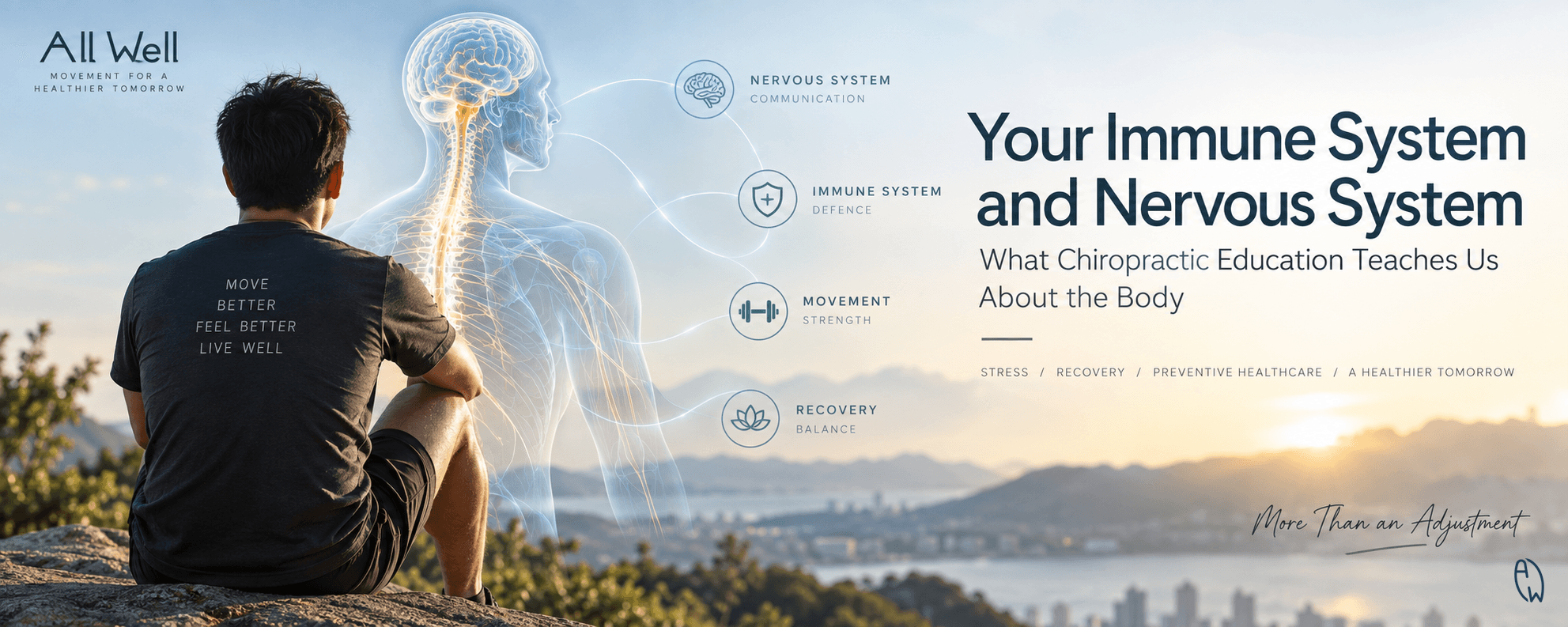
Your Immune System and Nervous System: What Chiropractic Education Teaches Us About the Body
The Connection Between Stress, Recovery, Preventive Healthcare and Chiropractic Care
We live in a world that rewards performance.
Work harder.
Study harder.
Train harder.
Achieve more.
We push our bodies to their limits and then wonder why they eventually demand our attention.
But there is something we often forget:
The human body is not a machine.
We are biological organisms. Our brain, nervous system, muscles, organs, hormones and immune system constantly communicate and adapt to what we ask of them.
Once you study anatomy and physiology deeply, you begin to see healthcare differently.
You realise there are no isolated systems.
Everything is connected.
And for me, that was one of the most eye-opening things about studying chiropractic in the United States.
What Chiropractic School in the U.S. Taught Me About the Human Body
When I entered chiropractic school in the United States, I thought I was going to learn how to work with the spine.
I didn't realise I was about to spend years studying something much bigger:
how the human body actually works.
Before you ever think about adjusting a patient, chiropractic education takes you through extensive study of the basic and clinical sciences.
According to the Council on Chiropractic Education, accredited Doctor of Chiropractic programs must include a minimum of 4,200 instructional hours and curriculum covering areas such as anatomy, physiology, biochemistry, microbiology, pathology, diagnostic imaging, biomechanics, neurology, clinical diagnosis and chiropractic technique.
And the deeper you go, the more fascinating it becomes.
You study the bones.
Then the muscles.
Then the nerves.
Then the blood vessels.
Then the organs.
Then the brain.
Eventually, you start putting everything together.
That's when something changes.
You realise that a muscle isn't simply a muscle.
It is connected to a nerve.
That nerve communicates with the spinal cord.
The spinal cord communicates with the brain.
The brain receives information from muscles and joints.
The nervous system coordinates movement.
The autonomic nervous system regulates countless functions that happen without conscious thought.
Suddenly, the human body isn't a collection of separate parts.
It becomes a system.
I remember how eye-opening that was.
The spine stopped looking like a stack of bones.
It became part of a living, moving, sensory and neurological system.
And that changed the way I thought about chiropractic.
I stopped seeing chiropractic as simply adjusting someone's spine.
I started seeing it as one part of a much bigger conversation about human function, movement, the nervous system and health.
The Spine Is Part of a Much Bigger System
Your spine provides structural support, protects the spinal cord and allows your body to move.
But movement is also information.
Your joints, muscles and other sensory systems constantly provide information to your nervous system.
Where am I?
Am I balanced?
How much force am I using?
Do I need to contract this muscle?
Should I change my position?
Your brain is continuously processing information and coordinating a response.
This is why biomechanics and neurology are so fascinating.
A problem that appears to be “just a back problem” may also involve movement patterns, muscle function, sensory information, previous injuries, work demands, habits and other factors.
That doesn't mean every symptom has a hidden neurological cause.
It means the body deserves to be understood as a connected system.
Your Nervous System and Immune System Are Connected
The nervous system and immune system are not independent.
They communicate through complex interactions involving the autonomic nervous system, the hypothalamic-pituitary-adrenal axis and immune signaling. Researchers describe these systems as an interconnected network that helps coordinate the body's responses to stress and changes in its internal and external environment.
This field is often called psychoneuroimmunology—the study of interactions between psychological processes, the nervous system, the endocrine system and the immune system.
This is where anatomy becomes more than memorising structures.
You start understanding physiology.
You start asking:
What happens when someone is under prolonged stress?
What happens when they stop sleeping properly?
What happens when they stop moving?
What happens when they are constantly asking the body to perform without allowing it to recover?
These questions matter because the systems of the body do not operate independently.
Can Stress Affect Your Immune System?
Stress is a normal part of life.
In fact, your body needs a certain amount of stress to adapt.
Exercise is stress.
Strength training is stress.
Studying is stress.
Working toward a deadline is stress.
Training for a competition is stress.
Your body is designed to respond to challenges.
The problem is not necessarily stress itself.
The problem can be prolonged stress without adequate recovery.
Research in psychoneuroimmunology has demonstrated complex interactions between psychological stress, the nervous system, endocrine responses and immune function. Importantly, the effects of stress are not as simple as saying “stress weakens the immune system.” Different types, durations and contexts of stress can produce different physiological and immune responses.
That distinction matters.
Because the human body is complicated.
And good healthcare should respect that complexity.
Stress + Recovery = Adaptation
Think about exercise.
You create a physical challenge.
Your body responds.
Then you recover.
Over time, your body adapts.
You become stronger.
You become more capable.
But what happens if you train intensely every day without enough sleep or recovery?
Eventually, performance can suffer.
Life works in much the same way.
You can work hard.
Study hard.
Train hard.
Play hard.
Build a business.
Raise a family.
But eventually, your body needs something from you.
Recovery.
Sleep.
Nutrition.
Movement.
Rest.
Time away from constant stimulation.
Recovery isn't laziness.
Recovery is part of performance.
We Are Not Superman
Modern society celebrates people who can keep going.
The executive who works late every night.
The athlete who trains twice a day.
The student who studies until midnight.
The entrepreneur who never switches off.
The parent who somehow manages everything.
But the human body has limits.
Think about your car.
You don't wait until the engine fails before servicing it.
You maintain it because you want it to keep working.
Why do we treat our bodies differently?
We often wait until pain becomes severe.
Until movement becomes difficult.
Until exhaustion catches up.
Until something becomes a diagnosis.
Then we ask:
“How do I fix this?”
Perhaps we should have asked earlier:
“How do I maintain this?”
What Is Preventive Healthcare?
Prevention does not mean you will never get sick.
It doesn't.
You can eat well and still get influenza.
You can exercise and still get injured.
You can sleep well and still develop a medical condition.
There are no guarantees in biology.
Preventive healthcare means paying attention to the things that influence your health before a problem becomes bigger.
That includes:
-
Adequate sleep
-
Nutritious food
-
Regular physical activity
-
Strength and mobility
-
Stress management
-
Recovery
-
Healthy lifestyle habits
-
Appropriate medical screening
-
Vaccination and other evidence-based preventive care
-
Seeking professional help when something isn't right
Prevention is not about perfection.
It is about maintenance and awareness.
Does Chiropractic Boost the Immune System?
This is where we need to be honest.
The nervous system and immune system are biologically connected.
But that does not mean we can claim that a chiropractic adjustment “boosts immunity” or prevents influenza.
A systematic review published in JAMA Network Open examined studies on spinal manipulative therapy and immune or infectious-disease outcomes. The authors found no clinical evidence establishing that spinal manipulation prevents infectious disease or improves disease-specific outcomes through immune effects. Some preliminary studies found short-term changes in certain biomarkers, but their clinical significance remained unknown.
And that's okay.
We never claimed to heal influenza.
If you have influenza, pneumonia, an infection or another medical condition requiring treatment, you should receive appropriate medical care.
Chiropractic care has a different role.
Understanding that role is important.
Good healthcare should know both what it can do and what it cannot do.
So Where Does Chiropractic Fit?
Chiropractic is sometimes reduced to one simple idea:
“You go to the chiropractor to get adjusted.”
But chiropractic education is much broader than that.
The traditional focus is the relationship between the musculoskeletal system and nervous system.
Depending on the practitioner and clinical setting, chiropractic care may involve assessment, manual therapy, exercise, rehabilitation, movement advice and lifestyle education.
And this is where the philosophy becomes bigger than the adjustment.
We should be asking:
How do you move?
How do you sleep?
How do you exercise?
How do you recover?
How do you manage stress?
What demands are you placing on your body every day?
The adjustment is one tool.
Understanding the person is the bigger job.
Your Symptom Is Important. But It May Not Be the Whole Story.
Someone comes into a clinic with back pain.
We could simply ask:
“Where does it hurt?”
But we can also ask:
How many hours do you sit?
How do you sleep?
How often do you exercise?
What happened before the pain started?
What movements make it worse?
What makes it better?
Have you had an injury?
How strong and mobile are you?
What does your workday look like?
How stressed are you?
Are you recovering properly?
These questions don't mean that every symptom is caused by lifestyle.
They simply help us understand the person behind the symptom.
A symptom is information. It isn't always the whole story.
Symptom Relief and Long-Term Health Are Not Always the Same Thing
Medicine has an important role in healthcare, including relieving symptoms when appropriate.
Pain medication, for example, can be extremely useful.
But symptom relief and addressing contributing factors are not always the same thing.
If someone has recurring pain, the next question may be:
Why does it keep coming back?
Is it related to an injury?
Movement?
Strength?
Work demands?
Sleep?
Recovery?
Another medical condition?
Sometimes the answer requires medical investigation.
Sometimes rehabilitation is appropriate.
Sometimes lifestyle changes are important.
Sometimes chiropractic care may be appropriate.
Sometimes the answer is a combination.
Good healthcare is knowing the difference.
Chiropractic Is Not Medicine Versus Chiropractic
Healthcare doesn't have to be a competition.
Medicine has an essential role in diagnosing and treating disease.
Surgery can save lives.
Medication can save lives.
Vaccination can prevent serious infectious diseases.
Physiotherapy can be essential for rehabilitation.
Nutrition professionals can help address dietary needs.
Mental-health professionals can support psychological wellbeing.
And chiropractic care can have a role in conservative musculoskeletal care and physical function.
The question shouldn't always be:
“Which profession is better?”
The better question is:
“What does this person need?”
Sometimes it is chiropractic.
Sometimes it is physiotherapy.
Sometimes it is medical care.
Sometimes it is surgery.
Sometimes it is several disciplines working together.
Good healthcare is not about winning an argument.
It is about helping the person.
Your Healthcare Practitioner Should Listen
There is another part of healthcare that matters enormously:
Time.
A good healthcare consultation should be more than identifying a symptom and immediately deciding what to prescribe or do.
You should be able to ask:
-
What do you think is happening?
-
Why are you recommending this treatment?
-
What are the potential benefits?
-
What are the limitations?
-
What are the risks or side effects?
-
What alternatives are available?
-
When should I see another healthcare professional?
And your practitioner should listen.
Not every practitioner is the right practitioner for you.
A beautiful CV does not automatically mean someone understands your individual situation.
Credentials matter.
Training matters.
Experience matters.
But so do empathy, communication and the willingness to listen.
If you don't feel heard, seek another opinion.
You are allowed to shop around for your healthcare.
High-Performance People Need Maintenance Too
This isn't just relevant to individuals.
It matters to companies too.
Businesses want productive, focused, high-performing employees.
But employees are human beings.
You cannot expect people to operate at maximum capacity indefinitely without recovery.
From an organisational perspective, supporting employee health can be relevant to wellbeing, productivity and absenteeism.
But perhaps the bigger question isn't:
“How do we reduce medical claims?”
It is:
“How do we help our people stay healthy enough to live and work well?”
That is a much more human approach to workplace health.
Because ultimately, your employee is not a productivity unit.
They are a person.
The Four Foundations of a Resilient Body
There is no magic supplement, adjustment or exercise that makes you invincible.
Start with the basics.
Sleep
Give your body time to recover.
Nutrition
Give your body the raw materials it needs.
Movement
Give your body a reason to stay strong and capable.
Recovery
Give your nervous system time to come down from the demands of everyday life.
And when something doesn't feel right, don't simply ignore it.
Find out why.
The Adjustment Is Only One Part of the Conversation
Perhaps this is the biggest misunderstanding about chiropractic.
People sometimes think:
“Go to the chiropractor and get adjusted.”
But chiropractic education is much broader.
You study anatomy.
Physiology.
Neurology.
Biomechanics.
Pathology.
Nutrition.
Clinical assessment.
Movement.
Structure and function.
You learn how the body is built before you try to influence how it functions.
That education changes how you see healthcare.
You begin to understand that an adjustment is not the entire answer.
The bigger conversation is about helping people understand their bodies.
That means talking about exercise.
Diet.
Sleep.
Stress.
Posture.
Movement.
Recovery.
Prevention.
Because what you do between appointments may be just as important as what happens inside the clinic.
You Don't Maintain Your Body Because You're Sick
This is perhaps the philosophy I believe more people need to understand.
You maintain your body because you depend on it.
You depend on it to work.
To exercise.
To think.
To travel.
To play.
To raise your family.
To build your career.
To enjoy your life.
We invest enormous amounts of time and money into our careers, businesses, homes and education.
But none of those investments mean much if we neglect the body carrying us through life.
You are not a machine.
You are an organic, adaptive biological system.
You can push it.
Challenge it.
Train it.
Test it.
But you also have to maintain it.
At All Well, We Believe Healthcare Should Be Empowering
At All Well, we don't believe in promising miracles.
We don't claim chiropractic adjustments cure influenza.
We don't claim chiropractic care makes someone immune to disease.
And we don't believe chiropractic should replace appropriate medical care.
We believe in understanding the body.
Understanding movement.
Understanding the nervous system.
Understanding biomechanics.
Understanding lifestyle.
Understanding recovery.
And helping people make better decisions about their health.
Chiropractic care may be one part of that process.
It is not the entire picture.
Your Body Is the System That Takes You Through Life
Perhaps the greatest lesson anatomy teaches us is simple:
The body is connected.
Your nervous system is connected to your body.
Your body is connected to movement.
Movement provides information to your brain.
Stress affects your physiology.
Sleep affects recovery.
Nutrition supports function.
Your lifestyle influences your biology.
And your biology influences how you feel and function.
We cannot control everything that happens to our bodies.
But we can influence many of the things we do to them every day.
So don't wait until something breaks before you start paying attention.
You don't maintain your body because you are sick.
You maintain it because you want to stay capable.
That is the heart of preventive healthcare.
And that is where chiropractic care can have a place—not as a replacement for medicine, not as a cure-all, and not as a promise of immunity, but as one part of a broader approach to physical function, health and wellbeing.
Take care of the system that takes care of you.
Sources & Further Reading
-
Council on Chiropractic Education (CCE) — Accreditation Standards for Doctor of Chiropractic Programs. The standards describe the minimum program length and required basic and clinical science curriculum.
-
Mueller B, et al. Structural and functional connections between the autonomic nervous system, hypothalamic-pituitary-adrenal axis, and the immune system: a context and time dependent stress response network. Neurological Sciences, 2022.
-
Psychoneuroimmunology research — Reviews examining the complex interactions between psychological stress, the nervous system, endocrine responses and immune function.
-
Chow N, et al. Assessment of Studies Evaluating Spinal Manipulative Therapy and Infectious Disease and Immune System Outcomes: A Systematic Review. JAMA Network Open, 2021;4(4):e215493.