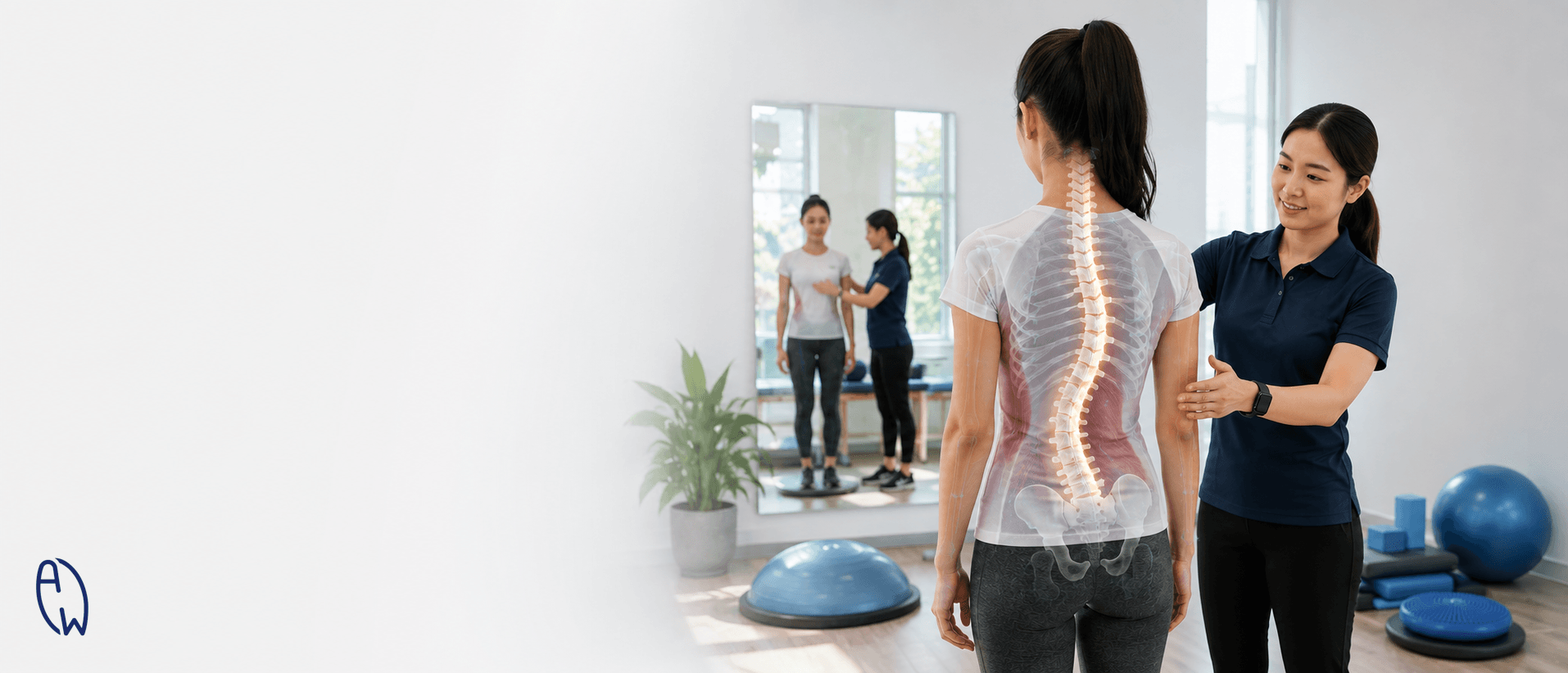
Why Chiropractic Alone Is Not Enough for Scoliosis
One of the questions we hear most often is:
"Can chiropractic fix scoliosis?"
As a scoliosis centre founded by chiropractors, many people expect our answer to be yes.
But our answer is actually:
No—not on its own.
That might sound surprising.
After all, chiropractic focuses on the spine. Surely adjusting the spine should correct scoliosis?
If only it were that simple.
The truth is, scoliosis is far more complex than a spine that is simply "out of place." It is a three-dimensional neuromuscular condition involving the bones, joints, muscles, ligaments, nervous system, balance, breathing mechanics, and the brain's control of posture.
Because of this complexity, manual adjustments alone cannot correct structural scoliosis.
At All Well Scoliosis Centre, we use chiropractic as one important part of treatment—but never as the entire treatment.
Understanding What Chiropractic Can—and Cannot—Do
There are many misconceptions about chiropractic care for scoliosis.
Some believe a chiropractor can "push the spine back into place."
Others think a few adjustments can permanently straighten a curved spine.
Neither is true.
A chiropractic adjustment is designed to improve the movement and function of spinal joints.
It can help:
-
Improve joint mobility
-
Reduce stiffness
-
Decrease muscle guarding
-
Improve spinal movement
-
Relieve pain and discomfort
-
Prepare the body for rehabilitation
Many patients genuinely feel better after an adjustment.
Their neck moves more freely.
Their back feels looser.
Their muscles relax.
Pain may decrease.
These are valuable outcomes.
However, pain relief is not the same as structural correction.
An adjustment can improve how the spine moves, but it cannot permanently change the structure of a scoliosis by itself.
We Are Not Carpenters
One phrase we often share with our patients is:
"We are not carpenters."
We cannot simply push, twist, or force a crooked spine into becoming straight.
If scoliosis could be corrected with a few manual adjustments, surgery would rarely be necessary, and intensive rehabilitation programmes would not exist.
The human body simply doesn't work that way.
Bones, muscles, ligaments, and the nervous system adapt gradually over time.
Meaningful structural change requires the entire body to learn a new way of supporting the spine.
That cannot happen in a 15-minute adjustment.
Scoliosis Is More Than a Bone Problem
One of the biggest misunderstandings about scoliosis is that it is only a problem of the bones.
In reality, your spine is supported by an incredibly sophisticated system that includes:
-
The brain
-
The spinal cord
-
The nervous system
-
Deep spinal muscles
-
Core muscles
-
Ligaments
-
Balance organs
-
Vision
-
Breathing mechanics
Every second of the day, your brain receives information from these systems to decide how your body should stand, walk, sit, and move.
Over time, people with scoliosis develop movement patterns that become automatic.
The brain begins to accept this posture as "normal."
Even after improving spinal mobility with a manual adjustment, the nervous system often returns the body to its familiar posture because that is the pattern it has learned over many years.
This is why scoliosis treatment must go beyond simply improving joint movement.
It must also retrain the nervous system.
Why Neuromuscular Retraining Matters
Imagine learning to write with your non-dominant hand.
The first few attempts feel awkward.
But with enough repetition, your brain gradually creates new neural pathways, and the movement becomes easier.
Posture works in exactly the same way.
Every movement, every breath, every step, and every standing position is controlled by the nervous system.
If the nervous system continues using the old scoliosis pattern, the body naturally falls back into it.
For lasting improvement, the brain must learn a new movement strategy.
This process is called neuromuscular retraining.
It teaches the muscles and nervous system to better support the spine throughout daily life.
Why a 15-Minute Adjustment Is Not Enough
Many patients tell us,
"I've been getting adjusted every week for years."
Others say,
"I get regular massages, and they help me feel better."
We completely understand.
Massage therapy can reduce muscle tension.
Manual therapy can improve flexibility.
Chiropractic adjustments can restore joint mobility.
All of these treatments have value.
But feeling better and changing spinal structure are not the same thing.
A 15-minute adjustment followed by a one-hour massage may reduce symptoms, but neither treatment alone provides the repetitive neuromuscular training needed to influence long-term postural control.
This is one reason why many people experience temporary relief but notice that their posture gradually returns to the way it was before treatment.
Why Our Intensive Programme Lasts at Least 10 Consecutive Days
Patients often ask us,
"Why is your scoliosis programme intensive instead of just coming once a week?"
The answer lies in how the brain and nervous system learn new movement patterns.
Scoliosis is not simply about a spine that has become curved—it is also about the way the brain has learned to control posture, balance, muscle activation, and movement over many years. These patterns become automatic, which is why the body naturally returns to its familiar posture even after a successful manual adjustment.
Learning a new postural pattern is much like learning to ride a bicycle, play the piano, or master a new sport. One lesson is rarely enough. Improvement comes through consistent repetition, allowing the brain to build stronger neural connections and gradually replace old movement habits with healthier ones.
This process is known as neuroplasticity—the nervous system's remarkable ability to adapt and reorganize itself through repeated practice.
For this reason, our programme is delivered over consecutive days rather than being spread out over weeks. Each treatment session builds upon the previous one, reinforcing the corrections introduced during spinal mobilization, breathing exercises, balance training, and scoliosis-specific rehabilitation.
In our clinical experience, an intensive programme of at least 10 consecutive days provides enough repetition to begin retraining the neuromuscular system. It gives patients the opportunity to develop greater body awareness, improve muscle coordination, and start maintaining a healthier postural pattern independently.
This does not mean the spine is "fixed" after 10 days.
Rather, it marks the beginning of a new movement strategy. Like any meaningful physical change, improvement continues through ongoing practice, home exercises, and consistent reinforcement. Every patient progresses at a different pace, depending on factors such as age, skeletal maturity, curve severity, flexibility, and commitment to the programme.
Building a Better Spine, Not a Perfect Spine
One of the biggest misconceptions in scoliosis treatment is that success means achieving a perfectly straight spine.
For many patients, that is neither realistic nor necessary.
Instead, our goal is to help each patient develop a spine that is:
-
More stable
-
Better balanced
-
Better supported
-
More functional
-
More efficient during daily activities
Some patients experience reductions in their Cobb angle.
Others notice improved posture, reduced rib prominence, better balance, less fatigue, improved breathing, or greater confidence.
Success looks different for every individual.
What matters most is helping patients build a spine that functions better throughout life.
Why We Use More Than Chiropractic
At All Well Scoliosis Centre, chiropractic adjustments are only one component of a comprehensive, evidence-informed scoliosis programme.
Because scoliosis is a three-dimensional condition, treatment should also address all three dimensions.
That is why we combine:
CLEAR Protocol®
The CLEAR Protocol® provides a structured rehabilitation programme using its Mix–Fix–Set approach. Spinal mobilization and chiropractic adjustments are used to improve joint mobility and prepare the body for corrective rehabilitation, while specialized exercises help reinforce better movement patterns and postural control.
ScoliBalance®
ScoliBalance® is a physiotherapeutic scoliosis-specific exercise (PSSE) programme that focuses on strengthening weak muscles, improving breathing mechanics, enhancing balance, and teaching patients how to actively maintain better spinal alignment throughout their daily lives.
ScoliBrace®
When appropriate, ScoliBrace® provides a custom-designed three-dimensional corrective brace that supports the spine while encouraging improved posture in the coronal, sagittal, and transverse planes. Rather than simply holding the body still, it works alongside rehabilitation to support long-term spinal development.
Together, these approaches address the spine, muscles, nervous system, breathing, posture, and movement patterns that contribute to scoliosis.
The Bigger Picture
One adjustment cannot undo years of neuromuscular adaptation.
One massage cannot retrain lifelong movement habits.
One exercise session cannot teach the brain a completely new way of controlling posture.
Lasting improvement comes from consistent practice, guided rehabilitation, and a treatment programme that addresses the whole person—not just the spine.
That is why modern scoliosis care has evolved beyond passive treatments alone.
Frequently Asked Questions
Can chiropractic cure scoliosis?
No. Chiropractic adjustments can improve spinal mobility, reduce pain, and prepare the body for rehabilitation, but current scientific evidence does not support chiropractic adjustments alone as a cure for structural scoliosis.
Why do adjustments feel good if they don't correct scoliosis?
Adjustments restore movement to stiff joints, reduce muscle guarding, and improve mobility. These changes can significantly reduce discomfort and improve function, even though they do not permanently change the spinal curve by themselves.
Why is neuromuscular retraining so important?
Your brain controls posture through learned movement patterns. Without retraining those patterns, the body naturally returns to its familiar alignment. Neuromuscular rehabilitation helps patients develop better muscle coordination and postural control over time.
Why does your programme involve consecutive days?
Motor learning and neuroplasticity depend on repetition. Consecutive treatment sessions reinforce new movement patterns before old habits return, helping patients begin developing improved posture and body awareness more effectively than isolated weekly sessions.
Conclusion
Chiropractic has an important role in scoliosis care—but it is not a standalone solution.
Manual adjustments can improve joint mobility, reduce pain, and prepare the body for rehabilitation, but they cannot permanently reshape a structural scoliosis on their own.
True scoliosis management requires much more than moving joints. It requires retraining the nervous system, strengthening the muscles that support the spine, improving posture, restoring movement patterns, and helping patients build better spinal control over time.
At All Well Scoliosis Centre, this is why we combine the CLEAR Protocol®, ScoliBalance®, and ScoliBrace® into a comprehensive, non-surgical programme. By addressing the three-dimensional nature of scoliosis and the neuromuscular system that supports it, our goal is not simply to provide temporary relief, but to help patients develop a stronger, more balanced, and more functional spine for the long term.