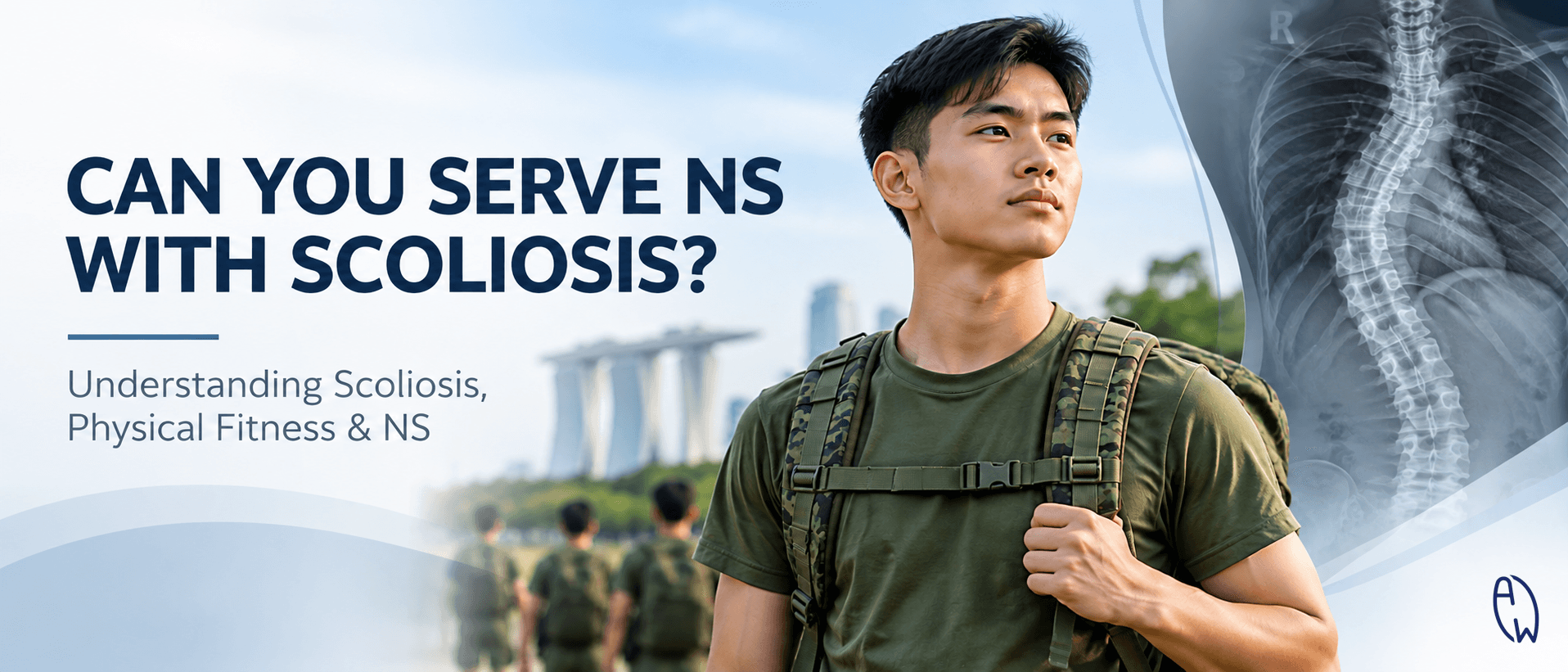
Can You Serve NS With Scoliosis in Singapore? What Parents and Young Men Need to Know
A scoliosis diagnosis does not automatically determine whether you can serve National Service. Discover what spinal curvature, physical conditioning, medical assessment and individual activity restrictions mean for young men in Singapore.
Can You Serve NS With Scoliosis?
Yes, some young men with scoliosis can serve National Service (NS) in Singapore. However, whether an individual is medically fit to serve, which activities he can perform and which vocation is suitable depend on his official medical assessment.
Having scoliosis does not automatically mean a young man must be exempted from NS. At the same time, it would be wrong to assume that everyone with scoliosis can safely undertake every type of military training.
At All Well Scoliosis Centre, we have patients with Cobb angles ranging from approximately 35° to 55° who remain physically capable of performing many activities. Some have continued serving NS while maintaining their scoliosis care.
Their experiences have reinforced an important lesson in my clinical practice: we should understand what a person can safely do rather than assume his limitations based on an X-ray alone.
I understand why parents worry when their son is diagnosed with scoliosis. Military training can involve running, marching, carrying equipment, lifting loads and prolonged physical activity. Parents naturally wonder whether these demands might aggravate their son's condition.
But the question is not simply whether the spine is curved.
It is whether the individual can perform particular activities safely, whether any modifications are necessary, and what medical supervision or rehabilitation may be appropriate.
This article explores those questions using Singapore's official NS guidance, published scoliosis research and our clinical experience with patients who continue to serve.
What Is Scoliosis, and Why Does It Matter During NS?
Scoliosis is a three-dimensional spinal deformity involving sideways curvature and, in many cases, rotation of the vertebrae.
It is more than a spine bending to one side. The rotation and changes in spinal alignment can affect trunk symmetry, posture and the way the body distributes forces during movement.
For a young man entering NS, this matters because military activities can place different demands on the body.
Consider the difference between walking without a load and marching while carrying equipment for an extended period. The second task requires greater endurance and the ability to manage additional loading.
Likewise, lifting an object with both hands is different from carrying equipment predominantly on one side of the body.
A person with scoliosis may tolerate these activities differently from someone else. The degree of curvature is important, but it does not independently tell us everything about pain, strength, balance, endurance or functional ability.
A proper assessment should consider:
-
The Cobb angle and spinal curve pattern.
-
The degree of vertebral rotation and overall spinal balance.
-
Whether the curve is stable or progressing.
-
Pain, fatigue and other symptoms.
-
Strength, movement control and physical endurance.
-
Previous spinal surgery or other relevant medical conditions.
-
The specific physical demands of the proposed activity.
For a more detailed explanation, read our guide to scoliosis-specific exercises (PSSE), which explains why scoliosis rehabilitation needs to consider the individual's spinal pattern and movement.
My Clinical Experience: Patients With 35° to 55° Scoliosis Who Continue to Serve
In our clinical practice, we have patients with Cobb angles ranging from approximately 35° to 55° who remain capable of many physical activities, including activities associated with their NS responsibilities.
I want to make an important distinction here. These are clinical observations from our patients, not a formal study demonstrating that everyone with a curve in this range can complete military training.
Two individuals with similar Cobb angles can have very different physical capabilities. Their symptoms, spinal balance, curve progression, medical history and training demands may differ considerably.
Nevertheless, these experiences remind us that the X-ray should not be the only consideration when understanding a young man's capabilities.
Instead of asking only, "How many degrees is the curve?", we should also ask:
Can he move comfortably? Can he maintain control of his body? Can he tolerate the required activity? Does a particular movement provoke symptoms? Could an appropriate adjustment make the task more manageable?
These questions are important when deciding what support or restrictions may be appropriate.
Sometimes, the task needs to be adjusted
I have seen situations in which a patient finds certain physical tasks more difficult because they require sustained strength or loading predominantly on one side of the body.
For example, carrying a particular instrument or piece of equipment in a fixed position may be challenging for someone who already has asymmetrical trunk mechanics.
However, a task that is difficult in one position is not necessarily impossible in every position.
Depending on the equipment, the individual's condition and the operational requirements, a change in carrying technique, handling position or load distribution may make the task more manageable.
Naturally, any modification must comply with military procedures and be approved by the relevant personnel. Some equipment cannot be handled differently for safety or operational reasons, and some individuals will require more substantial restrictions.
The lesson is not that every limitation can be overcome. It is that a specific functional difficulty deserves an appropriate assessment rather than an automatic assumption of complete incapacity.
What Does South Korean Research Tell Us About Scoliosis and Military Screening?
South Korea offers a useful international comparison because male military conscription involves a formal medical screening process.
A nationwide study published in BMJ Military Health examined adolescent idiopathic scoliosis among South Korean male military draftees screened between 2013 and 2022.
The researchers analysed data from 3,166,669 males screened at regional Military Manpower Administration offices. Individuals with a Cobb angle of at least 10° on routine chest radiographs were screened further using whole-spine radiographs, with previously surgically treated cases excluded from the study.
The study examined the prevalence and regional trends of scoliosis among military draftees. It demonstrates that scoliosis is a relevant consideration in large-scale military medical screening.
However, prevalence data are not the same as evidence of military fitness. This study does not prove that all individuals with scoliosis can safely complete every military activity, nor does it establish that a particular exercise programme prevents progression during service.
The useful lesson is that scoliosis can be identified and assessed within a military screening system. The medical implications still need to be considered for each individual.
Read the original research:
For comparison, South Korea's official Military Manpower Administration publishes information about its physical examination and medical classification procedures.
These Korean systems are not interchangeable with Singapore's NS system. Their criteria and administrative decisions should not be applied directly to Singaporean servicemen. For a young man serving in Singapore, the relevant authority is Singapore's CMPB and the applicable medical assessment process.
How Does Singapore Assess Medical Fitness for NS?
In Singapore, medical fitness is assessed through the official NS medical screening process. The outcome helps determine whether an individual can serve and which activities or vocations may be suitable.
The system is also changing.
According to the official CMPB medical fitness guidance:
-
Pre-enlistees enlisting before October 2027 continue under the existing Physical Employment Standard (PES) system.
-
Pre-enlistees enlisting from October 2027 onwards will be assessed under the refreshed Medical Classification System (MCS).
Under the refreshed system, medical fitness, specific medical exemptions and eligibility for certain NS activities are assessed more precisely.
A scoliosis diagnosis does not automatically determine the outcome. The medical authorities consider the individual's condition and determine the appropriate classification, restrictions or exemption.
If additional clinical information is required, the CMPB medical review process explains how further documentation or investigations may be requested.
For parents, the practical message is straightforward: provide accurate medical information, explain any genuine functional limitations and allow the official medical authorities to make the appropriate decision.
Why I Encourage Appropriate Physical Conditioning
One concern I encounter is the fear that exercise will inevitably worsen scoliosis.
This fear can lead some young people to become unnecessarily cautious about movement. Parents may worry that any physical training will place their son's spine at risk.
But avoiding all physical activity is not automatically the safest option.
Appropriate physical conditioning can help develop strength, endurance, balance and coordination. These qualities matter in daily life and may be relevant to the physical demands of NS.
The international SOSORT guidelines recognise the general benefits of physical activity for people with scoliosis while also acknowledging that individual circumstances may require restrictions on certain activities.
The distinction is important: general physical activity is not a guaranteed treatment for scoliosis, and scoliosis-specific exercises serve a different purpose from ordinary fitness training.
Strength is important, but movement control matters too
A person may have sufficient strength to lift an object but still struggle to control the movement comfortably or consistently.
For someone with scoliosis, rehabilitation may include learning how to position the trunk, coordinate movement, manage loading and recognise compensatory patterns.
Depending on the individual, a programme may address:
Trunk control: Developing appropriate control of the muscles that help stabilise the body during movement.
Hip and leg strength: Building the physical capacity needed for walking, climbing, lifting and other everyday tasks.
Balance and coordination: Improving the ability to control the body as its position and loading change.
Movement awareness: Learning how posture and technique influence comfort and performance.
Gradual conditioning: Increasing activity according to tolerance rather than suddenly pushing through demanding exercise.
The aim is not to force every person with scoliosis to perform at the same level. It is to help each individual develop appropriate physical capacity while respecting the limitations of his condition.
For a broader discussion of physical activity, see our article, Can I Exercise With Scoliosis? A Guide for Adults.
Can Someone With Scoliosis Continue Treatment During NS?
In our experience, continuity of care can be helpful for selected patients who require ongoing scoliosis management.
I particularly appreciate the NS personnel who communicate with our clinic to clarify a patient's diagnosis, treatment plan or specific physical limitations.
In one case, I explained to a serviceman's superior why ongoing scoliosis therapy was relevant to his care. The patient was able to attend our clinic once a week under the agreed arrangement while continuing his NS responsibilities.
I was grateful for that communication and cooperation.
It allowed us to continue working with the patient on his movement, exercise technique and individual treatment goals during a period when his physical demands and daily routine had changed.
For me, this is an example of constructive collaboration. The discussion was not simply about whether the serviceman should be exempted from physical activity. It was about understanding his needs and finding a practical way to support his health while respecting his service obligations.
Of course, weekly therapy is not a universal requirement for every person with scoliosis. The frequency and duration of treatment should be determined according to the individual's clinical needs, and attendance arrangements must be coordinated with the relevant NS personnel.
Treatment also cannot guarantee that a curve will remain stable or prevent every possible injury. The purpose of follow-up is to review symptoms, reinforce appropriate movement strategies and support the individual's management plan.
Why maintenance therapy may take time
Some of our maintenance programmes take approximately three to four hours, depending on the individual plan.
I recognise that this is a significant time commitment for someone serving NS. Where such a session is clinically justified, it may allow several components of an individual's programme to be addressed in one visit.
However, this duration should not be interpreted as a universal medical recommendation. Patients should understand why their particular programme requires the proposed time, what the session is intended to achieve and how progress will be reviewed.
I often remind patients that caring for the body is a long-term responsibility. Learning to move appropriately, maintain strength and recognise symptoms can be valuable well beyond the period of NS.
The goal is to help patients understand their bodies and become more capable of managing their condition—not to suggest that every person must attend lengthy maintenance sessions indefinitely.
What Should Parents Do If Their Son Has Scoliosis Before NS?
If your son has scoliosis and is approaching enlistment, start with information rather than assumptions.
1. Understand his spinal condition. Keep relevant medical reports and imaging records available. Clarify the curve pattern, symptoms and whether further assessment is required.
2. Review his physical function. Discuss pain, movement limitations, endurance and concerns about specific activities with an appropriately qualified healthcare professional.
3. Encourage suitable physical activity. Avoid both extremes: assuming that all exercise is dangerous and assuming that all forms of training are suitable.
4. Document specific limitations. If a particular movement or loading task is medically unsuitable, ask the treating professional to explain the concern and any relevant precautions.
5. Follow the official NS medical process. Submit the required documents and allow CMPB or the relevant medical authorities to determine fitness, exemptions and vocation suitability.
6. Discuss ongoing care if needed. If rehabilitation is part of the treatment plan, coordinate appointments and other practical arrangements with the relevant NS personnel.
A clinical letter should describe the diagnosis, relevant functional limitations and justified precautions accurately. It should not promise that a person is fit for all duties or assume that an exemption is necessary solely because scoliosis is present.
Frequently Asked Questions: Scoliosis and National Service
Can you serve NS with scoliosis in Singapore?
Yes, some people with scoliosis can serve NS. Their medical fitness, activity restrictions and vocation suitability depend on their individual official assessment. A scoliosis diagnosis alone does not determine the outcome.
Does a 35°, 45° or 55° Cobb angle mean you cannot serve NS?
No single Cobb angle automatically determines NS eligibility. Some people with curves in this range remain capable of many physical activities, while others may have symptoms or limitations that require further assessment. The official medical authorities determine fitness on an individual basis.
Does scoliosis automatically qualify you for an NS downgrade?
No. The diagnosis alone does not determine the medical classification. The relevant medical authorities assess the individual's condition, symptoms, medical history and suitability for different activities or vocations.
Can someone with scoliosis do physical training during NS?
Some people with scoliosis can participate in physical training. The suitability of particular activities depends on the individual's condition, symptoms and medical restrictions. Training should be appropriate to the person's physical capacity.
Can scoliosis get worse during NS?
Scoliosis may progress in some individuals, but progression is not inevitable simply because someone serves NS. Factors such as age, skeletal maturity, curve characteristics and the underlying condition influence risk. New or worsening symptoms should be assessed rather than assumed to indicate curve progression.
Can someone with scoliosis continue treatment during NS?
Ongoing treatment or rehabilitation may be possible where clinically appropriate and where practical arrangements can be coordinated with the relevant NS personnel. Appointment frequency and attendance depend on the individual's needs and applicable arrangements.
Should parents request an exemption letter for scoliosis?
Not automatically. If there are genuine medical concerns, relevant clinical documentation can help the official medical authorities assess the condition. Any letter should explain the diagnosis, functional limitations and specific precautions supported by the clinical assessment.
What does South Korean research say about scoliosis and military service?
South Korean research has examined scoliosis prevalence among millions of male military draftees. This helps explain the relevance of scoliosis in military screening, but prevalence studies do not establish that every individual with scoliosis can safely complete every military activity. South Korean medical classifications also cannot be used to predict a Singaporean serviceman's NS assessment.
What is the difference between general exercise and scoliosis-specific exercise?
General exercise develops overall physical fitness, strength and endurance. Physiotherapeutic Scoliosis-Specific Exercises (PSSE) are individualised around a person's spinal curve, posture and movement. Neither approach guarantees that a structural curve will stop progressing.
Where can I find official information about NS medical fitness?
Consult the CMPB medical fitness guidance and CMPB medical review process.
A Final Message to Parents and Young Men With Scoliosis
I understand why parents want to protect their sons. I also understand why a young man may feel uncertain about whether his spine can cope with the physical demands of NS.
But I believe we should be careful not to let the diagnosis become the only thing we see.
Scoliosis deserves appropriate assessment and management. At the same time, physical conditioning, movement education and a suitable level of activity can remain important parts of a young person's life.
Some servicemen will need substantial restrictions. Others may be able to participate in a broader range of activities, potentially with appropriate modifications and ongoing care.
The decision should be based on the individual rather than fear or assumptions.
I have great respect for the NS personnel who communicate with our clinic, the servicemen who take responsibility for their physical health, and the families who seek accurate information about their sons' conditions.
The goal is not to prove that scoliosis does not matter. It is to understand what each young man can safely do, what may need to be adjusted, and how he can maintain his physical health while contributing as fully as his medical fitness allows.
At All Well Scoliosis Centre, we believe that education, appropriate rehabilitation and constructive communication can help patients make informed decisions about their spinal health.
A diagnosis is an important part of a person's medical history. It does not, by itself, tell the whole story of his capabilities.
Medical disclaimer
This article is for educational purposes only and does not replace individual medical advice or the official NS medical assessment. Cobb angle alone cannot determine an individual's fitness for military service. Exercise, treatment and activity modifications should be tailored to the person's condition, and any required restrictions or arrangements must be determined by the appropriate medical and military authorities.
References
-
Central Manpower Base (CMPB). Medical Fitness for National Service.
-
Central Manpower Base (CMPB). Medical Review Process.
-
Kim HJ, et al. National and regional trends in the prevalence of adolescent idiopathic scoliosis in South Korean military draftees. BMJ Military Health. PubMed record.
-
Negrini S, et al. (2018). 2016 SOSORT guidelines: orthopaedic and rehabilitation treatment of idiopathic scoliosis during growth. Scoliosis and Spinal Disorders, 13, 3. Read the guidelines.
-
All Well Scoliosis Centre. Scoliosis-Specific Exercises (PSSE): Evidence-Based Rehabilitation.