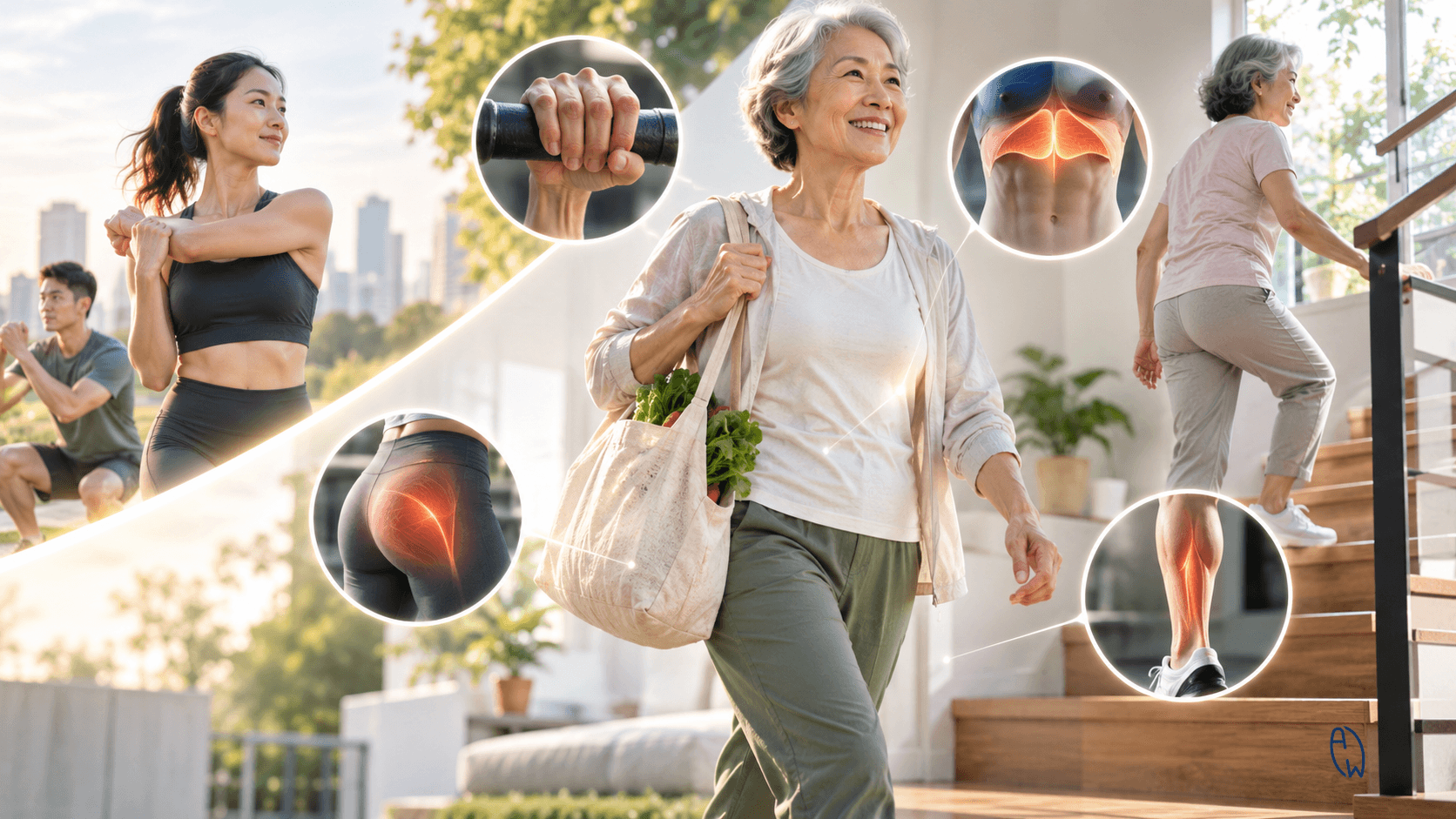
4 Muscle Groups That Matter Most for Your Quality of Life After 60
The strength you have at 60 doesn't start at 60. It is built years—even decades—before you need it.
Discover 4 muscle groups that matter for healthy ageing: grip, glutes, calves and diaphragm. Learn why building muscle early can support strength, mobility and independence after 60.
If you're in your 20s, 30s or 40s, you may think an article about muscle strength after 60 isn't really for you.
It is.
In fact, this may be the most important time for you to read it.
Muscle doesn't suddenly appear when you turn 60. And it doesn't disappear overnight either.
Your physical capacity is built gradually through years of movement, strength training, recovery and lifestyle.
That's why healthy ageing shouldn't begin when you become old.
It should begin while you're still young enough to build a physical reserve.
What Do You Want Your Body to Be Able to Do at 70?
Imagine yourself at 70.
Not your retirement account.
Not your house.
Not your job title.
Imagine your body.
Can you get out of bed without assistance?
Can you get up from the toilet?
Can you climb a flight of stairs?
Can you carry your groceries?
Can you walk across an uneven pavement?
Can you get up from the floor?
Can you travel independently?
Can you play with your grandchildren?
These are ordinary activities.
But they require extraordinary amounts of coordination between your muscles, joints, nervous system, balance and breathing.
And this is why exercise shouldn't be only about burning calories or looking fit.
It should also be about preserving your ability to function.
Our article on strength training and ageing explores why maintaining muscle becomes increasingly important as we age.
The question isn't simply:
“How much exercise do I do?”
A better question is:
“What will my body still be able to do decades from now?”
Four muscle groups deserve particular attention.
1. Grip Strength: A Window Into Your Overall Physical Strength
Your hands may seem like an unusual place to start.
But grip strength is surprisingly informative.
A 2019 review by Richard W. Bohannon, titled “Grip Strength: An Indispensable Biomarker for Older Adults,” examined the evidence surrounding grip strength and its relationship with overall strength, upper-limb function, falls, bone health, nutritional status, cognition, quality of life and other health outcomes.
The important point is that grip strength does not directly measure your heart.
Instead, it can provide a convenient indicator of broader physical strength and functional health.
The research also cautions that grip strength should not be treated as a perfect substitute for measuring strength throughout the entire body.
Still, it is an incredibly useful reminder:
Your ability to produce force matters.
Think about everyday life.
You need your grip to:
-
Carry shopping bags
-
Hold a railing
-
Carry luggage
-
Open containers
-
Pick objects up
-
Use certain walking aids
-
Hold onto equipment during exercise
Your hands are involved in much more of your life than you realise.
Try a Dead-Hang Challenge
One practical way to challenge your grip is a dead hang from a secure pull-up bar.
As a general fitness challenge, you could work toward:
-
Women: 20 seconds
-
Men: 30 seconds
But these numbers should not be interpreted as medical cut-offs or a diagnosis of health, frailty or overall strength.
Your dead-hang performance is affected by body weight, shoulder health, training experience and other factors.
If you cannot safely perform a dead hang, don't force it.
There are many other ways to train your grip.
The important question is:
Are you maintaining your strength—or slowly losing it?
Don't wait until carrying groceries becomes difficult before you start training your grip.
2. Your Glutes: Not for Aesthetics, but for Movement
When people talk about glutes, the conversation often becomes about appearance.
Bigger.
Rounder.
Firmer.
But your glutes have a much more important job.
They help you move.
Your gluteal muscles contribute to hip extension and help control your pelvis and lower limbs.
You use them when you:
-
Get out of bed
-
Stand up from a chair
-
Get up from the toilet
-
Climb stairs
-
Walk uphill
-
Step over an obstacle
-
Walk faster
-
Run
-
Recover from a change in balance
So if you are training your glutes only because you want a better-looking backside, you're missing the bigger picture.
Your glutes are functional muscles.
They help you generate force and control your body during everyday movement.
Balance Is More Than Standing on One Leg
Real-life balance is dynamic.
You need to control your body when you step onto a staircase.
You need to shift your weight when you stand up.
You need to respond when you stumble.
You need to control your body when walking on uneven ground.
Your hips, legs, feet, trunk, vision and nervous system all contribute to this process.
That's why strength and balance should be trained together.
Our Balance Training for Seniors: Fall Prevention, Strength & Healthy Aging article goes deeper into how strength, balance and functional movement work together to support independence.
Don't Confuse Being Slim With Being Strong
This becomes particularly important as you age.
You can be slim and still have poor muscle strength.
You can also have a larger body without having the muscle capacity needed for everyday movement.
Your appearance does not tell the whole story about your physical capability.
So don't focus only on losing fat.
Build and preserve muscle too.
Your goal isn't simply to have a smaller body.
Your goal is to have a body that can still:
Stand.
Walk.
Climb.
Carry.
Balance.
3. Your Calves: Don't Celebrate Being “Lean” Too Soon
Your calves are easy to overlook.
Yet every step you take requires them.
Your calf muscles contribute to ankle movement and the push-off phase of walking and running. They are part of the system that helps you move forward.
And there is an interesting reason to pay attention to calf size as we age.
What Does the Research Say?
A 2022 study published in BMC Geriatrics investigated the relationship between calf circumference and frailty in older adults using data from the Chinese Longitudinal Healthy Longevity Survey.
The researchers included 1,216 participants aged 60 and above from the 2014 survey.
They found that calf circumference was significantly smaller among participants classified as frail, and statistical analysis showed that calf circumference was independently associated with frailty. The researchers concluded that calf circumference can serve as a convenient marker associated with frailty in older adults.
That is interesting.
But let's be precise.
Calf circumference is not a diagnosis of frailty.
And a large calf does not automatically mean a strong calf.
The study shows an association, not proof that calf size itself causes or prevents frailty.
But it gives us something important to think about:
Don't automatically celebrate losing muscle from your lower legs just because your calves look “leaner.”
As we age, preserving muscle becomes increasingly important.
And your calves are part of the machinery that keeps you walking.
Try This Simple Calf Exercise
You can train your calves almost anywhere.
Try single-leg calf raises:
-
Stand near a wall, railing or other stable surface.
-
Lift one heel as high as you comfortably can.
-
Lower slowly and with control.
-
Work toward 25 repetitions.
-
Repeat on the other leg.
If 25 repetitions are too difficult, start with fewer.
As you become stronger, gradually increase the challenge.
And because calf raises require very little equipment, you can incorporate them into your day:
While waiting in a queue.
While brushing your teeth.
While waiting for the kettle.
During a work break.
You don't need to wait for a gym session to remind your lower legs that they still have work to do.
4. Your Diaphragm and Core: The Foundation for Breathing and Stability
There is a muscle you use every minute of every day that you probably don't think about.
Your diaphragm.
The diaphragm is the major muscle of breathing. Located beneath the lungs, it contracts during inhalation and contributes to the pressure changes that draw air into the lungs.
You're using it right now.
But breathing and movement are not completely separate systems.
Your diaphragm works together with your abdominal and trunk muscles to help regulate pressure and contribute to trunk stability.
That's why your core isn't simply about having visible abdominal muscles.
Your core is part of your body's movement-control system.
This is particularly relevant if you care about posture, spinal health and movement.
Our article on Posture Correction for Scoliosis: Strength, Movement & Freedom explains why functional trunk control involves much more than simply “standing straight.”
Train Your Core to Stabilise and Move
Instead of thinking only about “abs,” think about trunk control.
Exercises such as:
-
Dead bugs
-
Bird dogs
-
Planks and modified planks
-
Controlled core-stability exercises
-
Breathing-coordinated movements
can challenge your trunk while encouraging controlled breathing.
The goal isn't to hold your breath and brace as hard as possible.
The goal is to develop the ability to:
Breathe.
Stabilise.
Move.
Together.
Don't Make Cardio Your Entire Exercise Program
Walking is excellent.
Running is excellent.
Cycling is excellent.
Yoga can be excellent.
Pilates can be excellent.
But cardiovascular exercise and strength training develop different physical qualities.
Cardio is not a replacement for strength training.
And strength training is not a replacement for cardiovascular fitness.
You need your heart and lungs to support endurance.
You also need your muscles to support movement.
Your body needs both.
This is especially important when thinking about healthy ageing.
Because the real test isn't:
“Can you exercise?”
It's:
“Can you still do what you want to do?”
Can you climb the stairs?
Can you get up from the toilet?
Can you carry your groceries?
Can you get off the floor?
Can you walk safely?
Can you travel?
Can you participate in the activities that make life meaningful to you?
That is functional fitness.
Your 20s, 30s and 40s Are Your Opportunity
Now let's come back to the younger reader.
You may be thinking:
“I'll worry about this when I'm older.”
Please don't.
Your 20s, 30s and 40s are precisely when you have an opportunity to build your physical reserve.
Muscle doesn't happen overnight.
Neither does physical decline.
The habits you establish now can influence how much physical capacity you have to draw from later.
This doesn't mean you need to spend hours in a gym.
It means you should make strength part of your life before you need it.
Our article Why We Shrink With Age: Spine Compression, Muscle Loss & Posture Changes Explained discusses why movement and strength training are important parts of maintaining physical capacity as we age.
Think About Muscle Like an Investment
We understand financial investment.
You don't wait until retirement to start thinking about money.
You invest early because time is one of your greatest advantages.
Your body deserves the same thinking.
Don't only invest in your financial future.
Invest in the body that has to carry you there.
You can build a successful career.
You can save money.
You can buy property.
You can build a business.
You can plan for retirement.
But eventually, your body is the vehicle that carries you through everything you've worked so hard to create.
What is the point of building a future you cannot physically enjoy?
Don't Wait Until Something Goes Wrong
We often become proactive only after something bad happens.
We start exercising after an injury.
We think about balance after a fall.
We strengthen our legs after climbing stairs becomes difficult.
We think about mobility after we lose it.
We start paying attention to our posture after pain appears.
But prevention works differently.
You don't build physical capacity after you need it.
You build it before you need it.
That's why the best time to start isn't when you are already weak.
It's when you're still capable of getting stronger.
Healthcare Can Help You—but It Can't Build Your Muscles for You
Modern healthcare can help us prevent, manage and recover from many health problems.
Doctors can assess medical conditions.
Physiotherapists and other healthcare professionals can guide rehabilitation.
Healthcare systems can provide treatment and support.
But there is something nobody can outsource for you:
Your daily physical capacity.
Nobody can build your muscles while you sit on the sidelines.
Nobody can maintain your balance for you.
Nobody can create your physical reserve for the next 20 or 30 years.
That is your investment.
And the earlier you start, the more time you have to build it.
Your Future Independence Is Being Built Now
Getting older is inevitable.
But we should not assume that becoming increasingly weak and dependent is something we simply have to accept without doing anything about our physical capacity.
Start now.
Train your legs.
Train your glutes.
Train your calves.
Train your grip.
Train your trunk.
Challenge your balance.
Move regularly.
Recover properly.
And keep doing it.
You don't need to become a bodybuilder.
You don't need a perfect physique.
You don't need to live in the gym.
You need to build enough physical capacity for your future self to rely on.
Don't Just Invest in the Life You Want. Invest in the Body That Will Live It.
We spend years being told to invest.
Invest in education.
Invest in your career.
Invest in property.
Invest your money.
Build your retirement fund.
Those things matter.
But there is another investment that is easy to overlook:
Your body.
Because eventually, your body is the vehicle that carries you through everything you've worked for.
Your grip helps you hold.
Your glutes help you rise and control your body.
Your calves help you walk.
Your diaphragm and core contribute to breathing and stability.
Together with the rest of your body, they help you do something far more valuable than simply looking fit:
They help you participate in your own life.
Start building that capacity now.
Because muscle doesn't happen overnight.
And neither does independence.
What Are You Investing In?
If you're in your 20s, 30s or 40s:
Are you investing only in your financial future—or are you investing in your physical future too?
And if you're already over 60:
What physical ability do you most want to preserve?
Climbing stairs?
Walking independently?
Getting up from the floor?
Carrying your groceries?
Travelling?
Playing with your grandchildren?
Whatever your answer is, start training for the life you want to keep living.
Don't wait for something bad to happen before you begin your journey.